
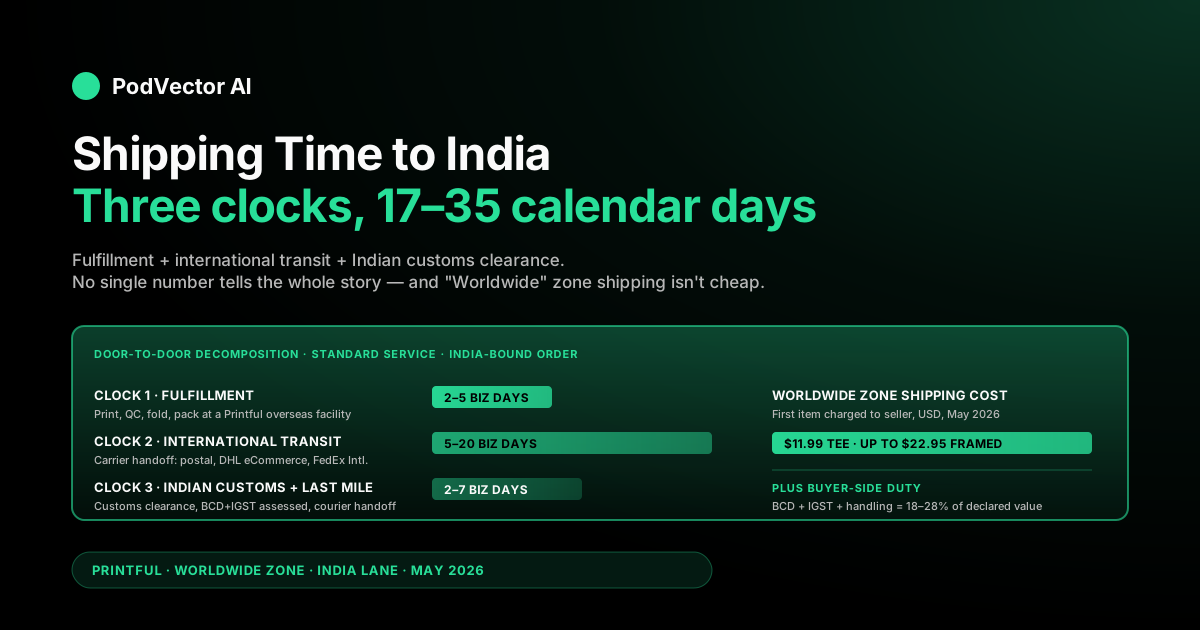
Quick Answer: Printful shipping time to India runs 12–25 business days door to door for standard service: 2–5 business days of fulfillment (per Printful's Help Center), 5–20 business days of international carrier transit, plus Indian customs clearance that typically adds 2–7 days on top.
Calendar-day translation: 17–35 days. That's the number to quote on the product page and in order confirmations. Anyone promising "10 days to India" will spend that month answering tickets.
India sits in Printful's "Worldwide" shipping zone — the catch-all bucket for countries without dedicated rates. First-item cost runs $11.99 for apparel, up to $22.95 for bulky items, plus $1.50–$8.00 per additional unit. Indian customs and GST add a further layer of cost on the buyer side, billed by the carrier on delivery — see the customs section for the current 2026 rate breakdown.
The headline India shipping number
For the bulk of Printful's India-bound catalog — t-shirts, hoodies, mugs, posters, hats — the standard door-to-door window is 12–25 business days. That breaks into 2–5 business days of fulfillment (per Printful's Help Center), 5–20 business days of international carrier transit, and a customs clearance step on the Indian side that typically lands at 2–7 days.
The 5–20 business day transit range is wide on purpose. India is not a Printful facility location, and routing depends on which Printful facility prints your order and which carrier handles the international leg. A US-printed apparel order to Bangalore goes through a different lane than an EU-printed mug to Delhi.
Calendar-day language matters because nobody outside operations thinks in business days. The 12–25 business day window translates to roughly 17–35 calendar days once weekends and the customs queue are included. That's the figure to quote in your shipping policy copy.
None of these numbers are levers the seller can pull. Production routing is automated, customs is the Government of India's clock, and the carrier's transit time is the carrier's transit time. The operator's job is to set the expectation honestly and to know what each India order is actually costing in margin. For cost comparisons across fulfillment partners, see our Printify t-shirt cost and profit breakdown — the unit economics structure is closely comparable.
Why India is in the "Worldwide" zone
Printful publishes named shipping rates for the US, Canada, the EU, the UK, Australia/New Zealand, Japan, and Brazil. Everywhere else — India, Singapore, UAE, South Africa, Mexico, the Philippines, most of Asia, most of Africa, most of South America — falls into a single bucket called "Worldwide."
The Worldwide zone is not a discount tier. It's the opposite — it's the price Printful needs to charge to absorb non-delivery risk on long-tail international lanes. According to PodVector's shipping rates guide, that same t-shirt costs $11.99 to ship to a Worldwide-region country versus $4.75 US domestic — a cost that reflects postage plus a built-in insurance margin for lost and returned packages on the route. Printful's own public shipping rates page publishes the Worldwide tier alongside named-country tiers, but does not break India out as a separate line.
For the seller, this means India shipping math is fundamentally different from US or EU math. The shipping cost is a larger fraction of the retail price, and the variance on transit time is wider. Treating India like a "Europe with longer transit" is the most expensive mental model an operator can carry.
Understanding how shipping costs flow through to margin is essential for India-bound POD — our guide on how to get contribution margin shows exactly how to account for these variable shipping costs in your per-order profit math.
Three clocks: fulfillment, transit, customs
The single most expensive misread on India shipping is treating "shipping time" as one number. For India specifically it's three clocks running in series, and each behaves differently.
Fulfillment (2–5 business days): the order sits in a Printful facility for printing, quality check, folding, and packing. According to Printful's Help Center, over 97% of orders ship within 5 business days and more than 50% ship within 3 business days or fewer. Paying for express shipping does not speed up fulfillment.
International transit (5–20 business days): the package is on a carrier, typically DHL eCommerce, FedEx International, or a postal handoff to India Post via a USPS or Asendia partner. The wide range is because some shipments fly direct; others sit in regional sortation hubs in Singapore, Frankfurt, or Hong Kong for several days.
Customs and last-mile (2–7 business days): the package clears Indian customs at the inbound airport, gets routed to a domestic courier (often DTDC, Delhivery, India Post, or Blue Dart depending on the carrier), and is delivered to the buyer's address. Customs is the most variable leg — duty assessment can add days on top of the typical pass-through.
If a customer sees "ships in 5 days" on the product page, they assume their order arrives in 5 days. When the order takes 25 calendar days, the support ticket queue fills with reasonable-sounding complaints. The fix is wording: "Ships from our facility in 2–5 business days. International transit and Indian customs take an additional 2–4 weeks."
Which Printful facility ships to India
India does not have a Printful facility. Every India-bound order is fulfilled from one of Printful's overseas locations — most commonly the US (Charlotte NC, Dallas TX, Los Angeles CA), Latvia (Riga), Spain (Barcelona), or the UK (Birmingham). Routing is automatic and depends on product type, stock level, and origin SKU.
The practical implication: an order placed by a buyer in Mumbai might be printed in Riga and shipped via Latvia's postal handoff to a DHL eCommerce partner. The same order placed an hour later, but for a hoodie the Latvian facility is out of stock on, might print in Charlotte and ship via USPS International Priority. The transit window differs by 5–10 days depending on which lane gets used.
There is no operator-side toggle for routing. Printful's system picks the facility based on inventory and load balancing, and you find out after fulfillment which lane the order ended up on. This is normal for Worldwide-zone destinations — it is also why the official transit estimate is a 15-day range and not a clean single number.
Note: as of June 2026, Printful's updates page flagged that fulfillment times for cut-and-sew products from the Mexico facility are running longer due to increased order volume — worth monitoring if your India-bound SKUs route through that facility.
Note for sellers using Printful's Shopify integration: the order routing happens in Printful's system, not in your store. Your store sees a single tracking number after fulfillment, but it has no advance visibility into which facility was assigned. For a deeper look at how automation can help you manage store-side changes around these variables, see our guide on Shopify Admin API store modifications and automation.
The Worldwide cost table for India
Printful's Worldwide-zone shipping rates apply to India directly. The numbers below are the Printful-charged cost to the seller, as of July 2026, in USD — cross-check against Printful's live shipping rates page before publishing to customers, as rates shift periodically. Indian customs and GST are billed separately to the buyer on delivery — that math is in the next section.
| Product category | First item | Each additional |
|---|---|---|
| T-shirts, tank tops, long sleeves | $11.99 | $1.50 |
| Hoodies, sweatshirts, joggers | $14.99 | $2.50 |
| Mugs (single) | $15.95 | $8.00 |
| Posters (rolled, up to 18×24) | $13.99 | $5.50 |
| Framed posters | $22.95 | $8.00 |
| Hats, beanies, snapbacks | $11.99 | $2.00 |
| Phone cases, small accessories | $9.95 | $1.50 |
For a single-tee India order, the seller pays Printful roughly $13 in production cost (Bella Canvas 3001 baseline) plus $11.99 in shipping. Before any retail markup, that's a meaningful landed cost on a product you'd retail at a slim margin. The math is brutal — and it's why most POD operators serving India price India SKUs separately or run minimum-order rules. For a detailed unit-economics framework, see our contribution margin guide.
These shipping numbers can shift as Printful reprices international lanes — always verify against the live rate card. For a comparison of how fulfillment costs stack up across providers, see our Printify t-shirt cost and profit breakdown.
Customs, GST, and what your Indian buyer actually pays
India treats incoming print-on-demand orders as commercial imports. The buyer is responsible for customs duty and Integrated GST (IGST) on the declared value of the package, billed by the carrier as a "delivery charge" or "duty collection fee" at the door.
Current rates for apparel and printed goods, as of mid-2026, per Deepbeez's 2026 import duty analysis and India Post's customs guide:
- Basic Customs Duty (BCD): according to Deepbeez, BCD on apparel imports is typically set in the range of 20–25% to encourage local manufacturing, though the applicable rate depends on the specific HS code Printful's facility uses on the customs declaration.
- Integrated GST (IGST): according to Deepbeez, IGST on apparel is usually 5% for items valued under ₹1,000 and 12% otherwise, calculated on the assessable value plus all preceding duties.
- Social Welfare Surcharge (SWS): per India Post's customs guide, a Social Welfare Surcharge is imposed at 10% of the Basic Customs Duty component.
- Carrier handling fee: a flat fee charged by the courier for customs clearance work — amount varies by carrier.
According to Patron Accounting's 2026 garment import guide, "the effective duty rate makes imported garments 30% to 45% more expensive than the CIF value" when BCD, IGST, and SWS are combined. The buyer is not warned about this by Printful, and they are usually not warned about it by the store either. The "surprise duty at the door" experience is the single largest driver of complaints and refused deliveries on India-bound POD orders.
The two ways operators handle this in practice:
- Disclose it. Add a line to the product page: "International buyers may be charged customs duty and GST on delivery. This is collected by the carrier, not by us." Sets expectations, materially lowers refund rate.
- Price it in. Charge more for India orders and absorb the duty via a Delivered Duty Paid (DDP) arrangement when Printful's carrier offers it. Higher friction at checkout, lower friction at delivery.
Most operators get this wrong in the first direction — they neither disclose nor absorb. Indian buyers see the surprise charge, refuse the package, and the order goes "RTO" (return to origin). Printful charges the seller again for the return logistics and discards the unit. That sequence is the single most expensive failure mode in India POD.
How shipping to India eats POD margin
The visible cost is the $11.99–$22.95 shipping line. The invisible costs are bigger and they are where most stores quietly lose money on the India lane.
RTO rate. India has among the highest return-to-origin rates of any major POD destination. On an RTO, the seller eats the production cost, the outbound shipping, and the inbound shipping. Even a modest RTO rate across the India book adds a meaningful per-order hit amortized across all India orders.
The single piece of advice every seller learns the hard way: every additional business day quoted-vs-actual on India orders generates a wave of "where is my order?" tickets that swamp a small support team. At several minutes per ticket fully loaded, a delivery-window mismatch on even a moderate volume of India orders per month is pure waste that compounds.
Chargeback exposure. An Indian buyer who waits 35 calendar days expecting 14 doesn't always file a support ticket — they file a chargeback through their card issuer. Chargeback fees on cross-border transactions run meaningfully per occurrence, plus the lost margin on the unit. Avoidable chargebacks from poor expectation-setting can compress net margin significantly on an India-heavy storefront.
Most operators don't see this because their dashboards show order count and revenue, not time-quoted-vs-time-actual delta per order, broken down by destination country. That number is sitting in the Printful order export and the store's shipping policy copy — but reconciling them by hand once a week is a Sunday afternoon nobody has. For the framework to track these numbers properly, see our guide on getting contribution margin right and our P&L and cash flow guide.
That visibility problem is one of the questions PodVector AI's Victor operator was built to answer. Victor connects to your live data warehouse — reading Shopify, Printful, Printify, Meta Ads, and Google Ads — and answers India-specific shipping and margin questions in plain English: "Show me India orders this month where actual delivery exceeded 25 business days, what carriers they used, and what the gross margin was after RTO." No spreadsheet, no SQL, no weekly export-and-reconcile ritual.
Tracking, RTO, and the lost-package playbook
India-bound Printful shipments come with a tracking number on fulfillment. That number is usually a postal-format ID (USPS, Latvia Post, Royal Mail) that hands off to an Indian last-mile courier roughly 7–10 days into transit. The handoff is the most common point where tracking goes silent for several days before the Indian courier scans the package in.
Operator playbook for slipped India orders:
- Business day 14 with no India scan: open a carrier trace via Printful support. Don't promise the customer a date — acknowledge the delay and confirm you're tracking it. Most resume movement within 5 days.
- Business day 21 still no Indian scan: request a lost-shipment claim from Printful. They will typically reship at no production cost after 25 business days, sometimes earlier with documentation.
- RTO notification: the package was refused by the buyer (usually customs surprise) or undeliverable (address issue). Printful charges return logistics and discards the unit. Don't reship without confirming the buyer accepts the duty.
- Address-format errors: India addresses often include floor, apartment, landmark, and PIN code on separate lines. Printful's address fields can compress these awkwardly. If checkout doesn't surface PIN code as required, undeliverable rates spike.
The proactive version of this is a weekly export of India orders aged 15+ business days without an Indian scan. That list is the support team's Monday morning queue. Most stores don't run it because it requires joining Printful's API export against the store's order export against the carrier's tracking webhook — three systems, no native view.
High undeliverable rates also have a downstream impact on ad economics — our guides on checkout conversion rate optimization and avoiding ad fatigue cover how delivery experience feeds back into paid traffic performance.
Is express to India worth it?
Printful offers an express upgrade on most Worldwide-zone destinations, India included. Standard service runs 5–20 business days transit at $11.99 first item for apparel. Express via DHL Express or FedEx Priority compresses transit to roughly 3–7 business days but carries a substantially higher per-item shipping cost.
The express upgrade compresses transit by 10–14 business days on average. Customs clearance is usually faster too (DHL Express and FedEx handle Indian customs in-house and typically clear most shipments faster than postal handoffs). The total door-to-door window drops from 17–35 calendar days to roughly 8–14.
The math on whether to absorb it:
- At a low retail price, a large express shipping upcharge wipes the order out completely. The only path is "buyer pays express" at checkout — almost no Indian buyer chooses it.
- At a higher retail price (premium hoodie, framed art, multi-unit bundle), absorbing shipping uplift to land in 10 days instead of 25 is a defensible margin trade for a brand that competes on delivery speed.
- For replacement orders (where you've already eaten an RTO), express is almost always worth it — the customer is already upset, and saving 15 days on the second attempt prevents a second refund cycle.
The default for most POD stores serving India: standard for first-time orders, express for replacements and high-value orders only. That policy keeps shipping cost as a controlled line and uses express as the recovery lever it's actually good at. For the broader question of how shipping choices affect your ad economics, see our guide on ad frequency — high return rates from poor shipping experience can force you to reach new audiences faster and spend more.
FAQs
How long does Printful take to ship to India?
Standard service runs 12–25 business days door to door: 2–5 business days fulfillment (per Printful's Help Center), 5–20 business days international transit, and 2–7 business days for Indian customs clearance and last-mile delivery. Calendar-day equivalents are 17–35 days. Express compresses this to roughly 8–14 calendar days at a significantly higher per-item shipping cost.
How much does Printful shipping to India cost?
India is in Printful's "Worldwide" zone. First-item shipping runs $11.99 for t-shirts, $14.99 for hoodies, $13.99 for posters, and up to $22.95 for framed art, with $1.50–$8.00 per additional unit. Indian customs and GST add a further layer of cost billed separately to the buyer on delivery — see the customs section above for the current 2026 breakdown.
Does Printful have a facility in India?
No. As of 2026, Printful operates fulfillment facilities in the US, EU (Latvia, Spain), UK, Canada, Mexico, Japan, and Australia. India-bound orders are printed in one of those facilities and shipped internationally. Routing is automatic and depends on product type and stock — typically the US or Latvia for apparel, Spain or Latvia for posters.
Will my Indian buyer get charged customs duty?
Yes. India treats incoming print-on-demand orders as commercial imports. According to Deepbeez's 2026 import duty analysis, the buyer pays Basic Customs Duty (typically 20–25% of declared value for apparel), Integrated GST (5% for lower-value items, 12% otherwise), and a Social Welfare Surcharge of 10% of the BCD. Per Patron Accounting, the effective combined rate makes imported garments 30–45% more expensive than their CIF value.
What happens if the package is refused at customs?
The package is marked "return to origin" (RTO) and shipped back to the Printful facility. Printful charges the seller a return logistics fee and discards the unit — they don't restock printed POD items. The original production cost and outbound shipping are not refunded. Always confirm the buyer accepts any customs duty before reshipping.
Should I quote a single shipping time for India on my product page?
No. Single-number promises like "ships in 14 days" generate disproportionate support load when a large share of orders take 25–30 days. The honest version: "Ships from our facility in 2–5 business days. International transit and Indian customs take an additional 2–4 weeks. Most orders arrive in 17–35 calendar days." Most stores see ticket volume drop significantly after switching to a window-based quote.
Can I offer cash on delivery (COD) for India?
Not through Printful. Printful only fulfills prepaid orders. COD is a dominant payment method in India — but offering it requires a separate Indian-domestic fulfillment partner or a regional warehouse with COD-capable couriers (Delhivery, DTDC, Blue Dart). Most cross-border POD stores stay prepaid-only and accept the lower conversion rate as the cost of using global fulfillment.
What's the cheapest way to ship to India through Printful?
Bundle multiple units in a single order. The "first item" rate is the same regardless of unit count, but additional units run $1.50–$8.00 each — far cheaper per-unit than separate orders. A 3-tee bundle to India is $14.99 in shipping ($11.99 + $1.50 × 2) versus $35.97 for three separate orders. For multi-product stores, configuring the storefront to incentivize bundles is the single largest India-shipping cost lever. For more on pricing strategy that protects margin across your catalog, see our guide on contribution margin for ecommerce.
Stop guessing what India shipping is costing you
India POD orders look fine in the dashboard. The numbers that matter — RTO rate, customs refusal rate, time-quoted-vs-time-actual — are buried in three different systems.
Victor is PodVector's AI employee that reads your live data warehouse — Shopify, Printful, Printify, Meta Ads, and Google Ads — and answers India-specific shipping and margin questions in plain English. "What's my India order performance this quarter and what's the gross margin after returns?" Answer in seconds, no SQL, no exports. Victor proposes moves; you approve before anything changes. — connect Printful and your store, and the next India margin review takes a sentence instead of a Sunday.
Try Victor free