
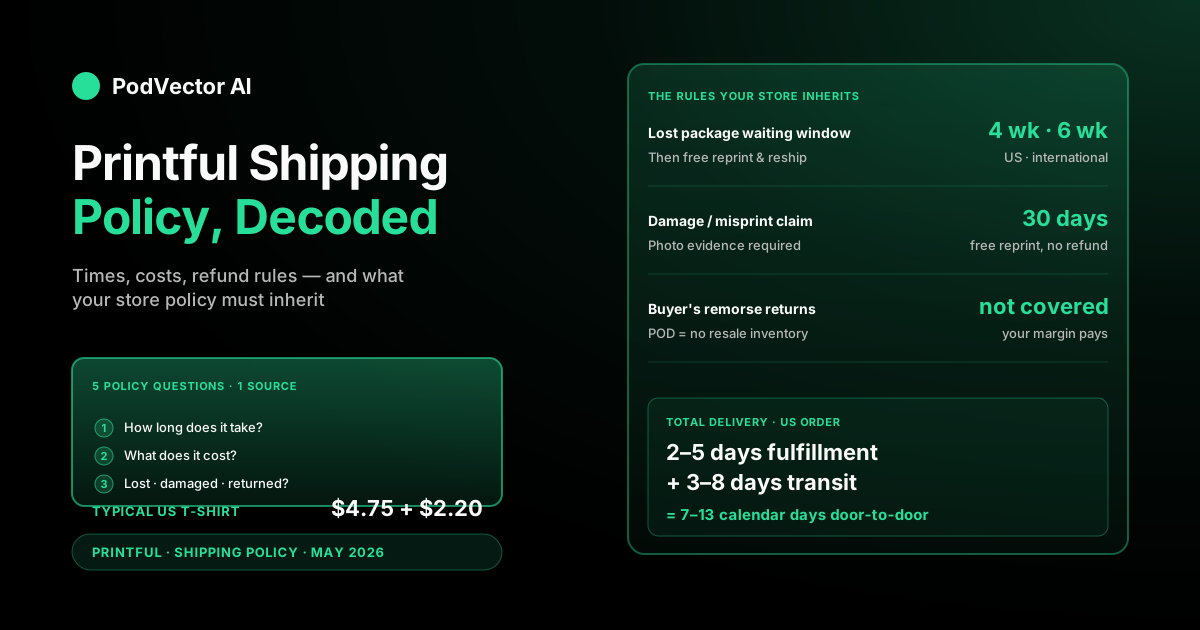
Quick Answer: Printful's shipping policy is a two-part promise: fulfillment in 2–5 business days for most apparel, followed by carrier transit of 3–8 days domestic US or up to 20 days international. Shipping uses flat regional rates — according to Printful's own ecommerce shipping guide, the standard rate for one t-shirt to a US address is $3.99, with each additional t-shirt adding $2.00.
Damaged or misprinted orders get reprinted free with photo evidence within 30 days. Truly lost packages get reshipped after a waiting window (4 weeks domestic, 6 weeks international). Refused or bad-address packages are held 30 days; reshipping costs you the carrier fee.
What this means for your store: Printful's policy is your store's reality. Your customer-facing shipping policy needs to inherit the same time ranges, the same edge-case handling, and the same international caveats — or you're writing checks Printful won't cash.
What Printful's shipping policy actually covers
Printful's shipping policy is not one document. It's a stack of operational rules spread across their shipping page, returns page, and help center articles.
Boiled down, the policy covers five questions. How long will the order take? What does it cost? What happens if it's lost? What happens if it's damaged? What happens if it's returned or refused?
Every other question — peak-season delays, customs duties, address errors, multi-package splits — is a branch off one of those five. Get the parent rule right and the branch follows.
For the broader Printful operator picture beyond shipping, see the Printful topic hub. The Printful shipping cluster hub indexes every shipping guide in this cluster, and Printful's own shipping page is the live source of truth for rates. Printful also publishes a dedicated shipping price updates page that logs every rate change by product and region — worth bookmarking before you set storefront shipping tables.
Fulfillment times — what's guaranteed and what isn't
Printful's policy on fulfillment is a soft commitment, not a hard SLA. They quote averages, not guarantees.
The committed average is 2–5 business days for most apparel. Mugs and posters are faster — typically 1–3 days. Embroidered apparel is slower, often 5–7 days. All-over-print clothing runs 3–6 days because the print process is more involved.
What the policy does not promise: a specific date. If your customer orders on a Friday afternoon, the clock doesn't start until Monday. If a print fails QC, the order re-queues without a new ETA — Printful just ships when the second print clears.
The transit leg is also estimates, not guarantees. After fulfillment, expect:
- USA standard: 3–8 business days
- Canada standard: 5–10 business days
- Europe (intra-EU): 3–7 business days
- UK standard: 4–8 business days
- Australia / New Zealand: 7–14 business days
- Worldwide (everything else): 10–20 business days
According to another PodVector shipping guide, standard delivery to most major markets lands inside 5–12 business days door-to-door after the fulfillment window — a useful combined ceiling for customer-facing copy.
Express shipping cuts the transit leg to 1–3 business days but does not touch fulfillment. A 5-day-fulfillment hoodie shipped express still takes a week minimum. That detail catches sellers — and customers — by surprise every peak season.
For country-by-country specifics, see our Printful shipping countries list breakdown and the broader shipping countries guide. They cover the regional zone-by-zone rules.
Shipping cost structure by region
Printful's cost policy is flat regional rates, not weight-based. According to Printful's ecommerce shipping guide, the flat shipping rate stays the same regardless of which fulfillment facility handles the order — the same product costs the same to ship to a US address whether it ships from Charlotte or Barcelona. Every product category has a first-item rate and an additional-item rate, set per shipping region.
Current US rates (first item / each additional) — verify against the live Printful shipping page before publishing to customers, as rates update periodically:
- T-shirts: according to Printful's ecommerce shipping guide, $3.99 / $2.00 additional
- Hoodies and sweatshirts: check Printful's current rate card — Cotton Heritage hoodies saw a price update in February 2026 per Bootstrapping Ecommerce's 2026 pricing analysis
- Mugs: see Printful's shipping calculator for the current first-item / additional-item split
- Phone cases: according to Bootstrapping Ecommerce's 2026 analysis, phone case shipping moved to $4.99 in February 2026
- Knitted products: according to the same analysis, knitted product shipping moved to $11.49 in February 2026
- Stickers, postcards, and patches (US): per Bootstrapping Ecommerce, rose to $4.29 in February 2026
International rates are the steep ones — according to the PodVector global shipping guide, flat-rate shipping starts around $3.99 for a US tee and climbs to $10–$15 for international destinations. A product that ships cheaply inside the US can cost multiples of that to a worldwide destination. According to our own Printful shipping rates guide, the same tee that costs $3.99 US domestic costs $11.99 to ship to a Worldwide-region country per Printful's rate table.
The policy also allows live rates as an alternative. According to Printful's ecommerce shipping guide, live rates are calculated by the carrier at checkout using the actual facility location and destination address — weight factors in too. In some cases the price is lower than the flat rate; in others it's higher. Most sellers using Shopify default to flat rates because they're predictable; WooCommerce sellers often prefer live rates for accuracy. Our live shipping rates for WooCommerce guide walks through that setup.
One detail the rate card hides: the spread between product categories is wider than people expect. If your product mix shifts from t-shirts to hoodies over a year, your blended shipping cost moves without anyone updating the model. For the full margin math see our Printful hoodie pricing breakdown and the hoodie production cost breakdown, and compare the Printify side in our Printify sweatshirt cost and profit breakdown.
June 2026 rate changes and what moved
Printful pushed a new batch of shipping price updates live on June 4, 2026, according to Printful's own shipping price updates page. This is the most recent rate change at time of writing (July 2026) and affects the figures you'll see if you look up current rates versus anything published before that date.
The February 2026 update that preceded it — documented by Bootstrapping Ecommerce — focused on select accessories and Cotton Heritage apparel. According to that analysis, product base prices on affected Cotton Heritage items rose by roughly 0.4%–1.7%, and several accessory shipping lines moved up. Importantly, per the same source, Bella + Canvas, Gildan, mugs, and posters were not affected by the February update.
International rate changes also hit in early 2026. According to Bootstrapping Ecommerce's analysis, apparel shipping to Australia and New Zealand increased, and hat shipping to Canada increased. These aren't dramatic per-order moves, but they compound at volume in high-international-mix stores.
The practical rule: any rate figures published before June 4, 2026 may be stale. Always cross-check against Printful's live shipping page or their shipping price updates tracker before setting storefront shipping tables or pricing models. Our complete Printful shipping rates guide keeps the rate table updated post-June 2026.
The lost-package policy
Printful's lost-package policy has a waiting window before they'll act. This is the single most misunderstood rule in their shipping policy.
The window: 4 weeks past expected delivery for domestic US orders, 6 weeks for international. Until that window closes, Printful's stance is "the package is still in transit." They will not reprint or reship on day 14, even if tracking has been silent for a week.
According to Printful's own policy templates blog, the recommended customer communication template is to ask the customer to wait and notify you no later than 30 days after the estimated delivery date — so their own suggested customer-facing language sets a 30-day claim deadline, which aligns with the waiting window logic.
Why the window is so long: most "lost" packages aren't actually lost. They're slow-tracking. A scan was missed at a sorting facility, so tracking shows no movement for days. Between weeks 2 and 4, the majority of these packages surface and deliver normally.
What this means for your support workflow: when a customer reports a missing order at day 10, you cannot immediately get it reshipped. You acknowledge the concern, explain the waiting window, and check back in. Most sellers script this as a templated reply — Printful's policy templates blog post has a usable starting draft.
If the waiting window closes and the package still hasn't arrived, you file a lost-order claim. According to Printful's policy templates guide, if a package is confirmed lost Printful typically covers the cost of a replacement. The seller pays nothing; the customer waits another fulfillment cycle plus transit for the replacement.
The total customer experience for a truly lost order: roughly 6–8 weeks from order to replacement delivery. Your store's shipping policy should set that expectation upfront, not after a complaint.
The damaged and misprinted policy
Damaged-on-arrival and misprinted orders get a faster track. According to return-policy.org's Printful policy summary, Printful only offers refunds for damaged or mislabeled products — not for buyer's remorse — and the remedy for faulty products is reprint or replacement at no charge.
Photo evidence is the gate. The customer needs to send a clear photo of the damage or the misprint within 30 days of delivery. Without photos, the claim won't move. With photos, Printful usually approves within 1–2 business days.
What counts as covered damage:
- Print defects: smearing, peeling, off-center placement, color shift outside spec
- Physical damage: cracked mugs, torn fabric, broken accessories
- Wrong item: the wrong product, size, or color was shipped
- Mislabeled item: the design printed doesn't match the order
What is not covered: customer changed their mind, the size doesn't fit, the color "looks different on screen." Those are buyer's-remorse claims. According to return-policy.org's Printful template summary, if you want to offer refunds for buyer's remorse you'll be responsible for the fulfillment and shipping costs yourself.
For embroidered orders specifically, the QC tolerance is different — embroidery has natural variation that wouldn't count as a defect on a printed shirt. Set that expectation on embroidered product pages so customers don't claim damage on what's actually within spec.
One operational note: according to return-policy.org, Printful does not handle customer service for your business — you are the middleman between your customer and Printful in order to resolve issues. Build that into your support workflow from day one.
Returns, refused packages, and address errors
This is the bucket that costs sellers the most. Printful's policy on returns is restrictive by design, because every POD product is custom-made.
Customer returns. Printful does not accept returns for buyer's remorse, size issues, or "I changed my mind." Each product is printed on demand, so there's no resale inventory. If your store accepts returns as a courtesy, the cost comes out of your margin.
Refused packages. Customer refuses delivery at the door, or the carrier returns the package as undeliverable. Printful holds returned orders for 30 days at no charge. Within that window, you can request a reship to a corrected address — but you pay the reshipping fee.
Address errors. The most common cause of returns. Customer typed a wrong apartment number, the carrier couldn't deliver, the package comes back. Printful flags this in your dashboard so you can correct the address and reship.
The economics of returns:
- Reshipping cost: roughly the original shipping rate, paid by you
- Refund-instead-of-reship cost: the entire product cost plus original shipping, paid by you
- International refused order: typically the worst case — original international shipping plus lost product cost, no automatic reship
Your store's policy should pick a default. Either you reship with a paid surcharge on address errors, or you refund and absorb the cost. Mixing the two on a case-by-case basis creates support overhead that compounds at scale. Understanding how these return costs flow through contribution margin is covered in our guide on how to get contribution margin for ecommerce.
International orders, customs, and duties
Printful's international shipping policy has three rules sellers regularly miss.
Duties are the buyer's responsibility. Printful does not pre-pay duties or import VAT for most destinations. The buyer can be hit with a customs bill at delivery. For low-value t-shirt orders this often clears under de minimis thresholds. For higher-value orders, the bill can be a surprise.
EU IOSS handling is automatic if your store is configured. For EU orders under €150, Printful's integrated checkout flows handle VAT-at-checkout under the IOSS scheme. The customer pays VAT at checkout, not at delivery. If your store integration isn't set up correctly, EU buyers can get hit with duty bills they shouldn't owe — and refuse the package.
DDP shipping is available for select corridors. According to Printful's ecommerce shipping guide, standard DDP options for Canada and the UK include customs duties and taxes in the shipping rate — so the buyer gets a clean experience with no surprise bill at delivery. The shipping rate is higher, but the refused-package rate tends to be lower. Worth enabling for any cross-border corridor where refused packages are a recurring problem.
Some destinations are more aggressive than others on duty assessment. Watch your refused-order rate by destination country — that's the early signal that a duty problem is forming.
If you sell internationally, your retail prices need to absorb a realistic return-or-refused rate without sinking the channel. Otherwise an international expansion looks profitable in month one and unprofitable in month four. The same margin discipline applies when you're scaling ad spend internationally — see our guide on ecommerce checkout conversion rate optimization for the full picture on international conversion drag.
Peak-season fine print
Printful's policy on peak-season delays is clear in their help center: estimated times don't apply during Q4.
Fulfillment stretches. Standard 2–5 days can become 7–10 days in mid-December. Embroidery and all-over-print can stretch further. Printful posts peak-season fulfillment notices in their dashboard each year — read them in October, not December.
Carrier capacity tightens. Even after the package leaves Printful, carriers run at peak load. USPS and UPS publish "guaranteed by Christmas" cutoff dates. After those dates, even express shipping doesn't guarantee delivery before December 25.
Lost-package rates rise. Volume plus temp workers plus weather equals a higher percentage of packages stuck in transit. December support tickets spike. Plan staffing.
What to do in advance: publish a holiday cutoff date prominently on your product pages — typically December 10 for standard US shipping, December 15 for express. After that date, switch to "delivery in January" copy. The conversion hit on late-December orders is smaller than the support cost of every angry "didn't arrive by Christmas" ticket.
What your store's policy needs to inherit
Your customer-facing shipping policy is downstream of Printful's. Whatever Printful won't refund, you shouldn't promise to refund — unless you're willing to eat the cost.
The minimum your store policy needs to cover:
- Total delivery time range. Don't quote fulfillment without transit. Quote the upper end of the combined range. Customers forgive early; they escalate late.
- Multi-package shipments. One line: "orders with multiple items may ship in separate packages with separate tracking." Prevents the majority of "where's the rest of my order?" tickets.
- Lost-package process. Explain the 4–6 week waiting window before a claim. Set the expectation that "lost" usually means "slow-tracking," and note the 30-day claim deadline per Printful's own recommended template language.
- Damage and misprint claims. Photo evidence within 30 days. Reprint, not refund.
- Returns. No buyer's-remorse returns. Optional courtesy refunds at your discretion — you bear the cost.
- International caveats. Duties are the buyer's responsibility. Extended delivery times. Limited recourse on refused packages.
- Peak-season cutoff. A holiday cutoff date, refreshed each year.
- Rate-change notice. A note that shipping rates are subject to change with carrier updates — covers you when Printful pushes periodic updates like those in February and June 2026.
Printful publishes a free policy template that covers this ground. According to Printful's policy templates blog post, the template covers returns, shipping, and damage policies and can be used as-is or adapted to your store's voice. Their policy templates blog post is the source. Adapt the language to your store's voice and check the rate ranges against the current shipping page and their shipping price updates tracker before publishing.
Tracking policy drift in your P&L
Shipping cost is the line on a POD P&L that moves most often without anyone noticing. Three drift patterns to watch.
Region mix shifts. Your store starts US-heavy. A creator share or viral post brings a wave of European or worldwide orders. Worldwide shipping is a multiple of US rates, your retail price didn't move, and gross margin dropped in a single week.
Carrier price changes. Printful re-prices shipping when carrier contracts roll over — as happened in February and June 2026, per Printful's shipping price updates page. A rate increase on one product category happens between quarterly newsletter announcements. If you priced your store before the June 4, 2026 update, your shipping cost assumption may no longer match what Printful is charging.
Product mix drift. You launched at 80% t-shirts and 20% hoodies. Twelve months later it's 50/50. Hoodie shipping is meaningfully higher than t-shirt shipping. Your blended per-order shipping cost moved without anyone updating the model. Understanding that product-level unit economics shift is the same discipline covered in our Printify t-shirt cost and profit breakdown — the math translates directly to Printful SKUs.
Static spreadsheets don't catch any of this because the inputs change but nobody re-runs the math. The fix is the same as it is for any drifting line in a P&L: pull itemized shipping cost into the same data layer as revenue and product cost, then watch per-order margin over time. The shipping rate card is the input. Your live margin number is the output.
Operators who track it catch the drift in week one. Operators who don't see it in the quarterly P&L review, three months after the damage is done. If you're scaling paid media at the same time shipping costs are drifting, you're essentially funding margin erosion with ad spend — a pattern worth flagging early. See our guide on how to avoid ad fatigue for how ad-side and margin-side drift interact during scaling.
FAQs
What is Printful's shipping policy?
Printful's shipping policy promises 2–5 business days of fulfillment for most apparel, then carrier transit of 3–8 days domestic US or 5–20 days international. They reprint damaged or misprinted orders free with photo evidence within 30 days, reship lost orders after a 4–6 week waiting window, and do not accept buyer's-remorse returns.
How long does Printful shipping take?
Fulfillment runs 2–5 business days for most apparel and 1–3 days for mugs and posters. Carrier transit adds 3–8 days for US domestic and 5–20 days for international. According to PodVector's global shipping guide, standard delivery to most major markets lands inside 5–12 business days door-to-door after the fulfillment window.
How much does Printful charge for shipping?
Flat rates by product category and destination region. According to Printful's ecommerce shipping guide, the standard US rate for one t-shirt is $3.99 with each additional adding $2.00. International destinations cost more — check Printful's live shipping page and their shipping price updates tracker for current figures, as rates have changed multiple times in 2026.
What changed in Printful's 2026 shipping rates?
Two updates hit in 2026. In February 2026, per Bootstrapping Ecommerce's analysis, Cotton Heritage product base prices rose slightly and select accessory shipping lines increased (phone cases, stickers/postcards/patches, knitted products). A second batch of rate updates went live June 4, 2026, per Printful's own shipping price updates page. Bella + Canvas, Gildan, mugs, and posters were not affected by the February update. Always verify current rates on Printful's shipping page before setting store prices.
What is Printful's policy on lost packages?
Printful waits 4 weeks past expected delivery for domestic US orders and 6 weeks for international before treating a package as lost. According to Printful's policy templates guide, the recommended customer-facing claim deadline is 30 days after the estimated delivery date. After the waiting window, Printful typically covers the cost of a replacement reprint and reship. Most "lost" packages arrive during the waiting window — slow-tracking, not truly lost.
Does Printful refund damaged or misprinted orders?
Printful reprints damaged or misprinted orders free of charge with photo evidence submitted within 30 days of delivery. According to return-policy.org's Printful template summary, refunds are only offered for damaged or mislabeled products, not for buyer's remorse. The remedy is reprint-and-reship, not cash refund. Buyer's-remorse claims (wrong size, didn't like it) are not covered by Printful.
Can my customer return a Printful order?
Not for buyer's remorse. Every Printful product is printed on demand, so there is no resale inventory to return to. Damaged or misprinted items get reprinted free. According to return-policy.org's Printful policy summary, if you want to offer refunds for buyer's remorse, you're responsible for the fulfillment and shipping costs.
What happens if a Printful order is refused or undeliverable?
The carrier returns the package to Printful, who holds it for 30 days at no charge. Within that window you can request a reship to a corrected address, paying the reshipping fee. If you decline the reship, you refund the customer and absorb the original shipping and product cost.
Does Printful pay customs and duties on international orders?
No. The buyer is responsible for any import fees, VAT, or duties imposed by their destination country. For low-value orders, duties are often waived under de minimis thresholds. According to Printful's ecommerce shipping guide, DDP options for Canada and the UK include duties and taxes in the shipping rate — enabling DDP avoids surprise bills at delivery for those corridors.
What carriers does Printful use?
USPS, UPS, FedEx, and DHL in the US. Royal Mail and DPD in the UK. DPD and national carriers in the EU. Australia Post and DHL in Australia/NZ. According to Printful's ecommerce shipping guide, when you use flat rates Printful selects the carrier that offers the best value at the time of the order — you don't choose it.
How should my store's shipping policy reflect Printful's?
Inherit the time ranges, the multi-package warning, the lost-package waiting window, the damage-claim window with photo evidence, and the international duty caveat. Don't promise refunds Printful won't fund. Include a note that shipping rates are subject to carrier-driven changes. Publish a holiday cutoff date each Q4 to protect peak-season support load.
Printful's shipping policy is one number. Your blended shipping cost is another. Most sellers only see the first.
The rate card on Printful's shipping page tells you what one order should cost. It doesn't tell you that your blended per-order shipping crept up this month, or that a growing share of your orders are going to worldwide destinations where margins are tight, or that a carrier rate update rolled in quietly — as happened twice in 2026 already.
Victor reads your live Shopify, Printful, Printify, Meta Ads, and Google Ads data together and can answer questions like "how is shipping eating my margin this week?" in plain English. He surfaces the drift before it shows up in a quarterly P&L surprise — and proposes Shopify-side actions like repricing your worst-margin SKUs or adjusting your free-shipping threshold, which you approve before anything changes.
Try Victor free