
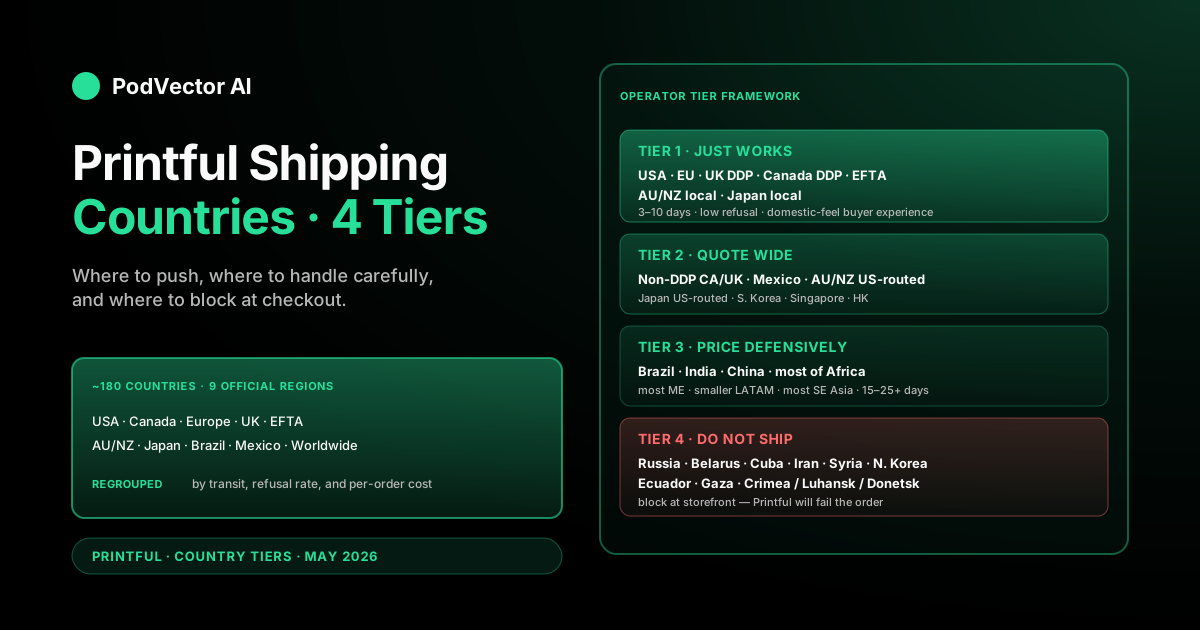
Quick Answer: Printful ships to roughly 180 countries across 9 regions, but operators should think in tiers, not regions. The country a buyer is in decides your shipping cost, transit window, refusal risk, and how many support tickets that order generates.
Tier 1 destinations (US, EU, UK, EFTA, Canada DDP, AU/NZ local, Japan local) are the ones to promote. Tier 2 (non-DDP Canada/UK, Mexico, AU/NZ US-routed) work but need wider delivery quotes. Tier 3 (Brazil, Worldwide bucket) is slow, expensive, and refusal-prone — price defensively.
Tier 4 is the do-not-ship list: Russia, Belarus, Cuba, Iran, Syria, North Korea, Ecuador, Gaza, and the Crimea/Luhansk/Donetsk regions of Ukraine. Block these at checkout to avoid forced refunds.
Rate note: Printful pushed a shipping price update on June 4, 2026 (per Printful's own shipping-updates page), and made targeted regional increases in February 2026 — always verify current rates against Printful's live shipping calculator before setting storefront prices.
Why thinking in tiers beats thinking in regions
Printful's official 9-region rate card is how you get billed. It is not how you should plan a store.
Two countries inside the same Printful region can have wildly different buyer experiences. A French customer and a Bulgarian customer both ship under the "Europe" region, at the same flat rate. The Frenchman gets the package in 4 days. The Bulgarian waits 9 and pays a customs surcharge. Same region, different reality.
A useful operator framework regroups destinations by what actually matters: how fast does it land, how often does it refuse, and how much shipping eats per order.
The tiers below combine Printful's published rates with operational patterns POD stores see week after week. They're decision-making buckets — not Printful's official categorization.
One structural caveat before diving in: Printful periodically adjusts international shipping rates — and not always by the same amount across regions. The specific dollar figures below reflect the post-June 4, 2026 update; treat them as reference points, not locked prices.
Tier 1: destinations that just work
These are the countries where transit is short, refusal rates are low, and shipping cost stays in a healthy ratio to order value. Push your ads and SEO toward these markets first.
United States. The 50 states plus DC, with Puerto Rico, Guam, USVI, and APO/FPO addresses at US domestic rates. According to Printful's shipping page, fulfillment time averages 2–5 business days for all products, with standard transit typically adding 3–4 business days after fulfillment for domestic US orders. Refusal rate is the lowest in the Printful network.
Canada (DDP). All provinces and territories. The DDP option pre-pays duties at the carrier handoff, so Canadian buyers see no surprise charge at the door. Transit runs 3–5 business days. The premium over standard Canadian shipping is small and the refused-package rate drops dramatically when you turn DDP on. Note that according to Bootstrapping Ecommerce, hat shipping to Canada increased in February 2026 — verify current DDP rates in Printful's calculator before publishing storefront prices.
United Kingdom (DDP). England, Scotland, Wales, and Northern Ireland. The EU-to-UK DDP route handles customs cleanly, with 3–7 business days transit from the Latvian or Spanish facility. Pair DDP with the £135 VAT-at-checkout rule and the UK becomes one of the smoothest international markets to sell into.
European Union. Most EU member states plus Monaco, Andorra, and San Marino route through this region. Riga and Barcelona facilities mean intra-EU orders land in 3–7 business days at a rate similar to US domestic. IOSS handling on the platform side keeps VAT clean for orders under €150.
EFTA states. Norway, Switzerland, Iceland, Liechtenstein. Slightly slower than the EU at 5–10 business days and a bit more expensive, but the buyer experience is comparable. EU-based facilities handle the bulk of these orders.
Australia and New Zealand (local fulfillment). When a product is stocked at the Australian partner facility, AU/NZ orders transit in 5–10 business days at a domestic-Australia rate. This is a meaningful upgrade over US-routed AU/NZ orders, which take 10–20 days at a higher international rate. Be aware that according to Bootstrapping Ecommerce, apparel shipping to Australia and New Zealand increased in February 2026 — check the live calculator for current figures.
Japan (local fulfillment). Same pattern as AU/NZ. Products available at the Japanese partner facility ship in 3–7 business days. Products that have to come from the US are a different conversation — see Tier 2. Note that some product categories (Tough Cases, Snap Cases, AirPod Cases) are not shipped to Japan at all, per Printful's shipping page.
For US-buyer transit math specifically, the Printful shipping time USA breakdown walks through fulfillment and last-mile by carrier. The Printful shipping times Europe guide covers the EU side.
Tier 2: manageable, but quote wide
These destinations work, but you should pad your delivery window quote and accept a higher support-ticket rate. Don't promote heavily, but don't block either.
Canada without DDP. Transit jumps to 5–10 business days and Canadian customs assesses duty on most POD orders because the CAD $20 de minimis is so low. If you turn DDP off to save the premium, expect a meaningful bump in refused packages from buyers declining the duty bill at the door.
UK without DDP. Above the £135 threshold, surprise customs bills are common. Transit times stay reasonable (4–8 business days), but the buyer experience degrades sharply. DDP is almost always the right call for the UK.
Mexico. Single-country region with a dedicated Tijuana facility. When products are stocked there, transit is 5–8 business days. When they're not, orders ship from a US facility and transit can stretch past 14 days. Mexican customs is generally cooperative for low-value POD orders.
Australia and New Zealand (US-routed). When a product isn't stocked at the Australian partner facility, the order leaves a US facility and transit runs 10–20 business days at the international rate. Buyer satisfaction drops noticeably on this routing. According to PodVector's own shipping guide, local fulfillment cuts shipping cost roughly in half versus cross-ocean US fulfillment — getting SKUs stocked regionally is the highest-leverage move here.
Japan (US-routed). Same pattern. Products not stocked locally ship from the US and transit can run 10–14 business days. Japanese buyers expect precise delivery windows, so any uncertainty here drives ticket volume.
South Korea. Technically in the Worldwide bucket, but the customs path is more efficient than most Worldwide destinations. Transit runs 10–14 business days and refusal rates are moderate. Worth treating as Tier 2 even though Printful prices it as Tier 3. Note that Tough Cases, Snap Cases, and AirPod Cases are not shipped to South Korea, per Printful's shipping page.
Singapore and Hong Kong. Worldwide pricing, but the small geographic footprint and strong logistics infrastructure mean transit lands in 7–12 business days, faster than most Worldwide destinations. Refusal rates stay low.
Tier 3: slow and refusal-prone
These destinations ship technically, but the combination of long transit, high duties, and inconsistent customs makes them risky. Price defensively (build duty risk into the retail price) or restrict to a curated catalog.
Brazil. Its own shipping region. Transit runs 10–20 business days and Brazilian customs frequently holds packages for inspection. Import tax on personal goods can be substantial, and the result is elevated support-ticket volume versus Tier 1 destinations.
India. Worldwide pricing. Transit runs 14–25 business days. Indian customs assess significant duty on apparel plus IGST, and refusal rates on apparel imports are high. Most Printful operators either price India-specific or restrict the SKUs offered there.
China. Worldwide pricing. Shipping is operational but import-side processing can stretch transit past 4 weeks during customs backlogs. The buyer base is small for most Western POD stores, so the operational cost rarely justifies the demand.
Most of Africa. Worldwide pricing. Transit windows range from two to five weeks depending on the country, with high last-mile variability. Customs experience varies country to country — South Africa is more predictable, much of West Africa is not.
Most of the Middle East. UAE and Saudi Arabia behave reasonably (10–14 business days, manageable customs). Other Middle East destinations under the Worldwide bucket are more variable.
Caribbean and smaller Latin American markets. Worldwide pricing, 15–25 business days transit, last-mile is the long pole. The Dominican Republic and Jamaica work; smaller islands are inconsistent.
Indonesia, Philippines, Vietnam, Thailand, Malaysia. All Worldwide. Transit runs 12–20 business days. Customs behavior is country-specific — Singapore and Hong Kong move up to Tier 2, the rest stay here. Note that hand towels ship only to select Asia-Pacific countries (Japan, Hong Kong, Indonesia, Malaysia, Philippines, Singapore, Thailand, Taiwan, Vietnam, South Korea), per Printful's shipping page — so product availability varies by category within this tier.
For the rate-card math by region, the Printful shipping times guide covers the full transit windows.
Tier 4: do not ship
The hard-blocked list. If your store accepts checkout from any of these destinations, the order will fail at the fulfillment step regardless of which carrier you select.
- Russia. Blocked since 2022.
- Belarus. Same block as Russia.
- Crimea, Luhansk, and Donetsk regions of Ukraine. Carrier-level restriction.
- Cuba. US sanctions.
- Iran. US sanctions.
- Syria. US sanctions.
- North Korea. US sanctions.
- Ecuador. Carrier-level pause.
- Gaza Strip (Palestinian territories). Carrier-level pause due to ongoing conflict.
Two special cases deserve a callout. Ukraine outside Crimea/Luhansk/Donetsk ships only from the Latvian facility with a narrow catalog — if a Ukrainian buyer orders a SKU not stocked in Latvia, the order fails. Kosovo follows the same pattern.
The fix is upstream of fulfillment: block these countries at your storefront so they never get to checkout. A failed Printful order after the customer has paid creates a refund cycle, a support ticket, and a chargeback risk if the buyer escalates.
Keeping up with Printful rate updates
Printful's rate card is not static. In February 2026, according to Bootstrapping Ecommerce, Printful increased apparel shipping to Australia and New Zealand and hat shipping to Canada, among other targeted adjustments. A further batch of shipping price updates went live on June 4, 2026, per Printful's own shipping-updates page.
The pattern to internalize: Printful periodically adjusts international shipping rates, and not always by the same amount across regions. A rate that was correct when you set your storefront prices may be meaningfully different today — especially for AU/NZ, Canada, Japan, and specialty product categories.
Three practices that keep you current:
- Check the live calculator before launching a new SKU internationally. Printful's product-page shipping calculator shows the current rate for any product-to-region combination. Treat your spreadsheet as a starting point, not a source of truth.
- Subscribe to Printful's shipping updates page. Printful publishes advance notice of rate changes. A few days of lead time is enough to adjust your storefront shipping tables before the new rate hits your cost line.
- Track actual Printful charges per order against what you charged the customer. The spread between your charged rate and your actual Printful cost is where margin quietly disappears. If that spread turns negative for a region, you're subsidizing international shipping without knowing it.
What the buyer actually sees by country
Your buyer experience is the sum of three things: how the package tracks, how customs surfaces (or doesn't), and how the last-mile carrier handles delivery. All three change by country.
US domestic. The buyer sees a USPS, UPS, or FedEx tracking number that updates in near-real-time. No customs touchpoint. Delivery confirmation is a porch photo or carrier scan. The package experience is invisible — which is the gold standard.
EU intra-region. Buyer sees a local carrier (DPD, DHL, Posti, etc.) once the package arrives in the destination country. Customs is invisible inside the EU. The end-to-end experience is close to domestic-shipping quality.
UK with DDP. Buyer sees Royal Mail or Evri tracking after the EU-UK handoff. The DDP label means no customs bill at the door. The experience feels domestic.
Canada with DDP. Similar pattern. Canada Post or UPS Canada handles the last mile after the border. No surprise duty bill.
UK or Canada without DDP. The package arrives, the carrier requests payment of duty and a customs fee at the door. A meaningful share of buyers refuse the package at this stage. The seller eats the outbound shipping and the return.
Australia and New Zealand local-fulfilled. Buyer sees AusPost or NZ Post tracking from day one, same-country shipping experience.
Australia and New Zealand US-routed. Buyer sees a US carrier (USPS International, DHL, etc.) for the first leg and AusPost/NZ Post for the last mile. Tracking can have a multi-day gap during the international handoff, which spikes ticket volume.
Brazil. Buyer sees the package enter Brazilian customs and sit there. Receita Federal hold notices are common. A large share of Brazilian POD buyers will write a "where is my order?" ticket during the customs delay window.
Worldwide region generally. Tracking is patchy. The package can disappear from tracking for 5–10 days during international transit. Last-mile carriers vary in reliability. Surprise customs bills are common.
The pattern: every step in the chain that introduces a customs touchpoint or a carrier handoff degrades the buyer experience. DDP routes hide the customs touchpoint. Local fulfillment hides the carrier handoff. Tier 1 is Tier 1 because both are invisible.
Setting product-page expectations by destination
The single cheapest way to reduce international support volume is to be specific about delivery times and customs on the product page, before checkout.
A delivery quote that says "5–7 business days" for a buyer who is actually going to wait 18 days is worse than no quote at all. The buyer plans for a date, the date passes, the ticket gets opened.
Three patterns that work:
Country-specific delivery quotes. Shopify and most ecommerce platforms let you display different shipping windows by destination country. Quote against the upper end of the Printful transit range plus 1 buffer day. A buyer who gets their package faster than quoted is happy. A buyer who gets it on time is satisfied. A buyer who gets it later than quoted is a ticket.
A duty-and-customs disclaimer on international product pages. One line — "Additional duties and taxes may apply at delivery, depending on your country" — pre-empts the surprise. It doesn't fix the duty, but it stops the buyer from refusing the package out of frustration.
A "currently shipping to" list. If you've decided to restrict Tier 3 destinations, surface that list on a shipping-info page. Buyers in restricted countries see the list, accept that they can't order, and don't generate failed-checkout support tickets.
Beyond shipping, the Printful Shopify integration cost breakdown covers the platform-side fees that interact with international pricing. The Printful sticker pricing breakdown shows what cross-border math looks like on a lightweight category where shipping is most of the cost.
Reading country mix as a margin signal
Country mix moves week to week, and it moves margins with it. Most stores miss this because the rate card looks static.
The Worldwide creep. Your store starts US-heavy. A viral social moment pulls a wave of new orders, some of them from countries in the Worldwide bucket. Your blended per-order shipping cost moves up several dollars before the next P&L review. Retail prices haven't changed.
The DDP-rate roll. Printful re-prices international shipping when carrier contracts roll over. According to Bootstrapping Ecommerce, February 2026 saw targeted increases on AU/NZ apparel and Canadian hats, and a further round of updates went live June 4, 2026. If you priced your store before either update, your international shipping cost is likely higher than your spreadsheet says.
The refusal-rate drift. A region that worked fine in spring starts refusing a higher share of orders in late autumn as duty assessments tighten. The refund volume goes up. What's hidden in that view is the rejection cost — outbound shipping plus return plus restocking — which is the real margin hit.
The product-mix interaction. Your international channel starts as mostly t-shirts. A new hoodie launch shifts the mix. International hoodie shipping is materially higher than international t-shirt shipping. Your blended international per-order shipping cost moves without anyone updating the model.
The category availability gap. Some product categories don't ship to certain countries at all — phone cases to Japan, South Korea, Hong Kong, and Taiwan, for example, per Printful's shipping page. If a buyer in one of those markets orders a restricted SKU, the order fails at fulfillment. A country-mix review should cross-reference catalog availability, not just rates.
Static spreadsheets don't catch any of these because the inputs change but nobody re-runs the math. The fix is structural: pull every itemized shipping line — country, region, product, DDP/DDU, refusal status — into the same place as your revenue and product costs, and look at per-country margin over time instead of per-region rate cards.
For the broader Printful operator view, the Printful topic hub indexes every guide. For the shipping-specific cluster, the Printful shipping cluster hub covers fees, transit, regions, and country-level math.
FAQs
Which countries does Printful ship to?
Roughly 180 countries grouped into 9 regions: USA, Canada, Europe, UK, EFTA states, Australia/New Zealand, Japan, Brazil, Mexico, and a Worldwide catch-all for everything else. Printful's official shipping page has the current country-to-region lookup and live rate calculator.
Which countries does Printful not ship to?
Russia, Belarus, Cuba, Iran, Syria, North Korea, Ecuador, the Gaza Strip, and the Crimea, Luhansk, and Donetsk regions of Ukraine. Sanctions-driven blocks (Russia, Belarus, Cuba, Iran, Syria, North Korea) are unlikely to change. Carrier-driven blocks (Ecuador, Gaza) can shift quarter to quarter.
What is the fastest country Printful ships to?
The US for US-based buyers (standard transit adds 3–4 business days after fulfillment, per Printful's shipping page), alongside EU buyers ordering products stocked at Riga or Barcelona (3–7 days). Local-fulfillment markets — Australia, New Zealand, and Japan when stocked — also land in single-digit days.
What is the slowest country Printful ships to?
Most of the Worldwide region runs 15–25 business days. Brazil is its own region but slow because of customs holds (10–20 days plus inspection time). India, smaller African destinations, and remote Caribbean markets can stretch past 30 business days during customs delays.
Does Printful ship internationally?
Yes. Printful runs facilities in the US, Canada, Mexico, Latvia, and Spain, plus partner facilities in Australia, Japan, and Brazil. International shipping is one of Printful's core capabilities — check Printful's shipping page for the current facility and region map.
How do I know which Printful shipping region a country falls into?
Printful's checkout shows the destination region and rate before order confirmation. For pre-order planning, the official shipping page has the country lookup, and Printful's product-page shipping calculator confirms which region applies for any specific destination.
Can I block specific countries from ordering?
Yes, and you should. Most ecommerce platforms (Shopify, WooCommerce, Etsy) let you set country-level shipping restrictions at the storefront level. Block the Tier 4 sanctions list at minimum. Many operators also block Tier 3 destinations to keep their support-ticket queue manageable.
Does Printful pay customs and duties?
Only on the two DDP routes: USA-to-Canada and EU-to-UK. Every other international route is DDU (Delivered Duties Unpaid), meaning the buyer is responsible for any import fees, VAT, or duties imposed at delivery. Below de minimis thresholds, duties are often waived. Above them, buyers can owe a significant share of the order value plus a customs broker fee.
Should I ship to every country Printful supports?
No. Most stores see better margins and lower support load by restricting to Tier 1 and Tier 2 destinations, pricing Tier 3 destinations defensively, and blocking Tier 4 outright. The marginal Tier 3 order rarely pays for the support time it generates.
How often does Printful update its shipping countries list?
The country-to-region mapping shifts a few times a year as new partner facilities come online and as carrier-level restrictions change. Rate updates happen independently — there were at least two rounds in early-to-mid 2026 alone, per Bootstrapping Ecommerce and Printful's own updates page. Worth cross-checking quarterly against Printful's official shipping page.
Are there product categories that don't ship to certain countries?
Yes. According to Printful's shipping page, Tough Cases, Snap Cases, and AirPod Cases are not shipped to Japan, South Korea, Hong Kong, or Taiwan. Hand towels ship only to a specific list of Asia-Pacific countries. Some products ship only to the United States. Always verify category-level restrictions in Printful's shipping calculator before adding a new SKU to an international market.
Your country mix shifts every week. Your shipping cost line shifts with it.
Printful's rate card tells you what one order to one country costs today. It does not tell you that a growing share of your orders are now routing through the Worldwide bucket where margins are tight. It does not tell you when a regional rate update has quietly made your international shipping more expensive than what you charged the customer. It does not tell you that a refusal rate in a specific region has started climbing.
Victor connects to your Printful account and pulls every itemized shipping line — country, region, product, DDP/DDU, refusal status — into your live data warehouse alongside revenue and product cost. Then it answers questions like "which countries are eating my margin this week?" in plain English, and proposes Shopify-side price adjustments to protect your margin — which you approve before anything changes. No spreadsheet. No quarterly P&L surprise.
Try Victor free