
What contribution margin actually is
Contribution margin is the money left from a sale after you pay the costs that move with volume. Those are your variable costs — the ones you only spend because a specific order happened.
It answers a simple question: does selling one more unit make you money before rent, salaries, and software ever enter the picture? That is why it drives pricing, ad-budget, and "should I keep selling this product" decisions. This standard definition is used across finance references like Wall Street Prep.
Contribution margin is different from profit. Profit is what remains after every cost, including fixed ones. Contribution margin is the step before that — the pool each sale contributes toward covering the fixed costs.
The contribution margin formula
The core formula has two costs in it and nothing else:
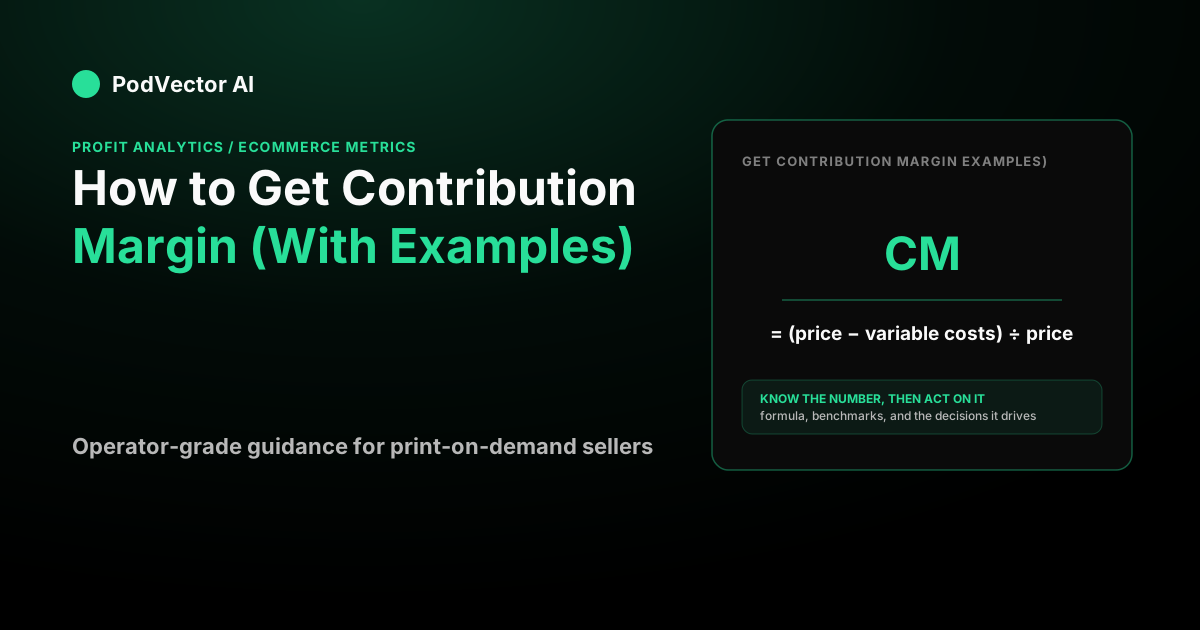
Contribution margin = Revenue − Variable costs
Variable costs scale with each order. For a product business they usually include cost of goods sold (COGS), shipping, payment processing fees, and per-order fulfillment labor. Fixed costs — rent, salaries, your monthly software — are deliberately left out.
Contribution margin ratio
The dollar figure is useful, but the ratio lets you compare products and channels of different sizes:
Contribution margin ratio = Contribution margin ÷ Revenue × 100
A ratio tells you what share of every sales dollar survives the variable costs. A forty percent ratio means forty cents of each dollar is left to cover fixed costs and become profit.
How to get contribution margin: a step-by-step example
Say you run a print-on-demand apparel store and you want the contribution margin on a typical order. Walk it in four steps.
Step 1: start with revenue
Take your revenue for one order. Say your average order value is $40. That is the top line you'll subtract costs from.
Step 2: list every variable cost
Now write down each cost that only exists because that order happened:
- COGS (blank garment + printing + the supplier's base fulfillment charge): $16.00
- Shipping (carrier): $5.00
- Payment processing (4% of $40): $1.60
- Pick and pack labor: $1.40
That's $24.00 of variable cost on this order.
Step 3: subtract to get contribution margin
Apply the formula: $40.00 − $24.00 = $16.00. This order's contribution margin is $16.00 before you've spent a cent on advertising.
Step 4: convert to a ratio
Divide by revenue: $16.00 ÷ $40.00 = 0.40, or a 40% contribution margin ratio. Every order like this hands you sixteen dollars toward fixed costs and profit.
The variable cost most sellers forget: ad spend
Here is where the tidy textbook examples fall apart for real stores. If you pay to acquire the order, that ad spend is a variable cost too — and it's often the biggest one.
Keep going with the same order. Say you run at a 4.0 return on ad spend, so the advertising allocated to a $40 order is $10.00. Subtract it: $16.00 − $10.00 = $6.00. That is your contribution margin after ads — $6.00, or a 15% ratio.
The $16.00 version answers "is this product worth making?" The $6.00 version answers "is it worth selling through paid ads at this cost?" Both are contribution margins; they just stop at different points. If you only ever calculate the pre-ad number, a product that looks healthy can quietly lose money once acquisition is priced in. Understanding how ad efficiency feeds this is why the difference between CPA and CAC matters so much for margin math.
Two more variable costs sneak past sellers:
- Returns and refunds. A returned order still cost you the product, the shipping, and often the return label. Net your expected return rate out before you call a margin final.
- Transaction fees beyond the gateway. Marketplace commissions or app fees per sale belong in variable costs, not fixed.
Contribution margin vs gross margin vs net margin
These three get mixed up constantly, and the difference is only which costs you subtract.
- Gross margin subtracts only COGS. On the example order,
($40 − $16) ÷ $40 = 60%. It says whether the product is worth making. - Contribution margin subtracts all variable costs — COGS plus shipping, fees, fulfillment, and ad spend. That's how a 60% gross margin becomes a 40% pre-ad and 15% post-ad contribution margin. It says whether the product is worth selling through this channel.
- Net margin subtracts everything, including fixed costs. If the same store nets $2,000 on $40,000 of revenue, that's a 5% net margin. It's the final scoreboard for the whole business.
Gross margin is optimistic, net margin is the verdict, and contribution margin is the decision-making number in between. The broader ecommerce metrics guide walks through how these connect to the rest of your numbers.
Why contribution margin drives your ad budget
Once you have your contribution margin ratio, you can back out the exact return on ad spend you need to break even. The identity is simple:
Break-even ROAS = 1 ÷ contribution margin ratio
On a 40% pre-ad contribution margin ratio, break-even ROAS is 1 ÷ 0.40 = 2.5. Below a 2.5 ROAS on that product, ads lose money no matter how good the campaign looks on the surface. This is the single most useful thing contribution margin unlocks — you can turn it into a target using a ROAS calculator.
The same logic connects to store-wide efficiency. Because contribution margin sets your floor, it's the number that makes a marketing efficiency ratio or a customer lifetime value figure meaningful rather than just a vanity ratio.
Getting an accurate contribution margin without a spreadsheet
The hard part isn't the formula — it's collecting every variable cost per order from tools that don't talk to each other. Your COGS lives in Printify or Printful, your fees in Stripe, your ad spend in Meta Ads and Google Ads, and your revenue in Shopify.
PodVector connects Shopify, Meta Ads, Google Ads, Printify, and Printful, then computes true per-order profit — pulling those costs together so your contribution margin reflects what actually hit each order. Victor, its AI employee, analyzes that live data and proposes moves, and with your approval executes Shopify-side actions. He reads your ad data to inform those proposals but does not touch your ad account. If you'd rather stop rebuilding this in a spreadsheet every month, you can try PodVector.
FAQs
What is the formula to get contribution margin?
Contribution margin equals revenue minus all variable costs. Variable costs are the ones that scale with each order — COGS, shipping, payment fees, per-order fulfillment, and ad spend. To get the ratio, divide the result by revenue and multiply by one hundred.
Is contribution margin per unit or total?
Both work, and they answer slightly different questions. Per-unit (or per-order) contribution margin is best for pricing and product decisions. Total contribution margin across a period tells you how much the whole business generated to cover fixed costs. Just keep the revenue and variable costs on the same basis.
Should I include advertising in contribution margin?
If ad spend scales with your sales, yes — it's a variable cost. Many sellers report a pre-ad contribution margin (sometimes called CM2) and a post-ad one (CM3) so they can see the product's economics and the channel's economics separately. Reporting only the pre-ad number hides whether paid acquisition actually pays.
What's the difference between contribution margin and gross margin?
Gross margin subtracts only COGS from revenue. Contribution margin subtracts every variable cost, including shipping, payment fees, fulfillment, and ads. Gross margin will always look higher, which is exactly why it's the wrong number for deciding whether to scale a paid channel.
What is a good contribution margin?
There's no universal threshold — it depends on your fixed-cost base and how much you spend to acquire customers. The practical test is whether your contribution margin covers your fixed costs at your current order volume and still leaves profit. Use it to calculate your break-even point and your break-even ROAS, then judge products against those.
How do I use contribution margin to set my break-even point?
Divide your fixed costs by your contribution margin per unit. If fixed costs are $4,000 a month and each order contributes $6 after ads, you need about 667 orders a month to break even. Below that you're losing money; above it, each order is profit.