
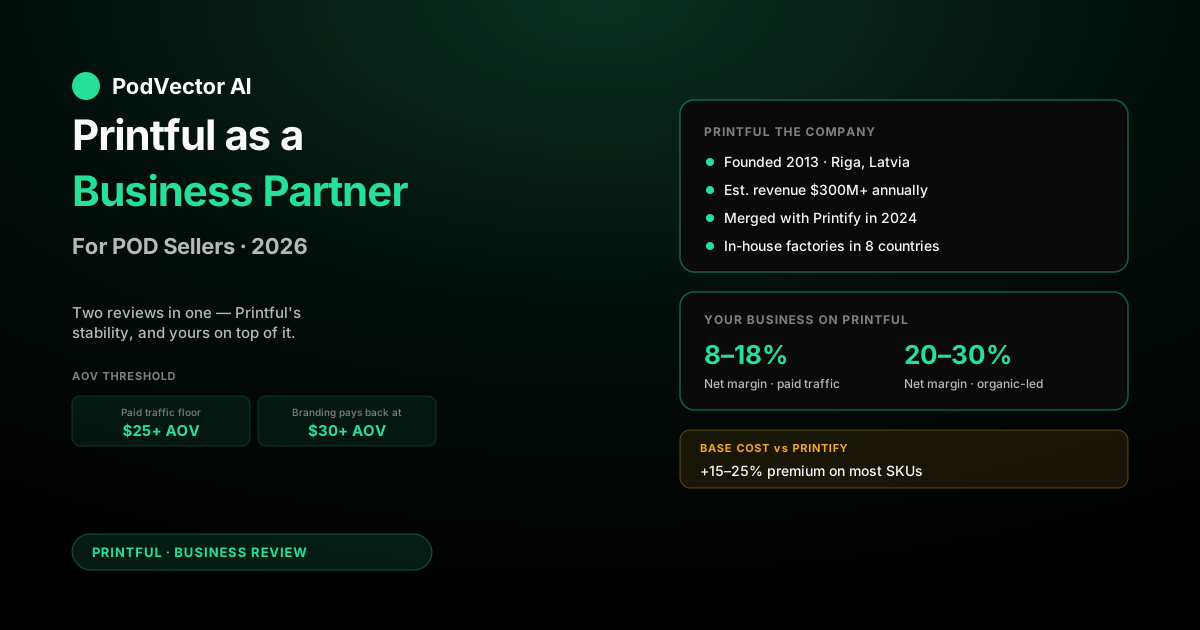
Quick Answer: Printful is a financially stable, vertically-integrated POD supplier — a safer business partner than most competitors, but not the cheapest one.
The harder question is whether your business model works on top of Printful. Base costs run 15–25% above Printify, so margin math only pencils out at $25+ AOV with disciplined ad spend.
Worth it if you're building a brand. Painful if you're trying to win on price.
Two Business Reviews in One
Most Printful reviews answer the wrong question. They tell you about t-shirt softness and DTG color accuracy, then call it a day.
A real business review has to answer two things. First, is Printful itself a stable business worth tying your store to? Second, does the business model of selling on Printful actually make money for you?
Those questions matter more than print quality. A great print on a shaky supplier is a future migration nightmare. A great supplier with broken unit economics is a slow bleed.
This breakdown covers both lenses honestly. No affiliate spin.
Printful, the Business
Printful was founded in 2013 in Riga, Latvia, with US operations spinning up shortly after. As of 2026, the company runs in-house fulfillment centers in the US, Mexico, Canada, Latvia, Spain, the UK, Japan, and Australia.
That's not a "marketplace of suppliers" — Printful owns and operates the factories. Vertical integration is the whole strategic bet.
Size and stability signals
Printful is privately held and doesn't publish full financials, but the operational signals are clear. Over 1 million stores have used the platform. Revenue has been estimated above $300M annually since 2022.
The company merged with Printify in late 2024 under a unified parent. Both brands continue to operate separately on the seller side, which matters because they target different segments — Printful for quality-focused sellers, Printify for cost-focused ones.
Translation: Printful isn't going anywhere. It's one of the two consolidated leaders in a category where most of the early players (Teelaunch, Pillow Profits, etc.) have either pivoted or quietly faded.
Operational maturity
Vertical integration delivers something most POD competitors can't promise: consistent quality batch-to-batch. When every shirt ships from a facility Printful owns, you don't get "Provider A vs Provider B" quality variance baked into your refund rate.
That same integration is also why Printful is more expensive. You pay for the in-house factory model. Whether that's worth it depends on your business — which is the second half of this review.
For deeper context on Printful's company history and stability, see our Printful company review 2025 honest breakdown.
Your Business on Printful
This is where most reviews get vague. Let's put numbers on it.
Net margins on Printful stores typically run 8–18% on mature catalogs with paid traffic, and 20–30% on stores leaning into organic or email. Those are reality numbers based on aggregated seller P&Ls, not Printful's marketing material.
The reason the spread is so wide: ad spend. Once you're acquiring customers paid, every dollar of CAC eats directly into a margin that started thin to begin with.
The unit economics floor
A Bella+Canvas 3001 t-shirt — the most-sold blank in POD — costs roughly $11–13 base on Printful in 2026. Add $4.69 US shipping for one shirt, and your landed cost is about $16.
Sell that shirt at $24.99, and your gross is $8.99 per unit. Subtract platform transaction fees (~$1), refund and defect reserve (~$0.80), and you're at roughly $7 of contribution per unit before any marketing spend.
Spend $7 to acquire a customer who buys one shirt, and your net is zero. That's the math.
Where the model actually works
Profitable Printful businesses share a few traits. AOV above $30 (multi-item carts or premium-priced products), repeat customer rate above 25%, and organic traffic share above 40% — preferably all three.
Stores running primarily on cold paid traffic with $20 single-item AOV almost always lose money on Printful. The base cost premium that buys quality consistency also kills the unit economics on price-led models.
Print on Demand isn't dead — it's just gotten more honest about who can run it profitably. That's not a Printful problem, it's a category reality, and the Printify vs Printful quality comparison shows the same pattern from a different angle.
The Cost of Doing Business With Printful
Printful's cost stack has more components than most sellers track in their P&L. Let's enumerate.
Base product costs
Roughly 15–25% above Printify on equivalent SKUs. For the most-popular categories:
- Bella+Canvas 3001 t-shirt: ~$11–13 base on Printful vs ~$9–10.50 on Printify
- Gildan 18500 hoodie: ~$22–25 base on Printful vs ~$18–22 on Printify
- 11oz ceramic mug: ~$7.50–8.50 base on Printful vs ~$5.50–6.50 on Printify
- Embroidered hat (Yupoong 6606): ~$15–18 base on Printful — Printify equivalent varies wildly by provider
Multiply across a 1,000-unit month and the gap is real money — typically $2,000–3,000 in lost contribution margin compared to running the same catalog on Printify.
Shipping costs
US domestic: $4.69 for the first apparel item, $2.19 for each additional. That's competitive with the category.
International shipping is where it gets ugly. Australia, Japan, and most of Asia run $8–14 per first item. Build that into your retail pricing or geo-restrict your store.
Subscription and branding add-ons
The base Printful account is free — pay-as-you-ship. Optional layers stack up:
- Printful Growth subscription: $24.99/month for product discounts up to 30%, branding discounts, and waived storefront fees
- Inside-label printing: $2.49 per item
- Custom packaging insert: $0.99 per order
- Branded sticker on packaging: $0.95–1.49 per order
- Custom packing slip: $0.50–1.00 per order (free with Growth)
Stack three branding options on a $24.99 shirt and you've added $5–6 in cost. That's the price of looking like a real brand instead of a generic POD store — but it eats margin fast on low-AOV catalogs.
Hidden costs sellers miss
Three line items most POD operators forget to model:
Refund-adjusted COGS. Industry defect rate runs 2–4%. If you're not subtracting this from gross margin, your reported profit is overstated.
Returns and re-prints. Printful re-prints free for production defects, but customer-side returns (wrong size, didn't like it) are on you. Build a 3–5% reserve.
Platform fees and payment processing. Shopify + Stripe takes roughly 3.5% of every sale. Multiply across your top-line and it's real money.
For the full Printful pricing picture, our Printful company reputation review covers the trust angle, and Style Factory's third-party take is the most detailed independent breakdown we've seen: Style Factory's Printful review.
Quality and Fulfillment Reality
Print quality is one of the few things Printful never has to explain away. DTG output holds up through 40–50 washes without significant fade. Color accuracy is consistent because the prints ship from a small set of facilities Printful operates directly.
Embroidery is also above category average — clean satin stitches, accurate Pantone matching, no loose threads in test orders. For embroidered apparel businesses (hats, hoodies, polos), the alternatives shrink quickly.
For shirt-specific quality detail, our Printful t-shirt quality review goes deeper on fabric, fit, and wash performance.
Fulfillment times
Quoted at 2–5 business days for production, plus shipping. In practice, US apparel orders hit "shipped" status within 3–4 business days. EU orders ship from EU facilities for fast intra-region delivery.
Compared to Printify's top providers (Monster Digital, Swiftpod), Printful runs roughly one day slower on average. For most sellers that's irrelevant. For holiday-season or fast-fashion categories, the difference compounds.
What slow fulfillment costs your business
Production speed isn't just a customer experience issue. It changes your cash conversion cycle.
The longer the gap between customer payment and order ship, the more refund disputes you'll see from impatient buyers. POD operators who track refund rate by season usually find a 1–2% bump during November/December purely from delivery anxiety.
Vendor Risk and Platform Dependency
This is the section other reviews don't write, and it's the most important one for sellers building a real business.
Your entire fulfillment pipeline lives inside Printful. Their site goes down, their facilities have a production hiccup, their pricing model changes — and you have no recourse. That's true of any single POD supplier, but it's worth naming directly.
What "platform dependency" actually means
If Printful raises base prices 8% (which happened in 2022), every store running on Printful absorbs that overnight unless they raise retail prices fast enough. Most don't.
If Printful discontinues a product (their Bella+Canvas 3001 catalog has been stable, but other SKUs have come and gone), you have to redesign and re-launch the product on a different blank. That's days of work per SKU.
If Printful's API goes down during a sales event, orders queue up and customer service complaints stack. You can't bypass it.
Mitigations real sellers use
The honest answer is: not many. The top tactics:
Multi-supplier setup. Run Printful as primary and Printify (or Gelato) as backup for high-volume SKUs. Requires double the design work but cuts single-vendor exposure. What sellers actually say on Reddit about Printify vs Printful covers how operators split workloads.
Margin buffer. Price retail high enough that a 5–10% supplier cost increase doesn't push you into the red. This is the boring discipline that separates surviving stores from dying ones.
Owned customer relationship. Email list, repeat purchase flows, content channels. The actual asset of a POD business isn't the products — it's the buyer relationship. If you can move customers to a new supplier on launch day, vendor risk shrinks.
Pros and Cons for POD Sellers
Pros
- Vertically integrated, financially stable, won't disappear next quarter
- Consistent print quality batch-to-batch
- Strongest branding service stack in POD (labels, inserts, packaging)
- Embroidery available at competitive pricing and quality
- Polished UI and reliable integrations with every major platform
- 24/7 support with response times under 5 minutes on chat
- EU fulfillment centers for fast EU delivery without import friction
- Warehousing service available for hybrid inventory sellers
Cons
- Base costs run 15–25% higher than Printify on most SKUs
- EU costs run 5–10 percentage points higher than Gelato for EU-only stores
- Production times slower than Printify's fastest providers by ~1 day
- Branding add-ons stack quickly on low-AOV catalogs
- Subscription savings only pencil above ~$1,500/month volume
- Single-vendor dependency risk that no POD platform truly solves
- Unit economics demand $25+ AOV to make ad-driven traffic profitable
Who Printful Is and Isn't For
Good fit
- Premium-brand stores selling at $30+ AOV with branding as differentiator
- Sellers who prioritize quality consistency over lowest unit cost
- Embroidered apparel businesses (hats, hoodies, polos)
- EU-focused stores wanting EU fulfillment without import fees
- Established sellers above $3K/month who can amortize subscription
- Businesses with meaningful repeat customer or organic traffic share
Bad fit
- Budget t-shirt stores trying to win on price ($19.99 shirts won't work)
- Beginners testing 50 designs hunting for one winner (base cost gap matters at low volume)
- Cold-traffic-only stores running aggressive paid ads on thin margins
- Single-item AOV stores where unit economics start underwater
The real test
The question that matters isn't whether Printful is a good business — it is. The question is whether your business model survives Printful's cost structure.
That requires looking at landed COGS, refund-adjusted margin, blended CAC, and repeat purchase rate. Not list prices. Not Trustpilot scores. Real numbers from your own store.
For broader context, see our cluster of Printful reviews and the full Printful topic hub. The 2025 Printful company review covers the corporate side from a different lens.
FAQs
Is Printful a profitable business model for sellers?
It can be, but the math is tighter than most marketing suggests. Net margins typically land 8–18% on paid-traffic stores and 20–30% on organic-heavy stores. Below $25 AOV with cold paid traffic, the model usually loses money.
Is Printful a financially stable company?
Yes. Founded in 2013, privately held, estimated revenue above $300M annually since 2022. Merged with Printify under a unified parent in late 2024. One of two consolidated POD leaders.
Why is Printful more expensive than Printify?
Printful owns its production facilities; Printify is a marketplace of independent providers. Vertical integration delivers quality consistency but costs more to operate, and that cost passes through to base prices.
What AOV do you need to make Printful work?
$25 minimum to make paid traffic pencil. $30+ if you're using branding add-ons. Lower than that and unit economics get uncomfortable fast.
How much can you realistically make with a Printful store?
Sellers at $10K+/month exist but aren't typical. The median Printful store sits well below that, and many lose money once true ad-attributed CAC and refund-adjusted COGS are accounted for honestly.
Is Printful worth the higher cost?
For brand-led stores building repeat customers, yes — quality consistency and branding services pay back. For price-led stores, no — the unit economics gap vs Printify is too large to overcome.
What's the biggest business risk of selling on Printful?
Single-vendor dependency. A supplier price increase, product discontinuation, or outage hits your entire catalog at once. Mitigate with multi-supplier setups, healthy margin buffers, and owned customer relationships.
Find out if Printful is actually profitable in your store
Base costs look fine in a spreadsheet. Then refunds, branding add-ons, and ad spend hit your real margin — and most sellers don't see it until quarter-end.
Victor is the AI employee built for POD operators. It pulls your store, ad, and supplier data into one live data warehouse and tells you the truth: which SKUs net positive, where margin leaks, whether the Printful premium is paying for itself.
No dashboards to wire up. Ask in plain English, get the answer.
Try Victor free