
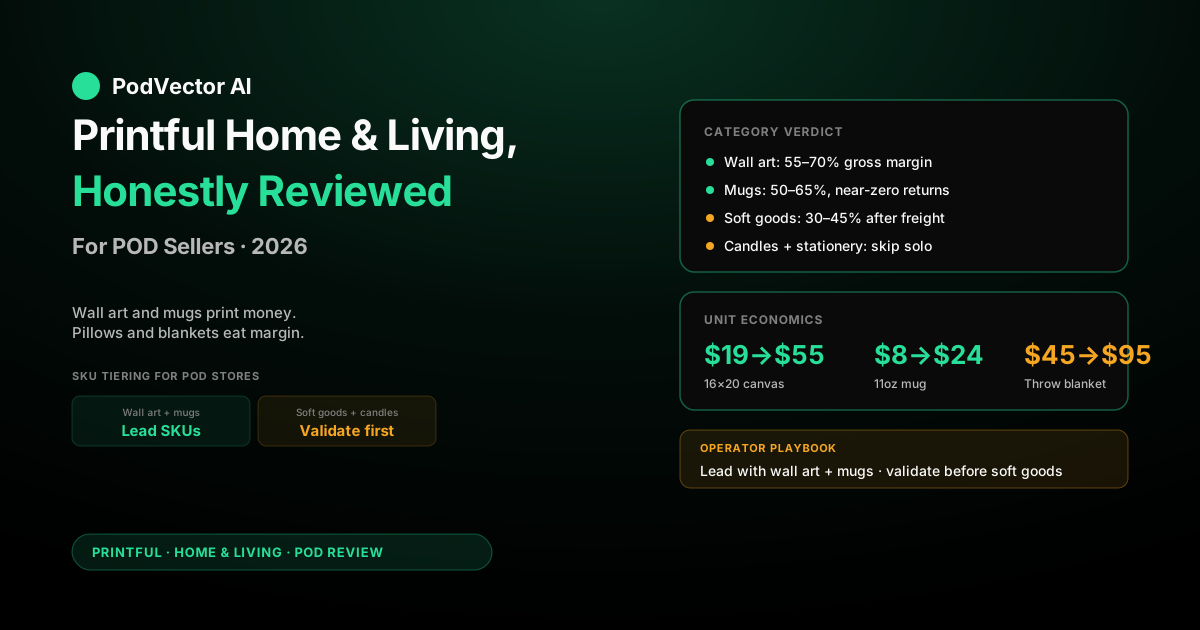
Quick Answer: Printful's home & living catalog is the strongest part of its lineup for margin — canvas prints, posters, and mugs print clean enough to charge $35–$60 retail on a $9–$18 base. That's a 60–75% gross margin window most apparel SKUs can't touch.
The trap inside the category is the soft goods. Blankets and throw pillows have the best photos and the worst unit economics: base costs $25–$55, retail ceilings capped by Wayfair and Amazon, and shipping that eats whatever margin you scraped together.
If you're a POD (print on demand — supplier prints and ships per order) seller adding home goods, lead with wall art and mugs. Add soft goods only after you've validated a buyer who'll pay brand prices, not commodity prices.
What's in Printful's Home & Living Catalog
Printful's home & living section spans wall art, drinkware, soft goods, candles, stationery, kitchen accessories, pet products, and a small bath/beauty assortment. The total SKU count sits around 75 items as of 2026, which is narrow compared to Printify but deep on the items that matter for POD sellers.
The category breaks into four meaningful buckets for margin purposes. Wall art and drinkware sit at the top — low base cost, high perceived value, durable shipping. Soft goods sit in the middle — premium photos, premium freight, thin margins. Candles and stationery sit at the bottom — single-digit margins after fees.
Most operators we've talked to who run a Printful home & living storefront concentrate on the first two buckets and ignore the rest. The data backs the instinct.
Wall Art: Canvas, Posters, Framed Prints
Wall art is Printful's best home & living category by every metric that matters to a POD seller — print quality, margin, return rate, shippability.
Canvas prints come on a 1.25" gallery wrap with a fabric finish that hides print grain well. Edges wrap cleanly. Bases run roughly $14–$32 depending on size (8×8 through 24×36). At $45–$85 retail, that's a 55–70% gross margin window after the base cost alone.
Posters print on semi-gloss 200gsm paper. Color is accurate and saturated; the paper itself feels mid-tier — appropriate for the $15–$35 retail range, not premium enough to justify $50+. Bases sit around $8–$18.
Framed prints add a wood frame to the poster, bumping the base to $22–$48 and the retail target to $55–$95. Frames ship in a much sturdier box, which is why return rates run noticeably lower than naked posters.
The unit economics on wall art are the cleanest in the entire Printful catalog. A 16×20 canvas at $19 base, $55 retail, $9 shipping passed to the customer, and a $1.30 processing fee leaves roughly $26 gross per order — better than most apparel SKUs and with a fraction of the size/color SKU sprawl.
Drinkware: Mugs, Tumblers, Water Bottles
Mugs are Printful's signature home & living item — and the one with the most operator data behind it. They're cheap to make, predictable to ship, and customers don't return them.
The 11oz white ceramic sublimated mug runs about $7.95 base. The 15oz version sits around $10.50. Sublimation gives a glossy, full-wrap print that survives dishwashers and microwaves — the same process most independent mug brands use. Retail $18–$28 is the common range, leaving $8–$15 per unit after base cost.
Tumblers, glass mugs, and travel mugs run $15–$24 base and retail $30–$45. The print is solid but the shipping cost spikes because the items are heavier and more fragile. Net margin lands close to ceramic mugs, just with higher revenue per order.
Water bottles are a weaker category. Bases run $18–$28, prints look fine, but the retail ceiling is held down by Stanley, Owala, and Hydro Flask owning the brand consideration set. Most POD water bottles don't move at the margins Printful needs them to.
Soft Goods: Pillows, Blankets, Towels
Soft goods are where the photos are best and the unit economics are worst. The temptation is real — a printed throw blanket photographs beautifully and reads as a premium gift. The math usually doesn't follow.
Throw pillows come in 14×14 through 22×22 sizes. The cover is a polyester twill that photographs as cotton-linen but feels synthetic on touch. Bases run $16–$28 with the insert. Retail $35–$55 is the realistic ceiling — anything above that and you're competing with cotton-velvet brands at Anthropologie price points.
Blankets are the prettiest item in the catalog and the hardest to make money on. The all-over print fleece blanket runs $35–$58 base depending on size. To clear $20 net margin you're pricing at $85–$120, which puts you in the Wayfair "branded throw" tier where consumers compare hard on price.
Towels are slightly better. Bath towels base at $22–$30, hand towels around $14, and the printing quality on the woven loop holds up through wash. Retail $40–$60 for a printed bath towel works if the design carries.
The honest verdict on soft goods: the photos sell the dream, but the freight cost — most soft goods ship in oversized boxes — eats 30–50% of the spread. Validate the buyer before you scale the SKU.
Candles, Notebooks, Greeting Cards, Pet Products
This tier is mostly worth skipping unless you have a specific reason to add it.
Candles base at $14–$22 for an 8oz scented soy candle. Custom labels print on adhesive sticker stock — not embossed, not foiled. At a $28–$38 retail you're netting $6–$12 per unit, which gets eaten by ad cost in two clicks on cold traffic.
Notebooks and greeting cards base in the $6–$12 range and retail $18–$28. The print quality is fine. The problem is order economics — single-item orders at $20 retail are net negative after card processing, app fees, and customer acquisition cost.
Pet products (bandanas, bowls, beds) are a small subcategory. Bandanas at $14 base print well and bundle nicely with apparel. Pet bowls and beds run $28–$55 base with the same soft-goods shipping problem as throws.
The pattern across this tier is consistent: print quality is acceptable, margins are too thin to absorb modern POD ad costs. These work as upsells inside a larger order, not as standalone listings.
The Margin Picture by Category
Here's how the four buckets shake out at typical retail prices, before shipping subsidies and platform fees:
Wall art: 55–70% gross margin. Lowest return rate. Easiest to ship.
Drinkware (mugs): 50–65% gross margin. Predictable shipping cost. Near-zero quality returns.
Soft goods: 30–45% gross margin after freight. Highest return rate (color expectations vs reality).
Candles, stationery, accessories: 25–40% gross margin. Order economics fail at sub-$30 AOV.
The interesting move for a POD seller isn't picking the best category — it's mixing wall art and drinkware to push average order value (AOV) past $50 before adding any soft good. A $55 canvas plus an $18 mug at $73 AOV runs a much healthier P&L than a $45 throw pillow at $45 AOV.
If you want the full apparel-vs-home-goods cost breakdown, our Printful fees breakdown walks through base costs, subscription tiers, and processing fees across the whole catalog.
Printful vs Printify for Home & Living
The Printful vs Printify comparison plays out differently in home & living than in apparel.
On apparel, Printify's network model gives a 15–25% base-cost advantage on equivalent SKUs because you can pick the cheapest provider. On home & living, that advantage narrows. Many of Printify's home-goods providers are mid-tier sublimation shops with print-quality variance that Printful doesn't have.
For wall art specifically, Printful's in-house gallery wrap quality is more consistent than Printify's distributed network. We've heard from operators running both: Printify's canvas pricing is lower, but the print-to-print color consistency for repeat customers favors Printful.
For mugs, the gap is roughly $1–$3 per unit. At Printful's quality control level, that gap rarely moves the conversion needle on a $24 retail mug — the customer either wants the design or they don't.
For soft goods, Printify's variety is larger (more pillow inserts, more blanket weights), but the same freight-cost problem applies on either platform. The supplier difference doesn't save the category.
The cleanest split: use Printful for wall art and drinkware where consistency matters, use Printify for apparel where price matters. Most successful POD home-goods stores we've seen run both.
Fulfillment, Shipping, and Returns
Printful's home & living fulfillment runs through the same network as apparel — eight fulfillment centers across the US, Mexico, Latvia, Spain, the UK, Australia, and Japan. Production for home goods averages 2–5 business days, with canvas and framed prints leaning to the higher end because of the assembly step.
Shipping is the line item that surprises new home-goods sellers. A 16×20 canvas ships in a 20×24 box at $9–$14 domestic. A throw blanket ships in a box that costs $11–$18 to move domestically. International shipping on either doubles or triples those numbers.
Returns on home goods are lower than apparel — there's no sizing risk and no fit anxiety. The exception is color expectation. Soft goods photograph more saturated than they print, and the resulting "this doesn't look like the photo" returns run 3–6% on pillows and blankets. Wall art and mugs run under 1%.
If you're tracking shipping economics in detail, our Printful shipping breakdown covers the time and cost picture in full.
What to Actually Sell (and What to Skip)
If you're starting a Printful home & living store from scratch in 2026, here's the operator-tested order to add SKUs.
Start with wall art. 16×20 and 18×24 posters, plus an 18×24 framed print version. Add 16×20 canvas once you've validated a design. Wall art is the lowest-friction way to validate that your audience will pay for prints, period.
Add the 11oz mug second. Match your wall art designs onto mugs as a bundle SKU. Average order value jumps and the margin profile stays clean.
Stop there until you have data. Most stores we've seen scale to $50K+/month on wall art + mugs alone. The temptation to add the entire catalog is the most common failure mode.
Add soft goods only after you've validated repeat purchase. If your buyer comes back for a second print, they'll pay $55 for a pillow. If they don't, the pillow is dead weight that ties up product photography time and customer service bandwidth.
Skip candles, notebooks, and accessories unless you're running them as gift-with-purchase or bundled upsells. The unit economics don't survive standalone listings at modern ad costs.
The hardest part of running a home & living POD store isn't choosing products — it's knowing which SKUs are actually paying back ad spend versus which ones look profitable but lose money on freight or returns. That's exactly the gap Victor, our AI employee for POD sellers, was built to close — it connects your store, ad accounts, and Printful order data into one live data warehouse and tells you, by SKU and by channel, what's working and what's bleeding. For Stage 4 operators evaluating their catalog, that's the question that matters.
For a category-wide quality assessment that goes deeper than home & living, see our Printful quality review. If you're evaluating whether to build a Printful-powered storefront at all, the Printful Quick Stores review and the full 2025/2026 Printful review cover the platform context. The Printful reviews hub indexes every category-specific deep-dive, and the Printful topic hub indexes the entire knowledge base.
For an external second opinion with deep methodology, Style Factory's Printful review covers ethics, sustainability, and integrations in more depth than we go into here.
FAQs
What's the best Printful home & living product to start with?
A 16×20 poster or canvas print. Lowest base cost relative to retail, easiest to ship, lowest return rate, and the print quality holds up to scrutiny. Add a matching 11oz mug as the second SKU.
Are Printful blankets worth selling?
Only if your store has a brand premium that supports $85+ retail and your buyer has already bought from you once. Cold-traffic blanket listings at $65–$75 rarely clear ad cost after freight.
How does Printful canvas quality compare to mass retailers?
The 1.25" gallery wrap and color saturation are competitive with Society6 and Minted, and noticeably better than Walmart or Amazon house-brand canvases. The bottleneck isn't quality; it's the base price point relative to the audience's willingness to pay.
Are Printful mugs dishwasher safe?
The ceramic sublimated mugs (11oz and 15oz) are rated dishwasher and microwave safe. Real-world wash durability holds past 40+ cycles in operator-reported data. Tumblers and travel mugs are hand-wash only.
Can I sell Printful home & living products on Etsy?
Yes. Printful integrates directly with Etsy, and home goods (especially wall art and mugs) match the platform's gift-purchase intent well. The catch is Etsy's transaction fees on top of Printful's base cost — model both before pricing.
What's the average production time for home goods on Printful?
2–5 business days. Posters and mugs ship faster (2–3 days typical). Canvas, framed prints, and soft goods sit closer to 4–5 days because of the assembly or sublimation step.
Does Printful or Printify have better home & living products?
Printful for wall art and mugs (consistency wins on repeat-purchase brands). Printify for breadth and lower base costs on soft goods. Most serious operators run both and split SKUs by category.
Know which SKUs actually pay back — across your whole catalog
The Printful home & living catalog hides its winners. A $55 canvas can outperform a $65 throw blanket on net margin even when the blanket sells more units. Most stores never see that picture because Shopify shows revenue, the ad platform shows ROAS, and Printful shows base cost — three different dashboards, three different stories.
Victor, our AI employee for POD sellers, connects your store, ad accounts, and Printful order data into a single live data warehouse and answers the question that matters: which SKUs and which channels actually make you money, by the dollar, this week. And find your real winners.
Try Victor free