
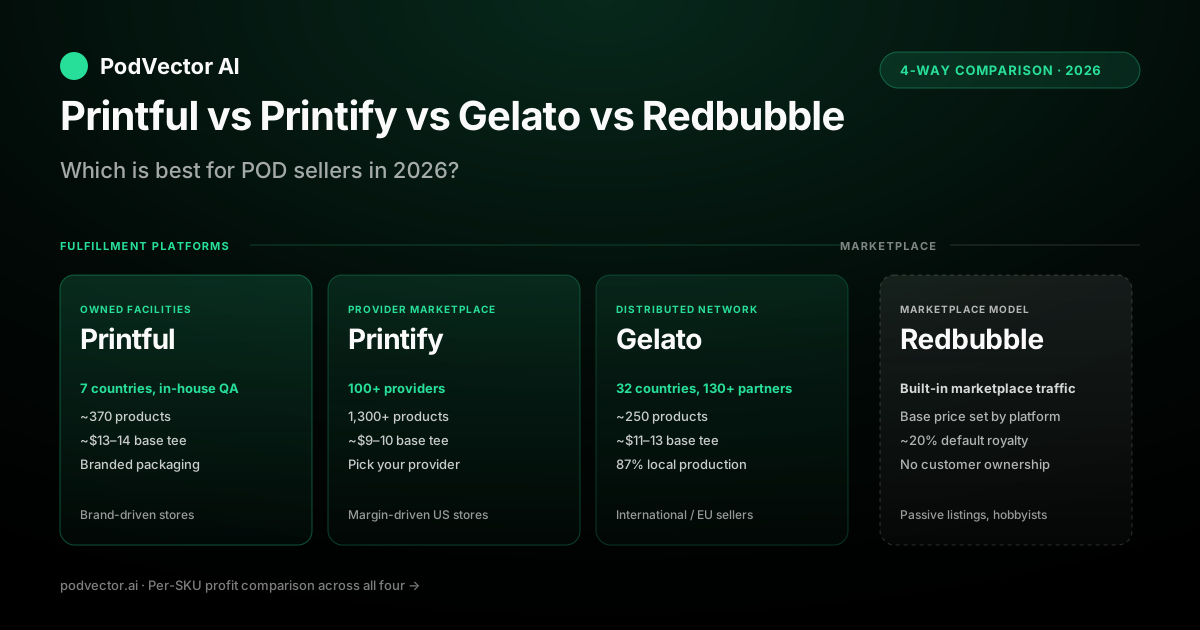
Quick Answer: Three of these are not the same kind of product. Printful, Printify, and Gelato are fulfillment platforms — they print and ship orders that come from your own store. Redbubble is a marketplace — it owns the traffic, sets the base price, and pays you a royalty on each sale.
Pick Printful for owned-facility consistency and branded packaging. Pick Printify for the lowest US base costs and broadest catalog. Pick Gelato for international and EU local production. Pick Redbubble only if you don't want to run a store and you accept a ~20% royalty in exchange for the platform's built-in traffic.
Most serious POD operators in 2026 run a fulfillment platform on Shopify or Etsy and treat Redbubble as a side-channel for passive exposure, not a primary revenue stream.
The 4-way decision in 60 seconds
The question "Printful vs Printify vs Gelato vs Redbubble" hides a category error. The first three are fulfillment platforms that integrate into a store you control. The fourth is a marketplace you list on, like Etsy or Amazon.
That difference changes everything — pricing, margins, branding, traffic, customer ownership. Treating them as four interchangeable options is how operators end up locked into the wrong model for their business goal.
If you want to build a brand, own your customer list, and run paid traffic, you need a fulfillment platform. If you want to upload designs and let a marketplace handle traffic and checkout for a smaller cut per sale, that's Redbubble.
Side-by-side snapshot table
Use this as the orientation. The rest of the article unpacks where each row leaks nuance.
| Dimension | Printful | Printify | Gelato | Redbubble |
|---|---|---|---|---|
| Business model | Fulfillment platform | Fulfillment platform | Fulfillment platform | Marketplace |
| Production | Owned facilities (7 countries) | 100+ third-party providers | 130+ partners, 32 countries | Owned + partner network (managed) |
| Where you list | Your store (Shopify, Etsy, etc.) | Your store | Your store | Redbubble.com only |
| Who sets retail price | You | You | You | You set markup; platform sets base |
| Who owns the customer | You | You | You | Redbubble |
| Monthly fee (free tier) | $0 | $0 | $0 | $0 |
| Premium tier | Growth $24.99/mo | Premium $29/mo | Gelato+ $24/mo | None |
| Base cost (Bella+Canvas 3001 tee, US) | ~$13–14 | ~$9–10 (top providers) | ~$11–13 | Set by Redbubble |
| Typical seller margin | 30–50% | 40–60% | 35–55% | ~20% default royalty |
| Built-in traffic | None | None | None | Yes — marketplace SEO + browse |
| Branded packaging | Yes (mature) | Limited, provider-dependent | On Gelato+ and above | No |
| Best for | Brand-driven stores | Margin-driven US stores | International / EU sellers | Passive listings, hobbyists |
The fundamental split: marketplace vs fulfillment platform
This is the section that should drive your decision before any pricing or shipping math.
Fulfillment platforms (Printful, Printify, Gelato)
You run your own store on Shopify, Etsy, WooCommerce, or similar. You drive traffic — paid ads, SEO, social, email. Customers check out on your store and pay you full retail. Behind the scenes, the order routes to Printful, Printify, or Gelato, who print and ship it under your label.
You set retail prices. You keep everything above base cost plus shipping. You own the customer email and order history. You can remarket, upsell, run lifecycle campaigns, and build a real brand.
The cost is that you have to drive traffic yourself. No one finds your store by browsing Printful.com — Printful has no marketplace surface.
Marketplace (Redbubble)
You upload designs to Redbubble. They handle hosting, product catalog, checkout, fulfillment, customer service, and traffic. Customers find your designs by searching or browsing Redbubble.com, not by finding your individual page.
Redbubble sets the base price per product. You set a markup on top of base — the default is 20%. Redbubble keeps the base and pays you the markup as a royalty.
You don't own the customer. Redbubble does. A buyer who loved your design comes back to Redbubble, not to you, and Redbubble can show them a competing artist's similar design on the next search.
Why the split matters
The two models optimize for opposite outcomes. Fulfillment platforms optimize for the seller building equity in their own brand and customer base. Marketplaces optimize for the platform building equity in its own catalog.
A seller making $10,000 a month on Shopify with Printful has an asset — a customer list, a brand, a store they could sell. A seller making $10,000 a month on Redbubble has a passive royalty stream that disappears the moment Redbubble adjusts its base prices or de-indexes their designs.
Printful — owned facilities, brand-first
Printful runs its own print facilities in the US, Canada, Mexico, Latvia, Spain, the UK, and Australia. Files go to a Printful press, get printed by Printful staff, get QA'd in-house, and ship from a Printful warehouse.
The result is the most consistent quality of the four. Order the same shirt a hundred times across a year, and you get a hundred nearly identical prints.
Where Printful wins
- Brand consistency: single team, single QA process, single source of blanks per facility.
- Branded packaging: the most mature suite in POD — neck labels, inside labels, packing slips, custom boxes, branded tissue, inserts.
- Premium products: embroidered apparel, all-over-print, custom hats — Printful's in-house operation is hard to beat on these.
- Integrations: 20+ ecommerce platforms including Shopify, Etsy, WooCommerce, Wix, BigCommerce, Squarespace, Amazon, eBay, TikTok Shop.
Where Printful loses
- Highest base costs of the fulfillment three — typically $13–14 on a Bella+Canvas 3001 t-shirt, versus $9–10 on Printify's top providers. The detailed per-tier math sits in the Bella+Canvas 3001 Printful cost breakdown.
- Limited geography — buyers outside the 7 facility countries pay international shipping and wait longer.
- Smaller catalog — around 370 products versus Printify's 1,300+.
Best fit
Brand-driven Shopify or Etsy stores in the US and EU where unboxing quality matters and the margin can absorb the higher base cost. Less ideal for high-volume, low-price competitive niches where every dollar of base cost matters.
Printify — provider marketplace, lowest base cost
Printify is a software layer sitting on top of 100+ independent print shops. When you add a product, you choose which provider prints it. Different providers carry different blanks, use different print methods, ship from different locations, and have different base costs.
That's where Printify's pricing edge comes from. You can shop for the cheapest base cost on every SKU. It's also where the quality variance comes from — a $9 t-shirt from a provider you've never used can land beautifully or land badly.
Where Printify wins
- Lowest US base costs — Bella+Canvas 3001 starts around $9 on SwiftPOD or Monster Digital.
- Broadest catalog — 1,300+ products across the marketplace.
- Premium subscription pays back fast — $29/month for 20% off products clears at around $145/month in product spend.
- Etsy popularity — Printify is the default among high-volume Etsy sellers chasing the lowest US base.
Where Printify loses
- Quality variance — picking the right provider per SKU is real operational work, and a bad provider creates refunds you don't see until orders ship.
- Branding gaps — inserts and neck labels are inconsistent across providers; if branded packaging is part of your unboxing, this is a weak spot. Printify Choice (Printify's routed US fulfillment tier, expanded in 2026) adds branded packaging, express shipping, and gift-message options on US orders, but coverage is limited to Choice-eligible SKUs and doesn't fully close the gap with Printful's mature label suite.
- Geography — many top providers are US-only, so EU and APAC orders ship internationally with customs friction.
- Support complexity — production issues sometimes need to route through the underlying provider, which adds resolution time.
Best fit
US-centric Shopify and Etsy stores where margin is the priority and the operator is willing to invest time in provider selection and sample ordering. Less ideal for international sellers or for shops where unboxing is a brand moment.
Gelato — distributed network, international winner
Gelato is neither owned facilities nor a marketplace. It's a software-orchestrated network of vetted local print partners across 32 countries. Each order routes to whichever partner is closest to the buyer's address.
A customer in Germany orders a poster. The file goes to a German printer who produces and ships domestically. Typically arriving in 2–4 days at domestic shipping rates.
Where Gelato wins
- Local production rate — around 87% of orders ship from inside the destination region.
- International shipping — most cross-border sales never actually cross a border in transit, which kills customs friction.
- Wall art and prints — posters, framed prints, canvas, and large-format wall decor are Gelato's strongest category, often 10–20% cheaper than competitors when produced locally.
- EU and UK coverage — local production in Germany, France, Spain, the Netherlands, the UK, Italy, Poland, and Scandinavia.
Where Gelato loses
- Smaller catalog — around 250 products, focused on globally-printable items.
- Less provider control — Gelato's routing engine picks the partner; you can't say "always print my orders at Provider X."
- Cross-region consistency — a poster printed in Germany may feel slightly different from the same poster printed in the US.
- Newer integrations — Shopify and Etsy work well, but advanced flows are still maturing versus Printful's deeper integrations.
Best fit
International sellers, EU-based stores, wall-art and home-decor brands, and operators expanding into multiple regions without wanting to manage cross-border shipping logistics.
Redbubble — marketplace with built-in traffic
Redbubble is a marketplace, not a fulfillment partner you plug into a store. You upload designs to Redbubble.com. Redbubble lists them across its product catalog — t-shirts, stickers, mugs, posters, phone cases, and more. Buyers find designs by searching or browsing.
You set a markup on top of Redbubble's base price. The default is 20%. Redbubble keeps the base, pays you the markup as a royalty, and handles everything else — production, customer service, returns, taxes, traffic.
Where Redbubble wins
- Built-in traffic — Redbubble has marketplace SEO, browse traffic, and search demand you don't have to generate yourself.
- Zero operational overhead — no store to run, no ads to manage, no customer support to handle, no inventory or shipping logistics.
- Wide catalog auto-generated — upload one design, Redbubble lists it across 60+ products automatically.
- Passive income for hobbyist designers — designs uploaded once can earn for years.
Where Redbubble loses
- ~20% royalty cap — the default markup is far below what a direct-store seller takes home on Printful, Printify, or Gelato.
- Seller tiers and account fees — Redbubble now sorts sellers into performance tiers, and accounts in the lower Standard tier can face an account/service fee that eats into already-thin royalties. Your effective take-home is the markup minus whatever tier fee applies, not the headline 20%.
- No customer ownership — buyers belong to Redbubble. No remarketing, no email list, no lifecycle.
- Race-to-the-bottom search — your design competes against millions of others on the same search term inside Redbubble.
- Platform dependency — Redbubble can adjust base prices, change discoverability rules, or de-index designs unilaterally. Sellers have seen royalty income drop 50%+ overnight when the platform changes its algorithm.
- No brand equity — you cannot build a real brand on Redbubble. The "store" is a Redbubble subdirectory the buyer barely notices.
Best fit
Designers who want passive royalty income without running a business, hobbyists testing whether a design has demand, or established brands using Redbubble as a side-channel for incremental exposure. Not a primary revenue path for anyone trying to build a real ecommerce operation in 2026.
Who wins on base cost
On core apparel in the US, Printify wins on base cost. A Bella+Canvas 3001 from SwiftPOD or Monster Digital runs around $9, versus $11–13 on Gelato and $13–14 on Printful.
On wall art and posters shipping to EU buyers, Gelato wins. Local production cuts both base and shipping, and Gelato's poster pricing is often 10–20% below Printful and Printify when produced inside the destination region.
On premium products — embroidered apparel, all-over-print, custom hats — Printful is competitive despite higher sticker base, because the in-house operation produces consistent results that don't show up in the base cost comparison.
Redbubble doesn't compete on base cost because you don't pay base — you take a royalty. The 20% royalty is the real number to compare, not Redbubble's listed retail price.
Who wins on shipping speed
Inside the US, all three fulfillment platforms ship in 2–5 production days plus 2–5 shipping days. There's no clear US winner on speed — pick on base cost or branding.
Inside the EU and UK, Gelato wins decisively. Local production means most orders ship domestically and arrive in 4–6 days end to end. Printful is competitive thanks to Latvia and Spain hubs but lags Gelato on Scandinavia and Eastern Europe. Printify's EU speed depends entirely on which provider you picked.
In APAC, Gelato is usually the only viable option. Australia, Japan, and Singapore have local Gelato partners. Printful has Australia. Printify is thin across APAC.
Redbubble's shipping speed varies by product and fulfillment region. It's typically slower than a well-tuned Printful or Gelato setup because you have no control over routing — Redbubble decides.
Who wins on take-home margin
This is the comparison most operators want and rarely get cleanly.
A $25 retail t-shirt on Shopify with Printful, base $13, shipping $4.50, after Shopify fees: roughly $5–6 take-home, or 20–24% margin. On Printify, same retail, base $9, shipping $4.50, after fees: roughly $9–10 take-home, or 36–40% margin. On Gelato (US), comparable to Printful with a small edge: roughly $6–7 take-home, or 24–28% margin.
That same $25 t-shirt on Redbubble: Redbubble sets the base at around $19, you set a 20% markup making retail $22.80, your royalty is around $3.80, or 17% — and if your account sits in Redbubble's lower Standard tier, a service fee trims that further. That's before considering that Redbubble's catalog is browsed against millions of competing designs at the same retail price.
On dollar-per-sale, Printify usually wins in the US. On dollar-per-sale net of ad cost, the answer flips depending on whether your traffic is paid or organic. Operators running Meta or Google Ads at $5+ customer acquisition cost (CAC) need every dollar of base savings Printify offers. Operators running organic Etsy or Pinterest traffic can absorb the higher Printful base for the brand consistency benefit.
The honest answer: margin depends on your full unit economics, not on base cost alone. Cost-of-goods, shipping, ad cost, refund rate, repeat rate, and platform fees all stack into the real number.
Who wins on traffic and discoverability
Redbubble is the only one of the four that brings traffic. Printful, Printify, and Gelato are silent on traffic — they fulfill orders you generate yourself.
Redbubble's traffic advantage looks great on paper. In practice, it's heavily diluted by competition. Search "vintage cat t-shirt" on Redbubble and you'll see thousands of competing designs at similar price points. Your design's chance of being clicked depends on Redbubble's internal ranking algorithm, which you don't control.
On a direct-store model with a fulfillment platform, you control traffic acquisition entirely. The cost is real — Meta ads, Google ads, SEO, content, email — but the upside is uncapped. A direct store with strong organic traffic can build a $1M+ revenue brand. A Redbubble store almost never does, because the royalty math caps total earnings.
Pick X if Y
Apply these in order. The first match is your answer.
- Pick Redbubble if you are not willing to run a store, drive traffic, or handle customer service. Accept the ~20% royalty cap as the cost of zero operational overhead.
- Pick Gelato if more than 30% of your sales ship to EU, UK, or APAC buyers. Local production wins on shipping cost, speed, and customs.
- Pick Printful if your store is brand-driven, your customer cares about unboxing, and you sell embroidered apparel, all-over-print, or custom hats.
- Pick Printify if you sell US-centric, high-volume, price-competitive apparel and you're willing to do provider selection and sample ordering as part of your operating cadence.
- Pick more than one if your catalog spans multiple categories or geographies — which is the right call for most operators above $5K/month. See the next section.
Running two or more at the same time
Most operators above $5K/month run two fulfillment platforms in parallel. The combination depends on your catalog.
Common stacks:
- Printful + Printify: Printful for branded apparel and embroidery, Printify for high-volume basics where base cost dominates margin. See the Printful vs Printify head-to-head for the per-category breakdown.
- Printful + Gelato: Printful for US-centric apparel, Gelato for international shipping and wall art.
- Printify + Gelato: Printify for cheap US apparel, Gelato for everything that ships outside the US.
- Printful only: for brand-driven stores where consistency outweighs base-cost savings. See the Printful vs Printify reviews comparison for buyer-side data on consistency.
For a structured 3-way comparison without Redbubble, the analysis in Printful vs Gelato vs Printify covers when each pair makes sense as a primary plus secondary stack.
Most Shopify themes and Etsy listing flows support multiple fulfillment partners per store. You assign a fulfillment partner per SKU or per product in the backend. The customer sees nothing — to them, it's one store with one checkout.
Redbubble does not stack well with a fulfillment platform model. They're different businesses. The closest viable combination is "primary direct store + Redbubble side-channel for exposure," but the operational overhead of maintaining Redbubble listings rarely pays back versus pointing the same energy at SEO or paid ads on the direct store.
The profit math nobody talks about
Every comparison article on this topic compares the four on base cost, shipping, branding, and catalog. None of them compare what actually matters: profit per order net of all costs across your catalog.
A Printify t-shirt at $9 base looks cheaper than a Printful t-shirt at $13. But if Printify's refund rate on that SKU runs 4% versus Printful's 1.5%, and shipping is $1 higher on Printify because the provider you picked is in a different state from your average buyer, the Printful tee is more profitable per order on net.
The same logic plays out for Gelato versus Printful in the EU. Gelato's local production is cheaper in transit but pricier on base for some SKUs. The right answer depends on which products you sell, where your buyers live, and which refund and replacement rates each supplier actually delivers — not the platforms' marketing pages.
That's the analysis most operators skip because pulling Shopify orders, Printify charges, Printful charges, and Gelato charges into one P&L is real work. The platforms don't volunteer that data in a comparable format.
A POD operating agent closes that gap by working your actual data — Shopify orders, supplier invoices, ad spend — and telling you which supplier to route each SKU to for the most profit per order, then flagging the ones bleeding margin so you can move them. That's the decision the article above can't make for you, because it depends on your catalog, your geography, and your traffic mix.
Related comparisons
For the broader Printful comparison surface, see the full Printful comparison cluster for head-to-head matchups against every major POD platform. For the topic-level overview of Printful versus alternatives, the Printful topic hub aggregates costs, integrations, and supplier guides.
Pricing-specific questions sit in does Printful cost money, which unpacks Printful's free-tier mechanics and where charges actually appear. The Listybox writeup on Printify vs Printful vs Gelato in 2026 covers a similar three-way analysis from an Etsy-seller angle.
FAQs
Is Redbubble really worse than Printful, Printify, or Gelato for serious sellers?
Yes, on every dimension except operational overhead. Redbubble caps your margin at the markup you can charge on top of their base — typically 20%. A direct store on Shopify with Printful or Printify lets you keep 30–60% per order. Over a year on the same design volume, the direct-store model usually earns 2–4x what Redbubble does, because uncapped retail pricing and remarketing compound.
Can I sell on Redbubble and Etsy at the same time?
Yes. Many designers do, because the upload overhead per platform is low and exposure compounds across channels. The catch is that the same design listed on multiple marketplaces can rank for the same keywords against itself, and customers price-compare. Set Redbubble's markup so retail is similar to or higher than your Etsy listing — never undercut your direct channel.
Which is best for beginners: Printful, Printify, Gelato, or Redbubble?
Redbubble is the easiest to start with because there's no store to build, but it teaches you the least about running a real ecommerce operation. If your goal is to learn POD as a business, start with Printful or Printify on Etsy. The learning curve is steeper, but the skills transfer to anything you build next. For pure design upload without business operations, Redbubble is the lower-friction starting point.
Can I use Printful, Printify, and Gelato together?
Yes, and most operators above $5K/month do. You assign a fulfillment partner per SKU or per product in your Shopify or Etsy backend. The customer sees one store with one checkout. The complexity is mostly in your own operations — tracking three sets of supplier costs and SLAs — not in the customer experience.
Which is cheapest on a Bella+Canvas 3001 t-shirt in 2026?
Printify is cheapest on base — around $9 on top providers like SwiftPOD or Monster Digital. Gelato runs $11–13. Printful runs $13–14. But cheapest on base isn't the same as most profitable per order — refund rate, shipping cost to your average buyer's zip code, and branded-packaging upcharge can flip the math.
Does any of these handle international VAT and customs cleanly?
Gelato handles it best because local production avoids customs for most international orders. Printful handles DDP (delivered duty paid) on most EU routes from its Latvia and Spain facilities. Printify's customs handling varies by provider — some include DDP, some don't, which means surprise customs fees on delivery are possible. Redbubble handles customs and VAT directly as the merchant of record.
Is Printful actually higher quality than Printify?
On average, yes — Printful's owned-facility model produces more consistent quality than the variance you get across Printify's marketplace. Top Printify providers (SwiftPOD, Monster Digital, Duplium) match Printful on quality. Lower-tier Printify providers don't. The seller's job on Printify is provider selection — sample-test before going live and stay on the top-tier shortlist.
What happens if a Printify provider goes out of stock or shuts down?
Printify lets you switch to a different provider for the same product without rebuilding the listing. You re-route the SKU to a new provider, and new orders flow to them. Existing in-flight orders complete with the original provider. The risk is real but manageable — most experienced Printify sellers keep a second-choice provider mapped per top SKU.
Stop guessing which supplier is cheapest. Ask which is most profitable on your actual catalog.
Base cost is one input. Refund rate, shipping zone, branded-packaging upcharge, and ad cost stack on top — and they decide which supplier actually pays you more per order. Victor is the POD operating agent that works your Shopify orders and your Printful, Printify, and Gelato costs together, then answers the question this article can't: which supplier is most profitable on each SKU you sell — and routes the ones losing money to a better one.
Try Victor free