
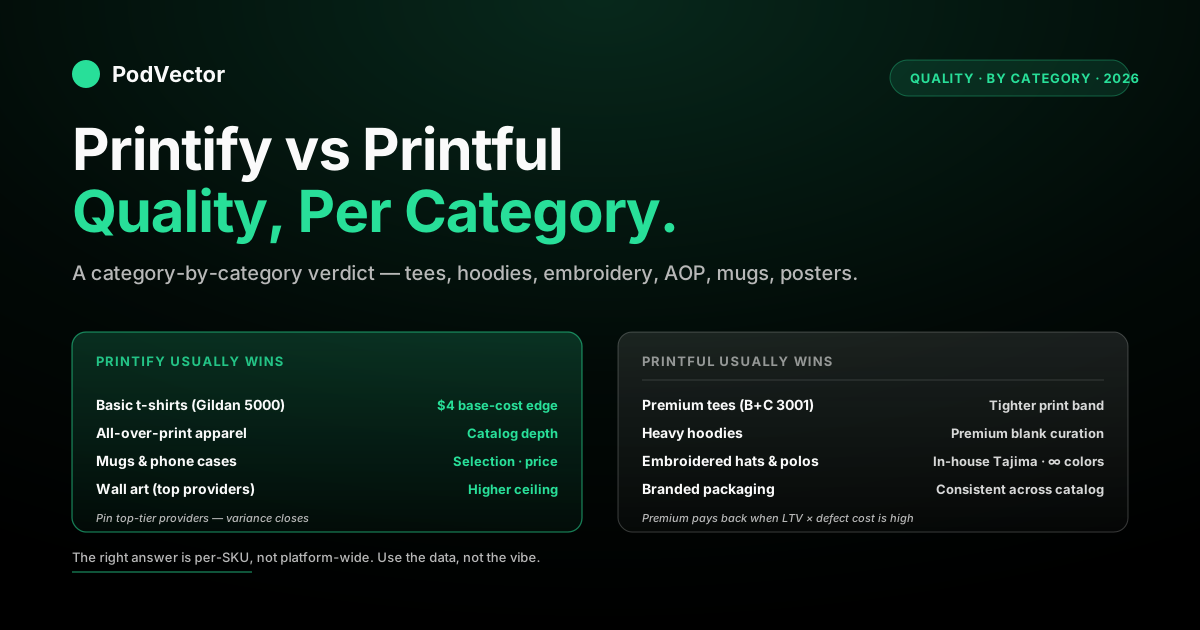
Quick Answer: Printful's average quality is higher because every order goes through the same in-house printers and the same quality team. Printify's quality depends on which provider routed the order — top-tier providers (Monster Digital, SwiftPOD, Dimona Tee) match Printful, while lower-tier ones drag the average down.
The category-by-category truth: Printify usually wins on basic front-print tees, mugs, and all-over-print. Printful usually wins on premium tees, heavy hoodies, embroidered hats, and branded packaging. The "winner" is a per-SKU answer, not a platform answer.
Below: the quality verdict for every major POD product category, the defect-cost math that turns the question into a margin number, and the data layer most POD sellers don't have but need to make the call.
The real quality question for POD sellers
Most "Printify vs Printful quality" comparisons stop at "Printful is more consistent because it's in-house." That's true on average, but it doesn't help you make a per-product decision.
POD operators don't ship a generic platform. You ship specific SKUs — a Bella+Canvas 3001 in heather grey, a Gildan 18500 hoodie in navy, an 11oz ceramic mug, a 18×24 matte poster. Quality varies by category, sometimes dramatically.
The right question isn't "which platform has better quality." It's "which platform produces the higher-quality version of this specific SKU at the price I'm paying?"
One thing to keep in mind before the category breakdown: the gap has narrowed over the last two years. Printify's top providers have tightened their print calibration, and the platform now surfaces provider quality ratings and "Printify Choice" recommendations that make pinning a strong supplier easier than it used to be. The "Printful is just better" verdict from older reviews is increasingly a per-SKU question, not a blanket one.
The answer flips category by category. Below is the breakdown — what to expect on each major POD product, why the platforms diverge, and what to test before you commit.
Basic t-shirts (Gildan 5000, similar)
Winner: Printify, usually.
The Gildan 5000 is the workhorse blank of low-cost POD. Both platforms source it from the same Gildan wholesale channel, so the garment itself is identical.
The difference is the print. Top-tier Printify providers running calibrated DTG (direct-to-garment, the standard print process for cotton apparel) produce results visually indistinguishable from Printful on a basic front-print Gildan tee.
Printify's base cost on a Gildan 5000 typically runs $4–5 lower than Printful's equivalent — and that holds even after Printful's 2026 round of price cuts (6–9% on many blanks), which narrowed but didn't close the gap. On a $25 retail tee that's a meaningful margin lift — usually larger than the cost of any quality variance you might see.
The catch: this only holds if you pin the product to a top-tier provider. Default routing can land you with a weaker supplier and inconsistent results. Pin Monster Digital, SwiftPOD, or Dimona Tee for US fulfillment and the quality holds steady.
For sellers running price-led basic tees as a volume product, Printify's category margin advantage is hard to beat.
Premium tees (Bella+Canvas 3001, Stanley & Stella)
Winner: Slight edge to Printful.
Both platforms stock Bella+Canvas 3001, the most popular premium POD tee. The blank is the same. The print process is where the gap shows.
Premium tees have a softer hand and tighter weave, which means the print sits more visibly on the surface. Color saturation, white underbase weight, and edge crispness are easier to spot than on a basic Gildan.
Printful's standardized Kornit-class equipment produces a tight, consistent print across orders. Printify's top providers match this on a per-order basis but show more variance order-to-order, especially across regions.
The price gap is smaller on premium blanks (around $1.50–$3 per tee), so the margin defense for going Printify is weaker. If you're selling a $30+ premium tee where the customer is paying for the feel and finish, Printful's consistency is worth the smaller premium.
If you're running both platforms, the same logic shows up in the broader cost question — see our Printful vs Printify cost breakdown for the dollar-by-dollar version.
Hoodies and sweatshirts
Winner: Printful, on premium blanks.
Hoodies are where Printful's quality reputation pays off most reliably. The category has more variables than tees: blank weight, fleece quality, drawstring construction, hood lining, pocket attachment, and the print itself sitting on a heavier fabric.
Printful's premium hoodie catalog (Independent Trading SS4500, Champion S700, AS Colour Stencil) is curated and consistent. The same blanks ship from the same facilities with the same quality standards.
Printify offers a much wider hoodie catalog including the same premium SKUs plus dozens of lower-priced alternatives. Quality on the premium SKUs from top providers matches Printful. Quality on the lower-priced alternatives can fall well short — thinner fleece, looser stitching, less consistent dye lots.
If you're selling a $55+ premium hoodie where the unboxing experience and garment feel drive the brand perception, Printful's narrower catalog is a feature, not a bug.
If you're testing 10 hoodie variants at lower price points, Printify's catalog depth gives you the room — but the quality risk per SKU is higher and you have to test each provider individually.
Embroidered hats, polos, jackets
Winner: Printful, by a clear margin.
Embroidery is the dimension where Printful's vertical integration shows up most visibly. They run industrial Tajima embroidery machines in-house with a calibrated stitch density, a standardized thread library, and centralized quality control.
The result is tight, dense logos with consistent registration across orders. Printful also offers unlimited embroidery colors, where Printify caps embroidery at 14 thread colors total and 6 per design.
Printify routes embroidery to specific providers, and quality varies. Top embroidery providers (MyLocker, Drive Fulfillment) produce work that compares well with Printful. Lower-tier providers can show looser stitches, color drift, registration issues on small logos, or thread breaks visible on the back of the garment.
If embroidered hats or polos are a hero product line, Printful is the safer default. If you need a specific niche embroidered SKU Printful doesn't carry, pin a top-tier Printify provider and order multiple samples before committing — embroidery quality drift is harder to spot from photos than DTG drift. Worth noting when you sample: Printful discounts samples (20% off, up to three products a month), while Printify charges standard base cost — a small but real factor when you're testing several SKUs side by side.
All-over-print apparel
Winner: Printify, by default.
All-over-print (AOP) — sublimation printing across the full surface of a garment — is one of the few categories where Printful's catalog is the limiting factor. Printful offers AOP on a small subset of products: a few tees, a hoodie or two, leggings, swimsuits.
Printify supports AOP across dozens of product types through specialized providers. The top AOP providers (Subliminator, MWW On Demand, ArtsAdd) have built their entire operation around sublimation and produce excellent results on the categories they specialize in.
If your store sells AOP as a category — leggings, swim, joggers, dresses, hoodies with custom panel prints — Printify is effectively the only platform with the catalog depth to support a real product line.
The quality on top AOP providers is competitive with anything else in the industry. The variance comes from picking the wrong provider, not from sublimation itself being a weaker process.
Mugs, ceramics, drinkware
Winner: Mixed — Printify usually wins on price, Printful on consistency.
Mug quality has two components: the blank ceramic itself and the print process (sublimation transfer, baked into the mug's coating). Both platforms source from similar wholesale channels for the most common SKUs (the standard 11oz and 15oz mugs).
Printful runs mug printing in-house with consistent results: white interior, sharp print, durable coating that survives dishwashers reasonably well.
Printify's mug providers vary more. Some are excellent — the print is sharp, the coating is dishwasher-safe, the blank is heavy ceramic. Some are weaker — coating that scratches, prints that fade after a few washes, lighter ceramic that feels cheap.
The blank-cost gap on mugs is smaller (around $1–$2), so the margin defense for Printify is thinner. The right move is to test two or three Printify mug providers, pick the strongest, and accept slightly higher base cost in exchange for predictable quality. If you can't be bothered, default to Printful for this category.
Posters, canvases, wall art
Winner: Mixed — provider choice dominates platform.
Wall art is a print quality category that depends almost entirely on the printer (the machine), the paper or canvas weight, and the post-production handling.
Printful runs wall art printing in-house with calibrated wide-format printers and consistent paper stocks. The output is reliable: good color accuracy, decent paper weight, careful packing for shipping.
Printify's poster and canvas providers vary widely. Top providers (Sensaria, Prodigi-equivalent) produce gallery-quality output. Lower-tier providers can ship lighter paper, show color drift, or pack poorly enough that posters arrive creased.
The quality ceiling on Printify wall art (with the right provider) exceeds what Printful offers, because specialized print providers invest in better wide-format equipment than Printful's general-purpose facilities. The floor is also lower.
If wall art is your hero category, Printify with a pinned top-tier provider is the higher-quality choice. If wall art is a side category, Printful's "good enough on average" output saves the testing time.
Phone cases and tech accessories
Winner: Printify, on selection. Quality is comparable on top providers.
Both platforms offer phone cases through UV printing (the standard process for hard plastic and TPU cases). Printful's case catalog is narrower, focused on iPhone and a handful of Samsung models with consistent quality.
Printify offers cases through providers like Case Escape and ArtsAdd, with much wider device coverage including older models, Pixel, and accessory categories Printful doesn't carry (popsockets, AirPods cases, MagSafe accessories).
Print quality on top Printify case providers matches Printful. The variance, again, comes from default routing landing you on a weaker supplier. Pin Case Escape for the major iPhone SKUs and the quality holds.
If your case product line spans 20+ device models or includes accessory categories, Printify is the only platform with the coverage. If you're selling iPhone cases only and want the simplest path, Printful works.
Packaging and unboxing quality
Winner: Printful, decisively.
Packaging is the part of "POD quality" your customer experiences first — before they even unfold the garment.
Printful offers branded packaging across the catalog: custom packing slips with your logo, branded tear-out neck labels (DTG-printed and embroidered options), pack-in stickers, and premium polybag inserts. The package looks like it came from your brand, not a fulfillment center.
Printify's branded packaging is provider-dependent. Some providers offer custom inserts and neck labels; others don't. What works on a Monster Digital tee may not work on a SwiftPOD tee, even within the same Printify account.
If your business model includes premium unboxing — gift items, subscription boxes, brand-led DTC — Printful's packaging consistency alone can justify the higher base cost.
If your customer judges quality by the product itself and ignores the bag, the gap doesn't move your refund rate. The deeper question of whether Printful's premium tier pays back at your volume runs through the membership math — see our Printful membership pricing breakdown and Printful Plus membership price analysis for the per-volume verdict.
Turning the quality gap into a margin number
Quality differences only matter as money. A higher defect rate costs you in replacement orders, refunded shipping, processing fees, ad spend that didn't convert, and the customer-acquisition cost of every unhappy reorder you have to win back.
Here's the simple model. For a $25 tee with a $10 base cost and $7 fulfillment shipping:
- Defect rate × replacement cost = quality variance cost per order
- Replacement cost ≈ $10 base + $7 shipping + $1.50 processing + $2 ad spend already attributed = ~$20.50 per replacement
If Printful's published return rate sits around 0.20% and Printify's effective defect rate (averaged across providers when you don't pin top-tier) runs around 1.0%, that's a 0.80 percentage-point gap. On 1,000 orders, that's 8 extra defects costing 8 × $20.50 = $164 of quality variance per 1,000 orders.
Printify's base-cost savings on those same 1,000 orders run roughly $4 × 1,000 = $4,000 at the typical Bella+Canvas 3001 list-price gap.
$4,000 minus $164 leaves $3,836 of net advantage to Printify even at a five-times-higher defect rate. The margin math doesn't favor Printful unless your defect rate gap is much wider, your replacement cost is much higher (premium niches, custom packaging, expensive ad spend), or your customer LTV is materially affected by every defect.
That's the math. The quality story isn't binary — it's a number that has to clear a bar. The bar depends on your store, not on the platform.
The per-SKU truth most comparisons skip
Every "Printify vs Printful quality" comparison ends with a verdict like "Printful is more consistent, Printify is cheaper." That's the right starting point. It's also where most analyses stop.
The truthful version, after you ship volume, is per-SKU. Some products are more profitable on Printify with acceptable quality. Some are more profitable on Printful with premium quality. The mix changes as Printify rotates providers, as Printful adjusts pricing, and as your customer base shifts.
To answer the question correctly you need: real base cost per SKU per supplier, real fulfillment shipping per region, defect rate per SKU per supplier, replacement cost per defect, ad spend per SKU, and refund-attribution drag per SKU. Refreshed monthly, because supplier pricing and provider routing both move.
Most POD operators don't have this layer. They have an export from Shopify, a CSV from Printify, a CSV from Printful, a Meta ad-spend dashboard, and a gut feeling about which supplier is "better."
This is exactly the gap Victor closes for PodVector AI users. Victor is an AI employee connected to your store, ad accounts, and POD suppliers through a unified data warehouse — meaning all the cost, sales, and fulfillment data lives in one queryable layer, with margin math computed against your real numbers.
You can ask "which supplier had the lowest effective margin after refunds on my hoodies in the last 60 days?" or "is Printful's premium paying back on my embroidered hat line?" in plain English. The answer comes back with real margins and per-SKU breakdowns, not list prices and averages.
Victor answers the question. The roadmap is acting on it — flagging SKUs that should switch suppliers, simulating the margin lift before you swap, and routing future production toward the supplier the data favors.
Decision matrix — which to pick by store profile
The framing that works in practice isn't "Printify or Printful." It's "which goes where in my catalog."
Use Printify when:
- You're running price-led basic tees, mugs, or AOP at volume
- Your catalog spans 20+ SKUs and you need depth Printful doesn't offer
- You're selling globally and want regional fulfillment routing
- Your customer is judging the garment, not the unboxing
- You're willing to pin every hero product to a specific top-tier provider
Use Printful when:
- You're selling premium tees, heavy hoodies, or embroidered apparel as hero SKUs
- Branded packaging and unboxing are part of the product
- Your customer LTV is high enough that a single bad print costs you future revenue
- You can't tolerate operational overhead — provider testing, pinning, re-testing every 6 months
- Your catalog is narrow (5–15 hero SKUs) and the higher base cost is absorbable on a focused list
Use both, mixed by SKU, when:
- You have a real catalog with mixed product types and price points
- You can pull per-SKU margin data and let the numbers route the decision
- You're optimizing for blended margin, not platform loyalty
The "correct" answer for most operations with more than 10 SKUs is the third option. The reason most sellers don't use it isn't that it's wrong — it's that it requires a data layer most don't have.
For two more angles into the same matchup, our Printful vs Printify difference breakdown covers the structural distinctions, and the multi-dimension differences article goes deeper on workflow and integration mechanics. The Printful comparison hub covers every alternative in the category, and the Printful topic hub is the entry point for everything Printful.
For an outside read on the same matchup with their own quality observations, Printful's own comparison page documents their in-house production claims in detail.
FAQs
Which has better quality, Printify or Printful?
Printful, on average. Their in-house production model produces a tighter quality distribution and a published return rate of around 0.19–0.24%. Printify's quality varies by provider — top-tier providers (Monster Digital, SwiftPOD, Dimona Tee) match Printful, while lower-tier providers fall below.
The category-by-category answer is more useful: Printify usually wins on basic tees, mugs, AOP, and case selection. Printful wins on premium tees, heavy hoodies, embroidery, and packaging.
Why is Printify quality inconsistent?
Printify uses a marketplace of 90+ third-party providers running different print equipment, color profiles, and quality standards. By default, orders route to the best-available provider in the customer's region — which can mean a different supplier ships your first order versus your second order of the same product.
The fix is to pin every hero product to a specific top-tier provider in Printify's settings. That eliminates most of the variance the "inconsistent Printify" reviews complain about.
Does Printify use the same blanks as Printful?
For most popular SKUs, yes. Both platforms source Bella+Canvas, Gildan, Stanley & Stella, Champion, and AS Colour from the same wholesale channels. A Bella+Canvas 3001 tee is the same garment regardless of platform.
The difference shows up in the print, the packaging, and the quality control — not the blank itself. Always match blanks SKU-for-SKU when comparing quality.
Is Printful's quality worth the higher price?
Depends on your defect rate, replacement cost, and customer LTV. Run the math: defect rate × replacement cost × order volume gives you the dollar swing of higher quality. Compare it to the base-cost savings of going with Printify.
For most front-print tee operations, Printify's base-cost advantage wins the math even at a five-times-higher defect rate. For premium hoodies, embroidered hats, or branded unboxing experiences, Printful's premium can pay for itself.
Which platform has better embroidery quality?
Printful, on average. Their in-house industrial Tajima embroidery machines and standardized thread library produce a tight, consistent stitch across all orders, with unlimited embroidery colors.
Printify's embroidery quality is provider-dependent and capped at 14 thread colors total. Top providers (MyLocker, Drive Fulfillment) match Printful. Lower-tier embroidery can show stitch variance, registration drift, or color issues on small logos.
Which is better for all-over-print products?
Printify, by a clear margin. Printful only offers AOP on a narrow subset of products. Printify supports AOP across dozens of product types through specialized providers (Subliminator, MWW On Demand, ArtsAdd) that have built their operations around sublimation.
If AOP is a category in your store, Printify is effectively the only platform with the catalog depth to support it.
How do I know which platform is more profitable for my catalog?
Look at real per-SKU margins, not list prices. Pull base cost, real fulfillment shipping, ad spend, defect-driven replacements, and refunds per SKU per supplier — refreshed monthly.
PodVector AI's Victor agent does this automatically by reading your live store, ad, and supplier data and answering plain-English questions like "which supplier is most profitable on my Bella+Canvas tees after refunds in the last 60 days?"
Stop guessing on POD quality. Ask Victor.
Printify's quality is a number you can measure. Printful's premium is a number you can compare it to. Both numbers depend on your real defect rate, replacement cost, ad spend, and refunds — not on a blog post's averages.
Victor connects to your store, ad accounts, and POD suppliers, builds a unified data warehouse, and lets you ask the question in plain English: which supplier is most profitable on my hoodies after refunds in the last 60 days?
Try Victor free