
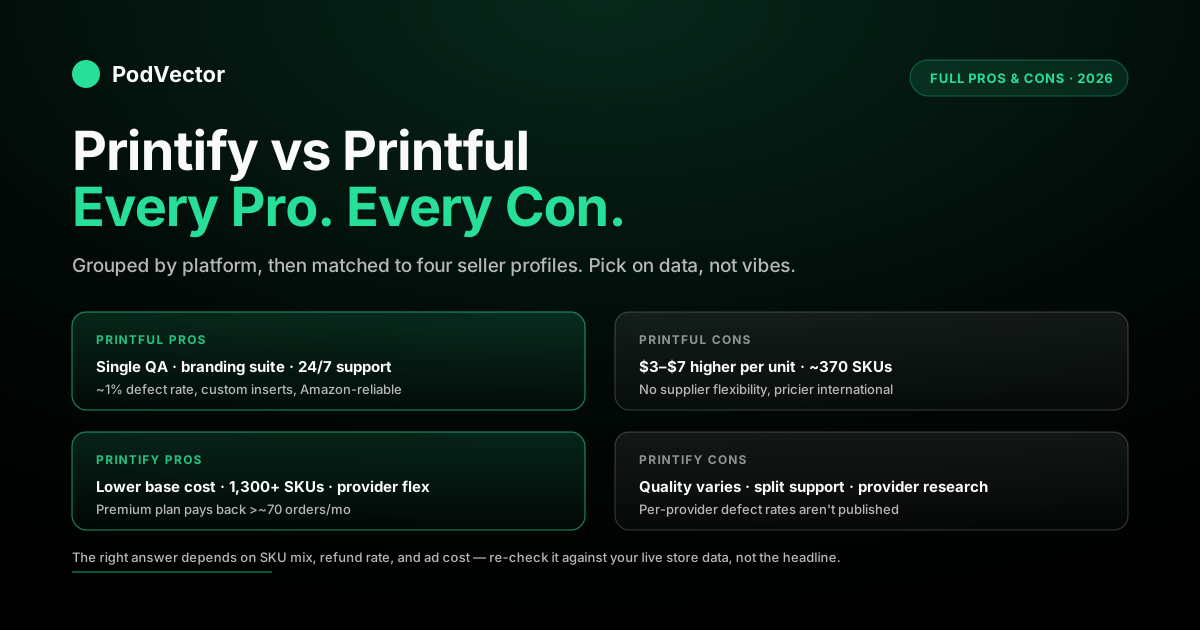
Quick Answer: Printful's biggest pros are quality consistency, branding control, and a single fulfillment SLA. Its biggest cons are higher base costs and a smaller catalog. Printify's biggest pros are low base costs, a 1,300+ product catalog, and provider flexibility. Its biggest cons are uneven quality across providers and shipping speed that depends on which provider you pick.
For most POD sellers, the choice comes down to two questions. Are your unit economics tight enough that a $3–$7 per-unit base-cost gap moves your store's profitability? And do you have the time to vet print providers, or do you need a single QA standard out of the box?
Below: every pro and con of each platform, grouped by platform (not by category), plus a decision matrix to match your seller profile to the right answer.
At-a-glance summary
Printful is the in-house, premium-priced option. They own the facilities, the QA team, and the shipping policy. The catalog is about 340–380 SKUs, prices are higher, and quality is consistent.
Printify is the marketplace option. You design once and pick from a network of roughly 100+ independent print providers across a dozen countries, competing on price, location, and product category. The catalog runs past 1,300 SKUs, base costs are lower, and quality depends on which provider you pick.
Both platforms announced a merger in late 2024, but as of July 2026 they still operate as separate brands with separate catalogs, separate pricing, and separate accounts. Treat them as two distinct choices.
Printful pros — all of them
1. Consistent print quality across every order
Printful's defect rate sits around 1% across in-house facilities, and some premium SKUs report under 0.5% (numbers consistent with operator-led reviews like the Merch Titans 2026 comparison). A single QA team enforces a single standard across products and regions.
Color reproduction stays consistent across runs. A batch of 100 navy hoodies in March will match a batch of 100 navy hoodies in November. That matters for repeat customers who reorder the same SKU.
2. Faster, more predictable fulfillment
Printful owns facilities in the US, Mexico, Canada, Latvia, Spain, and Japan. Domestic US orders typically fulfill in 2–6 business days. International orders auto-route to the nearest facility.
The shipping policy on your store actually means what it says, because the same network handles every order. There's no "5–7 days unless the underlying provider is backed up" footnote.
3. Real branding and white-label tools
Printful supports custom pack-ins, branded inserts, custom labels, packing slips with your logo, and custom return addresses. Higher tiers add jock tags, sleeve printing, embroidered tags, and custom shipping notifications.
If your business is brand-led — meaning your customers buy because of your brand, not just the design — Printful's branding suite is materially more complete than what most Printify providers offer.
4. Single accountable customer support
One team, one SLA, one escalation path. If an order goes wrong, you talk to one Printful support team. Compare that to chasing one of dozens of independent providers when an order from Printify's network goes sideways.
Support is 24/7 with live chat. Response times in operator forums consistently land under 2 hours for non-urgent tickets.
5. Strong native integrations and channel reliability
Native integrations include Shopify, Etsy, Amazon, Walmart, WooCommerce, eBay, Wix, Squarespace, Big Cartel, and many smaller platforms. The Amazon integration in particular is widely reported as more reliable than Printify's.
If you sell on Amazon and need to hit promised ship dates to avoid account dings, Printful's Amazon flow is generally the safer bet today.
6. Embroidery is in-house
Embroidery quality at Printful is genuinely impressive — stitch density, thread color matching, and placement consistency all hold up under scrutiny. Most Printify providers either don't offer embroidery or send it to a sub-network with looser QA.
7. Built-in mockup, design, and product tools
The Printful design tool, mockup generator, and product editor are tighter and faster than the equivalents on most Printify providers. For sellers who design and mock up dozens of products, the time savings compound.
8. No required subscription
You can run Printful entirely on the free tier. The paid plan (Growth, $24.99/mo) adds up to 33% off catalog prices, which becomes worth it once you're shipping high volume. No artificial pressure to upgrade.
9. In-house warehousing and fulfillment services
Printful offers optional warehousing (storage starts around $150/mo minimum) so you can stock your own inventory, bulk goods, or non-POD products and have Printful pick, pack, and ship them alongside your print-on-demand orders. Printify has no equivalent — storage has to be arranged separately with individual providers, if at all. For sellers blending POD with a small stocked catalog, that single-warehouse option removes a logistics headache.
Printful cons — all of them
1. Base costs are noticeably higher
A blank Gildan tee runs about $12.95 on Printful versus around $6.21 on Printify's lower-cost providers. That's roughly a $6–$7 gap on a single SKU.
On a $25 retail tee, that gap is the difference between a $12 contribution margin and a $5 one. Across 500 orders a month, that's $36,000 a year in foregone gross profit. For high-volume apparel stores, that's the decision driver.
2. Smaller catalog
Printful's catalog is curated at around 340–380 products. That works if you sell focused apparel, but it falls short if you need pet supplies, niche drinkware, custom puzzles, art prints across multiple substrates, or specialty home decor categories that Printify covers.
3. International shipping is more expensive
For markets without a local Printful facility, international shipping costs and times can both be worse than what a regionally located Printify provider offers. UK and Australia sellers regularly note this.
4. No supplier flexibility
If a facility is having issues — staff shortages, equipment downtime, a backed-up queue — you can't re-route to a different provider. You wait it out or absorb the delay. With Printify, you can switch providers mid-catalog.
5. Higher minimum to break even on plan upgrades
The Growth plan's discounts mostly apply to apparel and a slice of the catalog. To net positive on the $24.99/mo subscription, you need a meaningful volume of qualifying orders. Below that, the math doesn't work.
6. Customization caps on some product types
All-over-print products, sleeve placements, and certain specialty placements have stricter limits than what some Printify providers will accept. Designers used to Printify's flexibility sometimes hit a wall.
Printify pros — all of them
1. Significantly lower base costs
Across nearly every comparable SKU, Printify's top providers run $3–$7 cheaper per unit than Printful. On apparel, the gap is widest. On heavy garments (hoodies, sweatshirts), it can sit at the top of that range.
For a store moving 200+ apparel orders a month, the savings cover a Premium subscription many times over and still leave most of the gap as added margin.
2. 1,300+ products across the network
If a POD product category exists, Printify probably has it. Apparel, drinkware, tech accessories, home decor, pet supplies, art prints, canvases, jewelry, stickers, posters, blankets, mugs, phone cases — and dozens more niche categories.
Stores selling broad merch (not just shirts) get materially more coverage than they would on Printful's curated list. For more on how the two catalogs and providers compare end-to-end, see our Printify vs Printful quality comparison.
3. Premium plan economics work fast
The Premium plan ($29/mo monthly, or $24.99/mo billed annually) takes another 20% off most provider catalog prices. Most stores doing more than ~70 monthly orders earn the subscription back in margin within the first month.
The free plan covers the full provider network — you only lose the bulk discount tier — so there's no friction to test the platform before subscribing.
4. Supplier flexibility
If a provider is slow, out of stock, or having quality issues, you can switch the same SKU to a different provider in the network without redoing the design. That route flexibility is impossible on Printful.
For high-volume sellers, it's also a hedge: you can split production across two providers for the same SKU to insulate yourself from single-provider risk.
5. Better international fulfillment coverage
Providers cover more locations than Printful's owned facilities — including providers based in the UK, Australia, Germany, the Czech Republic, and elsewhere. Niche international markets often ship faster from a local Printify provider than from a routed Printful facility.
6. Some Printify providers match Printful on quality
Monster Digital, SwiftPOD, and a handful of other top providers in the Printify network produce work indistinguishable from Printful's. When you find a great provider for your specific SKU, you can win on price and quality.
7. Easy interface for beginners
The Printify dashboard and product creator are clean, fast, and beginner-friendly. New sellers report a shorter ramp-up time on Printify than on most competing platforms.
8. Massive Etsy, Shopify, and TikTok Shop integration footprint
Printify is the default POD recommendation on most Etsy and Shopify operator forums. The integration is stable, the order-routing is automatic, and the tracking sync is reliable. Printify also ships a native TikTok Shop (US) integration, which matters if social commerce is part of your channel mix — an area where Printful has been slower to build out first-party support.
Printify cons — all of them
1. Quality varies by provider
The same shirt SKU run through two different providers can come back looking like two different products. Color reproduction, print placement, fabric weight, and stitching can all vary.
New sellers underestimate how much research goes into finding the right provider for each SKU. Operator forums and the Printify subreddit are full of "great provider for X, bad provider for Y" threads — see our Printify vs Printful Reddit roundup for the consensus picks.
2. Defect rates aren't published per provider
You learn which providers have higher defect rates the hard way — through customer complaints and refund requests. Printify aggregates network-level metrics, but per-provider reliability is something you build a feel for over time.
3. Fulfillment speed depends on the provider
The same product can ship in 3 days from one provider and 8 days from another. Buyer expectations get messy when shipping copy on your store has to cover the whole range. Some sellers default to the wider window to be safe and lose conversions to slower expected dates.
4. Branding and customization are provider-dependent
Custom pack-ins, branded inserts, and custom labels exist on Printify — but only with some providers, and the menu varies. Building a consistent unboxing experience across multiple providers is more work than on Printful.
5. Customer service is split between Printify and the provider
For platform issues, Printify support handles it. For order issues, the underlying provider often handles it. That split can slow resolution on edge cases and adds friction during high-volume disputes.
6. Inventory at the cheapest provider isn't guaranteed
A product showing as available in Printify's catalog isn't always in stock at the cheapest provider. Cross-checking inventory at the provider level becomes a recurring task before promoting an SKU.
7. Embroidery is weak across most providers
If embroidery is core to your catalog, Printify's network is generally a step behind Printful. A few providers do it well, most don't, and the difference shows up in defect rates on those SKUs.
Side-by-side category matrix
One row per category, with the winner on the right. "Wash" means roughly even — close enough that it shouldn't drive the decision.
| Category | Printful | Printify | Winner |
|---|---|---|---|
| Base cost (apparel) | $11–$15 | $6–$10 | Printify |
| Catalog size | ~340–380 SKUs | 1,300+ SKUs | Printify |
| Print quality consistency | Single QA, ~1% defect | Varies by provider | Printful |
| Domestic US shipping | 2–6 business days | 2–8 business days | Printful (edges) |
| International coverage | 6 owned regions | Wider provider network | Printify |
| Branding tools | Comprehensive | Provider-dependent | Printful |
| Customer support | One team, 24/7 | Split Printify + provider | Printful |
| Embroidery | In-house, strong | Few good providers | Printful |
| Native integrations | Wider Amazon support | Strong on Etsy and Shopify | Wash |
| Supplier flexibility | None (single source) | Switch any time | Printify |
| Beginner friendliness | Good | Slightly easier | Wash |
| Subscription value | Growth $24.99/mo | Premium $29/mo (or $24.99 annual) | Wash |
Six wins to Printify, five to Printful, three washes if you collapse the close ones. The aggregate score isn't the answer — the seller profile is.
Decision framework: which one for your store
Forget which platform "wins" overall. The right one depends on what your store actually does. Four common profiles:
Profile A — Bootstrapping apparel store
You're under 100 orders/month, mostly t-shirts and hoodies, margin-led. The base-cost gap matters more than anything else.
Go Printify. Pick one of the well-reviewed providers (Monster Digital, SwiftPOD, or Marco Fine Arts depending on your SKUs). Skip the Premium subscription until you cross 70+ orders/month.
Profile B — Brand-led store with custom packaging
Your customers buy because of your brand. Custom inserts, branded labels, and a consistent unboxing experience drive repeat purchase.
Go Printful. The base-cost premium is the cost of a single SLA on branding, packaging, and quality — and your branding spend earns it back through higher repeat rates.
Profile C — Etsy or Amazon volume store
You ship 200+ orders/month across a niche apparel category. Your margin per unit is thin and your refund rate is low.
Go Printify Premium. The 20% provider discount on top of already-lower base costs translates directly into bottom-line margin. The reliability tradeoff is manageable once you've picked your two or three trusted providers.
Profile D — Multi-category merch store
You sell shirts, mugs, blankets, art prints, pet products, and tech accessories. You need a wide catalog and you can tolerate quality variance.
Go Printify. Printful's catalog is too narrow for this profile. Expect to vet providers per category — but that's the cost of doing business with a marketplace.
The third option: let your store data pick
The framework above is a starting point. The honest answer for an established store is more complicated, because the right choice depends on your specific SKU mix, your customer base, your refund history, and your current ad costs.
A $4 base-cost gap on a $25 tee looks like found money. But if your refund rate on that SKU is 3% on Printify versus 1% on Printful, and each refund costs you the COGS plus reshipment plus customer-service time, the gap can flip.
That's the level of analysis nobody does manually. It takes pulling order data, fulfillment data, refund data, and ad spend data into one place — and running the comparison SKU by SKU.
This is the angle Victor handles for PodVector AI users. Victor is an intelligent business employee for POD stores. He connects to your Shopify store, your Printify or Printful supplier data, your Meta and Google Ads, and your GA4 — and treats them as one live data layer.
You can ask Victor in plain English: "Which supplier is actually more profitable for my catalog this quarter, after refunds and reshipments?" He runs the math across every SKU and answers with itemized numbers. Then he can propose specific actions — like a price change or a discount — and execute them on Shopify when you approve.
Most operators picking between Printify and Printful do it once, on instinct, and never revisit. The right answer changes as your SKU mix and customer base evolve. The point isn't that you need an AI agent to pick a supplier — it's that the decision deserves to be re-checked against your actual margin data more than once a year.
The 2024 merger — what it changed
Printful and Printify announced a merger in November 2024. As of July 2026, the two brands still operate independently. Separate catalogs, separate pricing, separate accounts, separate dashboards.
Behind the scenes, some backend services have started consolidating, and operator chatter suggests the catalogs may eventually merge. But there is no public commitment to a unified product, no shared inventory, and no shared subscription as of this writing.
For the next 12 months, treat them as two distinct choices. The pros and cons in this article still apply on July 2026's product. We'll update this page if that changes.
For more context on whether Printful's paid tier specifically is worth it post-merger, see our Printful membership analysis and the related membership benefits breakdown. For deeper coverage of the comparison space more broadly, the Printful comparison hub and the Printful topic hub aggregate every angle we've covered.
FAQs
Is Printify or Printful better for beginners?
Printify is slightly easier to onboard, with a cleaner dashboard. But Printful is more forgiving — single supplier, one QA standard, one support team — so beginners make fewer expensive mistakes on Printful. Pick based on whether your bottleneck is interface friction or operational risk.
Which has better print quality, Printify or Printful?
Printful is more consistent across every SKU. Some top providers in the Printify network match Printful, but you have to find them. For a side-by-side breakdown including specific provider names, see our Printful vs Printify quality breakdown.
What is the biggest pro of Printify over Printful?
Lower base cost on nearly every SKU. The gap runs $3–$7 per unit on most apparel. For volume sellers, that's the decision driver.
What is the biggest con of Printify versus Printful?
Quality varies by provider. The same SKU run through different providers can come back looking like different products, and per-provider defect rates aren't published.
What is the biggest pro of Printful over Printify?
Consistency without homework. One QA standard, one shipping policy, one support team. You don't spend time vetting providers.
What is the biggest con of Printful versus Printify?
Higher base costs. The roughly $4–$7 per-unit gap on apparel translates directly into thinner margins, which becomes significant at volume.
Can I use both Printify and Printful at the same time?
Yes. Many established stores route some SKUs to Printful (where consistency matters most) and others to Printify (where base cost matters most). The trade-off is managing two dashboards and reconciling reporting across them.
Did the 2024 merger change anything for sellers in 2026?
Not yet, as of July 2026. The two brands still operate independently with separate catalogs, pricing, and accounts. Some backend integration has started, but nothing visible to sellers has changed.
Are Printify's base costs really $3–$7 cheaper than Printful's?
Yes for most apparel. The exact gap varies by SKU and provider, but the direction holds across virtually every comparable product. Hoodies and sweatshirts tend to show the widest gap.
Is Printful's quality worth the price premium?
Depends on your refund rate. If your store's refund rate on POD orders is already under 2% with consistent customers, you're paying for quality you might not be capturing. If it's higher — or if you've never measured it — Printful's premium often earns it back through fewer disputes and reshipments.
Stop guessing which supplier is actually more profitable
The pros and cons of Printify versus Printful look clean on paper. In your actual store, the answer depends on your SKU mix, refund history, ad costs, and customer base. Most sellers never run the real math.
Victor — PodVector AI's AI business employee — connects to your Shopify, Printify, Printful, Meta, and Google Ads data and treats them as one live data layer. Ask in plain English which supplier is more profitable for your catalog this quarter, after refunds and reshipments. Victor runs the math SKU by SKU and proposes specific actions you can approve in one click.
Try Victor free