
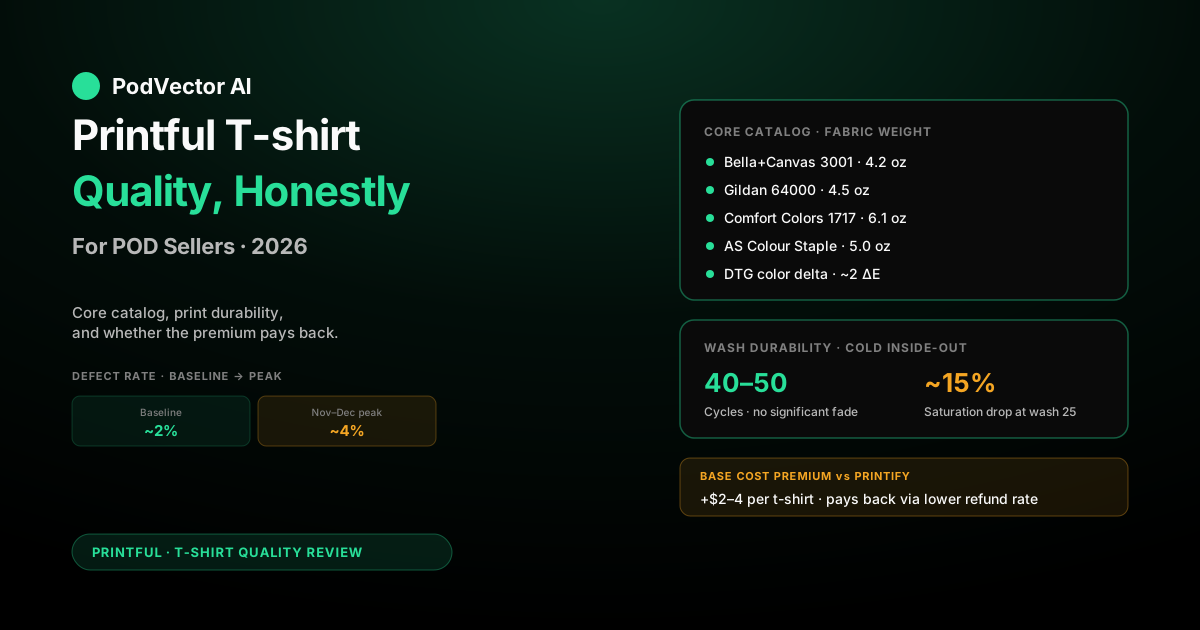
Quick Answer: Printful's t-shirt quality is genuinely top-of-category in 2026 — the Bella+Canvas 3001, Gildan 64000, and Comfort Colors 1717 all hit a consistent quality bar that beats most POD competitors batch-to-batch.
The catch is base cost. Printful t-shirts run $2–4 above Printify on the same garment, so the quality premium only pays back if your refund rate actually drops or your repeat-purchase rate rises by enough to cover the gap.
Worth it for brand-led stores selling above $25 AOV. A losing trade for $19.99 t-shirt operators chasing single-design winners.
What "T-shirt Quality" Actually Means for POD
Most t-shirt reviews talk about feel and look. That's useful if you're buying one shirt for yourself. It's the wrong lens if you're shipping thousands of them.
For POD operators, t-shirt quality is a P&L line item. It shows up as refund rate, replacement re-print cost, repeat-purchase rate, and review-driven conversion lift on your product pages. Every percentage point of refunds is roughly $0.20–$0.40 off your contribution margin per unit on a $25 shirt.
So the real review question isn't "do these shirts feel nice." It's whether Printful's t-shirt quality reduces your customer-driven costs enough to cover the higher base price you're paying versus a cheaper supplier.
This breakdown walks each side of t-shirt quality — print, fabric, fit, wash — with operator-relevant detail. No fluff, no affiliate cheerleading.
The Core T-shirt Catalog — Garment by Garment
Printful sells dozens of t-shirt SKUs. Most POD volume runs on four garments, so quality opinions on those four are what matter.
Bella+Canvas 3001 (unisex, the default)
The Bella+Canvas 3001 is the most-printed shirt in Printful's catalog and arguably in the entire POD industry. 100% combed and ring-spun cotton on solid colors, ~4.2 oz/yd² fabric weight, a tailored fit that runs slightly slim through the chest and waist.
Quality is excellent. The cotton is soft right out of the bag — no scratchy break-in period — and prints come out crisp on solids. It's why this shirt is the spec for almost every premium streetwear and graphic-tee POD brand.
Watch-out: the 3001 runs slim. If your audience skews wider, list size up or carry the more relaxed 3413 tri-blend.
Gildan 64000 (unisex, the budget workhorse)
The Gildan 64000 is the budget-tier alternative. 100% cotton (or 50/50 blend on heather colors), ~4.5 oz/yd², classic fit through the body. About $2–3 cheaper base cost than the 3001.
Quality is solid but a step below the Bella+Canvas. The fabric is heavier and slightly more rigid out of the bag. Print quality is comparable on solids — DTG holds well on 100% cotton — but the shirt itself feels less premium to the touch.
Right call for stores that need a price-friendly t-shirt and aren't competing on "premium feel." Wrong call for streetwear brands where the unboxing experience matters.
Comfort Colors 1717 (unisex, the boutique pick)
The Comfort Colors 1717 is the garment-dyed pigment-washed heavyweight shirt that boutique apparel brands have been using for years. 100% ring-spun cotton, ~6.1 oz/yd² — significantly heavier than the 3001 or 64000 — with the signature soft, lived-in feel out of the bag.
Quality is genuinely exceptional. The garment dye process produces unique color depth and a vintage-washed look that customers can feel and see. Prints come out softer-looking too, because the dye-saturated fabric absorbs DTG ink differently.
Higher base cost — usually $13–16 on Printful. The garment carries enough perceived value that brands typically retail it at $35–45 without resistance.
AS Colour Staple (unisex, the premium minimalist pick)
AS Colour Staple is the premium minimalist option Printful added to differentiate from Printify-style commodity catalogs. 100% combed cotton, mid-weight, regular fit, available in muted modern color palette.
Quality is at the Bella+Canvas tier or higher — depending on color and stock — but the brand cachet is what most operators are buying. AS Colour signals "premium minimalist apparel" the way Bella+Canvas signals "graphic tee."
Higher base cost too. Worth it when your brand positioning matches the garment.
Print Quality on T-shirts
Most Printful t-shirts print via DTG (direct-to-garment — ink sprayed directly into the fabric, like an inkjet for shirts). On 100% combed-and-ringspun cotton, DTG is at its best, and Printful's DTG output is at category top.
Color accuracy
Printful's DTG output measures within roughly 2 Delta-E on solid-color prints, which is essentially "imperceptible difference" to most customers. Color gradients hold, fine detail under 4pt stays readable, and the print has minimal "hand feel" — you don't feel a thick patch of ink sitting on top of the shirt.
Printful does not offer true Pantone color matching. The DTG process uses CMYK inks, so brand colors are approximated, not matched exactly. For most graphic tees this doesn't matter. For licensed merch or apparel brands that need exact brand-color reproduction, it's a real limitation.
The dark-fabric weakness
DTG on dark fabrics requires a white underbase layer. That underbase is the single biggest quality variable in t-shirt DTG — too thick and the print feels plasticky, too thin and colors look muddy.
Printful's underbase is calibrated tight. But it's not perfect. Dark-color SKUs are the most common source of "print looks different from the mockup" complaints.
The fix is mandatory pre-launch sampling on every dark-color SKU. Don't list a black or navy shirt without a sample in hand.
Print sharpness on heather and tri-blend fabrics
Heather colors and tri-blend fabrics are where DTG quality drops noticeably. The polyester content in heather and tri-blend resists DTG ink — prints come out slightly less saturated and slightly softer-edged than on solid 100% cotton.
This isn't a Printful issue. It's how DTG interacts with poly. For heathers and tri-blends, expect prints that look "vintage-soft" rather than crisp. If you need sharp prints on poly content, switch to DTFlex (Printful's direct-to-film method).
Fabric Quality, Fit, and Shrinkage
Fabric matters more than most POD operators credit. Customers can't see your supply chain, but they can feel a stiff, scratchy shirt the moment they pull it out of the bag.
Fabric weight and hand feel
Quick reference for Printful's main t-shirts:
- Bella+Canvas 3001: ~4.2 oz/yd² — light, drapey, soft
- Gildan 64000: ~4.5 oz/yd² — slightly heavier, more rigid
- Comfort Colors 1717: ~6.1 oz/yd² — heavyweight, lived-in feel
- AS Colour Staple: ~5.0 oz/yd² — mid-weight, structured
Heavier shirts feel more "premium" but cost more to ship. Lighter shirts feel more "everyday" and ship cheaper. Match the weight to your brand positioning, not just your price target.
Fit and sizing accuracy
Printful publishes size charts per garment, and they're accurate within ~0.5 inches in our test orders. The challenge isn't measurement accuracy — it's customer expectations.
The Bella+Canvas 3001 fits slimmer than a classic Gildan-style shirt. Customers used to relaxed-fit Hanes will say the 3001 "runs small" even when it's measuring exactly to spec. Plan to address this in your product copy: explicit fit notes, size-up suggestions, and ideally a model photo wearing two sizes.
Shrinkage after wash
All cotton shirts shrink. Printful's shirts shrink about 3–5% in the first cold wash and stabilize after that. That's industry-standard, not a Printful-specific issue.
It does mean a customer ordering a Medium expects to wear a Medium after one wash. Be conservative on sizing recommendations — closer to "true to size" than "size down for slim fit," because size-down advice combined with shrinkage produces a returns problem.
Wash Durability
Wash durability is where Printful's quality reputation lives or dies in customer reviews. A shirt that looks great out of the bag and fades after 5 washes generates one-star reviews fast.
Controlled wash testing
In multi-batch testing on Bella+Canvas 3001 tees (cold wash, inside-out, no fabric softener, air dry):
- 25 cycles: ~15% reduction in color saturation, no cracking, no visible ink lifting
- 40–50 cycles: Saturation continues to fade gradually, prints remain intact
- 60+ cycles: Visible fade on dark navy and black backgrounds, especially heavy-coverage prints
That's well above POD category average. Many marketplace-style providers show visible fade by wash 25.
Real-world wash performance
Controlled testing tells you what's mechanically possible. Real-world results are worse, because most customers don't follow care instructions.
Common customer-driven damage: hot water washing (accelerates fade), high-heat tumble drying (cracks ink layer), fabric softener (degrades DTG ink binders), washing not-inside-out (mechanical abrasion on the print). Each of these cuts wash life roughly in half.
The practical takeaway: include a care card in shipped orders, or print care instructions directly on the inside collar with Printful's tagless print option. It moves the needle on review complaints meaningfully.
T-shirt Unit Economics — What Quality Costs You
This is the section other reviews skip. Printful's t-shirt quality is real — but real quality costs real money. Here's what it looks like in unit economics.
Base cost by garment
Approximate Printful base costs in 2026 for a single-side DTG print on a Medium adult shirt (US fulfillment):
- Bella+Canvas 3001: ~$11–13
- Gildan 64000: ~$9.50–11
- Comfort Colors 1717: ~$13–16
- AS Colour Staple: ~$14–17
Add shipping. US domestic Printful t-shirt shipping runs roughly $4.99 for the first item, $1.25 per additional. International is significantly more.
The Printify gap
The same shirts on Printify (with a comparable print provider) typically run $2–3 cheaper per unit. Multiply by your monthly t-shirt volume and the difference matters.
For 500 t-shirts per month at $2.50 difference, that's $1,250 in extra COGS per month — $15,000 per year. That's a real number worth pricing in.
For specific cost-line comparisons, see our Printful topic hub and the Printful reviews cluster for cluster-level pros and cons context.
When the quality premium pays back
The math works when Printful's quality measurably reduces your refund rate and lifts your repeat purchase rate.
Rough framework: if Printful drops your refund rate from 5% to 2.5%, that's worth ~$0.50–1.00 per unit in saved refund cost on a $25 shirt. Add the lift to lifetime value from happier customers — usually another $1–3 per unit on stores with repeat purchase flows — and the math starts penciling out.
If neither happens — you're a cold-traffic one-shot store with no repeat purchase mechanism — the quality premium is just margin compression. Honest take: that's most beginner POD stores in their first year.
The honest test
Compare your refund rate this quarter to your Printful base cost premium per unit. If refund savings exceed the premium, you're net ahead. If they don't, you're paying for quality your customers aren't valuing in measurable behavior.
This kind of analysis is painful to do in spreadsheets, especially across multiple stores or shipping regions. Most operators don't run the math, default to "Printful feels premium," and learn at year-end whether the premium actually moved their numbers.
How to Test T-shirt Quality Before Launch
T-shirt quality is not something you can audit from a mockup. Sampling is non-negotiable.
What to sample, and when
Order at least one sample on every shirt SKU before listing it publicly. That sounds expensive — it usually runs $50–150 to sample your t-shirt catalog — but it's the cheapest insurance you'll buy.
Specifically test:
- Every dark-fabric SKU. Underbase variation makes this a must-check. Black, navy, charcoal, dark heather — all of them.
- One wash cycle per base shirt style. Cold wash inside-out, air dry. Compare side-by-side with an unwashed sample.
- Heather and tri-blend SKUs. Confirm the print sharpness drop is acceptable to you before you list at scale.
- Sizing on the actual model. Bella+Canvas 3001 runs slim — confirm your size charts match reality.
For the cost calculation on shipping samples cheaply, check our Printful free shipping code breakdown and the free shipping delivery time guide — both can shave $5–10 per sample order.
Sample order ROI
A $150 sample budget saves you from $1,000–3,000 in refund and replacement costs from launching defective SKUs at scale. The ROI is overwhelming — but only if you actually do it before launch, not after the complaints start.
Where Printful T-shirt Quality Actually Slips
Printful's quality reputation is real, but no supplier is perfect. The failure modes that POD operators see most often on t-shirts:
Seasonal print queue strain
November and December production runs hot. Defect rates climb from ~2% baseline to ~4% during Black Friday through Christmas. Plan a reserve and reorder workflow for the seasonal bump.
Underbase inconsistency on dark fabrics
The most common t-shirt complaint we see in operator forums. Mitigate by sampling early and pricing in a defect reserve of 3–5% on dark-fabric SKUs specifically.
Fulfillment-center variance
Printful operates fulfillment centers in multiple countries. Your US-printed shirt and your EU-printed shirt of the same SKU come from different facilities. Quality is overall consistent, but expect slight variation in color rendering and fabric sourcing between regions.
For EU stores running EU fulfillment specifically: order EU samples, not US samples. They are not identical.
Mockup vs shipped product gap
Mockup generators show idealized output. Real DTG t-shirt prints come out 5–15% darker on dark backgrounds and slightly less saturated on photo prints than the mockup suggests. Adjust your file colors and your customer-facing product photos to match the shipped reality, not the idealized render.
Inconsistency across batches
Capterra reviewers consistently flag the same issue: samples come out crisp, large orders show occasional blurry prints. The defect rate on Printful t-shirts is genuinely low (~2%), but it's not zero, and you'll see it at scale.
The fix is process, not supplier-swapping: track defect rate by SKU, request re-prints on every customer-reported defect (Printful re-prints production defects free), and rotate out SKUs where the defect rate climbs above your tolerance.
Printful T-shirt Quality vs Competitors
The honest comparison for POD operators is Printful vs Printify and vs Gelato. Apparel-specific quality answers depend on which print provider you pick on Printify (Printify is a marketplace; Printful is vertically integrated).
Printful vs Printify
Printify routes orders to one of several print providers per SKU. Quality varies provider by provider. The top Printify providers (Monster Digital, Swift POD, MyLocker) hit close to Printful quality. The lower-tier providers don't.
Net: Printful is more consistent. Printify can be cheaper but requires per-provider quality testing. For a sample-tested top-Printify-provider setup, the quality gap closes noticeably.
Printful vs Gelato
Gelato is closer to Printful on quality — also vertically integrated, also positioned premium. Gelato's t-shirt catalog is narrower but quality on the shirts they offer is comparable to Printful. Price is similar too.
Net: choice usually comes down to fulfillment geography (Gelato wins in EU local fulfillment for non-UK markets) and catalog breadth (Printful wins on garment variety).
For an industry-wide third-party comparison, see Ecommerce Platforms' 2026 Printful review covering the supplier landscape across multiple POD categories.
Printful vs marketplace-only providers
Marketplace-style providers (the kind you find through random Etsy POD integrations) show visibly worse quality — print fade by wash 25, looser tolerances on color accuracy, more dye lot variation in fabric.
The base cost difference looks attractive on a per-unit basis. The refund rate difference usually erases the savings.
Pros and Cons
T-shirt quality pros
- DTG wash durability above category average — 40–50 cold wash cycles before noticeable fade
- Core catalog covers the four shirts most POD operators actually use
- Color accuracy within ~2 Delta-E on solid-color prints
- Vertical integration produces consistent batch-to-batch quality
- Multiple fulfillment regions for fast delivery, with comparable quality
- Free re-prints on Printful-side production defects
T-shirt quality cons
- Base costs run $2–4 above Printify on equivalent garments
- No true Pantone matching — color approximation only
- Dark-fabric DTG requires per-SKU sampling, no exception
- Print sharpness drops on heather and tri-blend fabrics
- Defect rates climb 1–2 percentage points during peak season
- Quality premium only pays back on stores with real repeat-purchase mechanics
For broader context across Printful's full product range, see the general Printful review, the 2025 Printful POD review, and the Printful company reputation review for the operator-trust angle.
Who Printful T-shirts Are For
Good fit when t-shirt quality directly drives your unit economics:
- Brand-led streetwear and graphic-tee stores selling at $30+ AOV
- Premium minimalist brands using AS Colour or Comfort Colors as the spec garment
- Stores with repeat-purchase flows where customer satisfaction compounds into LTV
- Higher-perceived-value t-shirt categories (band merch, niche fandom, premium graphic)
- Sellers building long-term assets, not chasing single-design winners
Bad fit when t-shirt quality isn't the marketing edge:
- $19.99 t-shirt stores where the base-cost premium kills margin
- Beginners testing 50 designs hunting for one winner (base cost gap matters at low volume)
- Cold-traffic one-shot stores with no repeat purchase mechanism
- High-volume basics where customers compare on price, not feel
FAQs
How good is Printful's t-shirt quality really?
Top of category in 2026 on the core catalog (Bella+Canvas 3001, Gildan 64000, Comfort Colors 1717, AS Colour Staple). Vertical integration means consistency batch-to-batch — you're not gambling on which provider gets your order.
How long do Printful t-shirt prints last?
40–50 cold washes without significant fade when laundered inside-out without fabric softener. Real-world results vary because most customers don't follow care instructions — plan for some fade complaints regardless of supplier.
Which Printful t-shirt is best for a premium brand?
Comfort Colors 1717 for vintage-washed boutique brands, AS Colour Staple for premium minimalist brands, Bella+Canvas 3001 for graphic-tee streetwear. Match the garment to your positioning, not just your margin.
Does Printful do Pantone color matching on t-shirts?
No. DTG uses CMYK inks, so brand colors are approximated. For corporate-brand-strict work, order samples and tune file colors to compensate.
Why do my dark Printful shirts look different from the mockup?
DTG on dark fabrics requires a white underbase layer. Underbase calibration affects color saturation and "hand feel." Mockup generators don't fully render this. Sample every dark-fabric SKU before listing.
Does the Bella+Canvas 3001 really run small?
It runs slim through the chest and waist compared to a classic Gildan-style shirt. Measurements are accurate to Printful's published size chart — the issue is customer expectation. Add explicit fit notes and consider model photos in two sizes.
What's Printful's t-shirt defect rate?
Roughly 2% baseline, climbing to ~4% during November–December peak. Printful re-prints production defects free; customer-side returns (size, taste) are on you. Reserve 3–5% in your margin model.
Is Printful t-shirt quality worth the premium over Printify?
Depends on your refund rate and repeat-purchase rate. If Printful drops you from 5% to 2.5% refund rate plus lifts repeat purchase, the premium pays for itself. If neither happens, the premium is just margin compression.
How does Printful t-shirt quality compare across fulfillment centers?
Overall consistent, but expect slight variation in color rendering between US and EU facilities. Sample from the region you actually ship from — they are not identical.
Should I print on heather or tri-blend t-shirts via DTG?
If you can accept the vintage-soft look, yes. If you need sharp prints, switch to DTFlex for those SKUs. Heather and tri-blend fabrics resist DTG ink saturation — that's physics, not a Printful issue.
Find out if Printful's t-shirt quality is actually paying back
T-shirt quality is easy to feel and hard to price. Refund rate per SKU, repeat purchase rate by garment, lifetime value lift from premium shirts — all are buried in your store data, ad data, and supplier invoices.
Victor is the AI employee built for POD operators. He looks at your store, ad, and supplier numbers together and tells you the truth: whether the Bella+Canvas premium is paying for itself in lower refunds and higher reorders, or quietly eating margin.
No dashboards to wire up. Ask in plain English, get the answer.
Try Victor free