
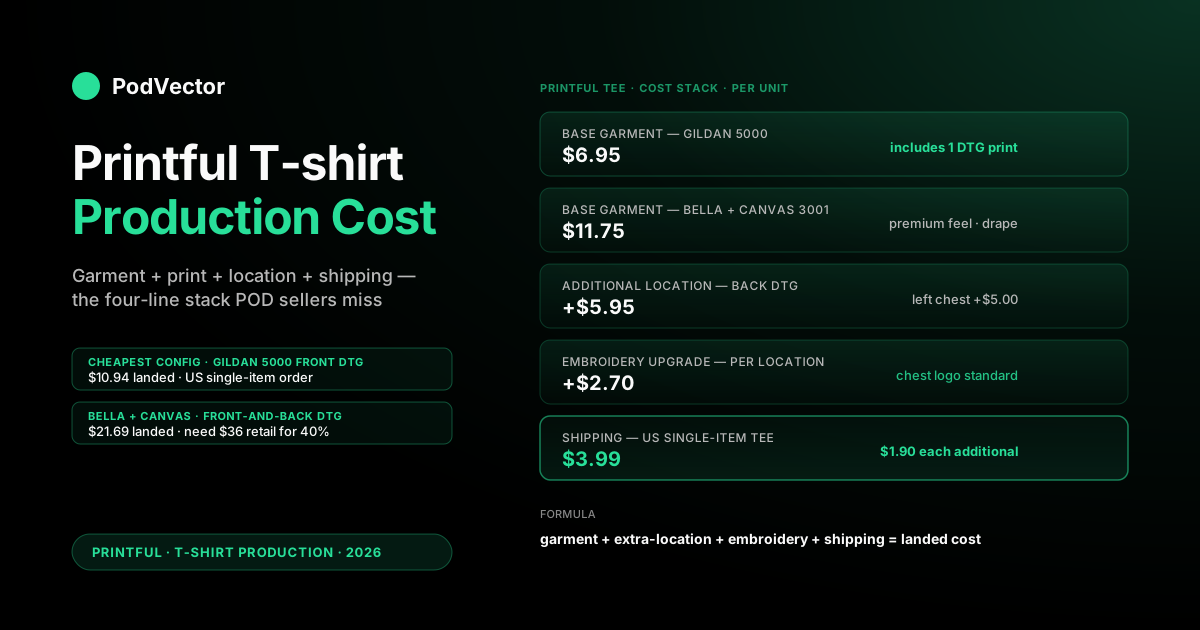
Quick Answer: A standard Printful t-shirt costs roughly $11.50–$15.74 fully landed for a US order. According to Printful's own pricing guide, garments from brands like Gildan and Bella + Canvas start at around $7.50 base, with domestic shipping starting at $4.75 for the shirts category. One DTG or DTF print on one location is included in that base price.
Add an extra back print and you'll pay $5.95 more. Add a sleeve print and that's another $2.50 per sleeve. Switch from DTG to embroidery and add roughly $2.70–$3.50 per location. Each additional shirt in the same order ships for less than the first — multi-item orders cut your per-tee shipping cost significantly.
This breakdown covers every cost line for the three best-selling Printful tees, how each fee compounds across order types, where the Growth membership changes the math, and where Printful's pricing quietly drops sellers below break-even.
Base garment cost by tee model
The base garment price is the largest line in your tee cost stack. It's also the line POD sellers most often quote from memory — incorrectly — because, as Bootstrapping Ecommerce notes, Printful "regularly makes changes to its pricing strategy" as supplier costs shift. Any number you sourced more than a few months ago may already be stale.
According to Printful's own pricing guide, t-shirts from brands like Gildan and Bella + Canvas start at around $7.50 base. The table below reflects the three best-selling unisex tees and their current positioning — always verify against Printful's live catalog before publishing a retail price.
| Model | Approx. base price (S–L) | 2XL surcharge | 3XL surcharge |
|---|---|---|---|
| Gildan 5000 Heavy Cotton | ~$7.50 | +$2.00 | +$3.00 |
| Bella + Canvas 3001 Jersey | ~$12.00 | +$2.50 | +$3.50 |
| Gildan 64000 Softstyle | ~$10.75 | +$2.00 | +$3.00 |
Note: Printful updates base prices without notice. Treat the figures above as directionally accurate and verify in your Printful dashboard before setting retail prices.
The gap between the Gildan 5000 and Bella + Canvas 3001 is substantial — on a tee you retail at $25, swapping garment lines moves your gross margin meaningfully before printing. Most established POD brands sell the Bella + Canvas anyway — it drapes better, dyes more vividly, and customers can feel the difference. Starting with the Gildan 5000 to validate a design before upgrading is a smart cost move.
For a full side-by-side on per-tee charges across both major platforms, see our Printify t-shirt cost and profit breakdown.
For the calculator-driven Printful view of the same numbers, see their official pricing guide.
Print method cost: DTG vs DTF vs embroidery
The base garment price includes one DTG or DTF print on one location. That's the most important pricing fact about Printful tees, and the one new sellers most often miss.
You only pay extra when you change the print method or add a second print location. Here's how each method maps to incremental cost on a standard tee.
| Method | Additional cost on tee | Best for |
|---|---|---|
| DTG (direct-to-garment) | Included in base | Full-color photographic / detailed art |
| DTF (direct-to-film / DTFlex) | Included in base on supported tees | Bright solid colors, durability on cotton/poly blends |
| Embroidery | +$2.70–$3.50 per location | Logo work, premium feel |
| All-over print (sublimation) | Garment-specific surcharge | Full-coverage designs on poly tees |
For most POD operators selling on Shopify, DTG handles the majority of orders and the cost stays at base. The trap is sellers who promote embroidered "premium" tees in collections without re-pricing — the per-location embroidery fee hits net margin on every single order.
Printful has also expanded its DTFlex product line in 2026, applying film-transfer technology to a wider range of garments. If your design involves bright solids or bold graphics on blended fabrics, DTFlex can deliver more durable results at no added base cost on eligible products — but verify eligibility in the catalog, because not every tee style supports it.
Additional print location fees
Printful's most under-discussed fee: each extra print location adds a flat surcharge on top of the base. The front is included; back, left chest, sleeves, and inside-neck label all bill separately.
| Additional location | DTG / DTF cost | Embroidery cost |
|---|---|---|
| Back print | +$5.95 | +$3.50 |
| Left chest / pocket print | +$5.00 | +$2.70 |
| Sleeve print (per sleeve) | +$2.50 | +$2.70 |
| Inside-neck label | +$2.99 | n/a |
Note: Additional-location fees are directional — verify the exact figure in your Printful dashboard before pricing, as these can change by product category.
A front-and-back DTG tee on a Gildan 5000 lands well above $13 before shipping once you add the back-print surcharge. Sellers who model only the front-print case routinely under-price their multi-location designs.
The neck-label upcharge is the one most sellers ignore. Replacing the manufacturer tag with your own brand label adds nearly $3 per tee — a clean margin hit if you're trying to project a premium brand and forgot to bake it into retail.
Shipping cost for tees (US and international)
Shipping is its own line item — never bundled into the garment price. According to Printful's blog, domestic shipping for shirts usually starts at $4.75 in the US. Merch Titans' 2026 POD cost breakdown confirms Printful domestic US shipping runs $3.99 for the first item, with each additional item adding less. Always check your current Printful dashboard for the exact rate on your specific product, as rates are product-specific and updated periodically.
Here's the regional breakdown for a single tee (verify current rates in Printful's shipping calculator):
| Region | First tee (approx.) | Each additional tee |
|---|---|---|
| US | ~$4.75 | lower per unit |
| Canada | CAD $8.29+ | CAD $2.99+ |
| Europe (EU + UK) | €4.79+ | €1.45+ |
| Australia | AUD $10.49+ | AUD $3.49+ |
| Rest of world | $10.49–$14.99 | $2.99–$4.49 |
Multi-item orders are wildly cheaper per unit than singles. That math is why "buy 2 get 10% off" promotions work for POD: you're not subsidizing the discount out of margin — the second-item shipping rate is doing it for you.
Express shipping (1–3 business days) carries a meaningful surcharge. Most sellers don't enable it for tees unless they sell merch tied to events or have a deadline-sensitive customer base.
According to Bootstrapping Ecommerce's 2026 Printful pricing guide, t-shirt shipping now starts at $4.69 — confirm the precise figure for your product in your dashboard, as Printful updates rates by product type.
The full per-tee cost stack (worked examples)
Here's what a real Printful tee actually costs you, landed, for the three most common configurations US sellers ship. These use directional garment prices based on Printful's published starting points — lock down exact figures in your own dashboard before setting retail.
Scenario 1: Gildan 5000, front DTG print, single-item US order
- Base garment: ~$7.50 (per Printful's pricing guide)
- DTG front print: included
- US shipping: ~$4.75 (per Printful's blog)
- Estimated total cost: ~$12.25
This is the absolute floor for a Printful tee. If you can't price profitably at this landed cost, no other configuration will save you.
Scenario 2: Bella + Canvas 3001, front-and-back DTG, single-item US order
- Base garment: ~$12.00
- DTG front print: included
- DTG back print: +$5.95
- US shipping: ~$4.75
- Estimated total cost: ~$22.70
At a $30 retail price, this leaves under $8 of gross — before Shopify fees, payment processing, and ad spend. Sellers who don't model the back-print configuration end up subsidizing back-print designs from front-print profits.
Scenario 3: Gildan 64000, embroidered chest logo, two-tee US order
- Base garment x2: ~$21.50
- Chest embroidery x2: +$5.40 (~$2.70 each)
- US shipping (first + additional): lower than two singles
- Estimated total: ~$31–$33 / ~$15.50–$16.50 per tee
The two-tee order shows why upsells matter: per-tee shipping cost drops sharply on the second unit, and you only pay one base-shipping fee.
How the Growth membership changes the math
Printful's Growth membership costs $24.99/month and discounts garment prices, not shipping. According to Printful's own blog, Growth can cut production costs by up to 33%, giving your business more room for profit.
The discount applies to the base price of eligible products — generally meaningful savings on most apparel lines. Re-run Scenario 1 with Growth and even a conservative discount turns the Gildan 5000 into a noticeably cheaper unit cost, with break-even on the monthly fee achievable within a modest monthly volume.
The discount stacks best with premium tees: a percentage off a $12 Bella + Canvas base saves more in absolute dollars than the same percentage off a $7.50 Gildan base. Sellers shipping mostly premium tees see better Growth ROI than those shipping mostly basics.
According to Bootstrapping Ecommerce, the Growth plan is available free when you reach $12K/year in Printful sales — meaning high-volume sellers eventually pay nothing for the membership.
Hidden costs most POD sellers miss
Most pricing guides stop at garment + print + shipping. The fees below are the ones that quietly chew margin once orders start flowing.
Payment processing. According to Printify's 2026 startup cost guide, Shopify charges 2.9% + $0.30 per online transaction. On a $25 tee, that's over $1 gone before you've counted anything else.
Etsy fees compound worse. Printify's guide also notes Etsy charges $0.20 per listing plus a 6.5% transaction fee on the total sale including shipping — layers that significantly erode margin on low-priced tees.
Returns and replacements. Printful doesn't accept returns for the wrong size or "didn't like it" reasons, only for misprints or damage. That means every customer-error return is on you to either refund or eat the replacement print and shipping. Factor a realistic replacement rate into your margin model.
Color sample orders. Mocking up a design on screen is one thing; seeing the actual print on the actual garment is another. Most sellers spend real money on sample orders per design family. That's a fixed cost that disappears into nothing on the P&L if you don't allocate it per product line.
Mockup tooling. Printful's built-in mockup generator is free. Premium mockups (lifestyle photography, model shots) come bundled with Growth, or are available à la carte. Most successful Shopify listings use lifestyle mockups, not flat-lays — so budget accordingly if you're not on Growth.
Currency conversion. As Avada's Printful pricing guide points out, if your store operates in a currency other than USD, be mindful of potential conversion fees on each transaction — a silent margin drain for international sellers.
Ad spend and checkout friction. If you're driving paid traffic, checkout conversion rates directly amplify or dilute every cost in this stack. See our guide on ecommerce checkout conversion rate optimization to make sure your cost-per-acquisition math holds up.
What you need to charge to hit a healthy margin
According to Printify's 2026 profit-first pricing guide, "a 40% profit margin is the standard benchmark for custom t-shirt businesses in 2026," with most sellers landing between 30% and 50%. Budget-focused shops operating on volume run closer to 30%; premium or niche brands can reach 50%+ through stronger positioning.
Working backward from the worked examples above:
| Configuration | Est. landed cost | Retail for 30% margin | Retail for 40% margin |
|---|---|---|---|
| Gildan 5000, front DTG | ~$12.25 | ~$17.50 | ~$20.42 |
| Bella + Canvas 3001, front-and-back DTG | ~$22.70 | ~$32.43 | ~$37.83 |
| Gildan 64000, embroidered chest (2-tee order) | ~$16.00/tee | ~$22.86 | ~$26.67 |
Those retails don't yet cover payment processing, returns, or ads. According to Printful's own guide, "most sellers keep a net profit of $3 to $8 per shirt after core costs." If you're running paid traffic, build in enough gross to absorb customer acquisition cost on top of fulfillment — which means the 40% gross target is a floor, not a ceiling.
The cost-plus formula: Retail = Landed cost / (1 – target margin). For 40% margin on a $22.70 landed cost: $22.70 / 0.60 = $37.83.
Most Bella + Canvas 3001 designs price below that formula. Shoppers compare your listing to cheaper alternatives, not to the tee's true unit economics. Premium positioning, lifestyle imagery, and brand story carry the price gap — not the garment label alone.
If you run paid ads, ad fatigue compounds cost-per-acquisition over time. See our guides on how to avoid ad fatigue and what is ad frequency to keep your acquisition costs from eroding the margin you've built here.
For a deeper look at contribution margin — the metric that ties fulfillment costs directly to ad profitability — see our guide on how to get contribution margin.
Printful vs Printify t-shirt production cost
Printify undercuts Printful on most base garment prices by routing through third-party providers, but loses on consistency. As Merch Titans' 2026 breakdown puts it, "Printful charges more but consistently delivers higher print quality and faster shipping."
The key structural difference: Printful's single-location front print is included in the base price. Printify's per-print pricing varies by provider. Once you compare landed totals on a one-print front-only tee, the gap between platforms is often narrower than the base-price headline suggests.
The bigger Printify trade-off is quality variance. A design that prints clean at one Printify provider might come back faded from another. Sellers who care about consistency typically pay Printful's small premium for it. Sellers optimizing purely on cost with a tolerance for some variance often prefer Printify's model.
For a head-to-head on per-tee charges across both platforms, see our Printify t-shirt cost and profit breakdown.
Per-SKU live margin tracking
The biggest gap in every pricing guide — including this one — is that costs change. Printful raises base prices, adjusts shipping by region, and adds surcharges. As Bootstrapping Ecommerce notes, Printful "regularly makes changes to its pricing strategy." Your spreadsheet from Q1 may already be wrong.
The way most POD sellers find out is the worst way: a profit-and-loss report three months later showing two SKUs ran negative for weeks. That's why live tracking — not spreadsheets — is the durable fix.
That's where Victor — PodVector's AI employee — comes in. Victor reads your live Shopify and Printful data, ingests every completed order with itemized garment, print, and shipping costs, and answers questions like:
- "Which SKUs dropped below 30% margin this month after Printful's price changes?"
- "What's my landed cost per unit on the Gildan 5000 front-DTG tee, weighted by shipping region?"
- "If I raise the retail price on my back-print designs by $4, what does projected monthly profit look like at current order volume?"
And Victor doesn't just answer. He proposes specific actions — for example, flagging that your 'Mountain Sunrise' tee is netting under $3 after fees and suggesting a price change to target 38% margin — then executes the reprice on Shopify when you approve. The proposal includes the math, the alternatives, and an audit trail you can reverse anytime.
Three things separate Victor from a dashboard or a generic AI chatbot: (1) a POD playbook baked into the agent — profit-leak audits, margin benchmarks, SKU-level diagnostics; (2) your live Shopify, Printful, Meta Ads, and Google Ads data in a single warehouse; (3) the ability to act on Shopify directly — repricing, discounts, collections — with your approval. Victor reads and proposes; you approve; he executes.
For context on how live P&L data connects to growth financing decisions, see how to get Shopify Capital — because Shopify uses your store's real revenue data, not projections, to make funding offers.
FAQs
How much does Printful charge per t-shirt total?
According to Printful's pricing guide, garments from Gildan and Bella + Canvas start at around $7.50 base, and Printful's blog states domestic shirt shipping starts at $4.75. Most tees land in the range of roughly $12–$23 fully landed for a US single-item order, depending on garment model and print configuration. Always verify the exact figure in your Printful dashboard before pricing.
Does Printful include the print in the base t-shirt price?
Yes — one DTG or DTF print on one location (typically the front) is included in the base garment price. Additional print locations and embroidery cost extra. Most new sellers miss this and either double-count the print cost or fail to account for multi-location surcharges.
How much does an extra print location cost on a Printful tee?
A back DTG print adds approximately $5.95, a left-chest print adds approximately $5.00, and a sleeve print adds approximately $2.50 per sleeve. Embroidery on those locations runs approximately $2.70–$3.50 instead. Verify exact figures in your Printful catalog, as these vary by product.
Is Printful or Printify cheaper for t-shirts?
Printify's base garment prices are often lower, but Printful's single-location print is included in the base while Printify charges per print. As Merch Titans notes, Printful charges more but delivers more consistent print quality. Compare landed totals — not base prices — on your specific configuration before choosing a platform.
What profit margin should I target on Printful tees?
According to Printify's 2026 pricing guide, a 40% profit margin is the standard benchmark, with most sellers landing between 30% and 50%. If you're running paid ads, target enough gross margin to absorb customer acquisition cost on top of fulfillment. Pricing a tee too close to landed cost leaves nothing for traffic, returns, or processing fees.
Does the Printful Growth membership reduce per-tee cost?
Yes. According to Printful's blog, Growth can cut production costs by up to 33%. The $24.99/month fee is waived once you reach $12,000 in annual Printful sales, according to Bootstrapping Ecommerce — meaning high-volume sellers eventually get the discount free.
Why is my Printful t-shirt margin worse than my spreadsheet predicted?
The three most common reasons: (1) Printful raised base prices since you built the sheet — they update pricing regularly with limited notice; (2) you didn't include payment processing fees, which Printify's 2026 guide confirms are 2.9% + $0.30 per transaction on Shopify; (3) your shipping math assumed multi-item orders but most of your orders are singles. Tracking landed cost per SKU live — not in a spreadsheet — is the only durable fix.
Stop guessing your Printful margin — track it live.
Printful raises prices. Shipping rates shift. Your spreadsheet drifts out of date the moment a single SKU re-prices. Victor — PodVector's AI employee — reads every completed Printful order with itemized cost, surfaces per-SKU landed cost from your live data warehouse, and flags SKUs that fall below your target margin before the month closes. He'll also propose the price changes that fix them and execute them on Shopify the moment you approve.
Try Victor free