
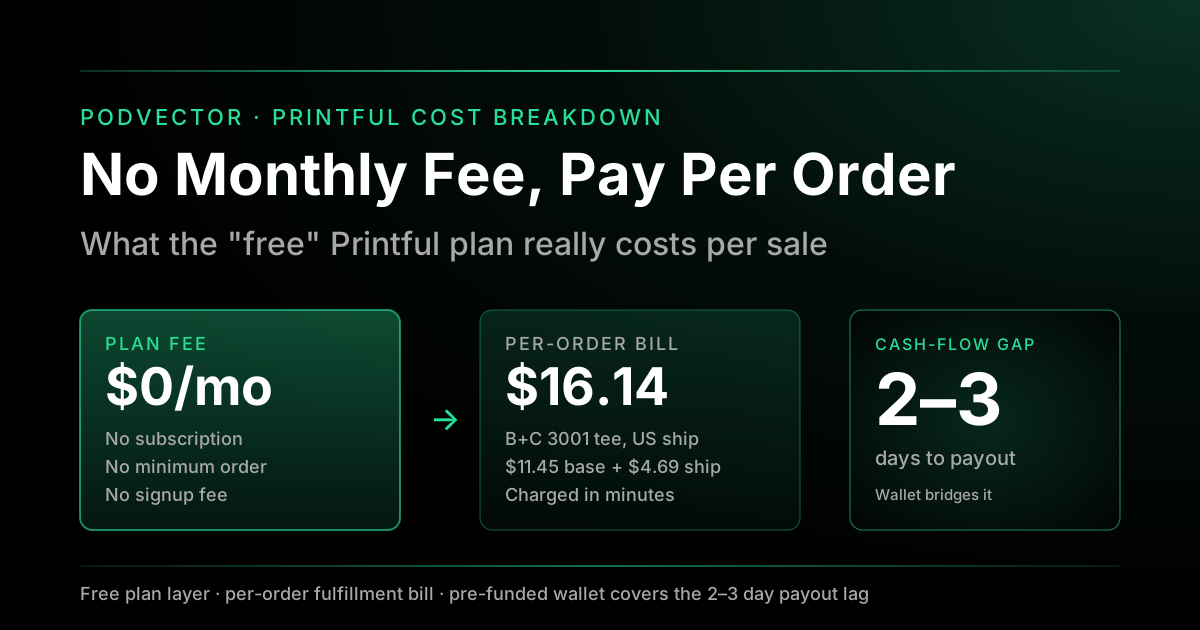
Quick Answer: Printful charges $0/month by default. There is no subscription, no signup fee, and no minimum order. You only pay when a customer buys — at which point Printful charges your Printful Wallet or payment method for the product base price + shipping + any optional extras.
The pay-per-order model is genuinely free at the plan level. According to Printful's current pricing page (checked July 2026 via PodVector's internal research), a Bella+Canvas 3001 tee runs approximately $11.50 base + $3.99 US shipping on every unit. There is no volume requirement, no contract, and no penalty for going dormant.
This breakdown walks the full 2026 pay-per-order mechanics: what hits your card on every sale, how cash flow works, where the "free" plan is actually costing margin, and when the optional Growth subscription pays for itself. For the wider pricing landscape see our Printful pricing guide and the Printful costs and charges hub.
What "no monthly fee, pay per order" actually means
Printful's default tier is a pay-per-order plan. You sign up, build products, list them on a store, and pay $0 until someone actually buys something. The platform is genuinely free to use — according to INSO's 2026 Printful pricing analysis, "the free tier isn't a stripped-down trial — it's a functioning way to run a print-on-demand store indefinitely."
When a customer places an order, Printful charges you — not your customer — for the base product, the shipping, and any extras you opted into. Your retail price minus what Printful charges you is your gross margin.
The phrasing matters. "No monthly fee" describes the plan structure. "Pay per order" describes the trigger. Together they mean: zero recurring cost, but every order has a fulfillment bill attached.
This is not the same as "free to operate." A $25 t-shirt with $16 in Printful charges leaves $9 gross before payment processing, ad spend, and your time. The plan is free. The orders are not.
2026 plan structure: three tiers, two self-serve
Printful's plan structure changed in early 2026. According to PodVector's own complete guide to Printful costs (checked July 2026), "the old Business tier was folded into Growth, leaving two self-serve plans plus a custom-priced Enterprise tier for large-scale brands." That means the current lineup is:
| Plan | Monthly cost | Who it's for |
|---|---|---|
| Free (pay-per-order) | $0 | New sellers, seasonal stores, low-volume testers |
| Growth | $24.99/mo (waived above $12K/yr sales) | Established sellers scaling on margin |
| Enterprise | Custom pricing | Large-scale brands with dedicated account support |
Every plan — including the free tier — gets unlimited product listings, all supported storefront integrations, and full catalog access, per Printful's plans page. The gating is around discount depth, not feature access.
The $12K Growth waiver is a reimbursement mechanic, not a lower price. Printful tracks store revenue against your account; once your yearly sales reach the threshold, Printful covers the Growth subscription for a year, per its plans page.
How the pay-per-order charge actually works
The flow is straightforward, but new sellers often get it wrong. Here is the exact sequence:
- A customer buys from your storefront (Shopify, Etsy, TikTok Shop, etc.) and pays your retail price.
- Their payment lands in your store's payment processor — Shopify Payments, Stripe, PayPal, Etsy Payments.
- Printful receives the order automatically through the store integration.
- Printful charges your Printful Wallet, credit card, or PayPal for the production and shipping cost.
- Printful produces and ships the order.
- You keep the difference between customer-paid retail and Printful-charged fulfillment.
Two things to flag. First, the customer never sees the fulfillment cost — Printful charges you, not them. Second, the timing matters: Printful charges you within minutes of the order landing, but your store's payout cycle is usually 2–3 days. You're funding the gap.
What gets charged on every order
Every pay-per-order charge from Printful is itemized into clear line items. Here's the full structure:
| Charge type | Required? | Notes |
|---|---|---|
| Product base price | Yes | Varies by SKU and print method; t-shirts from ~$11.50 per Avada's 2026 guide |
| Print method premium | Included in base | DTG, embroidery, sublimation, AOP — bundled into the SKU base |
| Shipping | Yes | US t-shirt shipping starts at $3.99 first item, $2.00 each add-on, per Avada's 2026 guide |
| Second print location | Optional | Additional charge depending on garment and method |
| Inside-label print | Optional | Standard rate; Growth plan subscribers get 9% off branding extras |
| Outside printed labels | Optional | Free on many SKUs; additional charge on others |
| Packaging insert (branded) | Optional | Per-order add-on; storage minimums apply for warehoused inserts |
| Custom packaging | Optional | Per-order add-on |
| Embroidery digitization | One-time per design | Free for bulk orders of 25+ embroidered items and on Growth plan samples, per checkthat.ai's 2026 analysis |
| Sales tax | Where applicable | Varies by state and product |
| VAT / duties | International only | EU/UK orders include VAT in invoice |
The first two rows — base price and shipping — are unavoidable. Everything below is opt-in and worth checking against your product margin. According to Avada's 2026 Printful pricing guide, branding add-ons like custom inside/outside labels and packing slips will add to your expenses on every order they're activated for.
Surcharges and regional fees to know
A few charges that frequently surprise pay-per-order sellers and should be priced into any margin model:
Minnesota Retail Delivery Fee. According to checkthat.ai's 2026 Printful pricing analysis, a $0.50 surcharge applies to orders over $100 (pre-tax) shipped to Minnesota, effective January 15, 2025 — state-mandated and non-refundable on returns.
Seasonal shipping surcharges. Printful applies temporary shipping increases during peak periods. Checkthat.ai's analysis notes a recent example where a holiday surcharge was applied in Q4 2025 through mid-January 2026. Budget for this in your Q4 margin projections.
Cotton Heritage price increases. As of February 26, 2026, Printful rolled out a targeted price increase affecting Cotton Heritage products — hoodies, heavyweight tees, sweatshirts, and sweatpants — and shipping rates on select accessories, per Bootstrapping Ecommerce's March 2026 update. Product base prices went up on affected items that cycle, so verify current catalog pricing before repricing a Cotton Heritage SKU.
Address correction fees. When a customer enters a bad address, Printful charges a correction fee to reroute. Pay-per-order sellers eat this directly — there's no plan-tier reduction. Stores with high address-error rates can see meaningful fulfillment cost bleed from corrections alone.
Currency conversion drag. According to Avada's 2026 guide, if your store operates in a currency other than USD, be mindful of potential conversion fees on each transaction. Wallets billed in USD face FX spread on international receipts.
Real per-order cost walkthrough
Numbers make the model concrete. The scenarios below use current 2026 catalog pricing as reported by Avada's 2026 Printful pricing guide and Bootstrapping Ecommerce's 2026 update, US-bound, on the no-monthly-fee plan. Always verify against Printful's live catalog before setting retail prices — catalog costs update periodically.
Scenario 1: Single Bella+Canvas 3001 t-shirt, one design
- Base price: ~$11.50 (per Avada's 2026 guide)
- Shipping (first item US): $3.99 (per Avada's 2026 guide)
- Printful charges you: ~$15.49
- Retail price: $24.99
- Gross margin before processing fees: ~$9.50 (~38%)
Scenario 2: AOP hoodie, full-coverage print
- Base price: varies by SKU — verify in Printful's catalog; hoodies are among the Cotton Heritage-affected items with price changes effective February 2026 per Bootstrapping Ecommerce
- Shipping (first item US): from $8.49 per Bootstrapping Ecommerce's 2026 update
- Retail price: $59.99
- Margin depends heavily on current SKU base cost — check the live catalog
Scenario 3: Ceramic mug, single design
- Base price: from $5.95 (per Avada's 2026 guide)
- Shipping (first item US): $4.99 (per Bootstrapping Ecommerce's 2026 update)
- Retail price: $19.99
- Gross margin before processing fees: ~$9.05 (~45%)
None of these include payment processing, ad cost, your store's monthly subscription, or returns. The "no monthly fee" headline is accurate at the Printful plan layer. The unit economics still have to clear the rest of the stack.
Cash flow on the pay-per-order model
This is where new sellers get bitten. Printful charges fulfillment costs in near real time. Your store payouts run on a delay. The gap is your working capital.
Typical timeline on a Shopify store with Shopify Payments:
| Event | Day |
|---|---|
| Customer places order, pays retail price | Day 0 |
| Printful charges Wallet for fulfillment cost | Day 0 (within minutes) |
| Shopify Payments releases revenue less fees | Day 2–3 |
| Net cash in your bank | Day 3 |
For a single order this is a non-issue. For 50 orders on a Friday flash sale, you might owe Printful hundreds of dollars in fulfillment charges before any of that revenue clears to your account. New sellers running thin Wallet balances get hit with declined fulfillment charges and stuck orders.
The fix is funding the Printful Wallet upfront with about 3–5 days of expected fulfillment cost. That's not a Printful fee — it's a working-capital reality of the pay-per-order model.
The "no fee" plan's hidden costs
Calling it "free" implies zero cost. Calling it "pay per order" implies the only cost is the fulfillment bill. Both miss real expenses that hit pay-per-order sellers harder than they hit subscribers.
Foregone catalog discount. The optional Growth subscription unlocks up to 33% off catalog pricing, per Printful's plans page as cited by multiple 2026 sources including Bootstrapping Ecommerce and checkthat.ai. Every unit sold on the free plan at full catalog price is margin that a Growth subscriber keeps. At consistent volume, that gap compounds fast.
Foregone branding extras discount. Growth subscribers get 9% off branding extras including inside labels and custom packaging, per checkthat.ai's 2026 analysis. Free-plan sellers pay full rate on every branded touch.
Currency conversion drag. If your store sells in EUR, GBP, or AUD but your Printful Wallet bills in USD, you're paying FX spread on every order. According to Avada's 2026 guide, currency conversion fees apply when your store operates in a non-USD currency.
Address correction fees. When a customer enters a bad address, Printful charges a correction fee to reroute. Pay-per-order sellers eat this directly with no plan-tier reduction. Stores with high address-error rates — TikTok Shop especially — can see meaningful cost bleed from corrections.
Sample order pricing. Pay-per-order sellers get 20% off samples, capped at one order of three items per month. Growth subscribers get 25% off and higher caps, per Printful's published plan details. If you're testing new SKUs aggressively, the cumulative sample bill adds up.
Premium-tool exclusion. Premium mockup tools and the background remover are only unlocked at Growth tier, per Avada's 2026 guide. None are strictly required, but each represents a workflow lever locked behind subscription.
The plan is free. The orders carry their own bill. The opportunity cost of not upgrading lives in the gap.
Pay-per-order vs the optional Growth subscription
Printful offers an optional paid tier — Growth — at $24.99/month. According to Bootstrapping Ecommerce's 2026 Printful pricing update and Printful's official plans page, once your store crosses $12,000 in annual Printful sales, the subscription is covered for a year. Here's how the two self-serve tiers stack:
| Feature | Pay-per-order (default) | Growth ($24.99/mo) |
|---|---|---|
| Monthly fee | $0 | $24.99 (covered above $12K annual sales) |
| Catalog discount | None | Up to 33% |
| Branding extras discount | None | 9% off |
| Sample discount | 20%, capped at 1 order/month | 25%, higher cap |
| Background removal + premium mockups | Not included | Included |
| Stores connected | Unlimited | Unlimited |
| Catalog access | Full | Full (identical) |
| Fulfillment quality | Identical | Identical |
The break-even calculation is simple: $24.99 ÷ (Growth savings per unit × monthly unit volume). Your per-unit Growth savings depend on the specific SKU's catalog price and the discount depth Printful offers on it — check your actual catalog prices against the Growth discount before calculating. The general rule: the higher your average order value and the more units you ship per month, the faster Growth pays for itself.
If your store sells under 10 units a month of low-cost SKUs, pay-per-order is likely cheaper. Above that threshold on most apparel SKUs, the math typically flips. See the deeper math in our Printful free plan breakdown.
How this compares to other POD platforms
Pay-per-order with no subscription is not unique to Printful. Most major POD platforms run the same default model, with different cost structures behind it. According to INSO's 2026 Printful pricing analysis, "Gelato is Printful's closest priced competitor at $29.99/month for its paid tier; Printify is positioned as a lower-cost, provider-network alternative."
| Platform | Default plan | Paid tier |
|---|---|---|
| Printful | $0/mo, pay per order | Growth $24.99/mo (up to 33% off) |
| Printify | $0/mo, pay per order | Premium $14.99/mo (up to 20% off) |
| Gelato | $0/mo, pay per order | Gelato+ from $14.99/mo; closest paid-tier competitor per INSO 2026 |
| SPOD | $0/mo, pay per order | No paid tier |
| CustomCat | $0/mo, pay per order | Pro $30/mo (lower base costs) |
The platform-level differences are not "monthly fee or not" — they're catalog breadth, fulfillment speed, garment quality, and the size of the available subscription discount. Printful's pay-per-order plan competes on catalog and reliability, not on being the cheapest fulfillment cost per unit.
Printify's free tier often offers lower base costs on comparable SKUs because Printify's network includes multiple print partners at different price points — the trade-off is fulfillment quality variance across providers. For the operator math on running across both networks, see how to make money with Printful step by step and the full Printful pricing breakdown.
Who the pay-per-order plan actually fits
The no-monthly-fee plan is not "for beginners." It's for any seller whose monthly unit volume doesn't justify the Growth subscription, regardless of experience level. Three profiles fit cleanly:
Sellers testing a new niche. If you're launching a new collection and don't know whether the audience will buy, paying $24.99 a month before validating demand is premature. Stay on pay-per-order until at least one SKU clears enough monthly orders to make the Growth savings exceed the fee.
Multi-store operators with one Printful account. Free accounts support unlimited connected stores. A single Printful Wallet fans out to Shopify, Etsy, and TikTok Shop without any per-store cost. The pay-per-order plan handles this natively.
Seasonal stores. Pop-up campaigns, Q4-only merch, holiday collections — stores that fire for two months and sleep for ten — should never pay subscription. Pay-per-order is the correct tier. There is no inactivity fee, no account-closure trigger, and your design files and product templates stay intact during dormant periods.
Beyond these, the math usually favors upgrading once you have consistent monthly volume. Margin you leave on the table by staying on the free plan at volume compounds over a year into real money — often exceeding the annual Growth subscription cost many times over.
For phone-case sellers running thin per-unit margins, the calculation flips sharply — see what you need to know about Printful phone case profit margin in POD for the specifics. For the wider topic context, the Printful resource hub indexes the full breakdown library.
Tracking per-order costs against actual margin
The pay-per-order model produces clean cost data — every order has an itemized Printful invoice. The problem isn't the data. It's that Printful's order data lives in one system, Shopify revenue lives in another, and ad spend lives in a third.
By the time you've manually reconciled them in a spreadsheet, the answer is two weeks stale. "Which SKUs dropped below 20% margin last week?" should not take an afternoon to answer. Add in the surcharges covered above — seasonal shipping premiums, address corrections, currency conversion — and spreadsheet margin math gets unreliable fast.
This is what Victor — PodVector's AI employee for POD stores — handles. Victor reads itemized Printful charges from completed orders into a unified live data warehouse, joins them against your Shopify revenue and ad spend from Meta and Google, and answers operator questions like:
- "What's my true cost per order on tees this week, including address corrections?"
- "Which SKUs would still be profitable if I upgraded to Growth?"
- "How much working capital do I need in the Wallet to cover a flash sale this weekend?"
And the part that separates an employee from a dashboard: Victor can propose specific actions on your Shopify store — price changes, discount creation, collection updates — and execute them on your approval, with a full audit trail. He reads Meta Ads and Google Ads to inform those recommendations, but ad-platform writes stay with you.
One honest limit to flag: Victor reads Printful order-side costs from completed orders — catalog costs are not synced independently, so margin on zero-sales products requires a manual reference to Printful's catalog. But once orders flow, every fee line is in the warehouse.
You don't need this on day one. You need it the month a pay-per-order store crosses 20+ SKUs and "is this product still profitable?" turns into a spreadsheet afternoon. If you're already there, see how Victor's profit analysis connects to real business moves in our piece on why Facebook Ads ROAS doesn't match Shopify — the same reconciliation logic applies to your supplier-cost layer.
FAQs
Does Printful really have no monthly fee?
Yes. The default tier costs $0/month, has no signup fee, and no minimum order. You can keep an account open indefinitely without paying anything. Charges only happen when a customer places an order, at which point Printful bills you for production and shipping. This is confirmed by Printful's current pricing page and multiple 2026 third-party sources including Bootstrapping Ecommerce and INSO.
How does pay per order work?
When your store receives an order, Printful automatically pulls the order data through your store integration, charges your Printful Wallet or payment method for the fulfillment cost (base price + shipping + extras), then produces and ships the order. You keep the spread between your retail price and Printful's charge.
Do I need to pay Printful before customers pay me?
Functionally yes. Printful charges you within minutes of an order landing. Your store's payment processor typically takes 2–3 days to release the customer's payment to your bank. You bridge the gap with the Printful Wallet, which you fund in advance.
Is there a minimum order requirement on the pay-per-order plan?
No. Printful has no minimum quantity, no minimum spend, and no order-frequency requirement. You can sell one unit a month or one unit a year and the plan stays free.
What's the difference between pay per order and the Growth subscription?
Pay per order is free and charges you full catalog prices on every order. Growth is $24.99/month and gives up to 33% off catalog prices, 9% off branding extras, 25% sample discounts (vs 20%), and access to premium mockup tools and background removal. Fulfillment quality, catalog access, and integrations are identical between tiers, per Printful's plans page.
How many plans does Printful have in 2026?
Three, per PodVector's July 2026 research into Printful's plans page: Free (pay-per-order), Growth ($24.99/mo), and Enterprise (custom pricing). The old Business tier was folded into Growth in early 2026. For most sellers the choice is between Free and Growth.
When does it make sense to leave pay per order for Growth?
The break-even depends on what you sell and the specific Growth discount depth on your SKUs. The general formula: $24.99 ÷ your per-unit Growth savings = the monthly unit volume at which Growth starts paying for itself. Check the Growth discount on your specific catalog items in Printful's pricing tool before deciding.
Are there hidden fees on the no-monthly-fee plan?
Not from Printful's plan side — the plan itself is genuinely $0. But every pay-per-order bill can include extras: print method premiums, second-location prints, custom packaging, address correction fees, and currency conversion if your store operates in a non-USD currency per Avada's 2026 guide. None are mandatory; all need to be priced into your retail. Also budget for seasonal shipping surcharges in Q4 and any applicable state delivery fees like Minnesota's $0.50 retail delivery fee on qualifying orders, per checkthat.ai's 2026 analysis.
Does pay per order include shipping?
No. Shipping is charged separately on every order. According to Avada's 2026 Printful pricing guide, US shipping for a t-shirt starts at $3.99 for the first item and $2.00 for each additional. The "no monthly fee" framing only refers to the plan layer — shipping is always a per-order line item.
Can I keep my pay-per-order account dormant?
Yes, indefinitely. There's no inactivity fee, no account-closure trigger, and your design files and product templates stay intact. Many sellers run seasonal stores that go dormant for months of the year on the pay-per-order plan with zero cost during the off-season.
Can I run multiple stores on one pay-per-order account?
Yes. Free accounts support unlimited connected stores. Multi-store operators frequently run a single Printful account that fulfills orders across Shopify, Etsy, and other storefronts. Volume across stores compounds toward the Growth break-even since discounts are per-account.
What payment methods does Printful accept for pay-per-order charges?
Credit card, PayPal, and the Printful Wallet (which you fund with credit card or bank transfer). Most stores route through the Wallet because it's faster and avoids individual card authorizations on every order. Wallet balances earn no interest but also have no fees.
The plan is free. Knowing your real cost per order is the harder part.
Pay-per-order data is clean — every fulfillment bill is itemized. The hard part is joining it to Shopify revenue and ad spend so you can answer "which SKUs are still profitable this week?" without a spreadsheet afternoon. Victor reads itemized Printful costs from completed orders, joins them against your Shopify revenue and Meta and Google Ads data, and tells you exactly which products are working. Then he proposes specific actions — price changes, discount creation, collection updates — and executes them on your approval, with a full audit trail.
For the broader pricing landscape, jump to our Printful resource hub, the costs and charges cluster, or Printful's official pricing page for the source-of-truth plan tiers.
Try Victor free