
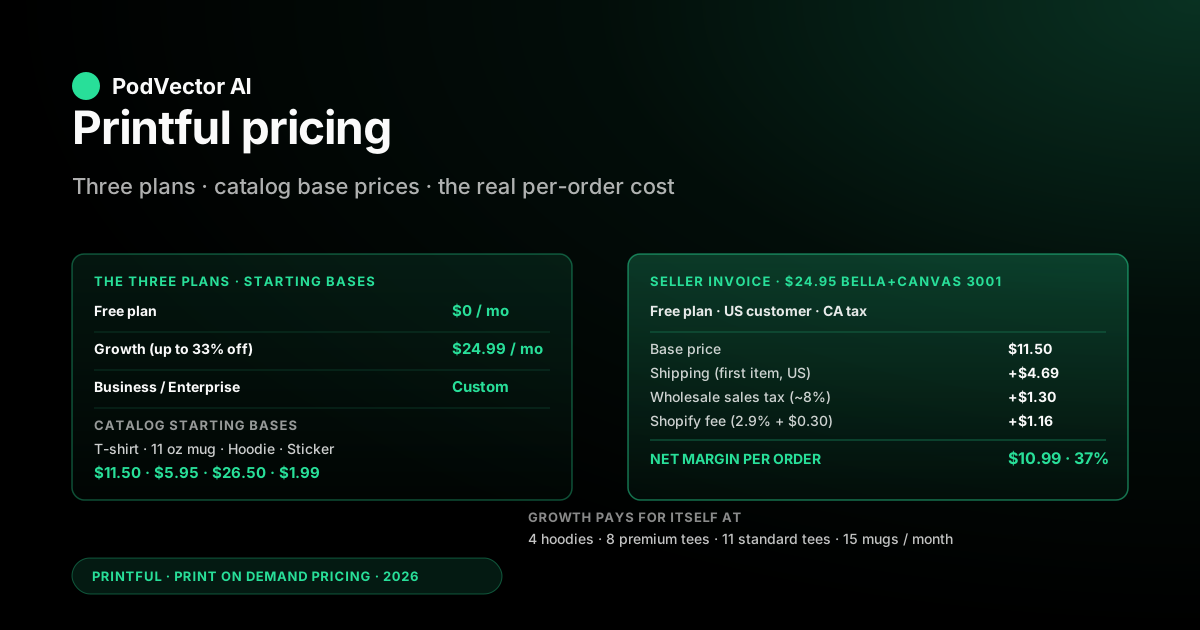
Quick Answer: Printful is free to use — no monthly fee to design products, list them, or connect to Shopify. You pay only when an order fulfills. The optional Growth plan ($24.99/month) takes up to 33% off base product prices and becomes free once you hit $12,000/year in sales.
Product base prices start at $5.95 for an 11 oz mug and $11.50 for a basic t-shirt. According to EcommerceCEO, US shipping for t-shirts starts at $3.99, and sticker/postcard shipping rose to $4.29 and phone case shipping to $4.99 following the February 2026 update. Embroidery digitization adds $2.95–$6.50 per design; extra print placements $2.20–$5.25.
This breakdown covers every Printful fee that hits a POD invoice in 2026, plan-by-plan math, and the costs operators most often miss when modeling margin.
How Printful pricing actually works
Printful runs on a pay-per-order model. You don't pay anything to design products, build your storefront, or connect Shopify — Printful only charges when a customer order triggers fulfillment.
Every order has the same three-cost stack: product base price + fulfillment shipping + any add-ons (extra prints, branding, embroidery digitization). Whatever's left after Printful's invoice — net of your own platform fees and tax — is your profit.
The Growth plan ($24.99/month) sits on top of that as an optional discount layer. It cuts the base price by up to 33% across the catalog but doesn't change the shipping rate or add-on fees like digitization. Business/Enterprise is a custom tier for high-volume brands negotiated case by case.
The pricing trap most new operators hit: assuming product base price equals your cost. It doesn't. By the time you load shipping, branding fees, sales tax on the wholesale invoice, and your storefront's transaction fees, the all-in cost is substantially higher than the catalog page suggests.
One other thing to watch: Printful applies temporary shipping surcharges during peak periods. According to CheckThat.ai, a holiday surcharge was applied from October 15, 2025 through January 17, 2026 — a fee that doesn't show in any annual pricing guide and can quietly erode Q4 margin.
Printful's three plans (Free, Growth, Business)
Printful has three tiers. The right one depends on your monthly order volume, not your store revenue.
| Plan | Monthly fee | Product discount | Best for |
|---|---|---|---|
| Free | $0 | None | New stores, under ~20 orders/month |
| Growth | $24.99 (free at $12K/year sales) | Up to 33% off base | Stores at 20+ orders/month |
| Business / Enterprise | Custom | Negotiated | Stores at 1,000+ orders/month |
Free plan. According to EcommerceCEO, the free plan gives full access to over 450 products, all 20+ ecommerce integrations, and every design tool Printful offers — there's no watered-down trial. You pay the standard base price on every order with no discounts, no branding perks, and no prioritized support.
Growth plan. $24.99/month, or free once you cross $12,000 in annual sales (Printful auto-applies the waiver). Per EcommerceCEO, Growth benefits include up to 33% off product base prices, 9% off branding services, 25% off sample orders, and free embroidery digitization on sample orders. Discounts vary by category — apparel gets the deepest cuts, small accessories the shallowest.
Business / Enterprise. For sellers doing meaningful volume — typically 1,000+ orders/month or seven-figure annual run rate. Pricing is negotiated, with deeper product discounts, dedicated account management, and custom fulfillment lanes.
The right plan switches at a specific volume threshold, not at a revenue number. On t-shirts, Growth's discount saves a meaningful amount per shirt — the $24.99 fee covers itself at a relatively small number of monthly orders. On mugs, the breakeven is around 20 orders. We'll walk the full math in the Growth plan section below.
Product base prices by category
Printful's catalog rotates regional availability — the configurator pulls the live number — but these are representative 2026 starting base prices on the US Free plan. Always verify against the live catalog before publishing a retail price.
| Category | Starting base (Free) | Starting base (Growth, approx.) |
|---|---|---|
| Unisex t-shirt (Bella+Canvas 3001) | $11.50 | ~$9.20 |
| Premium t-shirt (Comfort Colors, Cotton Heritage) | $14.95–$17.95 | ~$11.65–$13.99 |
| Pullover hoodie | $26.50 | ~$18.55 |
| Crewneck sweatshirt | $22.95 | ~$16.07 |
| 11 oz ceramic mug | $5.95 | ~$4.64 |
| 15 oz ceramic mug | $7.95 | ~$6.20 |
| Canvas print (12×12) | $18.95 | ~$15.16 |
| Phone case | $10.95 | ~$8.76 |
| Embroidered cap | $17.95 | ~$14.36 |
| Sticker (3×3 kiss-cut) | $1.99 | ~$1.59 |
A few patterns to read from the table. Hoodies get the deepest Growth discount because the base price is highest — the percentage compounds into a real-dollar gap. Mugs and stickers see the smallest absolute savings because the base prices are already low. T-shirts sit in the middle, which is why apparel-heavy stores benefit from Growth fastest.
According to EcommerceCEO, Printful rolled out a targeted price increase on February 26, 2026, affecting Cotton Heritage products (hoodies, heavyweight tees, sweatshirts, sweatpants) — product base prices went up by 0.4%–2.4% on affected items, and shipping rates on select accessories also changed. This was a targeted increase, not a catalog-wide reset. Keep that in mind when comparing to older breakdowns floating around the web.
For per-product deep dives, see the full head-to-head Printify vs Printful comparison and the companion article on Printful product pricing.
Pricing by print method (DTG, DTF, embroidery, AOP)
Printful charges the same base price for a blank product regardless of print method, but the add-on fees vary by method. Knowing which method each design needs decides whether the SKU clears margin.
DTG (direct-to-garment). The default print method for most apparel. One front print is included in the base price. A back print adds approximately $5.25. Sleeve, hood, or inside-neck prints add roughly $2.20–$3.95 each. No setup fees, no minimums.
DTF (direct-to-film). A newer method well-suited for poly-blends and dark fabrics where DTG ink absorption is inconsistent. According to inkandpxl.com, the shift from DTG to DTF printing changes the quality conversation meaningfully for sellers working with synthetic or blended garments. Pricing sits between DTG and embroidery for add-on placements — one front print is included; second placements add roughly $3.95–$5.25.
Embroidery. Used for caps, polos, and select apparel. Base product price covers one location (typically front). A second embroidery location adds approximately $4.95–$8.95. Every design requires a one-time digitization fee of $2.95–$6.50 per location, charged on the first order only. The Growth plan includes free embroidery digitization on sample orders, per EcommerceCEO. Stitch counts over 15,000 trigger a complexity surcharge.
AOP (all-over print). Sublimation print covers the entire garment. Bases are higher than DTG, but there's no per-placement fee — the whole product is one print. Growth discounts on AOP vary by category; verify in the configurator before modeling margin.
Operator rule of thumb: if your design uses fewer than three colors and sits in one location, DTG is the cheapest path. DTF wins on performance fabrics and dark-fabric designs. Embroidery wins on caps, polos, and structured wearables where perceived value justifies the digitization fee. AOP is for design-led brands where the whole-product canvas is the selling point.
Shipping costs by region and SKU
Shipping is the line item that breaks margin math more than any other. Printful charges shipping per-order, with a first-item rate and a smaller per-additional-item rate. According to EcommerceCEO, the February 2026 update raised sticker and postcard shipping from $3.99 to $4.29, and phone case shipping from $4.59 to $4.99 — check current rates in the Printful shipping calculator.
| Product | US first item | US each additional | EU first item | International (approx.) |
|---|---|---|---|---|
| T-shirt / sweatshirt | $4.69 | $2.49 | €4.49 | $5.99–$10.99 |
| Hoodie | $5.49 | $2.99 | €4.99 | $6.99–$12.99 |
| 11 oz mug | $6.49 | $3.50 | €4.95 | $8.49–$13.99 |
| 15 oz mug | $7.99 | $3.95 | €5.95 | $9.99–$15.99 |
| Canvas print (12×12) | $8.99 | $5.99 | €7.95 | $12.99–$18.99 |
| Sticker (updated Feb 2026) | $4.29 | $0.50 | €3.95 | $4.99–$6.99 |
| Phone case (updated Feb 2026) | $4.99 | $1.50 | €4.49 | $6.99–$10.99 |
Two things to internalize about shipping. First, the first-item rate is what breaks single-item orders — a $5.95 mug shipped solo costs the customer almost as much in shipping as the mug itself. Second, the per-additional-item rate is where multi-item carts make their margin back. A two-mug order ships for significantly less than two individual orders.
Printful auto-routes orders to the nearest fulfillment center — US (Charlotte, LA, Dallas), Canada, Mexico, Latvia (EU), Spain, UK, Australia, Japan. EU customers routed to the Latvia warehouse pay substantially less than the same SKU forced to ship transatlantic from the US.
Premium SKUs (color-changing mugs, certain embroidered apparel, AOP) sometimes only stock in the US, which means EU buyers eat international shipping regardless of their location. Worth checking quarterly which SKUs route where.
Also note: according to CheckThat.ai, Printful applies seasonal shipping surcharges during peak periods — factor this into Q4 margin modeling. For the complete shipping picture, see how Printful handles printing, shipping times, costs, and what to expect.
Branding, extra prints, and premium fees
Branding fees turn a generic POD product into a private-label feeling product. They're optional, but most premium-positioned stores use at least one.
| Add-on | Free plan | Growth plan (approx.) |
|---|---|---|
| Inside label print | $2.49 | ~$2.27 |
| Outside label / neck tag | $2.99 | ~$2.72 |
| Custom packaging insert | $0.50–$1.50 | ~$0.45–$1.36 |
| Branded packaging tape | $0.05–$0.10 | Included |
| Second DTG print placement (back) | ~$5.25 | ~$4.20 |
| Sleeve or hood print | ~$2.20–$3.95 | ~$1.76–$3.16 |
| Embroidery digitization (per design) | $2.95–$6.50 | $2.95–$6.50 (free on samples) |
| Second embroidery location | ~$4.95–$8.95 | ~$3.96–$7.16 |
| Premium stock image per placement | $1.00 | $1.00 |
| Pack-in / picking fee | $0.50 each | $0.50 each |
Branding fees stack fast. A t-shirt with inside label + back print + branded insert adds significantly to base cost on the Free plan — the math only works if your retail positions the SKU as premium. Note also that according to CheckThat.ai, premium stock images cost $1.00 per image per placement per item — a fee that doesn't appear in most cost models.
Digitization is the embroidery fee operators miss most often. It's charged once per design per location — so the first order using a new embroidered logo eats the $2.95–$6.50 hit, and every subsequent order on that same design is free of digitization. Stockpile new embroidery designs into one launch sample order to amortize the digitization across multiple SKUs. Growth plan members get free digitization on sample orders, per EcommerceCEO.
Warehousing for branded private-label inventory runs at a per-cubic-foot monthly rate with a minimum threshold. Below a meaningful monthly inventory turnover level, the minimum isn't worth absorbing — stay on dropship for individual SKUs.
The hidden costs spreadsheets miss
The Printful invoice is transparent. The operator's all-in cost usually isn't, because four costs hit downstream of Printful and never appear in any catalog.
1. Sales tax on the wholesale invoice. Printful charges sales tax on its invoice to you in states where it has nexus (most US states). That percentage is added to base + shipping. Exempted by submitting a resale certificate — most operators don't realize this until tax season and back-pay the lost margin out of pocket.
2. Currency conversion on non-USD orders. If your customer pays in EUR or GBP and Printful invoices in USD, Shopify Payments takes a conversion fee. Stripe and PayPal are typically higher. On EU sales, this quietly trims margin on every transaction.
3. Returns and replacements. Printful replaces defective products free, but customer-initiated returns (wrong size, changed mind) come out of your pocket — Printful doesn't restock or refund the original fulfillment cost. Budget a return rate for apparel into your margin model.
4. Seasonal shipping surcharges. As noted by CheckThat.ai, Printful applies temporary shipping increases during peak periods (e.g., Q4). These surcharges don't appear in any annual pricing guide and hit exactly when order volume is highest.
5. Failed-payment chargebacks and disputes. A lost dispute means lost product + lost shipping + a Stripe dispute fee per chargeback. Even a low chargeback rate on a modest revenue base runs meaningful losses per month in fully-loaded costs.
None of these are Printful's fault — they're the cost of running an ecommerce store. But they decide whether a retail t-shirt actually nets the margin your spreadsheet projects or something materially lower. Most models forget them entirely.
Worked example: a $24.95 t-shirt's true margin
Run the math on a single SKU end-to-end. A Bella+Canvas 3001 t-shirt sold at $24.95 retail, one front print, no branding extras, US customer, store on the Free plan.
| Line item | Amount |
|---|---|
| Customer pays (product) | $24.95 |
| Customer pays (shipping) | +$4.69 |
| Order total | $29.64 |
| Printful base (3001 t-shirt, Free plan) | −$11.50 |
| Printful shipping (US first item) | −$4.69 |
| Sales tax on wholesale invoice (varies by state) | varies |
| Shopify Payments processing fee (standard rate) | varies |
| Net margin (approximate, before tax/fees) | $13.45 on $29.64 order |
Two things to read from that table. First, the catalog base price only made up a fraction of the customer's total spend — the rest went to shipping and fees most operators forget to model. Second, the same SKU on the Growth plan (base price lower by the Growth discount) lifts net margin further, making the plan fee irrelevant at moderate volume.
Now flip the customer to the EU, routed to the Latvia warehouse. Base price holds in EUR equivalent, shipping drops to the EU rate. But you're charging the customer in EUR with an FX conversion fee, and EU sellers can recover VAT charged on the wholesale invoice — but most miss this in the first year.
Run the same exercise on a hoodie at a higher retail price and net margin climbs further. According to inkandpxl.com, hoodies, embroidered caps, and 15 oz mugs "consistently produce margin ceilings above 50% when positioned correctly in a focused niche" — apparel where perceived value exceeds the base cost premium.
To see how your real Shopify + Printful order data stacks up against these projections, see how Shopify Admin API automation can help you act on margin signals at scale.
When the Growth plan pays for itself
Growth costs $24.99/month. The breakeven question is simple: how many orders does it take for the per-product discount to cover the fee?
The math by category, using approximate Growth discount per unit:
| Category | Approx. discount per unit | Breakeven orders/month |
|---|---|---|
| Hoodie | ~$7.95 | ~4 hoodies |
| Crewneck sweatshirt | ~$6.88 | ~4 sweatshirts |
| Premium t-shirt | ~$3.30 | ~8 shirts |
| Standard t-shirt | ~$2.30 | ~11 shirts |
| Canvas print | ~$3.79 | ~7 canvases |
| 15 oz mug | ~$1.75 | ~15 mugs |
| 11 oz mug | ~$1.31 | ~20 mugs |
| Sticker | ~$0.40 | ~63 stickers |
The takeaway: Growth pays for itself fast on apparel and slowly on small SKUs. A store moving four or five hoodies a month is already winning on Growth. A store doing primarily stickers needs very high volume before the plan pays out.
Once total annual sales cross $12,000, Printful waives the Growth fee automatically — so the question becomes irrelevant for any store at scale. The plan is really a decision for the first several months of a new store, before the waiver kicks in.
One subtle point: Growth's product discount doesn't apply to embroidery digitization, picking fees, or sales tax — only the base product line. Embroidery-heavy catalogs need a higher order count before the math swings positive. Growth does, however, include free digitization on sample orders, which helps offset this for new design launches.
One additional lever that compounds with Growth: use discount code strategy to protect margin on promotional orders — the same logic applies when you're running any sale event on top of reduced base costs.
The Printify–Printful merger: what it means for pricing
This is a new development that most 2025 pricing guides don't cover. According to inkandpxl.com, Printify and Printful announced a merger in November 2024 and now operate under the combined entity Fyul. However, as of April 2026, both brands continue to run independently with separate catalogs, pricing, and accounts. Merch Titans confirms that as of their April 2026 update, both platforms still operate independently.
What this means practically for POD sellers in 2026:
- Nothing has changed operationally yet. You still log in to Printful and Printify separately. Pricing, catalogs, and fulfillment are separate.
- Watch for catalog or pricing alignment as the Fyul entity integrates. The most likely near-term impact is SKU overlap — products available on both networks may eventually route through the same fulfillment centers.
- Account integrations are not merged. Your Shopify app connections to Printful and Printify remain independent. Do not expect automatic cross-platform order routing.
- Pricing competition between the two may soften over time as the merger matures. Sellers who locked in Growth plan pricing now are protected at today's rates.
The full strategic comparison is covered in the Printify vs Printful comparison.
Printful pricing vs Printify, Gelato, SPOD
Printful isn't the cheapest POD platform on any single SKU — it's usually the most consistent. The category split:
| Aspect | Printful | Printify | Gelato | SPOD |
|---|---|---|---|---|
| Standard t-shirt base | $11.50 | Lower (varies by provider) | Higher | Lower |
| 11 oz mug base | $5.95 | Varies by provider | Higher | Lower |
| Subscription | $24.99 (waived at $12K) | $24.99 (Premium) | $24/€24 (GoldenPlus) | Free |
| Quality consistency | High (in-house) | Variable (per provider) | High (local print partners) | High (in-house) |
| Catalog size | 450+ products | 1,300+ products | Focused on print/wall art | Narrower |
| Global routing | 9 regions | Provider-dependent | 110+ countries | 3 regions |
According to Merch Titans, Printify offers over 1,300 products versus Printful's 370+ (EcommerceCEO cites 450+), with Printify's larger catalog coming from its network of print providers. According to CheckThat.ai, the Bella+Canvas t-shirt costs noticeably less with Printify's Premium subscription versus Printful, with quality variance as the trade-off.
How operators choose between them tends to break along three axes.
Base cost-sensitive stores (high volume, established designs, margin compression in a competitive niche) tend toward Printify where base prices are lower. The trade is print-quality variance — Printify's third-party network means one batch can ship perfect and the next ships off-color.
Brand-first stores (premium positioning, design-led, repeat-buyer focus) stick with Printful because in-house manufacturing keeps the quality floor predictable. A consistent product is worth the base premium when a significant share of revenue is from repeat customers.
Global stores (EU + US split, or APAC-heavy) often run on Gelato because its print-local network beats anyone on international shipping time. Base prices are higher, but shipping is faster and cheaper across regions.
For deeper context on this comparison, see Printful's official pricing page and the EcommerceCEO Printful pricing review. For the full strategic breakdown, see the Printify vs Printful comparison.
The full cluster of cost articles lives at the Printful product pricing hub.
FAQs
Is Printful free to use?
Yes. The Free plan has no monthly fee — you only pay when an order fulfills. According to EcommerceCEO, the free plan gives full access to over 450 products and all 20+ ecommerce integrations with no subscription required. The optional Growth plan is $24.99/month, waived at $12,000 in annual sales.
How much does Printful cost per month?
$0 on the Free plan. $24.99/month on Growth. Custom on Business/Enterprise. The Growth fee is automatically waived once your store crosses $12,000 in annual sales, so most stores at scale pay $0/month even on Growth.
What's the cheapest Printful product?
Kiss-cut stickers at $1.99 base (approximately $1.59 on Growth) are among the cheapest catalog SKUs. The cheapest standard apparel is a basic t-shirt. The cheapest drinkware is the 11 oz White Glossy mug at $5.95.
How much does shipping cost on Printful?
According to EcommerceCEO, US shipping for t-shirts starts at $3.99, sticker/postcard shipping rose to $4.29 following the February 2026 update, and phone case shipping rose to $4.99. Canvas prints are higher. EU shipping is typically lower because of the Latvia warehouse. Printful also applies seasonal surcharges during peak periods (e.g., Q4), per CheckThat.ai. For the complete picture, see Printful's printing and shipping costs.
Are there any hidden fees on Printful?
Not from Printful directly — its invoice is itemized. But costs hit downstream: sales tax on the wholesale invoice (exempted by a resale certificate), FX conversion fees on non-USD orders, customer-initiated returns (Printful doesn't refund original fulfillment), seasonal shipping surcharges (per CheckThat.ai), and payment dispute fees. According to CheckThat.ai, premium stock images add $1.00 per image per placement per item as well.
Does Printful charge for branding?
Yes. Inside label print, outside label/neck tag, custom packaging inserts, and pack-in fees all apply. According to EcommerceCEO, the Growth plan gives 9% off branding services. Branded packaging tape is included on Growth.
How much profit can I make per product?
It depends heavily on product category, retail price, and plan tier. According to inkandpxl.com, hoodies, embroidered caps, and 15 oz mugs can produce margin ceilings above 50% when positioned correctly in a focused niche. Lower-margin categories like stickers and basic mugs sit at the low end of the range.
Is the Growth plan worth it?
If you're moving a handful of hoodies or sweatshirts per month, or 10+ standard t-shirts, yes — the discount covers the fee at those volumes. Below those thresholds, stay on Free. Once your store crosses $12K/year in sales, Growth becomes free anyway, so the question stops mattering at scale.
Does Printful offer bulk discounts?
Not on the Free plan. Growth gives a flat per-product discount across the catalog. Business/Enterprise volume tiers negotiate further discounts, relevant above roughly 1,000 orders/month. The fastest "bulk" lever for normal-scale stores is increasing average order value (multiple items in one cart) to amortize shipping.
Can I get a sample at a discount?
Yes. According to EcommerceCEO, the Free plan gets 20% off sample orders, Growth gets 25%, and Growth members also get free embroidery digitization on sample orders. Sampling is non-optional for any premium-positioned store — color reproduction can shift between proof and final print, especially on dark fabrics and sublimation.
Does Printful charge sales tax?
Yes, in the states where it has nexus — which covers most US states. The tax is added to the wholesale invoice (base + shipping) you pay Printful. You can submit a resale certificate to exempt the wholesale invoice from sales tax, but you still need to collect and remit tax on the retail sale to your end customer.
How does Printful pricing compare to Printify?
According to CheckThat.ai, the Bella+Canvas t-shirt is meaningfully cheaper with Printify's Premium subscription versus Printful, with quality consistency as the trade-off. According to Merch Titans, Printify's base prices are generally lower, especially with their Premium plan, while Printful's Growth plan offers up to 30% off products in-house. Note that as of April 2026, both platforms still operate independently despite the announced Fyul merger. See the full Printify vs Printful comparison for a side-by-side breakdown.
What changed in Printful's February 2026 pricing update?
According to EcommerceCEO, Printful rolled out a targeted price increase on February 26, 2026, affecting Cotton Heritage products (hoodies, heavyweight tees, sweatshirts, sweatpants) — base prices rose 0.4%–2.4% on affected items. Shipping rates on select accessories also changed: sticker/postcard US shipping rose from $3.99 to $4.29, and phone case shipping rose from $4.59 to $4.99. This was not a catalog-wide reset.
Stop modeling Printful margin in spreadsheets
The catalog page is the easy part. The hard part is knowing — order by order, variant by variant — which SKUs actually clear margin after shipping, branding, sales tax, and the costs your spreadsheet forgot.
Victor connects to your Shopify store, reads every Printful order line by line into a live data warehouse, and answers the questions that actually move profit: which SKUs drop below margin after fulfillment? Where is shipping eating profit by region? Should I move to Growth this month, or wait?
Victor is an AI employee — not a static dashboard. He reads itemized Printful costs from your real order history, proposes specific actions (price changes, BXGY discounts, free-shipping thresholds on Shopify), and executes them on your approval with a full audit trail. Want to know whether your ad spend on those SKUs is actually profitable? Victor also reads your Meta Ads and Google Ads data so you can see the full picture — and when you're ready to act, he can reprice, restructure discounts, or adjust your free-shipping threshold in Shopify with one approval.
Try Victor free