
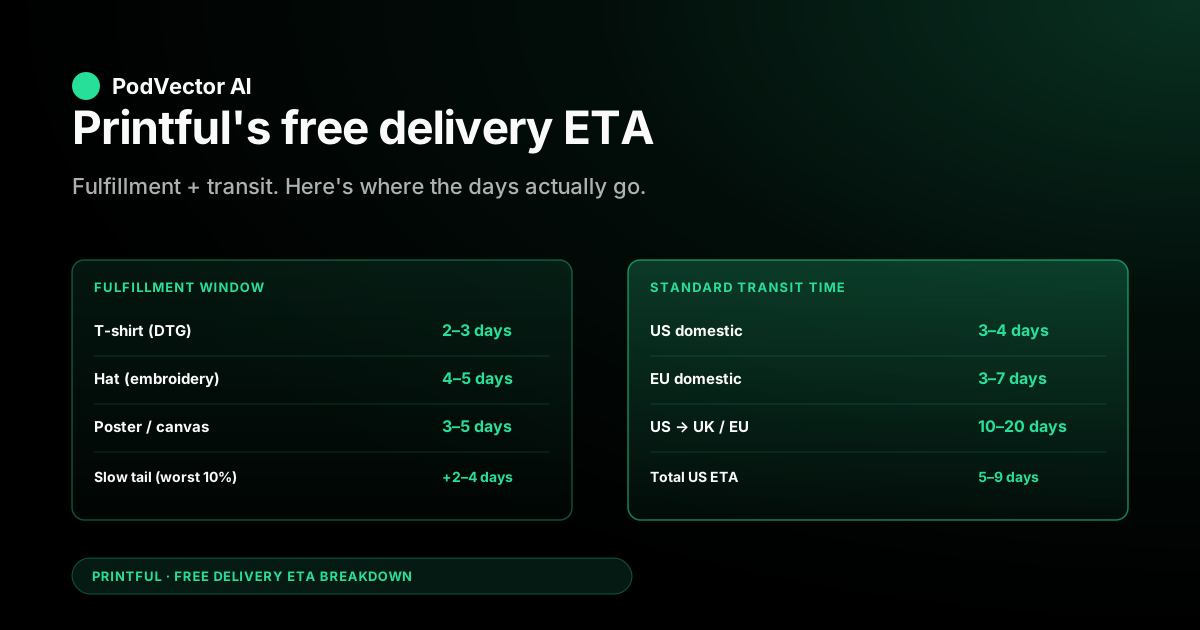
Quick Answer: Printful's "free delivery" is the standard (flat-rate) shipping tier that you absorb on your seller invoice. According to Printful's shipping page, the estimated delivery time is fulfillment + transit — typically 2–5 business days to print plus 3–4 days transit in the US/Canada or longer internationally.
So a US customer who orders today on your "free shipping" store sees Printful's t-shirt land in roughly 5–9 business days. EU domestic runs similar; transatlantic and international routes run longer.
This guide breaks down where the days actually go, why the ETA slips on multi-item carts, and how to set buyer expectations without bleeding margin on the shipping line.
The estimated delivery time formula
Printful's estimated delivery time (EDT) is a sum of two windows:
EDT = estimated fulfillment + estimated shipping.
Fulfillment is the print + pack window inside Printful's facility. According to Printful's shipping page, it averages 2–5 business days across all product categories. Shipping is the transit window after the carrier pickup — that varies by region and tier.
On the merchant dashboard and the customer's order confirmation, Printful shows a date range, not a guaranteed day. Printful's help center is clear: "the estimated delivery time is just an estimate, it's not a guarantee."
That's the part most new POD sellers miss. The ETA is a probability range, not a contract. Build your store policy around the slow end of the range, not the median.
Note: per Printful's help center, the day you place your order is not counted in the fulfillment window — the clock starts the next business day.
Fulfillment time — where the first 2–5 days go
Day one (next business day after order) is when Printful's clock starts. The moment the order is paid and pushed from your store to Printful's queue, it enters the print queue for its category.
Day two and three are the print queue. DTG (direct-to-garment) and embroidery sit in category-specific queues. Apparel typically prints on day 2 or 3 if there's no backlog.
Day four and five are quality check, packaging, and carrier handoff. Most orders hit a carrier well within the fulfillment window. The tail exists because backlogs and quality rejects can push specific orders.
According to GetFuelPod's POD provider comparison, Printful handles the large majority of orders within five business days, with most completed in just 2–3 business days.
Fulfillment time by category, in real-world averages:
| Category | Avg. fulfillment | Slow tail (worst 10%) |
|---|---|---|
| T-shirts (DTG) | 2–3 business days | 5 days |
| All-over-print | 3–5 business days | 7 days |
| Embroidery (hats, polos) | 4–5 business days | 7 days |
| Mugs and drinkware | 2–4 business days | 6 days |
| Posters, canvas, framed prints | 3–5 business days | 8 days |
| Phone cases | 2–3 business days | 5 days |
Embroidery is the slowest of the common POD categories. If your store sells embroidered hats, expect a longer total ETA than your tee-only competitors.
Black Friday through New Year's runs hot. Printful publishes deadline cutoffs each season — miss them and fulfillment alone slides to well beyond its normal window. See our breakdown of Printful's holiday shipping deadlines for cutoff dates and the specific categories that get hit hardest.
Standard shipping transit times by region
Once the order ships, the transit window varies by destination and the carrier Printful routes to. "Free shipping" on your storefront uses the flat-rate (standard) tier — not express.
Printful's help center lists the following transit windows after fulfillment:
| Route | Standard (flat-rate) transit | Express (paid upgrade) |
|---|---|---|
| US domestic | 3–4 business days after fulfillment | 1–3 business days after fulfillment |
| Canada domestic | 3–5 business days after fulfillment (up to 12 days to Atlantic region) | 1–3 business days after fulfillment |
| EU domestic (within country) | 3–7 business days | 1–3 business days |
| EU cross-border | 5–15 business days | 2–5 business days |
| US to UK / EU | 10–20 business days | 3–7 business days |
| US to Australia / NZ | 10–25 business days | 5–10 business days |
| US to India / SE Asia | 15–25 business days | 7–14 business days |
Total ETA stacks: fulfillment + transit. Per PodVector's free shipping delivery time breakdown, a US customer ordering a domestic-printed tee sees 5–9 business days total. A US customer ordering from your store but routing to a UK address sees a much longer window if Printful prints in the US.
Two routing notes that change the numbers:
First, Printful auto-routes to the closest in-stock facility. A UK customer typically prints at the Birmingham or Riga facility, not Charlotte — so transit collapses significantly. Make sure your product variants are stocked across regions.
Second, certain products only print at one facility globally. If a UK customer orders an all-over-print hoodie that only prints in Latvia, the cross-border transit eats the ETA. For region-specific timing detail, see our Printful India shipping breakdown.
Why "free" doesn't mean "fast"
The "free delivery" your customer sees at checkout is your storefront marketing. It maps to Printful's standard shipping tier on the back end — the slow tier.
Standard is what gets used when you don't pay extra for express. It's USPS Ground Advantage (US), Royal Mail (UK), Deutsche Post (DE), or a regional equivalent. These carriers run on truck routes, not air, so transit times reflect ground-level logistics.
As PodVector's free shipping guide notes, free shipping locks you out of the express tier entirely, so any customer who needs fast delivery has to pay for it themselves at checkout.
If you advertise "free shipping" and a customer expects two-day Amazon-style delivery, you'll get refund requests when the package is still in transit past that window. The friction isn't shipping speed itself — it's the expectation gap between your marketing and reality.
Two ways to handle this:
- Label your free option honestly: "Free standard shipping (5–9 business days US)" instead of just "Free shipping." Less conversion lift, fewer support tickets.
- Offer paid express alongside: Customers who need it fast self-select into express and pay for it. According to PodVector's express shipping breakdown, express premiums over standard run roughly $9.50 to $22 per order — but that cuts total US ETA considerably for the customer who needs it.
When the ETA slips (and by how much)
Printful's ETA is the median, not the worst case. Printful's help center acknowledges that orders can arrive past the EDT for reasons including fulfillment backlog, quality rejects, and carrier delays. Where do they slip most?
Fulfillment backlog (peak periods): Black Friday, holiday season, viral product spikes. Print queues fill, embroidery slips first. Add extra days during November–December.
For weather-related delays, see our breakdown of Printful's holiday shipping deadlines — the cutoff dates exist because the system can't absorb peak volume.
Quality reject: A printed tee fails QC and re-enters the queue. Adds multiple business days. You don't see this on the customer-facing ETA.
Carrier delay: USPS or DHL holds the package. Customs delay on cross-border. Weather. These are outside Printful's control but still hit your customer's experience. GetFuelPod notes that customs processing can affect final delivery times on international orders.
Address issues: Invalid address, no apartment number, P.O. box rejection. Order pauses until corrected. Adds multiple business days depending on response time.
What this means for your store policy: if Printful's ETA range is 5–9 business days, your customer-facing promise should pad that window by a few days. That covers the slow tail and dramatically reduces "where's my order" tickets.
Multi-shipment delays on mixed-category carts
Here's the part that surprises every new POD seller: multi-category orders don't arrive together.
A customer buys a tee + mug + hat on your "free shipping" store. That's three Printful shipments from three different facilities, with three independent ETAs. The tee might land before the mug, which might land before the hat — each on its own timeline.
Printful's shipping page confirms that orders may be split into multiple shipments due to product packaging requirements — some products are individually packaged to protect their shape and durability.
The categories that always ship separately as of 2026:
- Hats and caps (separate embroidery facility)
- Mugs and drinkware (sublimation facility)
- Posters, canvas, framed prints (large-format facility)
- Stickers and decals
- Phone cases and tech accessories
- Pillows, blankets, home decor
- Notebooks and journals
From the customer's view, this looks broken. They paid once, received three packages on three different days. Support tickets follow. The fix is at the storefront level — show shipment-by-shipment ETAs in your order confirmation email, not a single delivery date.
From your invoice view, this is also where free shipping silently eats margin. Three shipments mean three first-item rates billed to you. See our base cost breakdown for the rate-stacking math.
How to communicate ETAs to customers
The clearer your ETA messaging, the fewer refund and chargeback tickets you'll deal with. Three rules.
1. Communicate fulfillment + transit separately. In your order confirmation email, show both windows. "We'll print your order in 3–5 business days, then standard shipping takes additional time to reach you." Customers tolerate waiting when they understand the process.
2. Use the slow end of the range. Don't advertise a fast delivery figure if Printful's ETA window has a longer tail. Quote the outer edge. Under-promising and over-delivering converts as well as over-promising, and you don't generate refund requests.
3. Auto-trigger a tracking email when shipped. Most Printful integrations push tracking numbers back to your store automatically. Make sure your store actually sends a follow-up email at "shipped" status. Customers who can self-serve tracking generate far fewer "where's my order" tickets.
For a deeper look at how checkout experience and shipping policy affect conversion, see our guide on ecommerce checkout conversion rate optimization.
Free delivery's hidden margin impact
The shipping time question and the shipping cost question are linked. When you offer free delivery, you absorb Printful's flat shipping fee on every order.
According to PodVector's Printful shipping cost breakdown, Printful pushed targeted shipping rate increases in 2026 — specifically hitting accessories, not apparel — so the shipping line on mixed carts is moving up over time.
The core margin math: every order where you absorb shipping means that line item comes straight off your gross margin. On low-price items like stickers or decals, absorbed shipping can push the order into negative territory entirely.
Three setups and their trade-offs:
| Setup | Customer impact | Margin impact |
|---|---|---|
| Free shipping (absorbed) | Zero friction at checkout | Full shipping cost comes off margin every order |
| Free shipping baked into price | Higher sticker price, same checkout feel | Margin preserved — but price competitiveness may suffer |
| Threshold (free over a spend target) | Incentivizes larger carts | Multi-item orders offset shipping; single-item orders pay shipping |
The absorbed-shipping setup is survivable on apparel but can be fatal on low-margin accessories where Printful's per-item shipping rate rivals or exceeds the product's own base cost.
The fix is to bake shipping into product pricing or run a threshold. For deeper margin math see our 2025 t-shirt base price breakdown and the Bella+Canvas 3001 cost breakdown for category-by-category numbers. For a cross-supplier comparison, see our Printify t-shirt cost and profit breakdown.
For the broader cost picture across categories, the Printful costs and charges cluster indexes every rate and fee. The Printful topic hub covers everything else — service quality, integrations, alternatives.
To understand what absorbed shipping does to your real contribution margin (not just gross margin), see our guide on how to get contribution margin for an ecommerce POD store.
Tracking it live
Free shipping margin is one of those metrics that looks fine in the spreadsheet and goes sideways in production. Carrier rates climb — PodVector's Printful shipping cost breakdown notes Printful pushed a batch of rate changes live on June 4, 2026. Product mix shifts toward multi-shipment categories. The free-shipping threshold you set last year may no longer be covering Printful's invoice on a typical cart as those rates move.
The standard playbook is to export Printful invoices monthly, drop them into a sheet, and check whether the shipping line has crept. Works at low order volume. Breaks as you scale.
A live data warehouse changes the math. Pipe Shopify orders, Printful invoices (product + shipping), and ad spend into one place and you can answer "which SKUs went negative this week after absorbed shipping" without touching a spreadsheet.
That's what Victor does for POD sellers. He reads your Shopify orders and Printful invoices in real time, surfaces SKUs where absorbed shipping has compressed margin, and proposes a price or threshold change you approve in one click — then executes it on Shopify.
You can also see Printful's own published ETA windows on the Printful shipping page for the latest by category and destination.
FAQs
What is the estimated shipping time for Printful's free delivery option?
Printful's free/standard delivery is the flat-rate tier. Per Printful's shipping page, total EDT is fulfillment (2–5 business days) plus transit. US domestic transit runs 3–4 business days after fulfillment, so a typical US order lands in roughly 5–9 business days total.
Does Printful actually offer free shipping?
No. Printful charges flat shipping rates per category and destination on every seller invoice. "Free shipping" is what you can offer your customer — Printful still bills you the standard rate. See our breakdown on Bella+Canvas 3001 base cost for the underlying rate structure.
How long does standard shipping take after fulfillment?
Per Printful's help center: US domestic flat-rate runs 3–4 business days after fulfillment. Canada standard DDP runs 3–5 business days (up to 12 days to the Atlantic region). International routes vary widely by destination.
Why does my "free shipping" order show multiple delivery dates?
Because Printful ships from multiple facilities. A tee, mug, and hat in one cart triggers three separate shipments with independent ETAs and tracking numbers. Each arrives on its own timeline — typically within a few days of each other, but not simultaneously.
Can I get Printful to ship faster on a free-shipping order?
No, free/standard uses the cheapest carrier tier. To upgrade, switch the order to express shipping. Per PodVector's express shipping breakdown, express premiums over standard run roughly $9.50 to $22 per order, but cut transit to 1–3 business days after fulfillment for US domestic orders.
How accurate is Printful's estimated delivery time?
The ETA is a median range, not a guarantee. Printful's help center confirms orders can arrive past the EDT due to fulfillment backlog, QC rejects, carrier delays, or address issues. Build your customer-facing promise around the outer end of the window, not the median, to reduce support tickets.
What's the slowest part of the Printful free delivery timeline?
Fulfillment is the bigger variable for US domestic — 2–5 business days vs. 3–4 days transit. For international, transit dominates — fulfillment is still 2–5 days, but transit can run well beyond that depending on destination. International ETAs are mostly about how long the package sits in the carrier network.
Does Printful's holiday season change the estimated delivery time?
Yes, significantly. Fulfillment queues extend during November–December as order volume surges. Printful publishes cutoff dates each year — orders placed after those dates won't arrive by Christmas under standard shipping. See our holiday deadlines breakdown.
How do Printful shipping rate changes in 2026 affect free-shipping margin?
According to PodVector's Printful shipping cost breakdown, Printful rolled out targeted rate increases in early 2026 and pushed a broader batch of changes live on June 4, 2026 — specifically affecting accessories. If you offer free shipping on accessory categories, revisit your pricing or threshold to account for the updated rates.
Free delivery is a margin question, not just an ETA question
Your customer sees "free shipping, arrives in roughly a week." Your invoice sees the shipping cost absorbed on every order — and that number has been moving up as Printful updates rates on accessories and other categories.
Victor reads your Shopify orders and Printful invoices in real time. He flags SKUs where absorbed shipping has gone negative, proposes a threshold or price change, and executes it on Shopify after you approve.
Connect your store in a few minutes.
Try Victor free