
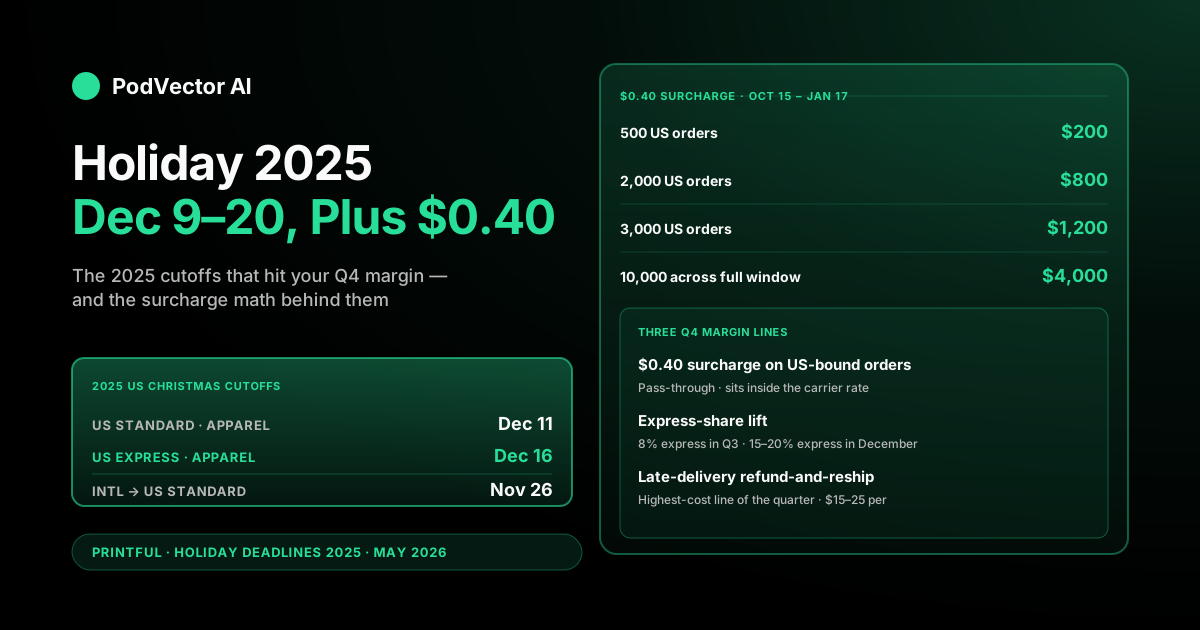
Quick Answer: Printful's 2025 holiday cutoffs for US Christmas delivery ran roughly December 9 to December 20, with apparel from US facilities targeting Dec 11 standard / Dec 16 express. International-to-US orders had to ship by late November on standard. Mixed-category orders defaulted to the earliest deadline in the cart.
A $0.40 USD holiday shipping surcharge applied to every US-bound order from October 15, 2025 through January 17, 2026, on top of normal carrier rates — regardless of shipping method.
The same cadence is the safest planning baseline for 2026. Cutoffs shift by a day or two each year as the calendar moves, but the structural pattern (Dec 9–20 window, ~$0.40 surcharge, intl-to-US ~2 weeks earlier) holds.
The 2025 holiday cutoffs at a glance
Printful's 2025 holiday deadlines published in mid-October and held through the Q4 push, with minor day-shifts as carriers updated their own projections.
The high-level window that ran across most of the catalog:
- Standard, US-to-US (apparel): ship by Dec 11 for Christmas
- Express, US-to-US (apparel): ship by Dec 16 for Christmas
- Standard, international-to-US (apparel): ship by Nov 26 for Christmas
- Express, international-to-US (apparel): ship by Dec 14 for Christmas
- Standard, intl-to-US (knitwear): ship by Nov 15 — earliest of the year
- Home and living, US-to-US: mostly tracked apparel (Dec 11 standard / Dec 16 express)
The single rule that bit the most sellers: mixed-category orders default to the earliest deadline in the cart. A buyer adding a knitwear sweater to a t-shirt order in early December pushed the whole order past the cutoff, and Printful did not split it.
For the authoritative per-country and per-product matrix, the Printful holiday order deadline guide is the live source. It updates as carriers re-quote.
Why the deadlines move every year
Three forces push the dates:
Calendar geometry. Christmas always falls on Dec 25, but the number of business days between the late-November holiday surge and that date shifts by one or two each year. A 2025 calendar with Thanksgiving on Nov 27 gave four full business weeks of pre-Christmas runway. A 2026 calendar with Thanksgiving on Nov 26 gives roughly the same — but the prior year's Nov 27 anchor pushes Cyber Monday into Dec 1, compressing the front end of December.
Carrier capacity quotes. UPS, FedEx, and USPS publish updated Q4 capacity projections every September. When the carriers see a softer ad market or more freight slack, they extend their cutoffs. When they see surge risk (severe weather precedents, labor disruption), they pull them in. Printful adjusts the published deadlines to match.
Printful's own fulfillment load. Facility-level capacity at the Riga, Charlotte, Tijuana, and Los Angeles print shops shifts year over year. A new facility opening or a new product category in heavy seasonal demand changes the realistic fulfillment floor for that quarter.
None of these move the deadline by more than a few days. The Dec 9–20 window for US delivery is structurally durable. Plan against it.
The $0.40 holiday shipping surcharge
From October 15, 2025 through January 17, 2026, Printful charged a flat $0.40 USD surcharge on every order with a US destination address. The surcharge applied to both Standard and Express, regardless of product category or order size.
Forty cents looks trivial on a single order. At order volume it isn't.
- 500 US orders in Q4: $200 in surcharge
- 2,000 US orders in Q4: $800 in surcharge
- 10,000 US orders across the full Oct 15 – Jan 17 window: $4,000 in surcharge
The surcharge is a pass-through cost — it shows up on Printful's invoice but rarely gets reflected on the storefront. That means it comes straight out of seller margin unless you raise prices or the shipping rate to absorb it.
Most sellers don't reprice for Q4. The $0.40 line sits inside the carrier-quoted live rate and gets bundled into the shipping invoice, where it's hard to see without itemizing by date. The result is a small but persistent margin drag from mid-October through mid-January that operators only notice at year-end reconciliation.
For the broader picture of how shipping cost interacts with product cost on Printful, the Printful product pricing breakdown and the 2025 t-shirt base cost guide sit alongside this one in the cost cluster.
Domestic US fulfillment: realistic 2025 cutoffs
Orders fulfilled from Printful's US facilities (Charlotte, Los Angeles, Dallas) carried the most forgiving deadlines because there was no cross-border transit step.
The published 2025 windows for US-to-US delivery:
- Apparel, standard shipping: Dec 11 final day to order
- Apparel, express shipping: Dec 16 final day to order
- Home and living (mugs, posters, blankets), standard: Dec 11
- Home and living, express: Dec 16
- Embroidery: Dec 8 standard, Dec 13 express — longer fulfillment floor pulled it forward
- All-over-print apparel: Dec 9 standard, Dec 14 express
The realistic story for a seller running a Shopify or WooCommerce storefront with live rates: the standard option at checkout cleared Christmas if the order landed before midnight on Dec 11, and the express option held the line through Dec 16. Anything later was a hope-and-pray.
If you ran flat-rate shipping with a paid express tier, the express cutoff was the only meaningful guarantee. Standard orders after Dec 11 went into 2026 delivery, and the customer assumed otherwise unless your checkout copy said so explicitly.
For sellers debating whether to wire live rates into Shopify or WooCommerce ahead of Q4, the Shopify live rates guide and the WooCommerce live rates guide walk through the integration. The live rates overview covers the cross-platform pattern.
International-to-US: the earlier deadlines
When the customer was in the US but the order routed through Printful's Riga (Latvia) or Barcelona (Spain) facilities — common when US facilities were at capacity, or when the SKU was only stocked in EU — the cutoffs ran two to three weeks earlier.
The 2025 windows for international-fulfilled orders shipping to a US address:
- Apparel, standard: Nov 26
- Apparel, express: Dec 14
- Home and living, standard: Nov 26
- Home and living, express: Dec 14
- Knitwear, standard: Nov 15 — the year's single earliest deadline
- Embroidery, standard: Nov 22, express Dec 12
Two cost dynamics changed for these orders.
The route was longer. A Riga-fulfilled hoodie crossing the Atlantic on standard ran 8–12 business days transit on top of fulfillment. Express compressed that to 4–7 business days at a premium of $20–$40 over the standard rate.
The $0.40 surcharge still applied. The destination, not the origin, was what triggered the surcharge. An EU-fulfilled order to a US customer carried the surcharge just like a US-fulfilled one.
Sellers with most of their catalog routed through EU facilities in 2025 effectively had a Black Friday cutoff for Christmas delivery, not a December one. A Nov 26 standard deadline lands the Wednesday before Thanksgiving — the same week you're running peak promo.
Embroidery, knitwear, and edge-case categories
Two categories carried materially earlier deadlines than the rest of the catalog.
Embroidery. The fulfillment floor for embroidered apparel runs 4–7 business days versus 2–5 for DTG-printed apparel. That pushed the standard cutoff to roughly Dec 8 domestically and Nov 22 internationally — a full three days earlier than the standard apparel deadline. If embroidery was a meaningful share of your catalog, your effective Q4 cutoff was the embroidery date, not the apparel date.
Knitwear. Bulkier packaging plus seasonal demand surge means knitwear (sweaters, knit hats, beanies) consistently carries the earliest cutoffs. The 2025 Nov 15 international-standard deadline was the harshest of the year. Sellers running knitwear listings should treat mid-November as the structural backstop, not December.
A few other edge cases worth flagging from the 2025 cycle:
- Custom packaging adds a day to fulfillment. Branded packaging, custom neck labels, and packing inserts each pushed the realistic cutoff back by 24 hours.
- Multi-facility orders. If your store routed orders across both US and EU facilities, the cutoff applied per facility — meaning the same SKU could clear Christmas from Charlotte but miss it from Riga.
- High-AOV bundle orders. Orders combining apparel with embroidery or knitwear took the earliest applicable deadline. Bundles structurally underperformed singletons on Q4 timing.
For the wider context on how international fulfillment interacts with shipping windows, the Printful shipping cluster covers per-region timing.
How holiday shipping ate your 2025 Q4 margin
The cost story of Q4 holiday shipping is not the surcharge alone. Three lines move at once, and most operators only see the blended result at the end of January.
Line one: the $0.40 surcharge on volume. A store with 3,000 US orders across the Oct 15 – Jan 17 surcharge window absorbed $1,200 in surcharge. On a 20% blended unit margin and a $25 AOV, that's effectively 80 orders of pure margin gone.
Line two: the express-share lift. Q4 shoppers buy more express than the rest of the year. A store that runs 8% express in normal months often runs 15–20% express in December. Express premiums are 2–4× standard, so the blended shipping cost per order climbs even if the carrier rates themselves haven't moved. If the seller passes the rate through transparently, the customer pays. If the seller absorbs any of it (flat-rate stores, free-shipping promo stores), the margin hit shows up here.
Line three: refund and reship costs on late deliveries. The orders that miss the cutoff and arrive after Christmas are the highest-cost line of the quarter. They typically refund at 3–5× the rest-of-year rate, and the express-reship to recover the customer eats another $15–$25 per order. A store that misses 50 orders to late delivery in Q4 can easily lose $2,000–$4,000 in refund-and-reship margin on those orders alone.
None of these lines show up cleanly on a per-order P&L. They show up as a blended Q4 margin dip that gets attributed to "the holidays" without anyone itemizing which line caused which.
Operators who saw the leak in 2025 had one thing in common: they had itemized their shipping line by date, service tier, and order outcome (delivered on time vs. late vs. refunded). Without that breakdown the surcharge, the express lift, and the late-delivery refund cost get bundled into a single number and the fix gets deferred to next year.
Planning the 2026 holiday season with 2025 data
The 2025 data is the cleanest input you have for 2026 planning. Three uses worth running now, in May 2026, rather than in October when the queue is hot.
Lock the cutoff calendar early. Take the 2025 dates (Dec 11 standard / Dec 16 express US domestic, Nov 26 standard / Dec 14 express international-to-US) and assume the same cadence holds for 2026. Communicate the cutoffs on product pages and in your shipping policy by November 1, not December 5. The 2025 sellers who lost orders to late delivery overwhelmingly waited until after Thanksgiving to publish their cutoffs.
Reprice ahead of the surcharge. If Printful runs a $0.40 surcharge again for the 2026 holiday season — historically they have — bake it into your storefront price or shipping rate before mid-October. Sellers who absorbed it in 2025 saw a 1–2% blended margin drag for three months. The fix is a $0.40 price bump on US-bound listings between Oct 15 and Jan 17.
Pull embroidery and knitwear cutoffs forward in your marketing. If those categories are in your catalog, treat mid-November as the working backstop and run any "last chance for Christmas" messaging on those SKUs by Nov 10. The sellers who saw the biggest Q4 lift on embroidery did exactly this — they marketed the Nov cutoff in early November as a scarcity driver, not as a Dec problem.
The reusable lesson from 2025: the cost lines that ate margin are knowable in advance. The surcharge, the express-share lift, and the late-delivery refund rate are all measurable in the data you already have from the prior holiday. The work is itemizing them, not predicting them.
For the full Printful operator picture across product, fulfillment, and shipping lines, work back through the Printful operator library.
FAQs
What were the Printful holiday shipping deadlines for 2025?
For US delivery the headline dates were Dec 11 (US-domestic standard apparel), Dec 16 (US-domestic express apparel), Nov 26 (international-to-US standard apparel), and Dec 14 (international-to-US express apparel). Embroidery, all-over-print, and knitwear each ran a few days earlier because of longer fulfillment floors. The full per-product matrix lived on Printful's holiday order deadline guide.
How much was the Printful 2025 holiday shipping surcharge?
$0.40 USD per order to any US destination, in effect from Oct 15, 2025 through Jan 17, 2026. It applied to both Standard and Express and to every product category. Forty cents per order is small but compounds across Q4 volume — 3,000 US orders absorbs $1,200 in surcharge, straight from margin if not repriced.
Did the Printful holiday surcharge apply to international orders?
No. The surcharge applied only to orders with a US destination address. International-to-international and US-to-international orders were not subject to the $0.40 surcharge. Origin facility did not matter — destination did. An EU-fulfilled order shipping to a US customer carried the surcharge.
What's the earliest Printful holiday deadline in 2025?
Knitwear shipping from international facilities to US customers via standard had to be placed by Nov 15, 2025 — the single earliest deadline of the year. The combination of bulkier packaging, longer transit, and seasonal demand pulled that date forward more than three weeks ahead of the headline apparel cutoff.
What happened if an order missed the Printful 2025 holiday cutoff?
Printful fulfilled the order on its normal schedule, which meant delivery landed after Christmas. The seller had no recourse to expedite past the cutoff — the deadline was a carrier promise, not a fulfillment override. The economically costly outcome was usually a refund-and-reship, where the seller refunded the late order and shipped a replacement on express at their own cost.
Do Printful holiday deadlines apply to mixed-category orders?
The earliest deadline in the cart applies to the whole order. A buyer adding a knitwear sweater to a t-shirt order in early December pushed the entire order past the cutoff. Printful did not split mixed orders to honor different deadlines per item. The defensive move is to flag this on the checkout page or in the cart drawer once the cutoff window opens.
When does Printful publish holiday deadlines each year?
The deadlines publish mid-October once the carriers have confirmed Q4 capacity projections. For 2025 the dates went live the second week of October and held with minor adjustments through early December. The 2026 dates will likely follow the same publishing window — expect them around Oct 10–17, 2026.
What's the best way to communicate the cutoffs to my customers?
Add a banner to your storefront and product pages by Nov 1 that lists the standard and express cutoffs for your top-shipping region. Embed the cutoff in cart and checkout copy once the deadline is within seven days. Send an email reminder list at T-minus-7, T-minus-3, and T-minus-1 day for each cutoff tier. The 2025 sellers who saw the lowest Q4 refund rate followed this cadence.
Will Printful run the $0.40 holiday surcharge again in 2026?
Printful has not committed publicly, but the surcharge has run for multiple consecutive years and is structurally a pass-through of carrier Q4 capacity pricing. The defensive plan is to assume it runs again from Oct 15, 2026 through mid-January 2027 and to reprice US-bound listings accordingly. Reverse the reprice in mid-January if Printful confirms no surcharge for the year.
How do I track holiday shipping margin without manual reconciliation?
Itemize the shipping line on your Printful invoice by date, service tier, and order outcome (delivered on time, delivered late, refunded). Most stores never run this breakdown because the invoice is monthly and the granularity isn't there by default. The data exists in your store and Printful order exports — the work is joining the two and tagging the surcharge window separately.
Q4 is the quarter where shipping margin quietly slips. The $0.40 surcharge, the express-share lift, and the late-delivery refund rate all compound — and most operators don't see the leak until late January.
Printful's invoice tells you what you paid. It doesn't tell you how much of your Q4 margin went to the surcharge, how the express share shifted week over week, or how many orders missed the cutoff and refunded.
Victor connects to your Printful and store accounts and itemizes every shipping line by date, service tier, and outcome. Ask "how is the 2025 surcharge eating my Q4 margin?" or "which holiday orders missed the cutoff?" and get the answer in plain English against the live data — no manual reconciliation, no January surprise.
Try Victor free