
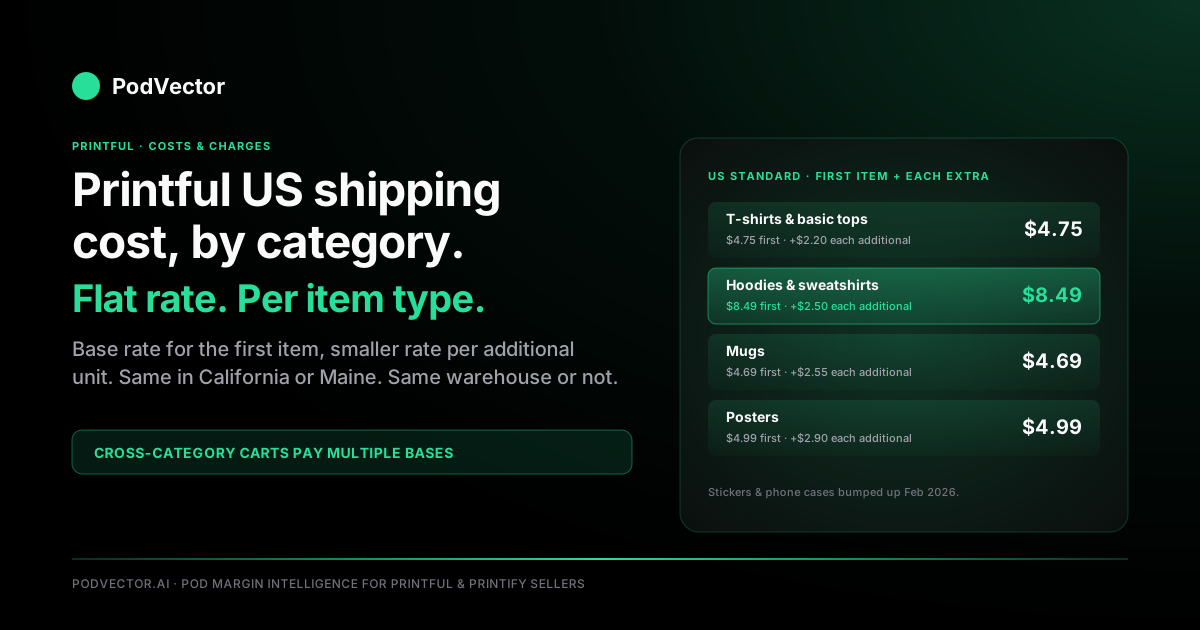
Quick Answer: Printful uses flat US shipping rates with a "first item + each additional" structure — per Printful's official shipping page, a US t-shirt ships at $3.99 first item / $1.90 each additional, a hoodie at $7.19 first / $1.80 additional, and a mug at $4.69 first / $2.55 additional. The rate is set by product category, not by which fulfillment center ships the order.
The catch for POD sellers: shipping is one of three line items (product + shipping + your margin) that determines whether a SKU is profitable. A $24 t-shirt with a ~$9.50 product cost and $3.99 shipping leaves a thin gross margin — before platform fees, ads, and returns.
This breakdown gives you the full per-category table, real cart math, the February and June 2026 rate changes, and the margin lens most "Printful shipping" posts skip.
How Printful US shipping actually works
Printful uses a flat-rate per-region shipping model inside the US. Per Printful's own shipping guide, the flat shipping rate is location-based and stays the same regardless of which facility fulfills the order.
That matters because Printful runs multiple US facilities (Charlotte NC, Los Angeles CA, Dallas TX, and others). Two customers in the same state can be fulfilled from different facilities — and they'll still pay the same flat shipping rate.
The structure is: base rate for the first item, plus a smaller "additional item" rate for each extra unit of the same category.
So shipping two t-shirts in one order costs less than ordering them separately. The discount only applies inside a single order — if your customer adds the second tee in a separate checkout, they pay the full base rate again.
Cross-category orders (e.g. a tee + a hoodie) often get split into two shipments, which means you pay two base rates. More on this in the mixed-cart section below.
One more thing worth knowing: Printful adjusts its shipping prices in batches. In 2026 alone there have been two separate rounds of changes — February and June — so check Printful's shipping price updates page after any major catalog expansion.
Full US shipping rate table (by product category)
These are Printful's US standard shipping rates as of August 2026, reflecting both the February 26 and June 4, 2026 updates. Rates sourced from Printful's official shipping page.
| Product category | First item | Each additional |
|---|---|---|
| T-shirts & basic tops | $3.99 | +$1.90 |
| Hoodies & sweatshirts | $7.19 | +$1.80 |
| All-over print basics | $4.49 | +$2.00 |
| All-over print jerseys | $4.75 | +$2.20 |
| All-over print hoodies | $7.99 | +$2.50 |
| Kids clothing | $4.49 | +$2.00 |
| Youth hoodies | $7.99 | +$2.50 |
| Knitted sweaters | $11.49 | +$5.75 |
| Sherpa jackets | $12.99 | +$4.00 |
| Hats & beanies | $4.49 | +$2.00 |
| Tote bags | $4.49 | +$2.00 |
| Backpacks | $10.49 | +$4.50 |
| Duffle bags | $13.49 | +$4.00 |
| Weekender bags | $7.99 | +$2.50 |
| Face coverings | $4.49 | +$2.00 |
| Mugs | $4.69 | +$2.55 |
| Posters | $4.99 | +$2.90 |
| Canvas prints (small) | $5.99 | +$3.50 |
| Phone cases | $4.99 | +$2.00 |
| Stickers / postcards / patches | $4.29 | +$1.25 |
Always verify against Printful's live shipping page before finalizing pricing — Printful publishes a "Pricing changes" log when rates shift, and 2026 has already had two rounds. Accessories move more often than apparel.
Comparing providers? According to a May 2026 PodVector rate comparison, Printful's each-additional rate ($1.90) is the cheapest in the t-shirt category — Printify providers typically run $2.50–$2.69 additional per item. On a five-tee order, that difference compounds. See our Printify pricing breakdown for a full side-by-side.
Real cart math: 1 tee vs 3 tees vs mixed cart
The rate table is half the story. The other half is what happens in a real customer cart.
Scenario 1 — Single t-shirt: $3.99 shipping (per Printful's shipping page). Standard delivery 2–5 business days transit.
Scenario 2 — Three t-shirts, same order: $3.99 (first) + $1.90 × 2 (additional) = $7.79 total. Same parcel.
Scenario 3 — One t-shirt + one hoodie: $3.99 (tee base) + $7.19 (hoodie base) = $11.18 total. Cross-category orders typically don't share the discounted "additional item" rate because they often ship from different facilities or in different parcels.
Scenario 4 — One t-shirt + one mug + one phone case: $3.99 + $4.69 + $4.99 = $13.67 total. Three base rates, three separate items, almost guaranteed split shipments.
This is where bundling strategy matters. A 3-tee bundle ships for $7.79. A tee + mug + case "starter bundle" ships for $13.67 — nearly double the shipping cost on similar retail value.
If you build product bundles, same-category bundles ship cheaper. Different-category bundles eat margin. For tactics to increase average order value through bundling, see our guide on increasing AOV with AI.
2026 rate changes — February and June updates
Printful has pushed two rounds of shipping rate changes in 2026. Knowing both matters for margin planning.
February 26, 2026 — accessories increase
The February round hit accessories and niche categories, not the volume products. Per PodVector's rate tracking:
- Stickers, postcards, patches: $3.99 → $4.29 (first item)
- Phone cases: $4.59 → $4.99 (first item)
- Knitted sweaters: $10.49 → $11.49 (first item)
What did not change in February: t-shirts, hoodies, mugs, posters, and the rest of the core catalog. Bella + Canvas and Gildan apparel — the bread-and-butter SKUs for most POD stores — held flat in that round.
June 4, 2026 — broader batch update
According to PodVector's June 2026 shipping guide, Printful pushed a broader batch of first-item and additional-item price changes on June 4, 2026 — published with a downloadable old-vs-new list on Printful's shipping price updates page. This round affected apparel categories including t-shirts and hoodies, which is why the rates in this article's table differ from pre-June figures you may see on older posts.
The June round is the key reason the "flat $4.75 tee" figure many articles still cite is now stale. The updated US t-shirt rate is $3.99 first / $1.90 additional, per Printful's current rate card.
Rate changes like these are uneven by category and region. As noted by PodVector's shipping guide, stores with a single flat shipping table at checkout silently absorb the deltas on every affected order — nothing breaks, no alert fires, your margin just gets thinner.
If you sell volume in stickers, phone cases, or knitted products, your shipping cost has crept up across both rounds. Worth re-running your margin math on those SKUs. Our net profit margin benchmark guide gives you a baseline to check against.
Express shipping: when it's worth the premium
Printful offers Express shipping (1–3 business days in the US) through DHL and FedEx at a premium over standard. Per PodVector's full shipping breakdown, express shipping adds roughly $9.50–$22 per order on top of standard rates, depending on product type and weight.
When express makes sense:
- Holiday/peak season catch-up. You missed the standard cutoff and need to deliver by a date.
- Premium pricing tier. You charge customers extra for "rush" and pocket the spread.
- Reorder for a missed/damaged unit. Make the customer whole fast.
When it doesn't: as a default option on a standard catalog. Most POD customers won't pay a large premium to save a few days on a standard tee. Standard is the sane default.
One nuance: for embroidered orders, fulfillment time is already longer. Express shipping on an embroidered item can compress transit but not production, so the total delivery window improvement is smaller than customers expect. Set expectations on your shipping policy page accordingly.
The POD margin problem: where shipping eats your profit
POD shipping doesn't show up as a separate "cost" on most platform dashboards. It gets bundled into "cost of goods" or "fulfillment" line items, and the per-SKU breakdown disappears.
Run the math on a typical t-shirt SKU (illustrative example; your actual costs will vary by product and ad spend):
| Line item | Amount |
|---|---|
| Retail price (customer pays) | $24.00 |
| Product cost (example: Bella + Canvas tee, Printful) | −$9.50 |
| Shipping cost (1 unit, US — per Printful's rate page) | −$3.99 |
| Platform fees (Shopify processing, approx.) | −$1.00 |
| Ad cost (example CAC) | −$6.00 |
| Net margin per unit | $3.51 |
That single-tee margin is thin. A single returned unit erases several sales of the same SKU. Conversion rate improvement and average order value are the two levers that move this number most — see our guides on CRO techniques and average checkout completion rates.
Same SKU, 3-tee bundle at $60 retail (illustrative):
| Line item | Amount |
|---|---|
| Retail price | $60.00 |
| Product cost (3 × $9.50 example) | −$28.50 |
| Shipping cost ($3.99 + $1.90 × 2, per Printful's rate page) | −$7.79 |
| Platform fees (approx.) | −$2.04 |
| Ad cost (single CAC, multi-unit) | −$6.00 |
| Net margin per order | $15.67 |
The bundle ships at $7.79 instead of $11.97 (3 × $3.99 if sold separately), and amortizes the ad cost across three units. Same product, materially higher take-home per order.
This is the kind of math that lives across your orders, products, and ad-spend data — and almost never in one place. Static POD dashboards show you order count and revenue, not "which SKUs sit below their breakeven shipping ratio." For a deeper look at how margin benchmarks should inform your pricing, see our net profit margin benchmark.
If you want this kind of itemized profitability view, you either build it in a spreadsheet (most sellers do, none stay current), wire your stack into a unified data layer that joins Printful's fulfillment data to your store and ads, or use an AI employee that does this on demand. The CTA box at the bottom links to ours.
Pass-through, absorb, or build-in: charging your customer for shipping
Three ways POD sellers handle shipping at checkout. Each has a tradeoff.
Pass-through: charge the customer Printful's exact rate at checkout. Cleanest accounting. But it makes the cart total visible — a $24 tee with $3.99 shipping reads as $27.99, and conversion can drop at the shipping reveal.
Absorb (free shipping): advertise "free shipping," eat the cost yourself. Conversion goes up. But the cost is now on your P&L every order, and customers who buy mixed carts cost you more than the average. Hard to model without per-cart visibility.
Build-in: raise retail prices to cover average shipping, then advertise "free shipping." Best of both — higher conversion and covered cost — IF your retail price tolerates it. A $24 tee that becomes $28 to absorb shipping needs to test whether conversion stays. For conversion benchmarks to calibrate against, see our checkout completion rate guide.
Most successful POD stores use build-in for hero SKUs and pass-through for low-margin accessories. The wrong move is to pick one and apply it to the whole catalog without checking the math per category. A free-shipping threshold is another lever worth modeling — Victor can raise your Shopify free-shipping threshold as an approval-gated action once you've run the numbers.
For a broader look at discount and shipping strategies that protect margin, see our guide on POD strategy with PodVector.
FAQs
Does Printful offer free US shipping?
No — Printful charges shipping on every US order. "Free shipping" exists only if you (the store owner) absorb the cost. Per Printful's pricing page, the Growth plan ($24.99/month, free once you hit the annual sales threshold) gives discounts on product fulfillment — but not on shipping itself.
Why does my customer's order ship in two parcels?
Cross-category orders (e.g. a tee + a poster) often fulfill from different Printful facilities and ship separately. You're billed two base shipping rates. Same-category orders ship together at the discounted "additional item" rate.
Are Printful US shipping rates the same in every state?
Yes — Printful uses flat-rate US pricing by product category, not zone-based pricing. A tee shipping to California costs the same as one shipping to Maine.
Does Printful ship to PO Boxes, APO, or FPO in the US?
Printful supports APO/FPO addresses for most products, but PO Box support varies by carrier. Express shipping through DHL or FedEx generally won't deliver to PO Boxes. Stick to USPS/standard for those addresses.
How long does standard US shipping take?
Transit is typically 2–5 business days after fulfillment. Fulfillment itself runs 2–5 business days for most apparel. Total door-to-door on standard: roughly 4–10 business days from order placement. Express compresses transit to 1–3 business days but doesn't reduce fulfillment time.
Can I see real-time Printful shipping rates from my store?
Yes — Printful integrates with Shopify and most major platforms to pass live shipping rates into checkout. Enable "real-time rates" in your Printful integration settings. The alternative is hard-coded flat rates you set yourself — just remember to update them after each Printful rate-change batch.
What's the cheapest way to ship a multi-item order on Printful?
Same-category bundles. Per Printful's rate page, three t-shirts in one order ship for $3.99 + ($1.90 × 2) = $7.79. Three t-shirts as separate orders ship for $3.99 × 3 = $11.97. The "additional item" discount only applies inside a single cart and inside the same product category.
How does Printful shipping compare to Printify?
According to PodVector's May 2026 provider comparison, Printful's each-additional rate ($1.90) is lower than Printify providers' typical range ($2.50–$2.69 additional per item). On high-volume multi-item orders, this difference is meaningful. However, Printify's per-provider routing means a two-design order using different providers ships as two separate first-item charges. See our Printify pricing breakdown and Printify Premium plan breakdown for the full comparison.
Do shipping rates change for Printful Growth subscribers?
Shipping rates themselves don't change with paid plans. What changes is the product fulfillment discount — per Printful's pricing page, the Growth plan offers up to 33% off product pricing — which lowers your per-unit product cost but leaves shipping at standard rates. Worth modeling if your shipping-to-product ratio is high.
Want to know which SKUs go red after shipping?
Most POD sellers don't have a per-SKU view of "retail − product − shipping − ads = real margin." It lives across three tools, none of which talk to each other.
Victor is an AI employee that connects your Printful orders, Shopify store data, and ad spend into one live data layer, then answers questions in plain English: "Which 10 SKUs are losing money after fulfillment this month?" "What's my net margin on the hoodie category?" "Which bundles ship cheapest?" When you want to act on the answer — reprice a product, raise a free-shipping threshold, create a bundle discount — Victor proposes the move and executes it on Shopify with your approval.
No dashboards to maintain. No spreadsheets to keep current. Ask, get the answer, approve the fix.
Try Victor freeRelated reading: Printful Hoodie Cost: Full Breakdown · Printful Hoodie Pricing Breakdown · Printful Hoodie Production Cost · Is Printful Premium worth it? · Printful Costs & Charges hub · All Printful guides · Can I dropship from Etsy to Shopify?