
Quick Answer: Printful phone cases land at 20–35% net margin for most sellers and 35–50% net for premium niches — below the 40–60% gross figures most guides quote because they skip shipping, platform fees, and ad cost per order.
A Snap case costs Printful $7–9 and a Tough case costs $13–15 depending on the phone model. At a $24.99 retail Snap or $34.99 Tough, gross looks healthy but the real margin depends entirely on channel mix and design freshness.
This guide walks the actual base prices, the itemized cost stack, the levers that move margin most, and the operator signals that tell you a phone case SKU is bleeding before the monthly P&L makes it obvious.
Why phone case margin behaves differently than apparel
Phone cases are the most-discussed POD product because they look like easy money on paper. Low base cost, high retail price, no sizing returns, low shipping weight.
That math hides three pressures specific to the category. First, the design-to-conversion cycle is short — trending art sells for two weeks then dies. Second, ad cost per order runs higher than apparel because phone cases are impulse buys, not searched intent. Third, Printful's base price varies wildly by phone model and case type, which means a single retail price across your catalog quietly creates margin chaos.
Operators who treat phone cases as a flat-margin product get blindsided when 60% of their orders come in on the higher-cost SKUs. The math we walk below assumes you price by case type, not by store-wide average.
You will also see guides quote 40–70% margins on phone cases. Those numbers describe bulk manufacturing — ordering 500 blank cases at $1–3 each and printing them yourself — or vending-machine setups, not print-on-demand. On Printful you trade that headline margin for zero inventory, zero upfront cost, and no dead stock when a design stops selling. The realistic POD trade is 20–30% net, and the rest of this guide is about defending the top of that range.
For a wider view of how Printful margins behave across categories, the related guide on Printful profit margins in print-on-demand covers the same gross-vs-net framework for tees, hoodies, and mugs that trips up most new operators.
Printful's actual phone case base prices
Phone case base cost is driven by two variables: case type (Snap, Tough, Clear, Biodegradable) and phone model. Newer iPhone Pro Max and Galaxy Ultra models always cost more than older flagship cases.
Here are the typical 2026 ranges before plan discounts:
| Case type | iPhone 12–14 base | iPhone 15–16 Pro Max base | Galaxy S23–S24 base |
|---|---|---|---|
| Snap case (polycarbonate, slim) | $7.95 | $9.95 | $8.95 |
| Tough case (2-piece, drop protection) | $12.95 | $14.95 | $13.95 |
| Clear case (transparent TPU back) | $9.95 | $11.95 | $10.95 |
| Biodegradable case | $11.95 | $13.95 | n/a (limited models) |
Two things stand out from this table. The Pro Max and Ultra premium is consistent at $2 per case — if those models are 30%+ of your mix, your blended base cost is meaningfully above the headline number.
Tough cases nearly double the base cost of Snaps. Stores that anchor on $24.99 across the catalog and let buyers pick Snap or Tough at checkout end up subsidizing every Tough sale at the expense of Snap margin.
Printful's plan tiers shave 5–7% off these base prices once you hit the Growth or Business tier. That discount sounds small but on phone cases it is the difference between 25% and 30% net at scale.
Itemized cost stack on a phone case order
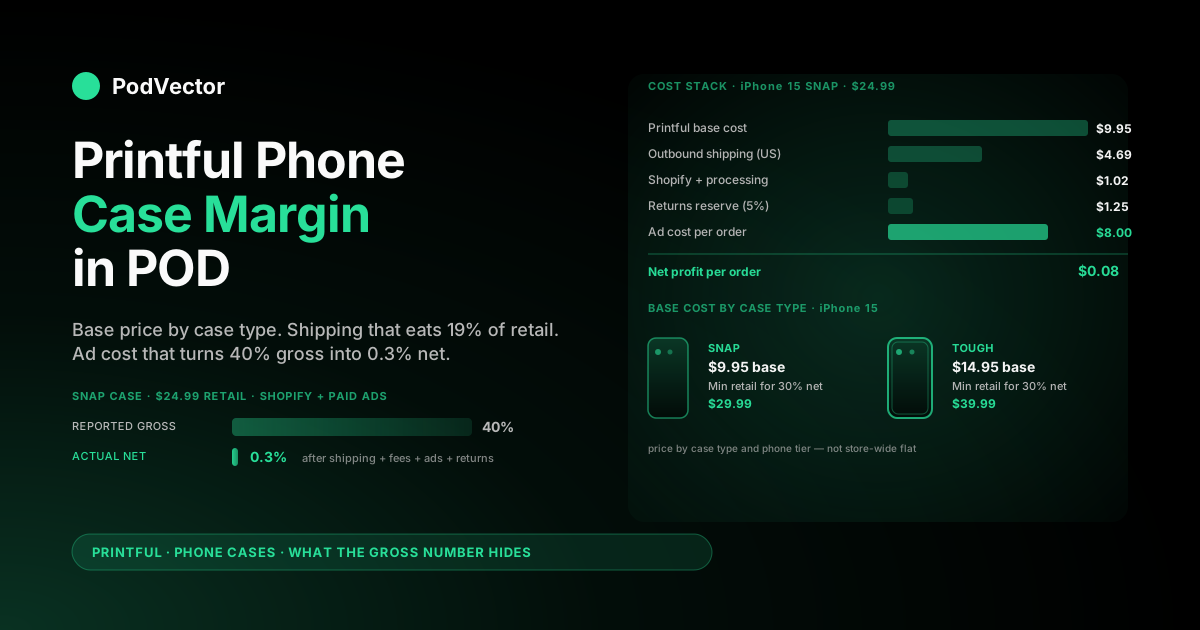
Here is the full cost stack on a single iPhone 15 Snap case sold at $24.99 on Shopify with paid ads turned on. We use a 5% return reserve and an $8 blended ad cost — both realistic for an established operator in 2026.
| Line | Amount | % of retail |
|---|---|---|
| Retail price | $24.99 | 100% |
| Printful base cost | $9.95 | 39.8% |
| Outbound shipping (phone case, US) | $4.69 | 18.8% |
| Shopify + payment processing (2.9% + $0.30) | $1.02 | 4.1% |
| Returns / replacement reserve (5%) | $1.25 | 5.0% |
| Ad cost per order (blended) | $8.00 | 32.0% |
| Net profit | $0.08 | 0.3% |
That number is not a typo. A Snap case at $24.99 with paid ads pencils essentially flat. Most operators do not run this math, see the 40% gross margin, and assume the business is working.
Three levers fix that. Raise retail to $29.99 (recovers $5 of margin). Cut ad cost by getting organic to carry half the orders (recovers $4). Move from Snap to Tough at $34.99 retail and the Pro Max premium tier (recovers $6–8 on the right traffic).
The point is not that phone cases lose money. The point is that the gross-margin headline is wrong by 30+ points once you include shipping, fees, and ads — and pricing decisions made against the wrong number cost real cash every month.
Realistic Printful phone case margin ranges
Across operator data we see, Printful phone case net margins cluster into four bands. The band a seller lives in tells you more about their business than the case mix does.
0–10% net. First six months of operation or any phone case business running heavy paid acquisition on Meta or TikTok at scale. Ad cost dominates the cost stack and a single weak design wipes the month.
10–25% net. Established phone case stores with mixed paid and organic traffic, decent design refresh cadence, and disciplined retail pricing by case type. This is where most viable phone case businesses live.
25–40% net. Niche stores — specific fandoms, regional pride, hobby communities — with strong organic and a small but loyal repeat audience. Usually on Shopify with email-driven traffic carrying 40%+ of orders.
40%+ net. Rare on Printful phone cases. Usually a creator business where audience replaces paid acquisition entirely, or a premium-positioned brand selling Tough cases at $39.99+ with branded packaging and styled product photography.
If your reported phone case margin sits above 35% net and you have not consciously engineered the levers behind it, the number probably reflects gross, not net. Re-run the math with return reserve, shipping, and ad cost per order included.
Why two stores selling the same case land at different margins
Two stores selling the same iPhone 15 Snap case at $24.99 can run 8% and 28% net respectively. The case is the same. The cost stack is not.
Channel mix is the biggest swing. Etsy adds a 6.5% transaction fee and 15% offsite ads on traffic Etsy attributes to its ads — that combination alone is a 15–20 point margin gap versus Shopify with organic and email traffic.
Design freshness drives ad cost. A design in week 1 of a viral run might convert at 3% on Meta with a $4 CPM, putting ad cost per order at $4–5. The same design in week 6 might convert at 0.6% with a $9 CPM, putting ad cost per order at $30+. The base cost did not change. The whole business model did.
Plan tier compounds. Free-plan sellers pay full base price; Business-plan sellers at $25/month get 7% off phone cases. That 7% only amortizes if you have 80+ phone case orders monthly. Below that, the plan fee eats the discount and then some.
Phone model mix is the quiet killer. A store with 50% Pro Max / Ultra orders pays a ~$2 premium on every case — an 8-point hit on a $25 case versus the headline base-cost number. Sellers who report margin against the lowest model price systematically over-state.
How shipping and platform fees compress phone case margin
Phone cases ship cheap on paper. They are small, light, and Printful's domestic phone case shipping rate runs $4.69 first item / $2.00 each additional in the US. International is $6.99–$9.99.
The compression comes from two places. First, phone cases are almost always sold as single-item orders — nobody buys two phone cases at once unless they are a couple or buying for two devices. So you pay the first-item rate on nearly every order.
Second, the absolute shipping cost is a high percentage of retail. $4.69 on a $24.99 sale is 18.8% — nearly as costly as the base print. On a $19.99 sale it is 23.5%, which is what tanks margin for stores that try to compete on price.
Many sellers offer "free shipping" on phone cases by absorbing the cost into retail. That works only if the absorbed retail still clears 25%+ net after the rest of the stack. Charging $4.99 shipping on top of retail is mathematically cleaner but converts 8–15% worse depending on channel, so most operators end up baking it in.
For a deeper look at how Printful shipping works and what it costs by zone, see the related shipping guides on Printful shipping times, costs, and what to expect and Printful shipping time in the USA. Both walk the rate cards and transit windows operators need before pricing phone case retail.
Platform fees stack on top. Etsy's 6.5% transaction fee plus a $0.20 listing fee plus payment processing puts the Etsy stack at 9–10% of retail. Shopify with payment processing runs 3–4%. The 6-point difference matters more on phone cases than apparel because the cost stack is already tight.
Pricing phone cases for 30%+ net margin
Hitting 30% net on a Printful phone case requires either premium retail or organic traffic carrying the cost. Most operators try to thread both.
Here is the retail range that pencils 30% net on Shopify with a 50/50 paid/organic mix and a $4 blended ad cost per order:
| Case type | Phone model tier | Minimum retail for 30% net |
|---|---|---|
| Snap | iPhone 12–14, Galaxy S23 | $26.99 |
| Snap | iPhone 15–16 Pro Max | $29.99 |
| Tough | iPhone 12–14, Galaxy S23 | $34.99 |
| Tough | iPhone 15–16 Pro Max | $39.99 |
| Clear | iPhone 12–14 | $28.99 |
These numbers assume 5% return reserve, 3.5% payment processing, $4 ad cost per order, and Printful's Growth-plan base prices. If you run on free plan, add $1.50 to each minimum retail. If your ad cost runs $8 per order, add $4.
The biggest pricing mistake we see is anchoring all phone case retail at one price. That subsidizes Pro Max Tough at the expense of older-model Snap. Better: price each case-type / phone-tier combination explicitly. Buyers do not balk — they expect newer flagship cases to cost more, because every retailer prices that way.
For the full pricing playbook across the catalog, the related guide on how to make money with Printful step-by-step walks the SKU-level pricing process most established sellers use. The full library of revenue and pricing guides lives on the Printful money-making cluster hub.
Three tactics that push phone case margin above 50%
Net margin above 50% on Printful phone cases is rare but not impossible. Three patterns produce it, usually in combination.
Niche audience with organic traffic. A creator who already has a community — Twitch streamer, hobbyist Instagram, regional sports fan page — can sell phone cases to that audience at zero CAC. The $8 ad cost line disappears from the stack and the rest of the math works.
Premium positioning with Tough cases at $39.99+. Cases marketed as drop-protection or branded as durable accessories support $39.99–$49.99 retail. At those prices the gross is high enough that even paid ads can clear 40% net if conversion is solid.
Bundle phone case with apparel. Phone case as a $19.99 add-on at checkout on a $34.99 tee or hoodie order does not need its own ad spend. The case rides on the apparel's CAC. Effective net on the case alone in that scenario lands 55–65%.
Operators who run all three at once — niche audience, Tough at premium retail, apparel-led upsell — can hit blended 50%+ net across the phone case line. But that is a specific business model, not the default Printful experience.
How to monitor phone case margin without spreadsheet pain
Most POD operators try to track phone case margin in a spreadsheet pulling from Shopify, Printful, Meta, and Google. By month three the sheet is broken, the formulas are wrong, and the numbers are stale by two weeks.
The structural problem is that margin is not a static number — it shifts every time base prices change, ad cost moves, or product mix tilts. The only durable way to track it is to consolidate the source data into a single source of truth and compute margin against the latest data each time you ask.
An AI employee that reads your unified data layer can answer "what is my Snap case net margin this week versus last month" in seconds — without you opening a spreadsheet. Victor is the agentic AI that handles those questions against your live data: SKU-level margin, by case type, by channel, by ad set, refreshed every time you ask. The same data layer that powers margin questions today is the foundation for agents that will act on those answers tomorrow — pausing weak ads, repricing thin SKUs, escalating bleed before it compounds.
For the broader picture of POD profit math beyond phone cases, Printful's own guide on what is a good profit margin for print-on-demand covers their full product line, though it reports gross figures and skips the ad-cost stack we model above.
FAQs
What is a good profit margin on Printful phone cases?
A healthy net margin on Printful phone cases is 25–35% for an established store with a mix of paid and organic traffic. New stores running paid ads often land at 5–15% net in the first six months as customer acquisition cost dominates the stack. Stores that report 40%+ are usually quoting gross margin or running on a niche audience that carries zero CAC.
How much does Printful charge for a phone case?
Printful's 2026 phone case base prices run roughly $7.95–$9.95 for Snap cases, $12.95–$14.95 for Tough cases, and $9.95–$11.95 for Clear cases. Newer iPhone Pro Max and Galaxy Ultra models add roughly $2 to each case type. Growth and Business plan tiers shave 5–7% off these prices.
Why is my Printful phone case margin lower than the calculator says?
Most POD calculators report gross margin — retail minus base cost. They skip shipping ($4.69 per order in the US), platform fees (3–10% depending on channel), payment processing (2.9% + $0.30), return reserve (3–5%), and ad cost per order ($4–$15 for paid acquisition). On a typical phone case the gap between gross and net is 25–35 points.
Are Tough cases more profitable than Snap cases?
Not at equal retail. A Tough case costs Printful $5 more than a Snap case but stores that price both at $24.99 take a 20-point margin hit on Tough. Tough cases become more profitable when priced at $34.99+ — the higher retail more than offsets the higher base cost, and buyers expect to pay more for drop protection.
What channel is best for Printful phone case margin?
Shopify with organic and email traffic produces the highest net margin because platform fees are lower (3–4% versus Etsy's 9–10%) and traffic that does not require paid acquisition strips the ad cost line entirely. Etsy is faster to discover and sells phone cases well, but the fee stack and offsite ads keep most Etsy phone case stores at 15–25% net even with strong sales.
How many phone case orders do I need to break even on Printful's plan fees?
Printful's Growth plan at $9/month and Business plan at $25/month produce 5–7% off base prices. On a $9.95 Snap case, that is roughly $0.60 saved per order. Growth pays for itself at 15 phone case orders monthly; Business at about 40. Below those volumes, the free plan is cheaper despite higher base prices.
How many phone case sales do I need to make $3,000 a month in profit?
At a realistic 25–30% net margin on a $26.99 Snap case — roughly $7–8 net per order — you need about 375–430 phone case sales a month to clear $3,000 in profit. Premium Tough cases at $34.99+ with higher net per order drop that to 250–300 sales. The faster path is usually more net per order, not more volume: a $3 retail bump or shifting orders from paid to organic moves the target more than chasing extra sales at thin margin.
Stop guessing your real phone case margin
Most Printful sellers can quote their gross margin to the penny and have no idea what their net margin is by SKU, channel, or week. The gap is where the cash goes.
Victor connects your Printful, Shopify, ad accounts, and order data into a unified source of truth, then answers margin questions against the live numbers — "what is my iPhone 15 Snap case net margin this week" or "which case design lost money on Meta last month" — in seconds. Victor answers. Victor acts on the answers with your approval.
More Printful operator playbooks live on the Printful topic hub.
Try Victor free