
Quick Answer: Printful does not have a built-in "free shipping over $500" feature. You set the $500 threshold yourself on Shopify, Etsy, or your platform — Printful still bills you its standard per-category rate (e.g., $4.75 for a US t-shirt) on every order.
A $500 threshold is high for a typical POD store. Most POD sellers see an AOV of $25–$60, so a $500 cart is a bulk, team, or corporate order. The math only works if those large carts hit your store often enough to lift average margin without dragging single-item orders down.
This guide breaks down what a $500 POD cart actually looks like, the exact Printful invoice on those carts, how to set the threshold on each platform, and how to keep margin intact once it's live.
What "free shipping over $500" actually means with Printful
"Free shipping over $500" is a customer-facing promise — not a Printful product. Printful charges you the same flat shipping rate on every order regardless of cart size.
A US t-shirt invoice line is $4.75 whether the cart was $25 or $525. A US hoodie line is $8.49 either way. A mug is $5.49. You absorb the difference between what your customer paid (zero, above the threshold) and what Printful bills you.
The threshold lives in your storefront, not in Printful. On Shopify you build a shipping rate with a Minimum order price = $500 condition. On Etsy you build a free-shipping profile and apply it to listings. Printful's integration doesn't see, override, or care about that rule — it just keeps invoicing standard rates.
This matters for two reasons. First, your margin math is on you — Printful won't warn you that the new rule is bleeding profit. Second, the multi-shipment trap (next section) hits hardest on the larger carts a $500 threshold is supposed to encourage.
Why $500 is an unusual threshold for POD
The standard advice on free shipping thresholds is to set them at roughly 1.3–1.5× your average order value (AOV). The threshold has to be reachable with one nudge — usually one extra item — but high enough to lift profit on the orders that clear it. Printful's own AOV guide recommends the same: proportional to AOV, low enough that buyers will reach, high enough that the lift is worth absorbed shipping.
For most POD stores, AOV sits between $25 and $60. A 1.3× threshold lands at $35–$80. A $500 threshold is 8–20× typical AOV — outside the "one extra item" nudge range.
That doesn't mean it's wrong. It means it's targeted. A $500 threshold is doing a different job than a $35 one: it's signaling to bulk buyers, team orders, and corporate gifting accounts that you treat them differently from a one-tee buyer. If those carts are a real slice of your revenue, $500 is reasonable. If they aren't, you've put a promise on your site that nobody clears.
The honest test is whether the orders you'd give free shipping to already happen at meaningful volume. Pull your last 90 days of orders. Count the ones over $500. If you have at least one a week, the threshold gives those buyers a perk and starts attracting more like them. If you have one per quarter, the threshold is decoration.
What a $500 POD cart actually looks like
A $500 cart isn't one buyer treating themselves. It's almost always one of three shapes.
Bulk apparel (team or event). 20 tees at $25 each = $500. Sometimes 15 hoodies at $35. This is the most common $500-cart shape for POD stores selling on Shopify. Single product category, single Printful facility, predictable invoice math.
Corporate gifting. 25 employees × $20 mug + branded notecard each, or a hoodie + tote + mug bundle × 12 employees. Multi-category by design — this is where multi-shipment fees stack ugly.
Influencer or affiliate seeding. A creator orders 30–50 units across SKUs to seed to their audience. Mixed-category, mixed-color, ships in several boxes.
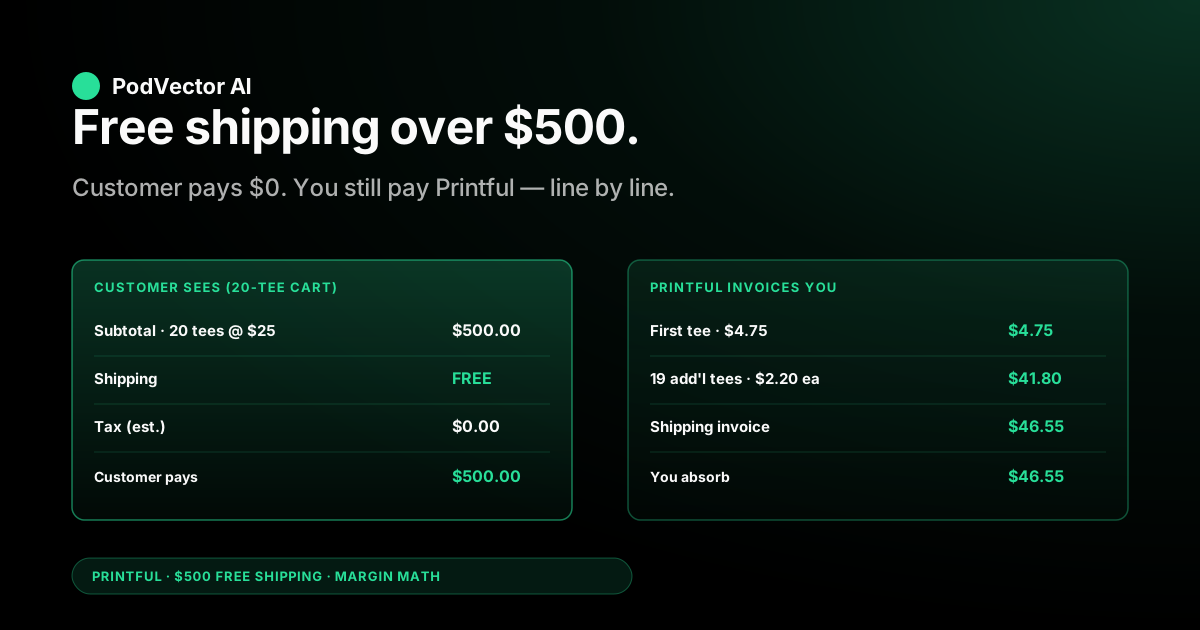
Single-category bulk is the friendliest of the three. Printful's first-item rate ($4.75 for US tees) gets charged once, and every additional unit ships at the additional-item rate ($2.20 for US tees). A 20-tee cart in the US is $4.75 + 19 × $2.20 = $46.55 of shipping on a $500 order. You absorb 9.3% of the cart in shipping — survivable on a 50%+ gross margin.
The multi-category corporate gifting cart is the danger case. Hats, mugs, posters, stickers, phone cases, pillows, notebooks, and water bottles each ship from different Printful facilities. Every category triggers its own first-item rate, even inside one customer order.
The math: what Printful invoices you on a $500 cart
Three worked examples. All assume US shipping, 2026 Printful rates.
Example 1: 20 US tees, single SKU. Retail $500. Printful base cost: 20 × $12.95 = $259. Shipping: $4.75 first + 19 × $2.20 = $46.55. Total Printful invoice: $305.55. Customer pays $0 shipping. Net gross profit: $500 − $305.55 = $194.45 (38.9% margin).
That's a healthy bulk order. The threshold did its job — you traded $46.55 of absorbed shipping for a customer who almost certainly wouldn't have completed the cart with a $40 shipping line at checkout.
Example 2: Corporate gift bundle, 12 employees. Per-employee: hoodie ($35) + mug ($15) + tote ($12) = $62. Cart of 12 employees: $744. Printful base costs: 12 × ($22 hoodie + $7.50 mug + $9 tote) = 12 × $38.50 = $462.
Shipping is where this gets painful. Hoodies all from apparel facility: $8.49 + 11 × $2.50 = $35.99. Mugs from drinkware facility, separate shipments by destination (varies — assume bulk to one HQ, so $5.49 + 11 × $5.49 = $65.88 because mugs often ship individually). Totes from accessories facility: $5.49 + 11 × $1.50 = $21.99. Total shipping: $123.86.
Total Printful invoice: $585.86. Customer pays $0. Gross profit on $744 cart: $158.14 (21.3% margin). That's still positive but the shipping share is 16.6% of revenue — twice the apparel-only case.
Example 3: Influencer seeding, 40 mixed units. 15 tees + 10 mugs + 8 hats + 7 phone cases. Retail $570. The four categories each trigger their own first-item rate plus per-unit additional-item rates. Tees: $4.75 + 14 × $2.20 = $35.55. Mugs (individual ship): 10 × $5.49 = $54.90. Hats: $4.49 + 7 × $2.00 = $18.49. Phone cases: $4.49 + 6 × $2.00 = $16.49. Total shipping: $125.43.
Printful base costs vary by SKU but plan on roughly $9 per unit average × 40 = $360. Total invoice: $485.43. Gross profit: $84.57 on a $570 cart — 14.8% margin. The fourth category did the damage.
Pattern: the more product categories in a $500 cart, the more first-item fees stack, and the worse the absorbed-shipping math gets. Single-category $500 carts are the win case. Three-or-four-category carts can compress margin to single digits.
When a $500 threshold makes sense (and when it doesn't)
Use a $500 threshold if all three are true.
You see real bulk demand. At least one $500+ cart per week in the last 90 days, ideally trending up. If bulk is a real slice of revenue, the threshold rewards it and attracts more.
Your bulk carts are single-category. Apparel-only stores get the best of this. The math holds when first-item fees don't stack — 20 tees from one facility is one first-item charge, not twenty.
Your AOV-blended gross margin is above 35%. Below that, absorbed shipping on bulk orders pushes you toward break-even. Above that, a 10% shipping hit on bulk orders still leaves real profit.
Skip the $500 threshold if any of these hold.
- Your store is multi-category by design (apparel + drinkware + posters). The multi-shipment trap turns most $500 carts into margin disasters.
- You almost never see $500 carts — fewer than one a month. The threshold is decoration; you're not changing buyer behavior.
- You ship internationally with US prices — international Printful rates run 2–3× US rates, and absorbing them on a $500 cart can wipe out the order's profit.
- You haven't modeled it against 90 days of order history. Free shipping decisions look fine in theory and turn ugly in practice when product mix drifts.
For the full mechanics of how Printful's invoice differs from what your customer pays — including the three live ways POD sellers offer free shipping — see does Printful offer free shipping. For the Printful API behavior that feeds Shopify shipping rate calls, see our Printful API shipping rates endpoint guide.
How to set up $500 free shipping on Shopify
Shopify makes this a five-minute config — but there's a Printful integration gotcha that catches POD sellers.
- Open Settings → Shipping and delivery.
- Click your shipping profile (usually "General shipping rates"). Do not edit a Printful-managed profile — those get overwritten on sync.
- If you have one, switch to your custom profile that contains all Printful products. If you don't have a custom profile yet, create one and move every Printful product into it. (Why: a Printful-managed profile reapplies live rates on sync and wipes your $0 rule.)
- Under your custom profile's US zone, click Add rate.
- Name it "Free shipping over $500". Set price to $0.00.
- Click Add conditions → Based on order price → minimum $500.00, maximum blank.
- Add a second rate for orders under $500. Either a flat rate ($5.99 is the POD industry norm) or Printful's calculated rate.
- Save the zone.
Repeat per zone if you ship internationally. International free shipping at $500 is almost always a margin loser — international Printful rates can run $20–$60 per first item. If you ship internationally, set a higher threshold on those zones ($800–$1,000) or skip free shipping outside the US.
The custom-profile rule is the one POD sellers miss. Printful's official integration reapplies its own shipping rates to Printful-managed profiles every sync. Your $500 rule will look fine in the morning and silently disappear by afternoon. The fix is to move all Printful products into a custom profile you control, then your $0 rule sticks.
How to set it up on Etsy and WooCommerce
Etsy doesn't support order-minimum thresholds the way Shopify does. You can only offer free shipping per-listing or as Etsy's "US free shipping guarantee" (free shipping on orders $35+ to US destinations).
For a $500 threshold on Etsy, the workaround is to set high item-level shipping costs on small SKUs and free shipping on listings priced above a level where the customer would naturally clear $500 with one unit (rare in POD — most Printful items are below $50 retail). For most POD sellers, Etsy + $500 threshold isn't viable; pick a lower threshold or use Etsy's $35 program.
WooCommerce handles it natively. Go to WooCommerce → Settings → Shipping → Shipping zones. Edit your US zone, add a Free shipping method, and set its requirement to "A minimum order amount" of $500. Add a flat rate as a fallback for orders below $500. Save.
WooCommerce's Printful integration uses the live rates by default for non-free orders. The free-shipping method overrides those rates above the threshold — you absorb the Printful invoice, customer sees $0.
How to market a $500 threshold without killing AOV
A $500 threshold is too high to surface in standard "free shipping over X" banners. Your average single-tee buyer will read it as "free shipping is impossible here" and bounce.
Put the threshold in front of the right audience instead. Three approaches work for POD.
Wholesale or bulk landing page. Build a dedicated page for team/event/corporate orders. Headline the $500 threshold there alongside bulk-pricing tiers. Hide it from your main product pages so single-buyer conversion isn't dragged down.
Cart-level upsell prompts. Trigger the "Free shipping at $500" message only when cart subtotal is above a level where it's reachable — say, $300+. Below that, show your standard messaging or a lower secondary threshold.
Email outreach to repeat buyers. Customers who've bought 3+ times are your bulk lead pool. Email a "Bulk orders ship free over $500" pitch with a curated SKU list of team-friendly products.
The mistake most POD sellers make is treating the threshold as a global storefront banner. The $500 buyer and the $35 buyer want different messaging — a banner that helps one alienates the other.
How to protect margin after it's live
The threshold looks fine on launch day and drifts over time. Three things break it.
Printful raises a rate. Most rate changes are small ($0.20–$0.50 per item), but on a 20-tee bulk order that's $4–$10 of margin you didn't budget for. Printful announces rate changes — you read the email and adjust — but the alert-to-action loop is slow.
Product mix shifts. The threshold launched when 80% of bulk carts were single-category apparel. Six months later, a corporate gifting push made 40% of bulk carts multi-category. The math that worked on apparel-only carts collapses on multi-category ones.
International orders sneak in. You set the threshold US-only, but an international buyer clears $500 via a workaround and you absorb $80 of international shipping. One order, half the month's bulk profit gone.
The standard fix is monthly invoice reconciliation in a spreadsheet. Export Printful invoices, drop them next to Shopify orders, calculate gross margin per order, look for outliers. That works at 50 orders a month and falls apart at 500.
A live data layer changes the math. Pipe Shopify orders, Printful invoices (product + shipping line itemized), and ad spend into one unified data warehouse and you can answer "which bulk orders went below 25% margin last week" without touching a spreadsheet. The data warehouse can be Snowflake, Redshift, Databricks, or equivalent — the point is unified, queryable, near-real-time.
That's what Victor does for POD sellers. He tracks itemized cost per order — product, shipping, fulfillment, ad spend — against your retail and surfaces the orders where absorbed shipping ate too much margin. When the $500 threshold starts losing money on a category, he flags it, shows the SKU pattern, and proposes a specific rule change (raise the threshold, exclude a category, add an apparel-only carve-out) that you approve in one click. Then he executes the discount or shipping rule update on Shopify.
For the base cost side of the equation, see our Printful t-shirt cost breakdown, the t-shirt pricing guide, and the t-shirt printing cost breakdown. The full Printful costs and charges cluster covers every invoice line. The Printful topic hub indexes everything across costs, shipping, and reviews.
If you're still evaluating whether Printful is the right fulfillment partner for a bulk-order strategy, our Printful t-shirt quality review covers what actually arrives in those 20-tee bulk boxes.
FAQs
Does Printful itself offer free shipping over $500?
No. Printful invoices you per-category at its standard rate on every order — there is no built-in order-minimum free-shipping tier on Printful's side. The $500 threshold is something you set on your storefront and absorb yourself.
What's the typical Printful shipping invoice on a $500 cart?
Single-category US apparel: $40–$50 (about 8–10% of cart). Multi-category US bundle: $100–$130 (16–25% of cart). The category count drives shipping cost more than the dollar size, because each Printful product category triggers its own first-item fee.
Is $500 too high a threshold for POD?
For most stores, yes — typical POD AOV is $25–$60, so $500 is 8–20× AOV and out of reach for most single-buyer orders. The threshold makes sense if you have meaningful bulk, team, or corporate order volume; not if you're trying to nudge a regular tee buyer over the line.
Will Printful's Shopify integration override my $500 free-shipping rule?
It can, if you set the rule on a Printful-managed shipping profile. Printful's sync reapplies its own rates to those profiles. The fix is to create a custom shipping profile in Shopify, move all Printful products into it, and set your $500 rule there. The custom profile is not touched by sync.
Can I set $500 free shipping on Etsy with Printful?
Not directly — Etsy doesn't support order-minimum thresholds the way Shopify and WooCommerce do. Your alternatives are Etsy's built-in "free shipping on orders $35+" program (much lower threshold) or per-listing free shipping on high-priced bundle listings.
Should the $500 threshold apply internationally?
Probably not. International Printful rates run 2–3× US rates, so a $500 cart to Europe can carry $80–$150 of absorbed shipping. Most POD sellers either set a higher threshold on international zones ($800–$1,000) or restrict free shipping to US orders.
What's the cheapest $500 cart to fulfill?
Single-category US apparel — 20 t-shirts ships for about $46.55 on Printful, because the additional-item rate ($2.20) is much lower than the first-item rate ($4.75). The expensive cart is anything with 3+ categories, because each category triggers its own first-item rate.
How do I know if my $500 threshold is profitable?
Pull 90 days of orders that cleared $500. For each, compute gross profit = retail − (Printful base costs + Printful shipping invoice + payment processing). Compare to your same-period non-bulk margin. If bulk margin is within 5 points of non-bulk margin, the threshold is working. If it's 10+ points below, absorbed shipping is too high — narrow the eligible categories or raise the threshold.
A $500 threshold should attract bulk buyers, not punish your margin
Printful invoices the same rates whether the cart was $25 or $525. The carts that hit your $500 threshold are exactly the ones where multi-category fees stack hardest.
Victor watches your Shopify orders and Printful invoices in real time, flags bulk orders that dropped below margin, and proposes specific rule changes — raise the threshold, exclude a category, add an apparel-only carve-out. He executes the change on Shopify after you approve.
Connect your store in five minutes.
Try Victor free