
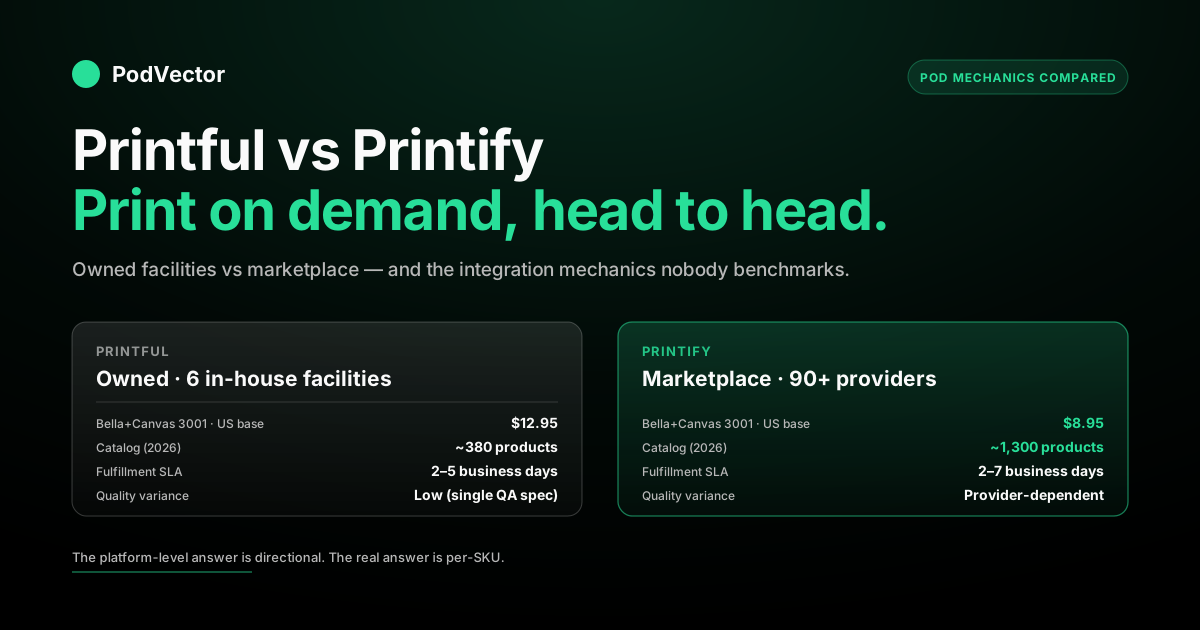
Quick Answer: Printful is owned facilities — consistent print quality at a higher base cost; Printify is a marketplace of 90+ providers — lower base cost with quality that depends on which provider you're routed to. Most Printful vs Printify print on demand comparisons treat the two as interchangeable storefront plugins. They aren't. Printful runs an owned-facility supply chain that behaves like one POD vendor; Printify routes orders to a marketplace of 90+ providers that behaves like a procurement layer.
That structural difference rewires every downstream metric — base cost, defect rate, fulfillment SLA, and the way each platform feeds order data back into your storefront and ad stack. Pick wrong and you're either overpaying on every unit or absorbing variance you can't trace.
Below: how each handles the actual mechanics of running a POD store, the integration depth nobody benchmarks, and the per-catalog question — which is more profitable on your SKUs — that platform-level comparisons can't answer.
The print on demand mechanics that actually differ
Most comparison guides reduce Printful vs Printify to a feature checklist — catalog size, base cost, integration count. That framing misses the point.
Print on demand is a supply-chain product, not a SaaS feature set. The thing you're choosing is how an order placed on Shopify at 2 a.m. becomes a printed garment in someone's mailbox four days later. Everything between that order event and that delivery — production routing, ink and substrate selection, QA, packaging, carrier handoff — happens inside the supplier's box. You're picking the box.
Printful and Printify built different boxes. The visible features differ because the boxes differ.
Printful runs a vertically integrated supply chain. Six owned facilities (US, Mexico, Canada, Latvia, Spain, Japan) handle production, QA, and shipping under one set of standards. One ink calibration. One reprint policy. One fulfillment SLA.
Printify runs a procurement marketplace. 90+ independent print providers list capacity through Printify's order-routing layer. When an order comes in, Printify's software picks a provider based on stock, region, and your Premium-tier defaults, then forwards the production job. The provider — not Printify — owns the printer, the ink, and the QA.
Every comparison axis below traces back to that structural difference.
Side-by-side snapshot
The 30-second version. Each row is unpacked in its own section.
| Axis | Printful | Printify |
|---|---|---|
| Supply model | 6 owned facilities | 90+ independent providers |
| Bella+Canvas 3001 tee, US | $12.95 | $8.95 (Premium) / $10.95 (Free) |
| Subscription | Growth $24.99/mo, up to 33% off | Premium $39/mo ($24.99 annual), up to 33% off |
| Catalog (2026) | ~380 products | ~1,300 products |
| Print quality | High and consistent | Provider-dependent variance |
| Avg. fulfillment | 2–5 business days | 2–7 business days |
| Native storefronts | Shopify, Etsy, WooCommerce, Wix, Squarespace, eBay, Amazon, TikTok Shop | Shopify, Etsy, WooCommerce, Wix, Squarespace, eBay, BigCommerce, TikTok Shop, Walmart |
| Branding (free tier) | Logos on packing slips, inserts | Limited; full branding on Premium |
Supply chain: owned vs networked
This is the axis everything else hangs off. Read this section, then re-read every other comparison article you've seen — most of their conclusions follow from this one structural fact.
Printful's owned model. Six facilities. Standardized DTG and DTF printers. Standardized ink. One QA spec. Reprints handled in-house with a documented defect-rate target.
The trade-off: you get one supplier's economics, full stop. Whatever Printful charges per unit is what you pay. There's no second provider to undercut them on a slow week. The base cost reflects the fixed cost of running owned facilities — capex, payroll, lease — amortized across orders.
Printify's networked model. 90+ providers. Different printers, different inks, different QA. When an order routes to Monster Digital it's one experience; when it routes to a lower-tier provider it's another.
The trade-off goes the other way: lower base cost because providers compete for routing volume, but variance because no two providers run the same kit. Printify mitigates with provider scoring, Premium-tier provider locks, and a reprint policy. None of those eliminate variance — they manage it.
For a POD seller, the practical question is which kind of variance you'd rather absorb: variance in margin (you pay Printful's higher cost on every unit) or variance in output (you accept Printify's lower cost in exchange for occasional supplier mismatches).
Per-unit pricing and subscription tiers
The price comparison most guides publish stops at base cost. Base cost is one input among five.
Subscription tiers. Both run a free tier and a paid tier. Printful's Growth plan ($24.99/mo) unlocks up to 33% off products, branded packing slips, and unlimited stores. Printify's Premium plan ($39/mo, or $24.99/mo billed annually) unlocks up to 33% off plus full custom branding — a 2026 bump from its old 20% ceiling that now matches Printful's headline discount.
On product cost alone, the two now advertise the same headline discount — up to 33% — so the gap comes down to the base cost each percentage applies to. Printify's lower provider base costs mean it still wins on most basic tees and hoodies after both discounts apply. The closer the SKU is to a commodity garment, the more Printify's pricing wins. The further it moves toward niche or premium fabric, the more Printful's catalog discipline reverses the cost edge.
Per-region pricing. Printify's networked model means a tee shipped from a US provider, an EU provider, and an AU provider have three different base costs. Some sellers exploit this by listing the same SKU through multiple region-specific providers, paying the lowest landed cost in each region. Printful's owned model gives a more uniform global base cost — useful for forecasting, less exploitable for arbitrage.
Reprints and refunds. Both reprint or refund on documented defects. Printful's lower defect rate means fewer refund-eaten orders. Printify's higher defect rate is a real cost line — and it varies by provider, so two stores running Printify can have very different effective margins.
For a fuller breakdown of where Printful's costs and fees actually land, see the complete guide to Printful costs and fees. For Printify, how much Printify charges per shirt covers the per-SKU view.
Catalog depth and the long-tail SKU question
The headline number — Printify's 1,300+ products vs Printful's ~380 — is misleading on its own.
Printify's catalog is broad because it pools products across 90+ providers. The same Bella+Canvas 3001 tee shows up multiple times — once per provider that prints it. Most sellers list one variant per garment, so the practical catalog is closer to a few hundred unique products. The breadth advantage is real, but smaller than 1,300 vs 380 implies.
Where Printify's catalog genuinely wins is the long tail. Embroidered hats from one provider, all-over-print hoodies from another, niche items like enamel pins or yoga mats from specialty providers. Printful's owned facilities mean Printful only carries what Printful's facilities can produce — and Printful won't add a substrate just because three providers in the Printify network already do.
Where Printful's catalog wins is curation. Every garment in Printful's catalog has been QA'd against Printful's print process. There's no "this tee looks great on the listing but bleeds ink on this specific provider" risk. For a seller building a brand around 5–10 hero SKUs, that QA is worth the narrower selection.
Practical rule: if your store leans on long-tail or trend-driven SKUs, Printify's catalog matters. If it leans on a tight hero-SKU set, Printful's catalog discipline matters more.
Print quality: average vs variance
Average quality on both platforms is roughly equivalent at the top of each catalog. The story is variance.
Printful's print quality is consistent. Order ten of the same SKU and you get ten near-identical prints. The ink calibration is the same; the QA spec is the same; the printer model is the same. This consistency is the case Printful makes for its higher base cost.
Printify's print quality varies by provider. Top-tier providers like Monster Digital and SwiftPOD match Printful on absolute quality. Lower-tier providers don't. On Printify, your effective quality is the discipline of your provider selection — which providers you've sampled, scored, and locked in via Premium.
The implication for a paid-ads operation is bigger than it looks. A consistent product at moderate quality compounds into a stable return rate, which compounds into stable LTV/CAC. Variance breaks that loop. One bad batch hits review scores on Etsy or Amazon, and the algorithmic penalty outlives the order.
For more on Printful's quality consistency, see the complete Printful review. For a deeper look at how quality variance feeds into Printify margins, is Printify profitable covers it.
Fulfillment SLAs and shipping economics
POD fulfillment is two steps: production time (order received → garment printed) and shipping time (printed → delivered). Both platforms publish averages; both have outliers.
Production. Printful averages 2–5 business days. Most US orders ship within 3 days; international orders route to the regional facility that holds stock. Printify averages 2–7 business days, but the spread is wider — top-tier providers hit 2–3, lower-tier providers can stretch to 7+.
Shipping. Printful uses standardized carrier rates by region with the math posted upfront. Printify's shipping varies by provider — each provider negotiates its own carrier rates, which means the same garment shipped from two providers can have different shipping costs. The gap shows up most on international orders: a single tee to the UK runs roughly $4–5 on Printful's posted rate versus $8–10 from a typical Printify provider, and on multi-item orders Printful's combined-shipping math usually lands cheaper.
International routing. Printful auto-routes to the closest facility — a UK customer's tee prints in Latvia, an Australian customer's prints in Australia, a Japanese customer's prints in Japan. Printify supports the same outcome through provider selection: list the same SKU through a US provider, an EU provider, and an AU provider, and Printify routes orders to the regional one. Printful's auto-routing is set-and-forget; Printify's is more configurable but takes setup.
Tracking handoff. Both pass tracking numbers to your storefront via webhook. Printful's tracking arrives faster on average — single facility to single carrier handoff. Printify's tracking depends on the provider's integration depth, and a few providers lag a day or two on tracking pushback.
For the full Printful shipping picture, see the complete guide to Printful shipping.
Integration mechanics: storefronts, ads, data
This is where most comparison guides go shallow — they list storefront names and stop. The mechanics of how each platform integrates matter more than the count.
Storefront integration. Both have native apps for Shopify, Etsy, WooCommerce, and TikTok Shop. The day-to-day mechanics differ.
Printful's app pushes products to your store with mockups generated from a single mockup engine. Edits to a Printful product update across all connected stores. Order data flows back as a single fulfillment event.
Printify's app pushes products provider-by-provider. The same garment listed across two providers shows up as two separate Printify products on your store-side dashboard, even if you've consolidated mockups. Order routing happens inside Printify; the storefront sees a single order, but reconciliation upstream needs provider-aware reporting.
Mockup generation. Printful's mockup engine is more polished — better shadows, better fabric texture, more lifestyle scenes. For paid social and TikTok Shop's image-heavy product cards, polish matters. Printify's mockups are functional and load faster, useful for trend-testing but rarely the cleanest visual on the page.
Ad-platform feedback loop. Both pass conversion events to Meta and Google through your storefront's pixel — the POD platform isn't in the loop directly. What does differ: Printful's predictable fulfillment data feeds cleaner ship-and-deliver event timing into Meta's purchase-conversion optimization. Printify's variable fulfillment can produce noisier signals if you're optimizing on delivered-purchase events rather than placed-order events.
Data-out for analysis. Both expose order-level cost data, both via API. Pulling Printful's data is straightforward — one supplier, one cost line per order. Pulling Printify's data takes more reconciliation — order routing means a single order may carry multiple provider charges, and aggregating per-provider costs across hundreds of orders is the kind of thing most sellers end up doing in a spreadsheet that goes stale fast.
For the broader integrations picture on Printful's side, see the complete guide to Printful integrations.
Branding, packing slips, and inserts
Branded unboxing matters more for repeat-purchase POD stores than for one-off ad-driven stores. Both platforms support branding; the unlock points differ.
Printful. Branded packing slips with logo and message are free on the Free plan. Branded inserts (postcards, thank-you cards) are billable per piece. Inside-collar labels, custom packaging, and folded shipping options are available on apparel where Printful's facilities support them.
Printify. Free-tier branding is limited. Premium ($39/mo, or $24.99/mo annual) unlocks the full branding stack — logos on packing slips, inserts, and provider-supported custom labels. Branding consistency across Printify depends on the provider; not every provider in the network supports every branding option, so listings get filtered by branding capability.
For a high-touch brand, Printful's owned-facility model makes branding more predictable. For a high-margin, lower-branding-priority operation, Printify's lower base cost compensates for the looser branding controls.
The Fyul merger and what it doesn't change
In November 2024, Printful and Printify announced a merger as equal partners under the new parent company Fyul. As of 2026, both platforms continue to operate as separate brands with separate accounts, dashboards, and pricing.
For an existing seller, the merger doesn't change the day-to-day comparison. Pick based on the trade-offs above. New sellers in 2026 still pick Printful for owned-supply consistency or Printify for marketplace pricing — the structural choice is unchanged.
What it does change is the long-term diversification calculus. If the two platforms eventually consolidate fulfillment operations, the value of running on a non-merged third supplier — Gelato, Gooten, CustomCat — increases as a hedge. Several POD operators are explicitly piloting a third supplier in 2026 for exactly this reason. The full picture is in Printful alternatives.
When to pick which
The decision matrix below condenses the trade-offs into operating profiles. Most sellers fit one cleanly.
Pick Printful if you're optimizing for:
- Brand consistency across thousands of orders. One supplier, one QA spec, one defect rate.
- Paid-ads economics on Meta or TikTok where a stable return rate compounds into stable LTV/CAC.
- Etsy listings on new accounts where ship-on-time and review-score discipline drive ranking.
- International shipping on autopilot — Printful's regional auto-routing is set-and-forget.
- A tight hero-SKU catalog where curation outweighs breadth.
Pick Printify if you're optimizing for:
- Per-unit margin on commodity garments. Premium-tier base costs are hard to beat.
- Long-tail or trend-driven SKUs that Printful's owned facilities don't carry.
- Per-region cost arbitrage — listing the same SKU through multiple regional providers.
- Mature stores with established review buffers that can absorb occasional provider variance.
- High-volume Google Shopping or paid-search operations where margin is more decisive than consistency.
Run both if you're optimizing for: total contribution dollars, not platform loyalty. Most established POD sellers route different SKUs to different suppliers based on margin, region, and quality requirements. The added cost is per-supplier mockup work and per-supplier sample orders. The upside is several hundred basis points of effective margin if your routing is right.
The per-catalog profitability gap
Every comparison guide above — including this one — answers the question at the platform level. Pick A for consistency, pick B for margin. That's a directionally useful answer and a structurally incomplete one.
The actual question is per-SKU. On your Bella+Canvas 3001 in heather grey, shipping to your top region, with your ad-blended customer acquisition cost — which supplier produces a higher contribution dollar per order? The answer flips by garment, region, volume, and season.
None of the public comparisons fill this gap. They quote averages — a $4 base-cost difference, a 99% accuracy rate, a 1–3 day fulfillment window — and stop there. Your P&L runs on specifics, not averages. A tee that's profitable on Printify and a hoodie that's profitable on Printful both belong in the same store; the platform-level answer can't surface that.
Closing the gap takes three moving parts working together. Every order's supplier-charged cost has to flow into one source of truth alongside revenue, ad spend, refunds, and processor fees. The math has to run per-SKU and per-supplier so different garments can land in different supplier columns. The answer has to surface fast enough to act on — switching a single SKU's supplier on a weekly cadence is high-leverage when the data is fresh and useless when it's a quarter old.
This is the architecture PodVector AI built Victor on — a unified live data warehouse that ingests Shopify, Printful, Printify, Meta, and Google per-order data, then lets you ask "which supplier is more profitable on my hoodies in EU shipments?" in plain English. The answer isn't always Printful or always Printify. The answer is per-SKU, and a POD seller without per-SKU supplier data is guessing on the most expensive lever in the business.
For more on the underlying profit picture per platform, see how to make money with Printful and is Printify profitable.
FAQs
What's the cleanest one-line Printful vs Printify print on demand comparison?
Printful is owned facilities with consistent quality at a higher base cost. Printify is a marketplace of 90+ providers with lower base costs and quality that depends on which provider you pick. Both ship from US, EU, and AU; both integrate natively with Shopify, Etsy, and TikTok Shop.
Which has better print on demand integrations with Shopify?
Both have mature, well-rated Shopify apps. Printful's app produces a cleaner one-product-per-SKU listing because there's only one supplier per garment. Printify's app surfaces provider-level products, which gives more flexibility but more dashboard items to manage.
Which is better for Etsy print on demand sellers?
For new Etsy sellers, Printful's tighter SLA and lower defect rate help with Etsy's ship-on-time and review-score ranking. For experienced Etsy sellers with mature listings and review buffers, Printify's margin advantage usually wins.
Which integrates better with TikTok Shop for print on demand?
Both have native TikTok Shop integrations and both work. Printful's mockup engine is more polished, which matters for TikTok Shop's image-heavy product cards. Printify's catalog breadth matters more if you're testing trend-driven SKUs Printful doesn't carry.
Is Printify always cheaper than Printful for print on demand?
On most apparel SKUs, yes — Printify Premium beats Printful Growth by $1–4 per unit, with the gap widening on hoodies. On premium-fabric garments where Printful's catalog is tighter than Printify's lower-tier providers, the gap narrows or reverses once defect rates and reprint costs are accounted for.
Can I run Printful and Printify together in the same print on demand store?
Yes — most established POD sellers do. Both apps run in Shopify without conflict, and you can route different SKUs to different suppliers based on margin, geography, or quality requirements. The added work is per-supplier mockup generation and per-supplier sample ordering.
Does the Fyul merger change which platform I should pick?
Not yet. Both platforms continue operating separately as of 2026 — separate accounts, separate dashboards, separate pricing. Pick based on current trade-offs. The merger does increase the case for piloting a non-merged third supplier as a diversification hedge.
Which has better international print on demand shipping economics?
Printful for low-config international shipping — auto-routing to EU, MX, JP, AU, and CA facilities is set-and-forget. Printify for optimized international shipping if you list the same SKU through multiple regional providers. The second approach is cheaper but takes more setup.
How do I tell which print on demand platform is more profitable on my catalog?
Pull every order's supplier-charged cost, ad spend, refunds, and processor fees into one place — your warehouse, a unified analytics layer, or a tool that does this for you — then run per-SKU contribution math against both suppliers. Don't trust the platform-level averages; the answer flips by garment, region, and season.
Stop comparing platforms. Compare suppliers per SKU.
The right Printful vs Printify answer changes by garment, region, and season. Spreadsheet comparisons go stale within weeks. Victor pulls every order, every supplier-charged cost, every ad spend, and every refund into one live data layer — then lets you ask "which supplier is more profitable on my hoodies shipping to the EU?" in plain English. POD-native unit economics, no spreadsheets.
Try Victor freeFor a 2026 outside view of the same axes, the Merch Titans Printful vs Printify breakdown covers similar ground with operator-direct framing. To go broader on Printful, see the complete Printful guide; the full Printful comparison cluster lives at the Printful comparison hub, and the broader Printful topic at the Printful topic hub.