
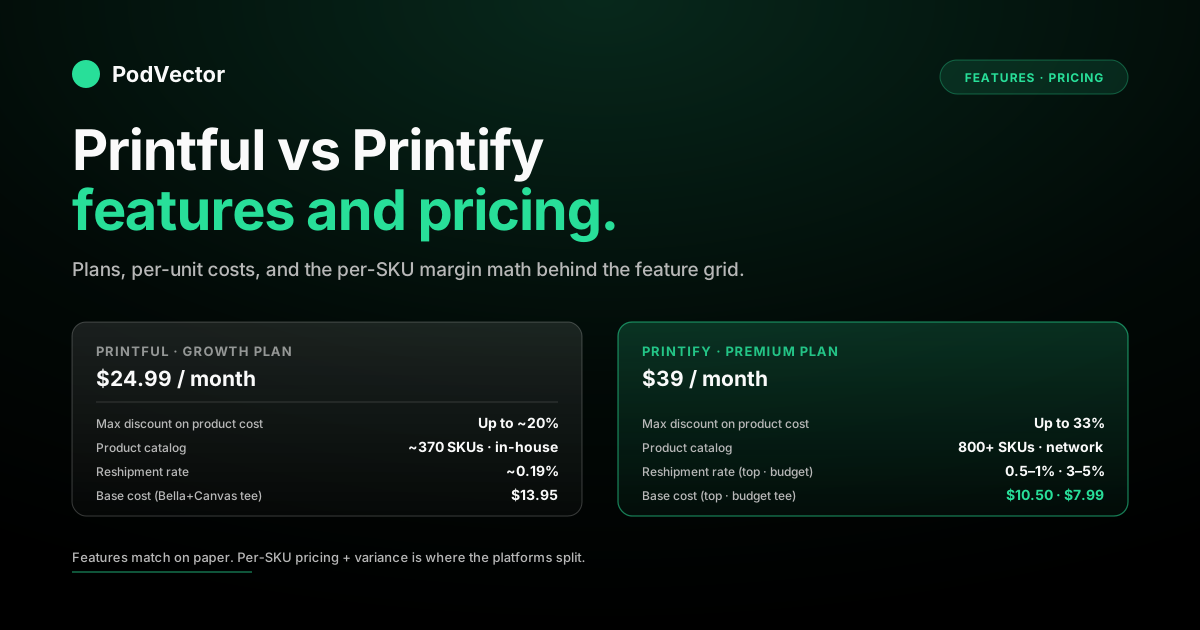
Quick Answer: Printify wins on base price; Printful wins on consistency. Feature-for-feature the two cover the same surface area — Shopify/Etsy/Amazon/eBay/TikTok integrations, mockup generators, branded inserts, embroidery, and bulk discounts via paid plans. The differences sit in execution and cost.
On pricing, Printify is ~$3–6 cheaper per unit on standard apparel. Its Premium plan runs $29/month ($24.99 billed annually) for up to 20% off across providers and up to 10 stores. Printful's Growth plan is $24.99/month for a larger up-to-33% discount that scales with sales (and turns free once you clear $12K in annual sales), and its in-house production holds quality variance to a ~0.19% reshipment rate. Both brands merged under one parent in November 2024 but still run as separate platforms with separate pricing.
Below: the feature-by-feature breakdown, the actual plan-and-pricing math on a Bella+Canvas tee, and the per-SKU framework that beats either-or platform picks.
At-a-glance feature and pricing snapshot
Printful and Printify hit the same checklist on paper. The bigger differences live one level deeper — execution, variance, and where each tier locks features behind a plan. Here's the high-level grid before the breakdown:
| Feature | Printful | Printify |
|---|---|---|
| Free plan | Yes | Yes (up to 5 stores) |
| Paid plan price | $24.99/mo (Growth; free at $12K/yr sales) | $29/mo Premium ($24.99 billed annually) |
| Max plan discount | Up to ~33% on Growth (scales with sales) | Up to 20% on Premium (up to 10 stores) |
| Product catalog | 370+ SKUs (~500 listed) | 1,300+ SKUs |
| Production model | In-house at 15 facilities | Network of independent providers |
| Base price (Bella+Canvas 3001 tee) | $13.95 | $7.99–$10.50 (varies by provider) |
| Native integrations | ~21: Shopify, Etsy, WooCommerce, Amazon, Walmart, eBay, Wix, Squarespace, BigCommerce, TikTok, more | ~11: Shopify, Etsy, WooCommerce, Amazon, eBay, Wix, Squarespace, TikTok, more |
| Mockup generator | Yes (1–4 per design) | Yes (6–10 per design, varies by provider) |
| Branding (inside-collar labels, inserts) | Native, $2.49/item label | Provider-dependent |
| Embroidery | Yes, in-house | Yes, via specific providers |
| Reshipment rate | ~0.19% | 0.5–1% top-tier; 3–5% budget |
| Production speed | 2–5 business days | 2–10 business days (provider-dependent) |
| International facilities | US, EU (Riga), MX, AU, JP — auto-routed | Provider-dependent (US, EU, UK, AU, CA, etc.) |
| Customer support | 24/7 live chat | Routed through provider |
The feature checklist matches on the obvious items. The pricing and variance numbers are where the two diverge. Both get unpacked below.
Plans and subscription pricing
Plans set the ceiling on what each platform can do for margin. Printful and Printify both offer a free tier — you can list products, push to Shopify, and fulfill orders without paying anything. The paid tiers buy you discounts and operational headroom.
Printful plans
Printful has consolidated to two tiers — Free and Growth — having retired the old Business/Pro membership.
- Free plan. All features available. Standard base costs.
- Growth ($24.99/month). Up to ~33% off product cost (the discount scales with your monthly sales), free design tools, unlimited mockup generation, a 9% discount on branded inserts, 25% off samples, and a priority support tier. The membership fee is waived automatically once you clear $12,000 in sales over 12 months.
Printful's discount mechanic is a percentage applied to product cost that grows as your sales climb — no surprise jumps between SKUs, just a single rate that improves with volume.
Printify plans
- Free plan. Up to 5 stores per account. All catalog access. Standard provider prices.
- Premium ($29/month, or $24.99/month billed annually). Up to 20% off product cost, supports up to 10 stores, unlimited product designs. The math: at ~$2 saved per Bella+Canvas tee on a top-tier provider, the plan pays for itself at roughly 15 orders/month.
- Enterprise (custom pricing). Unlimited stores, dedicated account manager. Aimed at 5,000+ orders/month operators.
Printify's Premium discount is a flat 20% applied off provider base prices. The catch: each provider sets its own product cost, so the saved-dollars-per-unit varies depending on which provider you pin.
Plan-to-plan verdict
The plan-level discount math has actually flipped from what older comparisons report. Printful Growth now carries the larger discount percentage (up to ~33%) at the lower monthly fee ($24.99 vs Printify's $29), and waives the fee entirely at $12K in annual sales. Printify Premium's edge is its lower base prices and the up-to-10-stores allowance, not the discount rate (capped at 20%). So the subscription tilts toward Printful on raw discount, while Printify's structural base-cost advantage is what actually keeps it cheaper per unit — the section below shows why.
For the full Printful membership economics, see the Printful Premium membership price breakdown and the price-and-benefits guide.
Per-unit pricing on real SKUs
Plan discounts matter, but base prices matter more. Most sellers don't max out volume-based discount tiers, so the published per-unit price drives 80% of margin variance.
Take a Bella+Canvas 3001 unisex tee, white, size M, shipped to a US buyer:
| Cost line | Printful (free plan) | Printify (free, top-tier) | Printify (free, budget) | Printify (Premium, top-tier) |
|---|---|---|---|---|
| Base + 1-side print | $13.95 | $10.50 | $7.99 | $8.40 |
| Shipping (US, single tee) | $4.69 | $4.69 | $4.69 | $4.69 |
| Total fulfilled cost | $18.64 | $15.19 | $12.68 | $13.09 |
| Margin at $24 retail (no shipping subsidy) | $5.36 | $8.81 | $11.32 | $10.91 |
The Premium plan (20% off) extends Printify's per-unit advantage from $3.45 to ~$5.55 over Printful's free plan. But the picture changes once both sides sit on their paid tiers: Printful Growth's up-to-33% discount drops that $13.95 base to roughly $9.35 ($14.04 fulfilled), narrowing the top-tier gap to about $1. The bigger Growth discount does most of that work — Printify's lead holds mainly because its base prices start lower, and it widens against budget providers.
On a hoodie or all-over-print product, the dollar gap is wider — typically $5–9 per unit. On lower-cost items like mugs or stickers, the gap shrinks to under $1.
The pricing math says: if margin is the lever you're pulling, Printify wins. If quality-related variance costs you more than the margin gain, Printful wins. For a deeper dive on the variance side, see Printful vs Printify quality.
Product catalog and customization features
The catalog gap is the easiest to count, and it has widened. Printful lists 370–500 SKUs; Printify now runs 1,300+. The difference matters at the edges — niche categories and AOP — but the core apparel catalog overlaps heavily.
Printful catalog highlights
- Apparel. Bella+Canvas, Gildan, Stanley/Stella, Champion, Sport-Tek. Curated list of the most-printed blanks.
- Accessories. Hats, beanies, tote bags, phone cases, jewelry, stickers, posters, framed prints.
- Home and lifestyle. Mugs, blankets, throw pillows, wall art, water bottles.
- Print methods. DTG, DTF, embroidery, sublimation, cut-and-sew, UV printing.
- Eco-conscious lines. Organic cotton tees (Stanley/Stella), recycled-poly options.
Printify catalog highlights
- Apparel. Same Bella+Canvas / Gildan / Champion lineup, plus Allmade, Comfort Colors, Hanes, Next Level. 50+ tee variants alone.
- Niche categories. Puzzles, beach towels, pet products, holiday goods, journals, candles. Printful doesn't carry most of these.
- All-over-print (AOP). Stronger AOP catalog than Printful — leggings, dresses, joggers, full-sublimation tees.
- Print methods. DTG, DTF, sublimation, embroidery, AOP. Method availability depends on the provider.
- Eco-conscious lines. Organic blanks via select providers (Print Geek, T-Pop).
Customization features
Both platforms support multiple print placements (front, back, sleeves), inside-label printing, and multi-product designs. The execution differs:
- Printful standardizes placements and methods across the whole catalog. A design rule set up once works everywhere.
- Printify exposes per-provider customization options. Some providers allow sleeve prints, others don't. Switching providers may require re-checking placement support.
For niche-store operators or AOP-heavy catalogs, Printify's range is the deciding feature. For a focused apparel shop, Printful's curated catalog removes choice fatigue.
Integrations and channel features
Both Printful and Printify cover the major sales channels. The native integration list is nearly identical:
| Channel | Printful | Printify |
|---|---|---|
| Shopify | Native app, deep sync | Native app, deep sync |
| Etsy | Native connector | Native connector (Etsy partner badge) |
| WooCommerce | Plugin | Plugin |
| Amazon | Native (US only at full feature parity) | Native (US only) |
| eBay | Native | Native |
| TikTok Shop | Native | Native |
| Wix | Native | Native |
| Squarespace | Native | Native |
| BigCommerce | Native | Via API/Zapier |
| Walmart | Native | Not native |
| Storenvy | Native | Not native |
| Wish | Native | Not native |
| Public API | Yes | Yes |
Printful carries roughly twice as many native integrations (~21 vs ~11) and covers several channels Printify doesn't — Walmart, Storenvy, Wish, BigCommerce. Printify holds the official Etsy partner badge inside Etsy's seller tools, which surfaces it to Etsy sellers browsing fulfillment options. In practice, both Etsy connectors work the same way for the seller.
What the integration does
- Product push. Both auto-sync designs, prices, variants, and mockups into your store listings. Printful's push transfers slightly more metadata by default; Printify's push often needs manual SEO cleanup on Etsy.
- Order routing. Both auto-pull buyer orders from your store, route them to fulfillment, and update tracking. Identical from the buyer's perspective.
- Inventory sync. Both update stock when a provider runs out. Printify's inventory updates can lag by a few hours when a single provider goes out of stock on a popular blank.
Branding features
Branding is where Printful pulls ahead on features executed in-house and Printify falls back on what each provider can deliver.
Printful branding features
- Inside-collar labels. Native option at $2.49/item. Printed during production. Survives wash cycles.
- Branded packing inserts. Printful prints and adds inserts to each shipment for ~$0.50–$1.50 depending on size.
- Polybag packaging. Optional branded polybag printing on outer packaging.
- Branded return slips. Custom-printed return slip via Growth plan.
- Tracking page. Custom-branded tracking page on Growth and above.
- No "fulfilled by Printful" labels on outgoing shipments. The buyer sees your brand, not the supplier.
Printify branding features
- Inside-collar labels. Supported by some providers (Monster Digital, SwiftPOD, Dimona Tee) but not all. Pricing varies by provider.
- Custom packing inserts. Only available through specific providers — usually mid-to-top-tier shops.
- Polybag printing. Limited and provider-dependent.
- Branded tracking page. Premium plan unlocks basic branded tracking but not the same depth as Printful's Growth tier.
- No "fulfilled by Printify" labels. Buyer-facing experience stays branded for your shop.
Branding verdict
If branded unboxing is a conversion lever — repeat customers, Shopify DTC, premium-priced product — Printful's standardized branding features ship cleaner. If branding is a nice-to-have and margin matters more, Printify's variance is manageable: pin your flagship SKUs to providers that support the labels you need.
Fulfillment and shipping features
Both platforms produce orders at a similar median speed, but the distribution differs.
Printful fulfillment
- 15 in-house facilities across the US (Charlotte, LA, Dallas), EU (Riga), Mexico, Australia, Japan.
- Auto-routing. Each order ships from the closest facility to the buyer.
- Production time. 2–5 business days, narrow variance.
- Carrier mix. USPS, UPS, FedEx, DHL, and regional carriers. Auto-selected by Printful.
- International coverage. Strong. EU buyers get Riga, AU buyers get Brisbane, JP buyers get the Japan facility.
Printify fulfillment
- Network model. Each provider runs its own facilities. Printify routes orders to the provider you pinned on each SKU.
- Production time. 2–10 business days, depending on the provider's queue and tier. Top-tier providers run 2–4 days; budget providers can hit 7–10.
- Carrier mix. Provider-selected. Usually USPS or UPS in the US, DPD/Royal Mail in the EU/UK, Australia Post in AU.
- International coverage. Strong via regional providers: Print Logistic and Drukarnia (EU), T-Pop (FR), T-Shirt and Sons (UK), Print Geek (CA), local AU providers. Cheaper than Printful for European sellers willing to pin manually.
- Multi-provider redundancy. If your pinned provider goes down or backs up, you can reassign to another provider for the same SKU.
Shipping cost comparison
On a single US tee, both platforms charge ~$4.69 for standard shipping. Multi-item orders are where each platform's structure diverges:
- Printful uses a flat-rate-plus-incremental shipping model. Adding a second tee typically costs $1.50–$2.50 more than the first.
- Printify shipping varies by provider. Some bundle items at one shipping rate, others charge full shipping per item. Multi-item orders need shipping math run per provider.
The shipping verdict: Printful is simpler to model. Printify can be cheaper but requires per-provider checking.
Print quality and consistency features
Quality has two components — peak quality and variance. Both platforms can hit comparable peak quality on a good day. Where they split is on variance across a 1,000-order sample.
Printful quality features
- In-house color management. Standardized inks, screens, and presses across all facilities.
- Quality control checkpoints. Printed items pass internal QC before shipping.
- Published reshipment rate. ~0.19%. That's ~2 reshipments per 1,000 orders.
- Fixed blank selection. Bella+Canvas, Gildan, Stanley/Stella, Champion. Predictable garment behavior.
Printify quality features
- Performance Score system. Each provider publishes quality, speed, and reliability scores updated weekly.
- Provider tier. Top-tier providers (Monster Digital, SwiftPOD, Dimona Tee) hold 0.5–1% reshipment rates. Budget providers can run 3–5%.
- Sample order program. Discounted samples to vet provider quality before scaling.
- Per-SKU provider selection. A bad-quality provider on one SKU doesn't taint the rest of your catalog.
Quality verdict
Printful's narrow variance is the feature. Printify's per-SKU pinning is the feature. If you want a single platform with predictable defect rates, Printful. If you want to optimize quality per SKU and have time to vet providers, Printify with top-tier providers gets close on quality at lower cost. The Reddit-sourced operator perspective on this same trade-off is unpacked in Printful vs Printify on Reddit.
Customer support features
Customer support is where the network model has a clear weakness for Printify.
Printful support features
- 24/7 live chat. Direct to Printful staff.
- Email support. Response within 24 hours on free plan, faster on Growth/Business.
- Claim resolution time. 3–6 days for reshipment claims on average.
- Phone support. Available on higher-tier plans.
- Self-service knowledge base. Deep, well-indexed.
Printify support features
- Live chat. Available, routed by topic. Less consistent staffing than Printful.
- Email support. Response within 24–48 hours.
- Claim resolution time. 5–10 days. Claims route through Printify, who routes them to the provider, who decides on the reship.
- Per-provider variability. Some providers respond same-day. Others take a week.
- Self-service knowledge base. Good, but provider-specific docs are thinner.
Support verdict
Printful's single-vendor support model produces faster, more consistent claim resolution. If you run high order volume, this matters — slow reships compound into worse review velocity on Etsy and Amazon.
Mockup and design tool features
Mockups drive listing conversion. Both platforms include a mockup generator and an in-app design editor.
Printful mockup features
- 1–4 mockups per design. Studio-style, consistent lighting, plain backgrounds.
- Lifestyle mockups. Available for select products (people-on-tee, scene shots).
- Design Maker. Built-in editor with templates, clipart, and AI image generation.
- Mockup style consistency. Same across the catalog. A brand pulling 10 SKUs from Printful gets a coherent product page.
Printify mockup features
- 6–10 mockups per design. More variety per design, because each provider runs its own photography.
- Style varies across providers. A SwiftPOD tee mockup looks different from a Monster Digital tee mockup. Consistency requires picking one provider for the brand.
- Magic Studio (AI mockup generation). Available on free plan with limited credits, more on Premium.
- Background removal and image enhancement. Native within the design editor.
Mockup verdict
Printful is the safer pick for visual brand consistency. Printify gives more raw mockup output per design but at the cost of style coherence. Most sellers split the difference: pin most of the catalog to one Printify provider, then accept the visual variance for the long tail.
Choosing on features and pricing
The feature checklist matches on the obvious axes. The differentiating features cluster into four trade-offs:
- Quality consistency vs base cost. Printful narrower variance, Printify lower base price.
- Curation vs catalog breadth. Printful 370 SKUs of curated apparel, Printify 800+ across more categories.
- Standardized branding vs per-SKU optimization. Printful uniform execution, Printify provider-by-provider.
- Simpler operations vs lower margin. Printful single dashboard, Printify provider selection per SKU.
Pick Printful when
- You're a brand-led Shopify shop and unboxing matters.
- You run paid ads and need predictable margin without supplier surprises.
- You sell internationally and want auto-routing across 15 facilities.
- You don't want to manage per-SKU provider selection.
- You sell embroidered hats, polos, or beanies where Printful's in-house embroidery pulls ahead.
Pick Printify when
- You're margin-sensitive — every $3–6 saved per unit compounds.
- You sell niche categories or AOP that Printful doesn't carry.
- You're willing to spend hours per quarter on Performance Score monitoring.
- You sell heavily in Europe or the UK and can pin regional providers.
- You want multi-provider redundancy in case a single provider's queue backs up.
Use both when
- You're over $10k/month in gross sales.
- You can identify which SKUs need Printful's quality consistency and which can run on Printify's cheaper providers.
- You have someone (or something) tracking margin per SKU per provider in one place.
The per-SKU math the feature grid can't give you
Every comparison post — including this one until this section — gives you a category-level answer. Printful for quality, Printify for margin. Both above $10k/month. But your P&L doesn't run on category averages. It runs on specific SKU, provider, buyer-state, and ad-channel combinations that produced your last 1,000 orders.
On your top-selling tee, in your chosen blank and color, shipped from your chosen provider to your top buyer state — what's the real margin after fees, after refunds, after the actual reshipment rate? Which 10 SKUs would clear $3+ more per order if you switched suppliers tomorrow? Which Printify provider's Performance Score has slipped enough to move flagship listings off it?
None of the public comparison reviews answer these questions. They quote averages — $4 saved per shirt, 0.19% defect rate, 3–5% budget defect rate — and stop there. Your margin runs on the specific combination that produced the actual order.
Closing that gap takes three things working together. Every supplier-charged cost, refund event, and reshipment has to land in a single source of truth alongside ad cost (Meta, Google, TikTok), processor fees, and customer LTV. The math has to run per-SKU and per-supplier so a tee profitable on Monster Digital and a hoodie profitable on Printful both surface clearly. The data has to refresh fast enough to act on — switching a provider 90 days late is too slow when review velocity drives Etsy and Amazon ranking.
This is what PodVector AI built Victor to do. Victor is an AI employee that connects to your Shopify store, ad accounts (Meta and Google), and both POD suppliers, then works your live per-order data the way you would — except it never goes stale. Ask "which SKU would improve margin if I switched suppliers?" or "which Printify provider's defect rate slipped this quarter?" in plain English and Victor pulls the answer and the specific move from your own orders, not category averages.
For the head-to-head verdict from the Printify side, see the companion Printify vs Printful breakdown and the broader Printful vs Printify guide. The 2025 review summary and the Printful comparison hub index the rest. Topic-level context lives on the Printful guide hub. For an outside read, the Spocket comparison breakdown covers the same matchup.
FAQs
What are the main feature differences between Printful and Printify?
Printful manufactures in-house at 15 facilities with standardized quality controls (~0.19% reshipment rate) and offers a $24.99/month Growth plan with an up-to-33% discount that scales with sales. Printify runs a network of independent providers with quality varying by tier (roughly 0.5–5% reshipment), offers a 1,300+ product catalog and lower base prices, and a $29/month Premium plan (up to 20% off, up to 10 stores).
Which has better pricing, Printful or Printify?
Printify is cheaper on base product cost. On a Bella+Canvas 3001 tee, Printify (top-tier provider) saves ~$3.45/unit vs Printful's free plan, and Printify (budget provider) saves ~$5.96/unit. Printify Premium's 20% discount stretches the top-tier lead to ~$5.55 — but if Printful is on its up-to-33% Growth tier, the top-tier gap narrows back toward ~$1. Printify's durable advantage is base price, widest against budget providers.
Does Printful or Printify have more features?
On native integrations, branding execution, and unified customer support, Printful has slightly more features in production. On product range, mockup variety, and provider flexibility, Printify has more. The feature checklist roughly matches; differences sit in execution depth.
How do plans compare on Printful and Printify?
Printful now runs two tiers: Free and Growth ($24.99/month for up to ~33% off, scaling with sales, and waived once you clear $12K in annual sales) — the old Business tier has been retired. Printify offers Free (up to 5 stores), Premium ($29/month, or $24.99 billed annually, for up to 20% off across providers and up to 10 stores), and custom-priced Enterprise for high-volume sellers.
Which is better for Shopify?
Both have native Shopify integration with deep sync — products, variants, mockups, and orders. Printful's product push transfers slightly more listing metadata by default. Printify's Shopify integration matches Printful on order flow and inventory sync. For Shopify-first DTC, Printful's narrower quality variance is the deciding feature.
Which is better for Etsy?
Both have native Etsy integration. Printify holds the official Etsy partner badge surfaced inside Etsy's seller tools. Functionally, both connectors work the same way: products auto-push, orders auto-pull, tracking auto-updates. The choice on Etsy depends on the same pricing/quality trade-off as on Shopify.
Which has better branding features?
Printful. Inside-collar labels, branded inserts, and polybag printing are standardized across the catalog. Printify offers the same features but through specific providers, so execution varies. For brand-led shops, Printful's consistency is the cleaner feature.
Is Printify Premium worth it over Printful Growth?
It depends on which lever you're pulling. Printify Premium ($29/month, or $24.99 billed annually) buys up to 20% off already-lower base prices plus up to 10 stores — worth it once you're past ~15 orders/month on cheap providers or running multiple stores. Printful Growth ($24.99/month) carries the larger up-to-33% discount and goes free at $12K in annual sales, so for a single brand-led store its plan economics are actually competitive. The deciding factor is usually base cost and quality consistency, not the membership math.
Did Printful and Printify merge?
Yes — the two officially merged on November 5, 2024, placing both brands under one parent company. They still run as separate platforms with separate catalogs, pricing, and dashboards, and the day-to-day seller experience hasn't materially changed. It's not a reason to switch either way; pick on base cost, quality consistency, and catalog fit as laid out above.
Can I use Printful and Printify together?
Yes, and many established shops do. Run flagship SKUs on Printful for quality consistency and branding, long-tail or margin-sensitive SKUs on Printify (top-tier providers). The hybrid splits the trade-off but adds dashboards and reconciliation work. It's a common move above $10k/month gross.
How do I know which platform gives better margin on my catalog?
The honest answer is: the public comparison data won't tell you. Margin runs on per-SKU + per-provider + per-buyer-state combinations specific to your shop. The cleanest way is to let an AI employee like Victor read your live Shopify, Printful, Printify, ad, and fee data per order and answer "which supplier is more profitable for my best-selling tees?" directly. Spreadsheets work at low volume; they break by $10k/month.
Where can I find more on Printful vs Printify comparisons?
Specific axes are at Printful vs Printify quality, Printful vs Printify on Reddit, and the 2025 review. The Printful comparison hub indexes every Printful-vs-X review.
Features and pricing don't decide it — your specific catalog does.
Public feature grids tell you the average. Your P&L runs on the specific SKU + provider + buyer-state combination that produced the order. Spreadsheets go stale by the next supplier-cost change. Victor is the AI employee that connects to your Shopify store, ad accounts, and both POD suppliers, then works your live order data — so when you ask "which provider had the best margin on hoodies last quarter?" you get the answer and the move, not a stale grid.
Try Victor free