
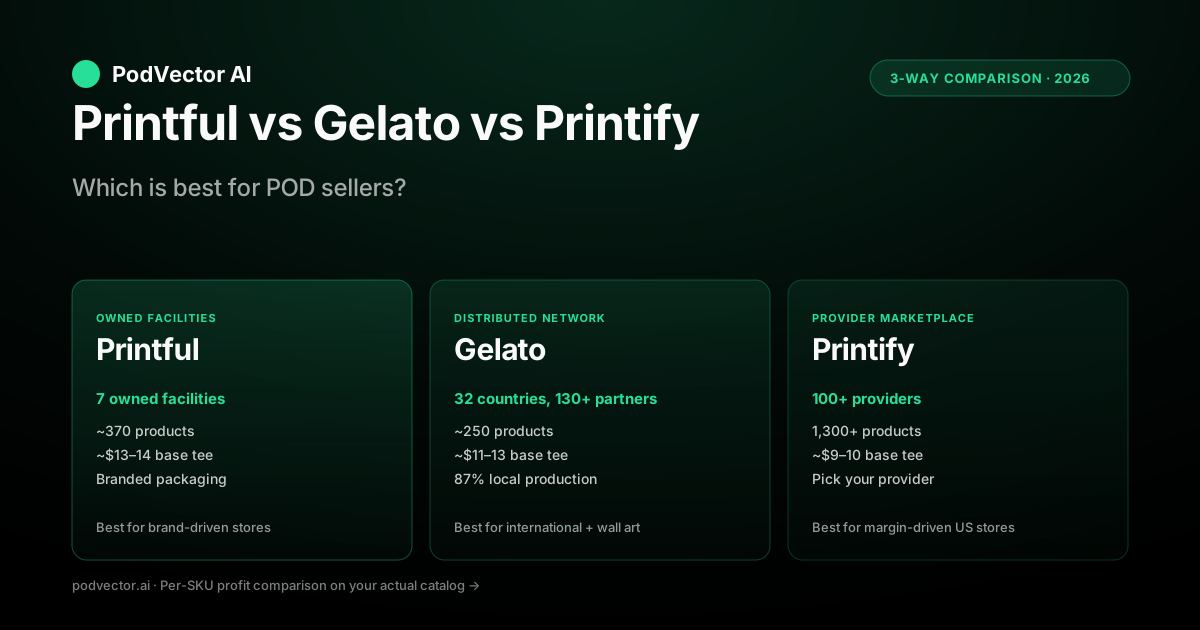
Quick Answer: Printful, Gelato, and Printify all plug into Shopify, Etsy, WooCommerce, and Wix and fulfill print-on-demand orders for you. The real difference is the production network behind the integration — Printful runs owned facilities for tight quality control, Printify is a marketplace of 100+ third-party providers competing on price, and Gelato is a software-coordinated network that prints close to the buyer's address.
Pick Printful if you sell branded apparel and want consistent print quality plus inserts, neck labels, and packaging extras. Pick Printify if you sell mostly to US buyers and want the lowest base unit cost on tees, hoodies, and mugs. Pick Gelato if a meaningful share of your orders ship outside the US — local production cuts shipping cost and refund rates more than the monthly fee.
Beyond that, the supplier you "should" use depends on your actual catalog: which SKUs sell, which countries they ship to, and which provider has the lowest landed cost on each. That answer is the one this article works toward.
The Printful-vs-rest decision in 60 seconds
The three platforms run a similar surface model — you upload a design, list a product on your store, and they print and ship when an order comes in. What changes underneath is who runs the press and where it sits.
Printful prints inside its own facilities in the US, Canada, Mexico, Latvia, Spain, the UK, and Australia. Printify routes each order to one of 100+ third-party providers you pre-select per product. Gelato sends the order file to whichever local production partner sits closest to the buyer inside its 140+ partner network across 32 countries.
That single architectural choice cascades through everything that matters — base cost, shipping speed, quality consistency, branding control, and which integration features each platform supports. The right pick depends on which trade-off matches your store.
Side-by-side snapshot table
Use this for orientation. Each row hides nuance unpacked further down.
| Dimension | Printful | Gelato | Printify |
|---|---|---|---|
| Production model | Owned facilities (7 countries) | Distributed network (140+ partners, 32 countries) | Marketplace of 100+ third-party providers |
| Monthly fee | Free; Growth ~$24.99/mo | Free; Gelato+ ~$24/mo; Gold ~$119/mo | Free; Premium ~$39/mo (raised Feb 2026); Enterprise custom |
| Base unit cost (Bella+Canvas 3001 tee, US) | ~$13–14 | ~$11–13 | ~$9–10 (top providers) |
| Catalog size | ~370 products | ~250 products | 1,300+ products |
| Native integrations | Shopify, Etsy, WooCommerce, Wix, Squarespace, eBay, Amazon, TikTok Shop, BigCommerce, Webflow + API | Shopify, Etsy, WooCommerce, Wix, BigCommerce, Squarespace, Storenvy, Magento + API | Shopify, Etsy, WooCommerce, Wix, eBay, Squarespace, BigCommerce, PrestaShop, Walmart, TikTok Shop + API |
| Strongest geography | US, EU (Latvia/Spain hubs) | EU, UK, APAC, multi-region brands | US (top providers) |
| Branded packaging | Yes — inserts, neck labels, custom packaging, packing slips | Available on Gelato+ and above | Provider-dependent — limited |
| Quality consistency | High (single owned chain) | Medium-high (audited partners) | Variable (depends on provider chosen per SKU) |
Production model: why architecture beats branding
Marketing pages compete on logos and pricing tables. The thing that actually determines your margin and refund rate is the production architecture each platform sits on top of.
Printful: owned facilities
Printful operates print floors it owns in the US, Canada, Mexico, Latvia, Spain, the UK, and Australia. The same staff, presses, and quality controls run every order — nothing is sublet to a third party. That is why Printful's quality consistency is the reference point in the industry and why its base prices are higher than the marketplace alternative.
The trade-off is geography. Orders from countries without a Printful facility ship internationally from the closest hub, which raises transit time and cost. Brazil, Japan, and most of Southeast Asia are examples where buyers wait noticeably longer than they would on a network with local production.
Gelato: distributed software-coordinated network
Gelato does not own the presses. Instead it runs the routing software on top of 140+ vetted print partners across 32 countries, and it claims roughly 90% of orders are produced inside the destination region, with about 90% delivered within five business days.
The model is more like an airline alliance than a single carrier. Quality controls are enforced by Gelato's onboarding and audit processes, so consistency is high but not as tight as a single owned chain. The win is shipping cost and speed for international orders, especially in Europe, the UK, Australia, and Japan.
Printify: open marketplace
Printify is the loosest of the three. It hosts 100+ independent print providers — each with their own facility, equipment, base prices, shipping rates, and lead times — and lets you pick which one fulfills each product.
That is how Printify hits the lowest base costs in the table above. It is also why Printify's quality is the most variable of the three: a Bella+Canvas 3001 tee from Monster Digital prints differently than the same SKU from SwiftPOD, and you have to do that vetting yourself.
Integrations: how each one actually connects to your store
All three integrate with the platforms that matter — Shopify, Etsy, WooCommerce, Wix, Squarespace, BigCommerce, eBay, and the rest of the long tail. The headline list is not the differentiator. What changes between them is what the integration actually does once it is connected.
Printful integrations
Printful's Shopify and Etsy integrations are the most polished of the three. Mockups generated inside Printful push directly into the store as product images, variants sync with Printful's catalog, and orders flow back automatically with tracking once shipped.
The integration also supports custom packaging settings per channel — useful if you want plain packaging on Etsy and branded inserts on Shopify. Printful additionally offers WooCommerce, Wix, Squarespace, eBay, Amazon, TikTok Shop, BigCommerce, and Webflow native apps, plus a documented public API.
Gelato integrations
Gelato's Shopify, Etsy, WooCommerce, Wix, BigCommerce, Squarespace, Storenvy, and Magento connections cover essentially the same channels. The integration includes automatic product publishing, variant sync, and an in-network shipping profile that maps Gelato's regional rates onto your store's shipping settings.
The notable strength is Etsy — Gelato lets you publish straight to Etsy with category, tags, and SEO copy fields filled in from inside Gelato's product editor. The notable weakness is the smaller native app surface relative to Printful (no Amazon native app, no eBay native app at the time of writing).
Printify integrations
Printify integrates natively with Shopify, Etsy, WooCommerce, Wix, eBay, Squarespace, BigCommerce, PrestaShop, Walmart, and TikTok Shop. The selection is the broadest in the category, and Walmart and TikTok Shop in particular are channels where Printful is weaker.
The catch is that Printify's integration sits on top of a marketplace of providers, so the integration's reliability is partly downstream of which provider you picked. If your chosen provider goes out of stock on a SKU, Printify can route to a backup provider only if you set that up in advance — otherwise the order pauses.
Order sync, inventory, and webhook behavior
Surface integrations look identical in screenshots. The interesting differences show up at the webhook layer — what data each platform pushes back to your store and how reliably.
Printful pushes order status updates (created, fulfilled, shipped, returned) to your store with low latency, and tracking numbers populate the Shopify or Etsy order automatically. Inventory is virtual — Printful only flags out-of-stock when a base product is genuinely unavailable across all facilities, which is rare.
Gelato pushes the same lifecycle events with similar latency and adds a "production started" event that Printful does not. Inventory works the same virtual way, with localized substitutions when a partner runs out (e.g., switching the Latvia partner for the UK partner on EU orders).
Printify's webhooks fire from the chosen provider, so behavior varies. Top providers (Monster Digital, Duplium, SwiftPOD, Awkward Styles) push status updates reliably; lower-tier ones can be slower or skip events entirely. If your store relies on order webhooks for analytics or downstream automation, the provider you pick on Printify directly affects data quality.
Pricing, base costs, and subscription tiers
Subscription fees are the small lever; base costs are the big one.
Free vs paid tiers
All three offer a free plan. The paid plans cut base unit costs by roughly 7–20% across the catalog and unlock branding or workflow features.
Printful Growth runs around $24.99/month with discounts on most apparel SKUs and access to the full branding suite. Gelato+ at ~$24/month and Gelato+ Gold at ~$119/month unlock branded packaging, premium shipping rates, and design tool extras. Printify Premium moved to ~$39/month (or ~$299/year) in February 2026 and gives a flat ~20% off most SKUs — the higher fee pushes the break-even to roughly 30+ orders per month before the discount pays for itself.
Base costs in practice
On a Bella+Canvas 3001 tee shipping to a US buyer, Printify's top providers come in around $9–10. Gelato's US partner runs $11–13. Printful's US facility runs $13–14. The gap on a single SKU is small in absolute terms but compounds at volume — 1,000 units a month on Printify can save $3–5K versus Printful before any branding or shipping difference.
The pattern flips outside the US. On the same tee shipping to a German buyer, Gelato's local Latvia or Germany partner often beats Printful's Spain facility on landed cost once shipping is included, and Printify's US-only providers stop being competitive entirely.
The fee that nobody quotes
Refund and reprint rate is the silent line item. Suppliers with longer transit times take more "where is my order" tickets, more lost-package claims, and more refund requests than suppliers with local production. Most operators do not track this until it is in the books, and at that point it has already eaten the supposed base-cost savings.
Catalog and quality controls
Printify's 1,300+ catalog is the broadest by raw count. Most of that breadth is duplicate SKUs across providers — the same Bella+Canvas 3001 listed by 8 different providers — but the long tail does include items the other two skip (e.g., niche pet products, non-standard packaging products).
Printful's ~370 products is the most curated. Quality is consistent because everything ships from owned facilities, and Printful tends to add new products only after testing the production process end-to-end.
Gelato's ~250 products is smaller but skews toward items that benefit from local production — wall art, photo books, calendars, mugs, and apparel. Gelato leans into product categories where shipping a printed product internationally is genuinely uneconomical, which is also why its catalog reads narrow on apparel compared to Printify.
Shipping speed by region
Shipping speed is downstream of where the product is printed. The architectural choice each platform made is what determines transit time.
United States
Printful and Printify both fulfill US orders out of US facilities, so transit times are similar — typically 2–5 business days after production. Gelato fulfills US orders out of US partners as well, with comparable transit times.
European Union and UK
Gelato wins. Local production from partners in Germany, Latvia, the UK, Spain, France, and the Netherlands keeps transit under 5 business days for most EU buyers. Printful covers Europe out of Latvia and Spain, which is competitive but loses on countries far from those hubs. Printify's EU production is provider-dependent and often involves shipping from the US, which is the worst case.
APAC, LATAM, and rest of world
Gelato wins again on the strength of Australian, Japanese, and Brazilian partners. Printful has an Australian facility but otherwise ships internationally. Printify is rarely the right call outside the US.
EU VAT, customs, and cross-border compliance
For any store shipping into Europe, where the product is printed changes more than delivery speed — it changes which VAT, customs, and packaging rules apply to the order. This is the fastest-moving part of the 2026 POD landscape, and it is where the production-model choice quietly pays off or bites.
The EU is tightening its low-value import regime: the customs reform phases out the €150 duty exemption on parcels arriving from outside the bloc, so orders that Printify fulfills from US providers into the EU increasingly pick up customs handling, import VAT, and potential duty at the border. That is cost and friction a locally produced Gelato order avoids entirely because it never crosses a customs line. Printful's Latvia and Spain hubs give it the same in-region advantage across most of the EU.
Germany's packaging law (VerpackG) adds another layer: sellers placing packaged goods on the German market are expected to register in the LUCID packaging register and license their packaging volumes. When production is local, the fulfillment partner's packaging already sits inside a compliant chain; when a parcel is shipped in from outside the EU, the compliance burden is murkier and lands on you.
The practical takeaway matches the shipping section from a different direction: if a meaningful share of your orders ship inside the EU or UK, in-region production — Gelato, or Printful's EU hubs — is not just faster, it sidesteps a tax-and-customs surface that US-only fulfillment walks straight into.
Branding, packaging, and white-label options
This is Printful's strongest single feature.
Printful supports branded packaging across most SKUs — custom packing slips, neck labels, sleeve prints, inside labels, branded poly mailers, custom inserts. The packing slip can be customized per store, and there is no Printful logo on packaging by default.
Gelato adds branded packaging on the Gelato+ tier and above. Coverage is improving but not as deep as Printful's — neck labels and inside-collar branding are not available on every SKU, depending on the partner producing the order.
Printify's branding depends on the chosen provider. Some top providers offer custom packing slips and branded inserts; others ship in plain Printify packaging with a generic slip. If branding matters, Printify is the most painful path because you have to verify each provider individually.
Design tools, mockups, and product personalization
All three include a design editor, a mockup generator, and product personalization features. The differences are in polish and depth.
Printful's mockup generator produces the most photorealistic results — model shots, lifestyle backgrounds, and flat lays look closer to studio photography than the alternatives. The design editor handles vector files, transparency, and multi-area placement (front, back, sleeve, inside-collar) cleanly.
Gelato's design tools are strong on print-quality validation — DPI checks, bleed warnings, color profile flags — which matters for wall art and photo book products where buyers notice quality issues immediately. The mockup generator is less photorealistic than Printful's.
Printify's design editor is the most basic of the three, but it is consistent across providers, so what you see is what you get. Personalization (letting buyers add their own text or upload a photo) is supported on all three with varying depth.
Customer support and operator experience
Printful runs 24/7 chat and email support with documented response time targets. Most issues route to a single team that can see the order end-to-end because Printful owns the production chain.
Gelato runs email and chat support during business hours across regions, with a separate enterprise support track on the higher plans. Response times are reasonable but not the fastest.
Printify's support is provider-mediated. Printify's own team handles platform issues quickly, but anything related to the actual order (production delays, quality, lost packages) often involves passing the ticket to the chosen provider, which adds latency.
Printful vs Printify head-to-head
Printful and Printify are the two suppliers most sellers compare first because they fulfill broadly the same product categories.
Printful wins on quality consistency, branding depth, and integration polish. Printify wins on base unit cost (the gap is real and meaningful at volume) and catalog breadth. The right pick is usually a function of where you sit on the brand-vs-margin spectrum: brand-led stores benefit from Printful, price-led stores benefit from Printify.
For a deeper unit-economics view, see the Printful vs Printify cost comparison. For the full feature/integration deep dive, see the features and pricing comparison and the longer-form reviews and pricing breakdown. The reviews-and-pros-cons piece is the right starting point if you have not used either yet.
Printful vs Gelato head-to-head
Printful vs Gelato is more about geography than brand vs price. Both invest in quality, both support branded packaging, and both have polished integrations.
The trade-off is fulfillment footprint. Printful's owned facilities offer tighter control on quality and branding consistency. Gelato's distributed network offers faster, cheaper international shipping. If your buyer base is concentrated in North America with a side of EU, Printful is a comfortable default. If your buyer base spans Europe, the UK, Australia, and Japan, Gelato is usually the cheaper landed-cost option per order.
Shipping mechanics matter here — see the complete guide to Printful shipping rates, times, and zones and the Printful shipping calculator walkthrough for how to model that out for your own catalog.
Pick X if Y
The shorthand most operators end up using.
Pick Printful if
You sell branded apparel, you ship mostly to the US or EU, and you care more about quality and branding consistency than the absolute lowest base cost. You also pick Printful if your store's reputation depends on packaging — the inserts, neck labels, and packing slip control are not optional for a premium brand.
Pick Gelato if
You sell internationally, especially in Europe, the UK, Australia, or Japan, or your catalog skews toward wall art, photo books, calendars, or mugs. The shipping cost and refund rate savings on international orders typically pay for the higher subscription tier within the first 50 orders.
Pick Printify if
You sell mostly to US buyers, your catalog is price-sensitive, and you are comfortable doing the provider vetting yourself. You also pick Printify if your catalog needs items the other two do not stock, or if you sell on Walmart or TikTok Shop, where Printify's native integrations are deeper.
Running Printful alongside another supplier
Most sellers past 1,000 orders a month run two suppliers in parallel — one for branded core SKUs, one for cost-sensitive long-tail SKUs. Printful + Printify is a common pairing: Printful for the hero apparel that defines the brand, Printify for niche items the catalog needs but the brand does not depend on.
Printful + Gelato is the geography pairing: Printful for North American orders, Gelato for international. This split is usually managed inside Shopify by routing rules — the order tag determines which supplier the order draft is created with.
The operational cost of running two suppliers is real. Reconciling refunds, reprints, and inventory across two systems takes more time than running one. The math only pays off when the per-SKU savings on the second supplier exceed the operational overhead, which usually starts being true past four-figure monthly volume.
The comparison most sellers actually need
Side-by-side feature tables answer the wrong question. The right question is: across the SKUs my store actually sells, in the countries my buyers actually live in, which supplier produces the highest profit per order after base cost, shipping, payment fees, and refund rate?
That answer is different for every catalog. A Florida-based unisex tee brand selling 70% to the US Southeast lands on Printify. A Berlin-based wall art store shipping 60% inside the EU lands on Gelato. A Toronto-based premium hoodie brand shipping cross-border in North America lands on Printful. The right supplier is downstream of your data, not downstream of which review article ranks highest on Google.
This is the gap PodVector AI sits in. Victor — PodVector AI's AI business employee — connects to your Shopify store, your Printful and Printify accounts, and your Meta and Google ad platforms, and lets you ask in plain English: which supplier is actually more profitable for my catalog? The answer comes back as an itemized per-SKU view, computed against your live order history and current supplier base costs, and Victor can propose price changes or supplier switches and execute them on your approval.
That is a different kind of comparison than this article. This article tells you what each supplier does. Victor tells you which supplier wins on your Printful and Printify orders.
FAQs
Is Printful better than Printify and Gelato?
Printful is better on quality consistency and branding depth. Printify is cheaper at the base-cost line for US orders. Gelato is faster and cheaper for international orders. "Better" is decided by which of those three trade-offs matches your catalog and customer base.
Which is cheapest — Printful, Gelato, or Printify?
On base unit cost in the US, Printify's top providers are cheapest, followed by Gelato, then Printful. Once you factor in international shipping and refund rates, Gelato often wins on landed cost outside the US even though Printify's sticker price is lower.
Can I use Printful, Gelato, and Printify together on one Shopify store?
Yes. All three install as separate Shopify apps and manage their own product variants and order routing. The work is reconciling reporting across three systems — most sellers do this by tagging Shopify orders with the supplier name and exporting to a single sheet or warehouse.
Which integrates best with Etsy?
All three integrate natively with Etsy. Printful's mockup quality and listing polish are the highest. Gelato's Etsy publishing flow is the most streamlined for filling out tags, categories, and SEO copy from inside the editor. Printify's Etsy integration is the most basic but the cheapest to operate at low volume.
What about Shopify integration?
All three have official Shopify apps. Printful's is the most polished and supports custom packaging settings per channel. Gelato's includes a regional shipping profile that maps cleanly onto Shopify's shipping zones. Printify's is broad but the underlying behavior depends on the provider you picked per SKU.
Does Printful have lower shipping costs than Gelato or Printify?
For US-to-US orders the three are roughly comparable. For international orders Gelato is almost always cheapest because the order is produced inside the destination region. Printful is competitive in EU thanks to Latvia and Spain hubs but loses badly in APAC outside Australia.
What is the catch with Printify being so cheap?
Printify is a marketplace, so quality and reliability vary by provider. The cheapest provider on a given SKU is not always the most reliable, and switching providers requires manually re-publishing the product. The base cost savings are real, but the operational tax for vetting providers is what most new sellers underestimate.
Do all three offer branded packaging?
Printful has the deepest branding suite (inserts, neck labels, packing slips, custom poly mailers) and includes much of it on the free plan. Gelato adds branding on Gelato+ and above. Printify's branding is provider-dependent and inconsistent.
Which is the best for a beginner?
Printful is the most forgiving for a first-time POD seller because the integration polish, support, and quality consistency mean fewer surprises. Printify is fine for beginners willing to do provider vetting up front. Gelato is the right call for a beginner with an international buyer base.
Do EU customs and VAT rules change which supplier I should use?
Yes, and more so in 2026. As the EU phases out the €150 low-value duty exemption, orders printed outside the bloc and shipped in — Printify's US providers, most often — pick up customs handling and import VAT that a locally produced order avoids. If you sell into the EU or UK, in-region production (Gelato, or Printful's Latvia and Spain hubs) sidesteps that friction, and Germany's LUCID packaging registration is cleaner when the parcel never crosses a customs line.
How do I decide between Gelato and Printful in Europe?
If your EU orders are concentrated in Germany, the UK, France, the Nordics, and Italy, Gelato's local production usually wins on landed cost and delivery time. If your EU orders skew toward countries close to Printful's Latvia or Spain hubs, Printful is competitive and the branding control is a tie-breaker. Printful's full coverage and pricing details are worth a closer look in the EU shipping context.
Can I see this comparison applied to my own store?
Yes — this is what we built PodVector AI for. Connect your Shopify store and supplier accounts, and Victor compares your live SKUs and order history across Printful and Printify and reports which supplier wins on each. See the full Printful comparison hub for sibling deep-dives, or jump in below.
Stop guessing which supplier is more profitable.
Victor — PodVector AI's AI business employee — connects to your Shopify store and supplier accounts, computes per-SKU landed cost across Printful and Printify on your live order history, and proposes the switches that win you margin. You ask in plain English. He proposes the action. You approve. He executes it on Shopify with a full audit trail.
Try Victor free