
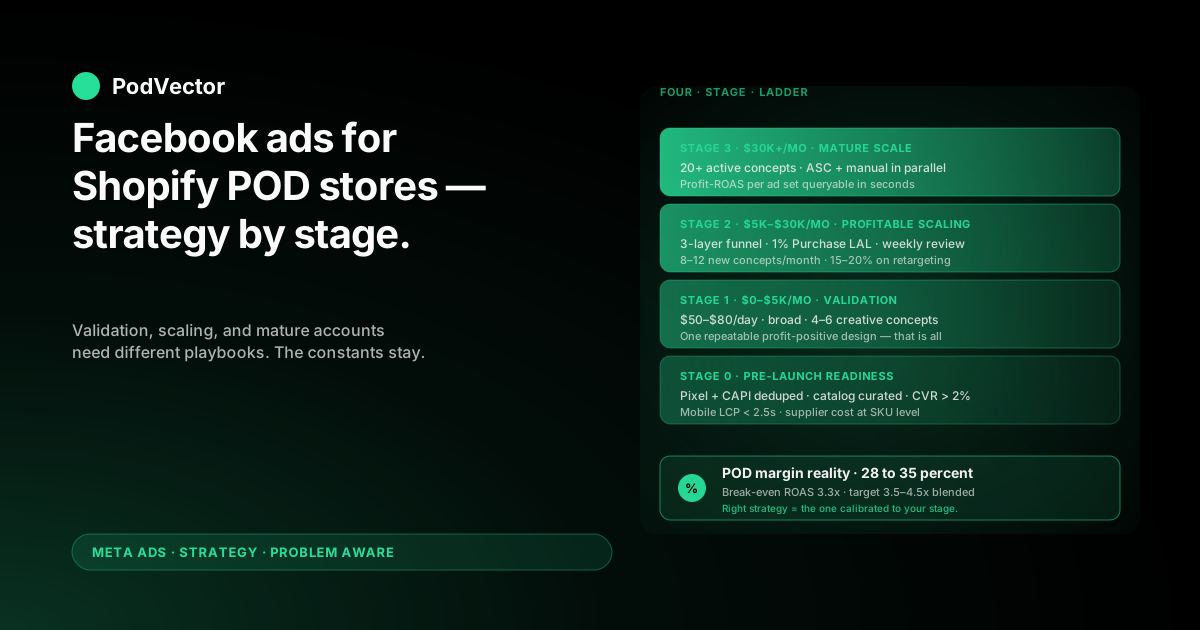
Quick Answer: A Facebook-ads strategy for Shopify print-on-demand stores has to flex with store stage. The same playbook does not work at $0/mo, $10k/mo, and $50k/mo — what helps a validation-stage store launch its first winner actively gets in the way at scale, and the structures a $30k/mo store needs would suffocate a brand-new account.
This article maps the strategy across four stages: pre-launch readiness, validation ($0–$5k/mo), profitable scaling ($5k–$30k/mo), and mature scale ($30k+/mo). At every stage, the constant is POD's 28–35% margin — the constraint that doubles break-even ROAS and quietly turns Meta-reported "winners" into profit losers.
If you only remember one thing: the right Facebook strategy for your Shopify store is the one calibrated to your stage and your true profit number, not the one a bigger store on YouTube swears by.
Why "Shopify stores" is plural — the strategy is not one-size-fits-all
Generic Facebook-ads guides treat every Shopify store like the same machine. They are not. The standard advice — pick a niche, install the pixel, target lookalikes, scale the winners — appears in teeinblue's Facebook Ads starter pack, PodNinjas' POD ads guide, and Merchize's 2025 POD advertising guide in roughly the same shape, and it is mostly correct in outline.
What it misses is stage. The same playbook does not work at $0/mo, $10k/mo, and $50k/mo.
A pre-launch store needs signal, not scale. A $5k/mo store needs structure, not more spend. A $30k/mo store needs measurement that survives Meta's optimiser pulling toward the wrong SKUs. Each stage has different bottlenecks, different decision rules, and different failure modes.
The reason most operators get stuck is not bad tactics — it is using a stage-three playbook at stage one, or a stage-one playbook at stage three. The four-stage map below is meant to fix that.
The four constraints every Shopify POD ad strategy fights
Before stages, the constants. Every Shopify POD store fights the same four constraints, and every stage of the strategy is a different answer to them.
1. Margin is thin and Meta cannot see it
After Printify or Printful supplier cost, contribution margin lives between 28% and 35%. Meta's optimiser sees order subtotal — including supplier cost — and optimises against the largest receipt, not the largest profit.
That single fact reshapes every other rule. Break-even ROAS roughly doubles. "Winners" can be profit losers. Cut decisions need to be more sensitive than raise decisions.
2. Mobile attention budget is ~1.7 seconds
Around 80% of Facebook traffic on a Shopify product page comes from mobile. The first frame and the first three words of caption decide whether the ad gets to deliver its content. Hooks built for desktop attention spans burn budget without registering.
3. Signal density requires a feeding floor
Meta's algorithm needs ~50 conversions per ad set per week to optimise toward Purchase reliably. Below that, every signal is noise — and the account looks broken when it is just under-fed. The minimum daily spend that produces enough events lives around $50–$80/day per ad set.
4. Creative fatigue compounds faster than ad-set optimisation
One concept run for three weeks across three formats is not three concepts — Meta's algorithm treats them as the same creative for fatigue purposes. Frequency above 3.0 on a single concept is the single largest cause of account decline. Concept volume — not format-cropping — is what keeps an account alive.
Every stage below is a different answer to those four. The constraints do not change; the response to them does.
Stage 0 — Pre-launch readiness
Stage zero is everything that happens before $1 of spend. Most operators sprint past it and pay for the skip later.
The seven-point store-side check
This is the floor — fail any of these and Facebook spend will buy traffic to a leaking bucket:
- Pixel and Conversions API both live, deduplicated. The Facebook & Instagram channel app on Shopify installs both. Confirm in Meta Events Manager that browser and server events match within 10% on Purchase, AddToCart, and ViewContent.
- Catalog feed published and curated. Default behaviour pushes every SKU. For POD, curate to 8–15 of your highest-margin, best-converting designs.
- Product page conversion rate above 2%. Below 2%, the answer is not more ads — it is product-page work.
- Mobile load under 2.5 seconds (Largest Contentful Paint). A 4-second page bleeds 30–40% of paid traffic between ad click and pixel fire.
- Supplier cost captured at SKU level. Metafield, inventory app, or warehouse export — anything queryable. Without it, profit is unanswerable.
- Post-purchase upsell live. A one-click "same design, also on a hoodie?" lifts AOV 15–25% at near-zero ad cost.
- Email and SMS recovery flows running. Meta retargets cart abandoners on-platform; email and SMS catch the rest at a fraction of the variable cost.
Score the audit. Six of seven and you are ready. Below five and the foundation needs work first — the Meta Ads + Shopify integration guide walks the technical setup.
What "ready" actually means
Ready is not "the pixel is firing." Ready is: events deduped, catalog curated, page converting, supplier cost queryable, recovery flows catching the misses Facebook can't.
The seven items above are the smallest set of fixes that compound. Each one matters more than another round of audience tuning.
Stage 1 — Validation ($0–$5k/mo)
Validation is one job: find a niche-design combination that converts to paid traffic at break-even or better. Not five winners. One.
Spend posture
$50–$80/day on prospecting. One ad set, broad targeting, four to six creative concepts in rotation. Anything more elaborate at this stage is structure for data you do not yet have.
Plan for $1,500–$2,500 across the first 30 days, split between media and creative production. Spending less starves the algorithm; spending more burns budget on structure that does not yet pay for itself.
Audience strategy
Pure broad, plus one 1% AddToCart Lookalike if you have ~500 AddToCart events from any prior traffic. No interest stacks unless your niche is genuinely small (e.g., "left-handed bass guitarists") and broad will not find it.
Lookalikes off your customer list are not available yet — you do not have enough purchasers to seed a stable seed audience. That unlocks at stage two.
Creative posture
Concept volume beats concept polish. Four to six different hooks, different angles, different creators — not four crops of the same UGC clip. Niche-identity hooks travel best in POD: "If you've ever taught third grade, you'll get this" lets the viewer self-identify in frame one.
Discount-led hooks ("10% off") are a trap at this stage. They burn through audience without building niche-design recognition, and POD's repeat-purchase rate depends on that recognition.
Decision rule
Take no decisions on individual ad sets in week one. Meta needs that ~50-conversions-per-ad-set-per-week floor before any signal is real. By day 14, profit-ROAS is the cut/keep number, not Meta-reported ROAS — and most stores discover their first apparent winner is a 0.9x profit-ROAS loser.
Validation is not "get to $5k/mo" — it is "produce repeatable, profit-positive signal on at least one design." If that takes 60 days, take 60 days. The step-by-step Shopify setup walkthrough covers the launch mechanics in order.
Stage 2 — Profitable scaling ($5k–$30k/mo)
Stage two is the longest stage. It is also where the most stores die — not because spend stops working, but because the structure that got you to $5k/mo cannot get you to $30k/mo.
Account architecture
Three-layer funnel. Run all three concurrently, let CPA arbitrate budget:
- 55–65% top-of-funnel (TOF) prospecting — broad, 1% Purchase Lookalike (now that you have 500+ purchasers), Advantage+ Audience.
- 20–25% middle-of-funnel (MOF) — page viewers, AddToCart, 30-day site visitors.
- 15–20% bottom-of-funnel (BOF) — Advantage+ Catalog Ads (formerly Dynamic Product Ads) on the curated catalog, 7–14 day cart abandoners, recent purchasers excluded.
The retargeting weight is slightly higher than generic Shopify because POD is design-led — a niche-design viewer is more recoverable than a generic apparel viewer. They self-selected by clicking a niche-specific creative.
Audience ladder
Build the ladder narrowest to widest, run rungs concurrently:
- 1% Purchase Lookalike off your highest-LTV customer decile. Often beats broad on prospecting CPA by 20–35%.
- 1% AddToCart Lookalike for wider behavioural pool.
- 3–5% Purchase Lookalike as the scaling rung once 1% saturates.
- Advantage+ Audience seeded with your customer list — parallel ad set, not replacement.
- Pure broad — usually highest volume at scale, noisiest on quality.
Creative volume
This is the lever most stage-two stores under-invest in. Volume floor by spend tier:
| Daily spend | New concepts/month | Active concepts at any time |
|---|---|---|
| $50–$200 | 4–6 | 6–10 |
| $200–$800 | 8–12 | 10–18 |
| $800–$2,000 | 15–20 | 20–30 |
Plan 15–25% of media spend on creative production at this stage. UGC creators charge $80–$300 per video; static design-on-product mockups can be produced in-house. The scaling playbook covers how to push volume without inflating cost.
Decision cadence
Weekly profit-ROAS review. Winners get +20% budget. Losers get killed. Anything at 2.5+ frequency gets refreshed before it fatigues into the floor.
Monthly: funnel allocation drift, lookalike rebuild, ASC catalog re-curation, creative concept post-mortem.
The trap that ends most stage-two stores
Scaling on Meta-reported ROAS while profit-ROAS is silently below 1.0x. Meta-reported 4x with profit-ROAS at 0.9x means you are growing revenue and shrinking profit at the same time — the trap a thin-margin model punishes hardest.
Most POD accounts at this stage have at least one apparent "winner" that is a profit loser. Only profit-ROAS — revenue minus supplier cost minus fees, divided by spend — surfaces it. The ROAS & attribution guide covers the calculation in depth.
Stage 3 — Mature scale ($30k+/mo)
Stage three is where the system gets harder, not easier. The intuition that "more spend equals more sales" stops being true; what replaces it is a measurement layer most stores never build.
Why mature stores plateau
Three reasons, in order of frequency:
- The 1% Purchase Lookalike has saturated. Adding spend to it now adds incremental cost, not incremental sales.
- Creative refresh cadence has not kept up. The store is at $40k/mo running 12 active concepts when it needs 25.
- Meta is scaling the wrong SKUs. ASC and broad ad sets drift toward high-receipt, high-supplier-cost designs because that is what Meta's optimiser rewards.
None of those problems gets solved by more spend. Each gets solved by structure.
Account structure that survives at scale
Two campaign structures running side by side:
- Manual prospecting with the full audience ladder (broad, 1%/3%/5% Purchase LAL, AddToCart LAL, Advantage+ Audience). Caps drift and gives clean signal per rung.
- Advantage+ Shopping Campaigns (ASC) on the curated 8–15 SKU catalog. ASC delivers 15–30% lower CAC for most stores once Meta has data — but only if the catalog has been curated. Otherwise it scales the worst-margin SKUs.
Run both for 30 days minimum before comparing. Read on profit-ROAS, not Meta-reported ROAS.
Creative pipeline
The constraint at $30k+/mo is rarely budget — it is the concept pipeline. Operators who can ship 20+ new concepts a month outperform operators who ship 5, regardless of media skill. The pipeline needs to live as an actual production process: brief → creator → review → ship — running in parallel, not sequentially.
Measurement layer
This is the part that does not scale in spreadsheets. Below ~$30k/mo, an operator can reconcile profit-ROAS by ad set in a Saturday morning. Above $30k/mo, the join breaks — too many orders, too many SKUs, too much variance week to week.
The pattern that survives at scale is a unified data warehouse that reads from Shopify, Printify or Printful, Meta, and your payment processor on a schedule, joins on order ID, and exposes profit-ROAS per ad set on demand. Snowflake, Redshift, Databricks, or equivalent all work. The principle is the same: ad-set-to-margin queryable in seconds, not assembled once a week.
The complete Meta Ads playbook covers the cluster-wide picture; the Meta Ads strategy hub indexes the rest.
The profit signal that ties every stage together
Three numbers decide whether your Facebook ads are growing the business or quietly draining it. None of them lives inside Meta Ads Manager.
The three numbers
- MER (Marketing Efficiency Ratio) — total Shopify revenue ÷ total ad spend across all platforms. POD's workable MER lives between 3.5x and 5x, depending on margin and AOV. Below 3.3x, you are losing money in aggregate.
- Profit-ROAS — (Shopify revenue − Printify or Printful supplier cost − Shopify fees − payment processor) ÷ ad spend. The number Meta will never show you, because it does not have supplier cost. Break-even is 1.0x. Most stores discover their "4x" winner is a 0.9x profit-ROAS loser.
- Item-level margin per ad set — which SKUs each ad set is selling. ASC and broad ad sets drift toward high-supplier-cost SKUs because Meta scales receipts. Catching this needs SKU-level tagging on every order, joined to ad-set ID.
Where the signal has to live
Across Shopify orders, supplier exports, Meta spend reports, and payment processor data — joined in one place. Spreadsheets work to ~$30k/mo. Above that, the join belongs in a live data layer that operators can query in the moment.
The same architecture handles the cross-platform question — Meta versus Google versus TikTok — because the join is on order ID, not platform. Most working POD stores end up running Meta at 60–70% of total ad spend with Google capturing the bottom-of-funnel intent Meta created.
Five reasons Shopify POD stores stall between stages
1. Skipping the readiness audit
Launching ads on a 1.5%-converting product page with a 4-second mobile load is paying Meta to deliver traffic to a leaking bucket. The store-side fixes return more than another round of audience experiments — they just do not feel like "doing ads work."
2. Scaling on Meta-reported ROAS
The single largest profit drain at stage two. Meta-reported 4x with profit-ROAS at 0.9x grows revenue and shrinks profit at the same time. Run profit-ROAS as the primary cut/keep number. Run Meta-reported ROAS as the secondary delivery-health check.
3. Cropping one creative into three formats and calling it volume
Meta's fatigue clock treats 1:1, 4:5, and 9:16 of the same UGC clip as one creative. Concept volume needs different hook, different angle, different creator, different design — not different aspect ratios.
4. Running uncurated Advantage+ Shopping Campaigns
ASC on a full POD catalog scales whichever SKUs Meta sees as biggest — which, for POD, is whichever has the largest supplier cost. Curate the feed to 8–15 high-margin designs first. Then turn ASC on. Otherwise you pay Meta to find your worst-margin orders.
5. Treating the strategy as set-and-forget
The Meta auction shifts. iOS shifts. Audience pools saturate. Creative tastes shift. A strategy decided in Q1 and never re-decided is a Q3 loss. The 4-weekly review catches drift before it compounds — not to second-guess every week, but to catch the slow leaks.
FAQs
How is "Facebook Ads for Shopify Stores" different from "Facebook Ads for a Shopify Store"?
Functionally, the same SEO intent. The plural framing in this article emphasises that the strategy is not one-size-fits-all across stores at different stages — a $0/mo, $5k/mo, and $30k/mo Shopify POD store need different account structures, different audience ladders, and different creative volumes. The constants (margin math, profit-ROAS) carry through; the playbook around them flexes.
What's the smallest budget that can validate a POD design on Facebook?
$50–$80/day on one prospecting ad set with 4–6 creative concepts. Plan $1,500–$2,500 across the first 30 days. Below that, Meta's algorithm cannot collect enough Purchase events (it needs ~50/ad-set/week) to optimise toward conversions, and the account looks broken when it is just under-fed.
When should I add lookalike audiences?
1% AddToCart LAL: as soon as you have ~500 AddToCart events. 1% Purchase LAL: when you have 500+ purchasers — usually mid-stage-two. 3–5% Purchase LAL: when 1% Purchase LAL saturates, typically late stage two or stage three. Building lookalikes earlier than that uses an unstable seed and the audience does not transfer signal.
What ROAS should I target on Facebook for a Shopify POD store?
3.5–4.5x blended Meta-reported ROAS, with 5x+ on retargeting and 3.0x+ on cold prospecting. POD's 28–35% margin makes ~3.3x literal break-even, so the buffer above absorbs supplier price changes, refunds, and seasonality. Stores running at "industry-standard" 2.5–3x targets are scaling losses without realising it.
Do I need both the Facebook Pixel and the Conversions API?
Yes — run both with deduplication. The Pixel handles browser-side events for fast in-session signal; CAPI handles server-side events resilient to ad blockers and iOS opt-outs. Most working 2026 setups have CAPI as primary signal and Pixel as backup, with event_id deduplication so Meta does not double-count. Shopify's Facebook & Instagram channel app handles the dedup automatically once both are firing.
How do I track profitability when Printify or Printful costs vary by SKU?
Capture supplier cost at the SKU level — Shopify metafield, inventory app, or warehouse export — then join to each Shopify order, then join to ad-set ID via UTM or attribution data. The output is profit-ROAS per ad set: revenue minus supplier cost minus fees, divided by spend. Spreadsheets handle this until ~$30k/mo; above that, the join needs to live in a live data layer.
Should I use Advantage+ Shopping Campaigns or stick with manual?
Both, in parallel, once you are at stage two or beyond. ASC delivers 15–30% lower CAC for most stores once Meta has data — but it needs a curated catalog feed to work for POD. Otherwise it scales the highest-supplier-cost SKUs because Meta only sees receipt size. Run ASC on an 8–15 SKU shortlist alongside manual prospecting, give it 30 days, then compare profit-ROAS.
How does this strategy connect to other Meta Ads work?
This article is the stage-by-stage strategic frame. The setup mechanics, ad-type playbooks, and ROAS detail sit beside it across the Meta Ads topic hub. If your foundation is not in place — Pixel + CAPI clean, Shopify catalog feed live, baseline conversion tracking matching within 10% — none of the strategic decisions above will hold.
Profit-ROAS is the number Meta will never show you
Meta-reported ROAS is one number. Shopify revenue is another. Printify or Printful's supplier cost is the one Meta cannot see — and it is the one that decides whether your Facebook ads are scaling profit or scaling losses.
PodVector AI's AI employee Victor connects all of them. Ask "is this Facebook ad set actually profitable after Printify cost?" and Victor answers with live numbers from your Shopify, Printify or Printful, and Meta data — not a delayed export, not a yesterday-end snapshot. Victor answers and acts on what he sees — with your approval.
Try Victor free