
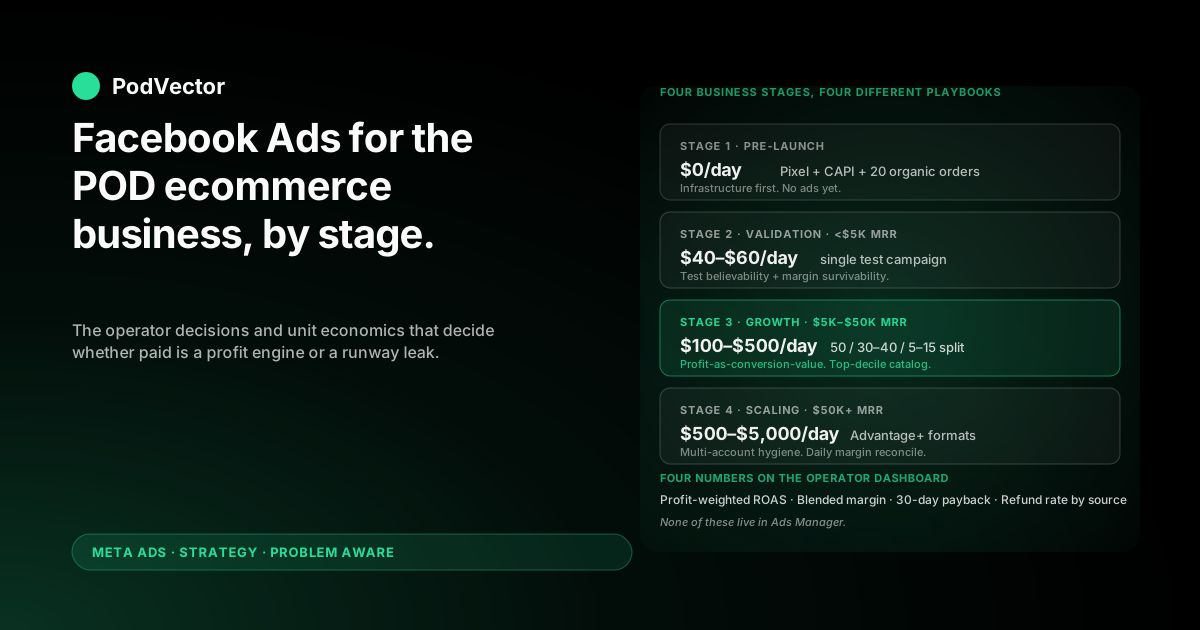
Quick Answer: Most "Facebook Ads for ecommerce businesses" guides answer the campaign question (which placements, which audiences, which creative). For a print-on-demand business, the harder question is the business question: at what stage do you turn paid on, who runs it, what working capital does it need, and which numbers should the operator actually watch.
This guide walks the operator-side decisions for a POD ecommerce business across four stages — pre-launch, validation, growth, and scaling — with the unit economics, payback math, and reporting cadence that decide whether Facebook Ads is a profit engine or a runway leak.
The campaign mechanics (Pixel, CAPI, lookalikes, creative format) are covered in the linked siblings. This piece is for the person making the business decision, not the person clicking inside Ads Manager.
Why "ecommerce businesses" needs a different guide than "ecommerce"
Search "Facebook Ads for ecommerce" and the top results — LeadsBridge's 2025 strategies guide, WebAppick's 11 must-have strategies, and Convertcart's 26 secrets — all answer the campaign question. Use Dynamic Product Ads. Train the Pixel. Layer in Conversions API. Test 26 hooks.
Those are correct, but they're aimed at the practitioner clicking inside Ads Manager. A POD ecommerce business owner needs an answer one layer up: given my stage, my margin profile, and my working capital, what should this function look like in my business?
That's the question this guide answers. The campaign-mechanics version of the playbook lives in the sibling Facebook Ads for ecommerce strategy for print-on-demand, and the platform-specific install lives in Shopify Facebook Ads strategy for print-on-demand.
The unit economics every POD business owner has to know first
Before any stage-specific decision, three numbers anchor the entire business case for Facebook Ads on a POD store. Get these wrong and the rest of the playbook misallocates capital.
1. Contribution margin per order
Order subtotal minus supplier cost (Printify or Printful) minus payment processing minus shipping subsidy minus the prorated return rate. On a $30 t-shirt this typically lands at $9–$12.
This is the ceiling on what a Facebook Ads campaign can spend per acquired order before the business goes underwater. Generic ecommerce playbooks assume $18–$25; POD operators who use that number lose money quietly.
2. Customer payback period
If the average POD customer places 1.3 orders in their first 90 days at $9.50 contribution margin, the business has $12.35 of margin to recover acquisition cost. A $9 cost-per-acquisition pays back in roughly 80 days; a $12 cost-per-acquisition never pays back inside the 90-day window.
The payback period decides how aggressively a business owner can scale. Sub-30 day payback supports daily budget increases. Over-90 day payback means every dollar of growth burns working capital first and recoups it months later — a different financing problem entirely.
3. Working capital available for negative-ROAS days
Even on a working campaign, the first 14–21 days run negative ROAS while Meta's algorithm exits the learning phase. A $90/day budget consumes $1,260–$1,890 before the account starts showing the right shape.
The business needs to survive that window without supplier non-payment. POD operators with under $3,000 of working capital should not be running a $90/day Facebook Ads test — the math says the test will outlive the bank account.
Stage 1 — Pre-launch (no ads, just infrastructure)
The biggest single mistake POD business owners make is launching Facebook Ads on day one of the store. Before any ad spend, the business needs a tracking and economics foundation that the ad spend can actually train against.
The pre-launch checklist that has to be true before a single dollar leaves the ad account:
- Meta Pixel installed and firing through the platform's native channel, with at least PageView, ViewContent, AddToCart, InitiateCheckout, and Purchase events validated in the Test Events tool.
- Conversions API (CAPI — Meta's server-side event channel) live alongside the Pixel, deduplicating browser and server events. Browser-only Pixel has been functionally degraded since iOS 14.5 and is no longer enough.
- Domain verified in Meta Business Manager with the eight-event slot priorities assigned, Purchase as #1.
- A working profit number per SKU — subtotal minus Printify or Printful supplier cost minus payment fee — pulled from your platform or maintained as a metafield. This is the input to the highest-leverage strategic move POD operators have available, covered in the sibling guide.
- 20+ organic orders on the books so that creative and audience tests have something real to compare against. Ads run before organic baseline produce no signal; you can't tell whether the campaign worked or whether the store would have done that volume anyway.
This stage is unglamorous — it's tax software, not growth — but the businesses that skip it spend the next stage learning the same lessons with money attached.
Stage 2 — Validation (sub-$5k MRR)
The validation stage is not "scale this thing." It's "find out which designs and audiences earn their cost-per-purchase at all." Most POD businesses live here for 60–120 days, and the businesses that try to skip past it usually return to it later with less capital.
Budget shape
$40–$60 per day, single campaign, single cold prospecting ad set. Below $40/day Meta's algorithm doesn't accumulate enough purchase events to escape the learning phase; above $60/day the business is over-spending for the data it needs.
Plan for $1,200–$1,800 over the first 30 days as test capital, not as growth capital. The business owner should expect this money back over 60–120 days, not 30.
What to actually test at this stage
Two things, in this order: is my creative believable, and is my margin survivable. Almost everything else (lookalike segments, advanced bid strategies, retargeting funnels) is premature optimization at sub-$5k MRR.
Run two creatives — one lifestyle photo of the design on a real human, one 15-second vertical video of the same design — against a broad audience. If neither earns a cost-per-purchase under your contribution margin within 14 days, the problem is the design or the offer, not the campaign.
Operator hours per week
Three to five hours, mostly spent on creative production (sample orders, photo shoots, motion ad cuts) rather than dashboard tweaking. POD business owners at this stage who are spending 15+ hours per week inside Ads Manager are usually optimizing too early.
Stage 3 — Growth ($5k–$50k MRR)
The growth stage is where Facebook Ads actually changes the business's trajectory — and where most operator decisions go wrong because the playbook from stage 2 stops working.
Budget shape
$100–$500 per day across two or three campaigns: a cold prospecting campaign (50–60% of budget), a retargeting campaign on 14-day site visitors and add-to-cart abandoners (30–40%), and a small retention layer on 90-day post-purchase audiences (5–15%).
The split intentionally overweights retargeting compared to the generic ecommerce 70/20/10 because POD's tighter margin makes captured-intent conversions disproportionately valuable. A retargeted POD buyer at $4–$6 cost-per-purchase is the difference between a profitable month and a break-even one.
What changes at this stage
Three structural shifts the business has to make to support a $100+/day budget without breaking:
- Profit, not subtotal, as conversion value. By default the platform sends order subtotal to Meta, which means the algorithm chases the lowest-margin SKUs. Switching to profit (subtotal minus supplier cost) routes optimization toward your actual profit drivers. This single change reliably moves contribution margin 10–30% in growth-stage POD accounts.
- Catalog scoped to your top decile. A POD store with 200 SKUs synced to the Meta catalog produces no usable signal at this budget. Restrict the catalog feed to the top 8–15 SKUs from organic order volume, then expand only after the trained algorithm has signal to extend.
- Refund uploads as offline conversions. POD has elevated refund rates (3–6%) versus owned inventory (1–2%) because of garment fit and shipping damage. Without uploading refunds back to Meta with negative value, the algorithm keeps optimizing toward buyers who'll refund — a slow leak that compounds.
Operator hours per week
Six to ten hours, increasingly weighted toward creative production rather than dashboard work. The single highest-leverage shift at this stage is moving the operator's time out of Ads Manager and into "what's the next ten lifestyle photos and video cuts."
Businesses that try to fix a stage-3 plateau by clicking deeper into Ads Manager almost always have a creative refresh problem, not an optimization problem.
Stage 4 — Scaling ($50k+ MRR)
At $50k+ monthly revenue the business is no longer asking does Facebook Ads work for us. It's asking how much can we deploy without breaking the unit economics we proved in stage 3. That question is fundamentally different.
Budget shape
$500–$5,000 per day, with budget concentrated in the campaigns that have already proven profit-weighted ROAS above 1.0 over a 30-day window. This is the stage where Advantage+ Shopping campaigns (Meta's automated full-funnel format) start to outperform manually-structured campaigns for most POD accounts, because Meta's algorithm now has enough signal density to do the targeting work itself.
What the business has to add at this stage
- Multi-account hygiene. Spend over $10k/month should be split across at least one backup ad account (separate Business Manager, separate domain verification) to insulate against a Meta enforcement action. POD businesses that scale on a single ad account are one false-positive policy violation away from a 30-day blackout that the cash flow can't survive.
- Daily margin reconciliation. Meta-reported ROAS doesn't see Printify or Printful supplier cost. At $50k+ MRR, a 5% misread on margin is real money — the business needs a daily reconciliation that pulls Shopify orders, supplier costs, payment fees, and ad spend into one view. This is where most operators stop being able to do it in a spreadsheet at 11pm.
- Creative production as a function, not a hobby. A scaling POD account burns through creative inventory in 2–4 weeks. Most $50k+/month accounts need 8–12 new creatives per week to hold ROAS, which is a separate operational problem (UGC partners, in-house photographer, weekly motion ad shoots).
- Working capital that survives a 60-day swing. Even healthy scaling accounts go through 30–60 day stretches of degraded ROAS during creative refresh cycles or platform-side algorithm changes. The business needs runway to ride those out without collapsing the budget.
Operator hours per week
This is usually where the founder steps out of day-to-day Ads Manager work and either hires an in-house buyer or moves to a hybrid agency model. Founder hours move to creative direction, partnership building, and reading the dashboard — not pulling levers inside the platform.
In-house operator, freelancer, or agency — when to flip
The staffing question is one of the highest-stakes business decisions in the playbook, and the right answer changes by stage in a fairly predictable pattern.
Sub-$5k MRR — founder runs it
An agency on a $1,500/month retainer eats 30%+ of a stage-2 POD business's revenue. No agency does meaningful work for $300/month. The right answer at this stage is for the founder to run the small budget themselves and learn the platform.
$5k–$50k MRR — founder + freelancer or specialist
This is the muddy zone. Two paths work, and the right one depends on the founder's appetite for the work.
Path A: founder keeps running it, brings in a freelance creative producer ($800–$2,000/month) for the 8–12 weekly creatives that the budget now needs. This keeps the strategic decisions in the founder's head, where they belong.
Path B: founder hands the dashboard to a freelance media buyer ($1,500–$3,500/month) and keeps creative production. This works if the founder is the brand voice; it doesn't work if the founder is also the only person who knows the margin economics.
$50k+ MRR — in-house buyer or specialized POD agency
At this revenue level the business can support a $5,000–$10,000/month in-house media buyer or a specialist agency. The deciding factor isn't cost — it's whether the agency understands POD's contribution margin reality. Most generic ecommerce agencies do not. The agency selection guide for POD operators covers the diligence questions in detail.
Business reporting: which numbers belong on the operator dashboard
The Ads Manager dashboard is built for the practitioner. The business owner needs a different view — fewer numbers, more interpretation, and the supplier cost layer that Meta's UI literally cannot show.
The four numbers that should appear on the operator's weekly dashboard, in order:
- Profit-weighted ROAS (subtotal minus Printify or Printful supplier cost minus payment fee, divided by ad spend). Anything above 1.0 is profitable; anything below means the campaign is subsidizing buyers from working capital.
- Contribution margin per order, blended. Tracks whether the SKU mix Meta is finding is the SKU mix the business actually wants. A drifting blended margin is the leading indicator that conversion-value optimization has gone wrong.
- 30-day payback ratio. Of the dollars spent on Facebook Ads in the last 30 days, what percentage has been recovered through margin in the same window. Below 60% means the business is increasingly funding growth from working capital rather than recycled margin.
- Refund rate on Meta-acquired orders, vs. organic. If Meta-acquired buyers refund at materially higher rates, the algorithm is finding the wrong people — usually because the conversion value signal upstream is wrong.
This is also where Victor — PodVector AI's AI employee built specifically for POD operators — does the work most founders end up doing in spreadsheets at 11pm. Victor pulls Shopify, Printify or Printful, and Meta into one live data warehouse and answers "is the business profitable on margin this week, accounting for supplier cost?" with a single number. The point isn't the tool; it's that the four numbers above are the right ones to watch and most POD businesses don't have a fast way to surface them.
For the underlying ROAS math, see the pillar on the complete guide to Meta Ads ROAS and attribution for POD.
Five business-level mistakes that look like ad problems
- Launching paid before validating organic. A store with zero organic orders has no signal to tell whether ads worked. The first $1,500 of ad spend is buying data, not customers — and there's no comparison baseline to interpret the data.
- Treating Meta's reported ROAS as the business KPI. Ads Manager doesn't see Printify or Printful supplier cost. A 2.0 reported ROAS on a 60% supplier cost basis is unprofitable; a 1.5 reported ROAS with a 35% supplier cost basis is profitable. The dashboard number is wrong by definition for POD.
- Scaling on a one-week ROAS spike. Attribution lag and natural week-to-week variance mean single-week numbers are noise. The business should make scale decisions on rolling 14-day windows minimum, with stable cost-per-purchase for 5+ consecutive days as the trigger.
- Hiring an agency before the unit economics work. An agency cannot fix bad contribution margin. Pre-product-market-fit POD businesses hiring agencies usually waste 90 days and $4,500 finding out the offer was the problem, not the targeting.
- Underfunding the working capital buffer. The business that spends its last $1,800 launching a $60/day test has a 14-day window to find product-market fit before the supplier invoices come due. The math almost never works on that timeline. Defer the launch until the buffer is real.
FAQs
What's the right Facebook Ads strategy for a print-on-demand ecommerce business?
The right strategy is stage-dependent. Sub-$5k MRR: $40–$60/day single test campaign to validate creative and margin. $5k–$50k MRR: $100–$500/day with a 50/30/40/15 budget split across cold, retarget, and retention, plus profit-as-conversion-value enabled. $50k+ MRR: $500–$5,000/day on Advantage+ formats with multi-account hygiene and daily margin reconciliation. Skipping a stage almost always means returning to it later with less capital.
How much should an ecommerce print-on-demand business spend on Facebook Ads?
The honest answer is "whatever your contribution margin and working capital can sustain for 30 days of negative ROAS." For most POD businesses that's $40–$90/day at validation, $100–$500/day at growth, $500+ at scale. Below $40/day Meta's algorithm cannot accumulate enough signal to exit the learning phase, and the spend produces no useful data. The budget question is downstream of the working capital question.
When should a POD ecommerce business hire an agency for Facebook Ads?
Roughly $50k+ MRR, and only after the business has validated unit economics in-house. Below that revenue level, agency retainers ($1,500–$5,000/month) eat too much of the margin to justify, and most generic ecommerce agencies don't understand POD's contribution margin profile. Founders running sub-$50k MRR POD businesses usually get more leverage from a freelance creative producer than from a media-buying agency.
What's the difference between Facebook Ads strategy for an ecommerce business vs. ecommerce in general?
The "in general" version of the playbook assumes 50–60% gross margin from owned inventory and tolerates a $12–$15 cost-per-purchase. The ecommerce business version factors in stage (validation vs. growth vs. scaling), staffing (founder vs. freelancer vs. agency), working capital constraints, and operator-level reporting. The campaign mechanics overlap heavily; the surrounding business context does not.
How do I know if my Facebook Ads are actually profitable for my POD business?
Calculate profit-weighted ROAS: (order subtotal minus Printify or Printful supplier cost minus payment fee) divided by ad spend. Above 1.0 is profitable; below means you're subsidizing buyers from working capital. Meta's reported ROAS is structurally wrong for POD because it can't see supplier cost — using it as the business KPI is the most common reason POD operators discover their "profitable" ad accounts have been losing money for months.
How long until Facebook Ads contribute meaningfully to a POD ecommerce business?
Days 25–45 for accounts that are going to work. The first 14 days are infrastructure and learning-phase shakeout (Pixel, CAPI, catalog, creative testing); days 15–24 are when the algorithm starts converging on profitable buyers; days 25+ is when business-level metrics (contribution margin, payback ratio) start showing the right shape. Earlier than that is usually noise; later than that means the strategy needs structural change, not more time.
Should an early-stage POD business focus on Facebook Ads or organic first?
Organic first, paid second. Without 20+ organic orders the business has no creative validation, no audience baseline, and no margin reality check — meaning the first $1,500 of ad spend is buying data with no comparison set. Paid amplifies what's already working; it doesn't create what isn't.
Run Facebook Ads as a business function, not a campaign experiment.
The four numbers that decide whether your Facebook Ads spend is profitable for your POD business — profit-weighted ROAS, blended contribution margin, 30-day payback ratio, refund rate by source — are not in Ads Manager.
Victor pulls them from Shopify, Printify or Printful, and Meta into one live data warehouse and tells you, this week, whether the business is making money on margin or borrowing from working capital. Same playbook above, honest numbers underneath.
Try Victor free