
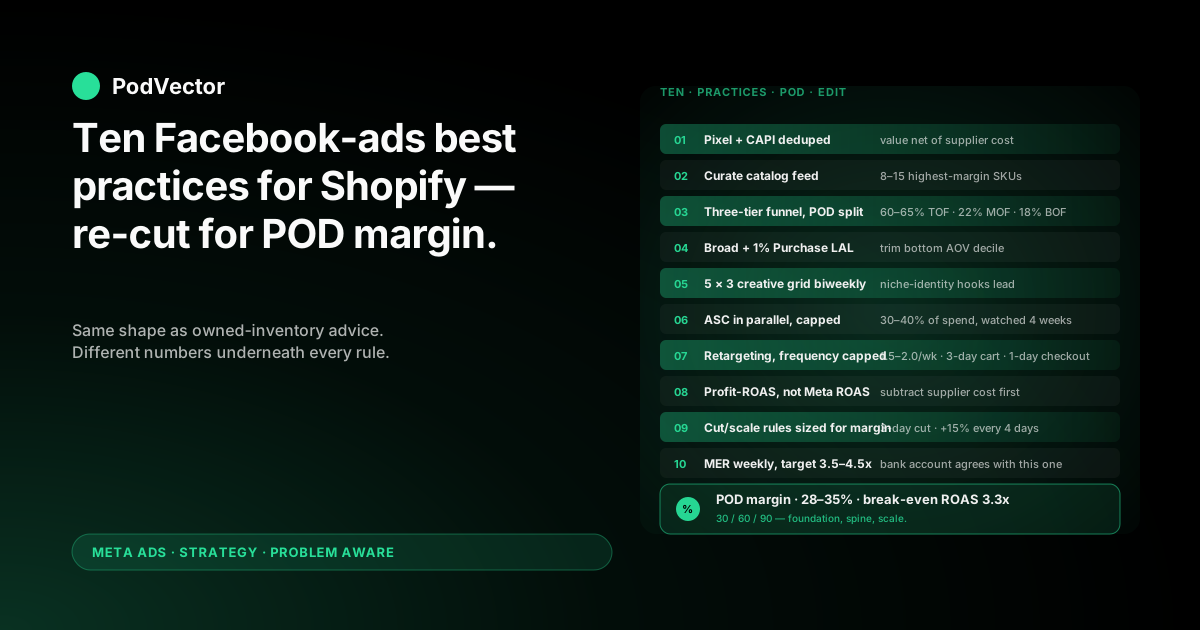
Quick Answer: Most "Facebook ads best practices for Shopify" lists are written for owned-inventory stores keeping 50–60% of every order. Print-on-demand keeps 28–35%. The same advice — broad audiences, Advantage+ Shopping, UGC creative, 2.5x ROAS — quietly buries POD operators because the math underneath assumes margin you don't have.
Ten practices below are re-cut for POD reality: deduplicated Pixel and Conversions API, a curated catalog feed of your highest-margin SKUs, a broad-plus-lookalike spine, niche-identity creative volume, and a measurement layer that subtracts supplier cost before declaring a winner.
Each practice is paired with the specific POD adjustment owned-inventory guides skip. Skim the list, audit your account against it, then work the 30/60/90-day plan at the bottom.
Why Shopify-Facebook best practices need a POD edit
The current top-ranking Shopify-Facebook-ads guides — Shopify's own conversion-rate playbook, AdCreate's 2026 sales guide, and EasyApps' acquisition playbook — agree on the shape. Pixel plus CAPI. Three-tier funnel. Broad audiences. UGC video. Advantage+ Shopping Campaigns. ROAS targets in the 2.5x–3x band.
The shape is right. The numbers underneath assume an owned-inventory Shopify store keeping 50–60% gross margin.
Print-on-demand doesn't keep that. After Printify or Printful supplier cost — base garment, decoration, shipping — contribution margin sits between 28% and 35% on most catalogs. That single fact rewrites four things in the playbook.
Break-even ROAS roughly doubles
An owned-inventory store at 55% gross margin breaks even around 1.8x ROAS. A POD store at 30% margin breaks even around 3.3x. The "healthy 2.5x" most articles cite is, for POD, the platform paying you to lose money.
Meta optimises against the wrong number
Meta's auction ranks events by the order subtotal it sees in your Pixel and CAPI. That subtotal includes supplier cost. So Meta scales the ads delivering the largest receipts, not the largest margin — and on a POD catalog those are not the same SKUs.
Cut decisions need to be more sensitive than scale decisions
At 55% margin, a 10% ROAS dip still leaves a profitable ad set. At 30% margin, the same dip pushes the ad set under break-even. POD operators who use generic 7-day cut windows let losers run a week longer than the math allows.
Creative iteration is unusually cheap and unusually high-leverage
POD has near-zero inventory risk. Swapping a hoodie design for a new one costs minutes, not a manufacturing run. That makes creative volume — concepts, hooks, formats — the highest-return lever the playbook has, more than audience or bid tuning ever will.
Hold those four shifts in mind. The ten practices below are the standard Shopify-Facebook list, re-cut for them.
1. Pixel and Conversions API, deduplicated
Every credible 2026 Shopify-Facebook guide opens here, and they're right. Browser-side Pixel only loses 20–35% of conversion signal post-iOS 14. Server-side Conversions API (CAPI — Meta's server-to-server event channel) only loses in-session optimisation. Both, deduplicated, is the only working pattern.
Shopify makes this easy. The native Facebook & Instagram channel app installs both. Your job is to verify in Meta Events Manager that browser and server Purchase events match within 10% — if they don't, the deduplication ID isn't firing.
The POD adjustment
Set the order value sent to Meta to net of supplier cost, not gross order subtotal. Shopify metafields can hold supplier cost per variant, and the CAPI payload can read from them.
This single change retrains Meta's optimiser to scale your highest-margin SKUs, not your largest-receipt ones. Most POD operators ship Pixel and CAPI with the default gross subtotal and never revisit it.
2. Curate your catalog feed before turning on Advantage+
The Shopify Facebook channel pushes every available product to your Meta catalog by default. For an owned-inventory store with 30 SKUs, that's fine. For a POD store with 200+ designs across mugs, hoodies, tees, and posters, it's a trap.
Advantage+ Catalog Ads and Advantage+ Shopping Campaigns both read from this catalog. If half your feed is low-margin or low-converting designs, half your budget gets spent there.
The POD adjustment
Curate the active feed down to 8–15 SKUs — your highest-margin, best-converting designs only. In Meta Commerce Manager, build a product set from that list and point your catalog campaigns at it.
Refresh the set monthly based on the previous 30 days of profit-per-SKU. New designs prove themselves on standalone ad sets first, then earn promotion into the catalog set.
3. Run a three-tier funnel — but allocate it the POD way
Top-of-funnel cold prospecting, middle-of-funnel warm retargeting, bottom-of-funnel hot retargeting. Standard. The split is where POD differs.
Generic Shopify guides recommend a roughly 60/25/15 spend split (TOF/MOF/BOF). For POD, push harder on prospecting:
| Layer | Owned-inventory split | POD split | Why |
|---|---|---|---|
| TOF — broad + lookalike | 55–60% | 60–65% | POD audiences saturate fast on niche designs; you need volume of new buyers |
| MOF — engagement, video-view, site-visit | 20–25% | 20–22% | Same band |
| BOF — cart, checkout, view-product | 15–20% | 15–18% | POD repeat-purchase windows are short; bigger BOF buys diminishing returns |
The POD adjustment
Don't run BOF retargeting on a 7-day window. POD design buyers either click through and buy in the first session or churn. Use a 3-day window for cart abandoners and a 1-day window for checkout abandoners; spend the saved frequency cap on prospecting instead.
4. Lead with broad and a 1% Purchase lookalike spine
Meta's 2026 algorithm rewards broader audiences. Stacked-interest ad sets with 200,000-person audiences underperform broad with no targeting in roughly 70% of POD accounts we see.
The exception worth keeping is a 1% Purchase lookalike. With 500+ purchase events seeded into Meta, a 1% lookalike on Purchase consistently delivers a 15–25% lift in cold ROAS over pure broad.
The POD adjustment
Build the lookalike on a clean source. Pull the customer list from Shopify, drop the 10% lowest-AOV orders (often coupon-driven one-and-done buyers), and upload the rest. A POD store's lookalike trained on coupon-stack buyers scales to more coupon-stack buyers — the worst kind of growth.
Demote interest stacks unless you can show, with margin-aware data, that they outperform broad. If you're scaling design-led niches like fishing, nursing, dog-mom, or veteran apparel, the niche signal is already in the imagery — Meta finds those buyers from broad faster than your interest stack can.
5. Treat creative as the lever — five concepts, three hooks each
Creative is where POD's structural advantage shows up. You can ship a new design in an hour. You can ship a new hook on an existing design in fifteen minutes. Lean on it.
UGC video ads deliver 2–3x the click-through rate of static images on Shopify-POD accounts. The 2026 SERP top three all confirm the pattern.
The POD adjustment
Build the creative pipeline as a 5×3 grid: five product concepts, three hooks each, every two weeks. Concepts are designs or design families. Hooks are the opening 1.5 seconds — niche-identity ("If you've ever pulled a 14-hour shift at the bedside, this one's yours"), social-proof ("3,400 nurses already wear this"), and design-detail ("Look at the embroidery on this — it's not a print").
Niche-identity hooks reliably out-perform price-led or discount-led hooks in POD by 30–50% on hook-rate. Discount-led hooks attract the same coupon-stack buyer pattern that wrecks lookalikes.
For the deeper creative-architecture piece, see our complete guide to Meta ad types for POD sellers.
6. Use Advantage+ Shopping in parallel, not as a replacement
Advantage+ Shopping Campaigns (ASC — Meta's automated all-in-one campaign type) deliver 15–30% lower CPA than manual campaigns once you have 50+ Purchase events per week feeding it. That's the average across owned-inventory Shopify stores.
POD outcomes vary more. ASC is a black box that optimises against Meta-reported revenue, which (per practice 1) includes supplier cost on POD. Without the net-of-supplier adjustment, ASC will scale your largest-receipt SKUs, not your most profitable ones.
The POD adjustment
Run ASC in parallel with manual prospecting, not instead of it. Cap ASC at 30–40% of total spend until you've watched it for four weeks against manual on profit-ROAS, not Meta-reported ROAS. If it wins on the right number, scale the cap. If it doesn't, keep it where it is and grow manual.
7. Run a tight retargeting layer with capped frequency
POD audiences are smaller than owned-inventory equivalents — design-led niches saturate quickly. The default Meta frequency on retargeting (2–4 impressions/week) burns through small audiences in two weeks and starts cannibalising organic conversions in the third.
The POD adjustment
Cap retargeting frequency at 1.5–2.0 impressions per week. Rotate creative every 10 days on the BOF layer. If your retargeting audience is under 50,000, reduce daily budget rather than letting Meta spread the same creative across the same eyeballs.
Our Facebook retargeting playbook for Shopify POD covers the audience-window architecture in more detail.
8. Optimise on profit-ROAS, not Meta-reported ROAS
This is the single biggest gap between owned-inventory advice and POD reality. Meta-reported ROAS = (attributed revenue) / (ad spend). Profit-ROAS = (attributed revenue − supplier cost − ad spend − fees) / (ad spend).
For a POD store at 30% contribution margin, a Meta-reported 3.0x ROAS is roughly a 1.0x profit-ROAS — break-even on cash, before counting Shopify fees, payment processing, and the labour of running the account.
The POD adjustment
Build a single source of truth that joins your Shopify orders with your Printify or Printful supplier costs and your Meta ad spend, then computes profit-ROAS per ad set per day.
Some teams build this in a spreadsheet refreshed weekly. Some pipe it into a live data warehouse — Snowflake, Redshift, Databricks, or equivalent — and query it ad-hoc. Either works. Without it, you're optimising on a number that doesn't reflect your P&L.
This is the gap PodVector AI's AI employee Victor was built around — joining Shopify revenue, Printify and Printful supplier cost, and Meta ad spend in a single live data layer, so "what's the profit on this ad set?" gets a real answer in seconds rather than a Sunday-night spreadsheet rebuild. Victor answers and acts on those answers — pausing losers, raising winners — under operator approval.
9. Set cut and scale rules sized to POD margin sensitivity
Generic Shopify advice: cut an ad set after 7 days under target ROAS, scale 20% every 3 days when over target. Both windows are too lax for POD margin.
| Decision | Owned-inventory rule | POD rule |
|---|---|---|
| Cut ad set | 3 days under 1.8x ROAS, $50 spend | 3 days under 3.3x profit-ROAS, $30 spend |
| Scale ad set | +20% every 3 days when above 2.5x | +15% every 4 days when above 4.0x profit-ROAS |
| Refresh creative | 14 days or 2.0 frequency | 10 days or 1.6 frequency |
| Lookalike rebuild | Quarterly | Every 6 weeks (faster turnover) |
The POD adjustment
Smaller scale steps, tighter cut windows, more frequent creative refresh. Margin sensitivity demands it. Operators who run owned-inventory cadence on a POD account routinely overspend losers by 30–40% before realising it.
10. Watch MER weekly, not Meta ROAS daily
Meta-attributed ROAS at the ad-set level is noisy and platform-self-reported. Marketing Efficiency Ratio — total Shopify revenue divided by total ad spend across all channels — is the number your bank account agrees with.
For a 30%-margin POD store, target blended MER sits at 3.5x–4.5x. Below 3.5x, you're funding Meta and Printify, not your business.
The POD adjustment
Track MER on a weekly cadence, not daily. POD daily revenue swings 30–50% on creative cycle and audience saturation; daily MER is mostly noise. Weekly MER smoothed over four-week windows is the line you scale or cut against.
For a deeper measurement piece, see CAC vs LTV modelling for Shopify Facebook ads in the comparison cluster.
A 30/60/90-day rollout plan
Practices listed are useless without a sequence. Here's the order most POD-Shopify accounts should adopt them.
Days 0–30: foundation
Lock practices 1, 2, and 8. Verify Pixel + CAPI dedup. Curate the catalog feed to your top 8–15 designs by margin. Build the profit-ROAS source of truth — spreadsheet is fine to start.
Run a single broad prospecting ad set against an Advantage+ creative test of 5 concepts, 3 hooks. Spend $30–$80/day. The goal of month one is signal, not scale.
Days 31–60: spine
Add practice 4 (lookalike spine) once you have 200+ purchase events. Add practice 7 (retargeting layer) with capped frequency. Add ASC in parallel (practice 6) if month one delivered >3.5x profit-ROAS on prospecting.
Cadence the cut and scale rules from practice 9 from day 31 forward — applying them on day 1 with no signal just shuffles randomness.
Days 61–90: scale
Push spend up by 15% every 4 days only on ad sets above 4.0x profit-ROAS. Refresh creative every 10 days. Rebuild the lookalike if hook-rate has dropped 25% from peak. Watch MER weekly.
By day 90, a healthy POD account is running 3–5 prospecting ad sets, 2 retargeting ad sets, 1 ASC, and a creative refresh pipeline shipping 15 new variations every two weeks.
For the broader strategic frame, our complete Meta Ads playbook for POD sellers sits one rung up from this article in the cluster, and the scaling Facebook ads on Shopify piece picks up after day 90.
Five POD-specific mistakes worth naming
If you've already worked through the practices and something still feels off, one of these is usually the cause.
1. Letting Meta optimise on gross order subtotal
Default behaviour. Quietly scales largest-receipt SKUs. Fix: net-of-supplier value in the CAPI payload (practice 1).
2. Pushing the entire 200-SKU catalog into Advantage+ Shopping
Default behaviour. Sprays budget across low-margin designs. Fix: curate to a product set of 8–15 (practice 2).
3. Building lookalikes on the full customer list
Includes coupon-stack and one-and-done buyers. Scales the wrong audience. Fix: trim the bottom AOV decile before uploading (practice 4).
4. Using owned-inventory cut windows
7-day windows let losing ad sets bleed margin. POD margin doesn't tolerate it. Fix: 3-day cut at 3.3x profit-ROAS (practice 9).
5. Tracking Meta ROAS instead of MER
Meta over-attributes by 20–40% post-iOS 14. The bank account knows the truth. Fix: weekly MER as the line that decides (practice 10).
The Meta Ads strategy cluster hub indexes the rest of the cluster, and the Meta Ads topic hub points across to ad types, agencies, integrations, and comparison clusters.
FAQs
What's the right ROAS target for a Shopify POD store on Facebook ads?
Break-even sits around 3.3x at a 30% contribution margin. Healthy is 4.0x–4.5x blended (MER). Anything Meta-reported under 3.0x is a loser by the time you net out supplier cost, fees, and processing.
Should I use Advantage+ Shopping Campaigns for a POD store?
Yes, in parallel with manual prospecting, capped at 30–40% of spend until you've watched it for four weeks on profit-ROAS. ASC works when fed clean signal — net-of-supplier order values and a curated catalog feed. Without those two, it scales your largest-receipt SKUs, which on POD are usually not your most profitable ones.
How much should a POD store spend on Facebook ads to start?
$30–$80 per day for the first 30 days while you build signal. Scale only after profit-ROAS, not Meta-reported ROAS, sits above 4.0x for two consecutive 14-day windows. Most POD accounts that fail at scale failed at signal first and just didn't notice for six weeks.
How many designs should I run ads on at once?
Eight to fifteen on the curated catalog feed. New designs prove themselves on standalone ad sets first, then earn promotion into the catalog set if they hold above target profit-ROAS for two weeks. Running ads on 100+ designs simultaneously is the most common reason POD-Shopify accounts plateau.
How do I measure true profit on a Facebook ad set when supplier costs vary by SKU?
Capture supplier cost per variant (Printify or Printful base + decoration + shipping) in Shopify metafields or a dedicated app, then join Shopify orders to Meta ad-set attribution and subtract supplier cost from each attributed order. The output is profit-per-ad-set per day, which is what you actually want to scale or cut against.
Is broad targeting really better than interest stacking for POD?
In our experience, broad plus a 1% Purchase lookalike beats stacked-interest ad sets in roughly 70% of POD accounts once you have 500+ purchase events seeded. The exception is brand-new accounts with no purchase signal — there, a single tight interest stack can give Meta something to learn against until the lookalike is buildable.
How often should I refresh my Facebook ad creative for a POD store?
Every 10 days or once frequency hits 1.6, whichever comes first. POD audiences saturate faster than owned-inventory audiences because design-led niches are smaller. The creative pipeline that supports this is 5 concepts × 3 hooks every two weeks — 15 new variations, run as Advantage+ Creative tests.
Want profit-ROAS, not Meta-reported ROAS, on every ad set?
Meta will happily report a 3.0x ROAS on a Shopify POD account that's actually running at break-even. Profit-ROAS is the number your bank account agrees with — and it requires joining Shopify orders, Printify or Printful supplier costs, and Meta ad spend in one place.
Victor is the AI employee PodVector AI built for that. Ask "what's my profit-ROAS on this ad set?" or "which designs in my Advantage+ catalog actually earn?" and get an answer pulled from your live store data, not last week's spreadsheet.
Try Victor free