
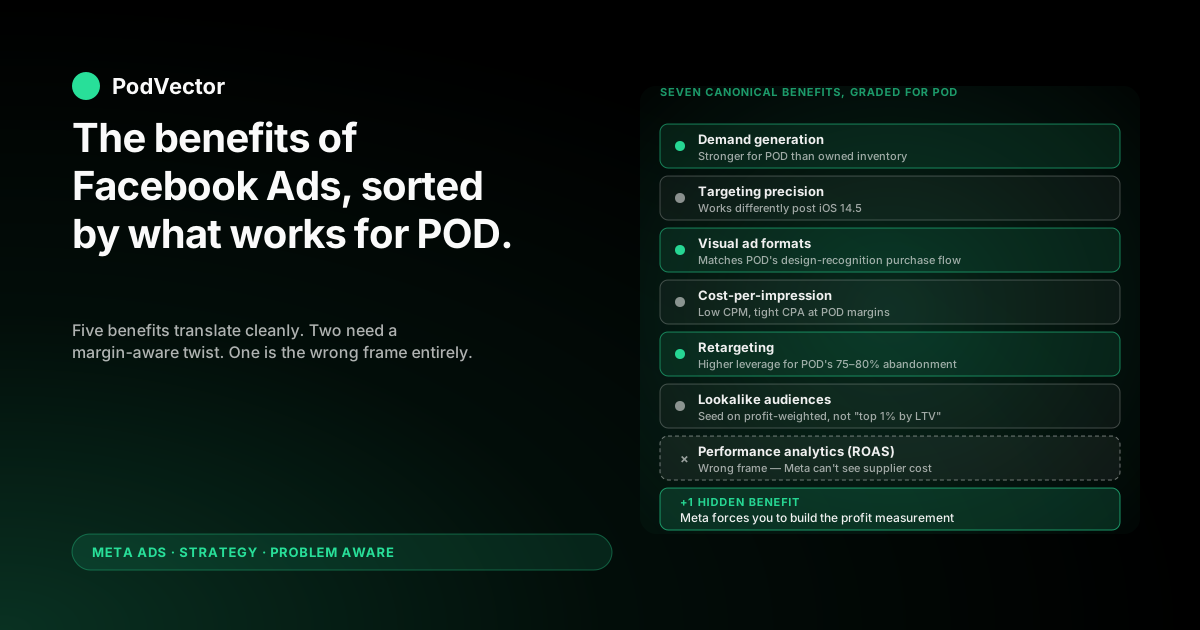
Quick Answer: Generic "benefits of Facebook Ads for ecommerce" articles list the same seven things — reach, targeting, formats, cost, retargeting, lookalikes, analytics — and they're all real. But they're written for owned-inventory direct-to-consumer brands running 50–60% gross margin.
For print-on-demand, only some of those benefits land cleanly. Reach and demand generation are stronger benefits for POD than for owned-inventory ecommerce. Cost-effectiveness, lookalikes, and analytics need re-framing because POD's 28–35% contribution margin makes ROAS-based measurement misleading.
This guide walks the seven canonical benefits one by one, marks which ones translate cleanly to POD, which ones need a margin-aware twist, and adds the one benefit that nobody on the SERP mentions: a Facebook Ads channel forces you to build the profit measurement infrastructure your store will need anyway.
Why benefits articles need a POD lens
Most "benefits of Facebook Ads for ecommerce" articles — the ShipStation explainer, the BigCommerce glossary entry, and longer guides like SimplicityDX's full strategy breakdown — list the same seven advantages. They're not wrong. They're just written for a different business model.
The default ecommerce reader those articles assume sells owned inventory. Bulk-ordered apparel. Beauty SKUs by the pallet. Supplements with 60% gross margin baked in. That reader can absorb a $12 cost-per-purchase because each order leaves $18–$25 of contribution margin.
Print-on-demand operators don't have that cushion. A $30 t-shirt fulfilled by Printify or Printful costs $14–$17 in supplier fees before payment processing, shipping subsidy, or returns. Contribution margin per order lands closer to $9–$12.
That smaller margin doesn't kill any of the seven benefits — but it does change how you cash them in. Below, each canonical benefit gets a verdict for POD: "translates cleanly," "needs a margin-aware twist," or "wrong frame, here's the right one."
Benefit 1: demand generation reaches buyers who aren't searching
POD verdict: translates cleanly. This is actually a bigger benefit for POD than for traditional ecommerce.
Google Ads is a demand-capture channel. Someone has to type "novelty cat dad shirt" into the search box for your campaign to bid on them. Facebook Ads is a demand-generation channel — Meta surfaces your design to people scrolling Instagram or Facebook who weren't looking for anything in particular.
For most POD niches, that distinction is everything. Nobody Googles "shirt for fly fishing dads with autistic sons who love Pokémon." That buyer exists, and they will laugh and tap "Buy" when the design appears in their feed. But they will never type the search query that lets Google show it to them.
Roughly 70% of high-performing POD designs target intent layers that don't show up in search volume data. Visual humor, identity-stack combinations, lifestyle moments, niche-fandom crossovers. All discovery-driven. All dependent on a channel that can put a creative in front of someone before they know they want it.
Meta is that channel. The "1.39 billion monthly active users" stat in every benefits article is real, but the more useful framing for POD is this: Meta has the largest audience that can be reached without anyone typing a search query. For POD, that's the entire game.
Benefit 2: targeting precision matched to design niches
POD verdict: needs a margin-aware twist. The targeting works — but the way you use it has changed since iOS 14.5.
Every benefits article praises Facebook's targeting precision. Demographics, interests, behaviors, custom and lookalike audiences. All true. But the playbook that worked in 2019 — stack five interest categories on top of a narrow age band and watch the cost-per-click drop — doesn't work anymore.
Apple's iOS 14.5 update in 2021 broke detailed targeting precision for everyone. Meta lost a meaningful share of the device-level signal it used to verify whether someone in an "interest: cycling" cohort actually clicks on cycling content. Detailed-targeting accuracy degraded by an estimated 30–50%, depending on the audience.
The targeting benefit didn't disappear — it just moved. Today the highest-leverage targeting decisions for POD are:
- Lookalike audiences seeded on profit-weighted purchasers, not on interest stacks. Let Meta find buyers who look like your most profitable customers, not buyers who self-identify as cyclists.
- Custom audiences from your email and SMS list, uploaded as first-party data Meta can use for retargeting and lookalike seeding.
- Broad targeting with strong creative, letting the algorithm do the audience-finding work the interest stack used to do.
The targeting benefit is real, but the form changed. "Precision targeting" in 2026 means precision in your seed data — not precision in your interest dropdowns. We unpack the structural shift in the complete Meta Ads playbook for POD sellers.
Benefit 3: visual ad formats showcase the design, not the product
POD verdict: translates cleanly, with one POD-specific note.
The ad format library on Meta — image, carousel, video, collection, dynamic product, slideshow, instant experience — is the most varied of any major paid channel. For owned-inventory ecommerce, that variety is nice-to-have. For POD, it's load-bearing.
A POD purchase decision is mostly a design-recognition moment. A buyer sees the design, recognizes it as something they want to wear or gift, and taps Buy. The shirt itself is interchangeable across sellers — what's selling is the visual.
That makes Meta's visual-first ad surface genuinely well matched to POD economics. A 15-second vertical Reel showing the design moving on a real human can do more conversion work than three pages of product-description copy on a Google Shopping listing.
The POD-specific note: stock Printify and Printful mockups underperform real-human lifestyle shots by 1.5–2x on click-through rate. Order a sample, photograph the design on a person, and use that as the creative. The sample order pays for itself in the first week of spend. Mockup-on-blank-tee creative screams "POD store" to ecommerce-fatigued shoppers; a real human in the design closes the credibility gap before the price even loads.
Benefit 4: low cost-per-impression, with a POD asterisk
POD verdict: needs a margin-aware twist. CPM is low, but cost-per-purchase math is tighter than every benefits article admits.
The "Facebook Ads are cost-effective" benefit usually means cost-per-thousand-impressions (CPM). Meta CPMs sit around $7–$15 in most ecommerce verticals — meaningfully lower than search-based equivalents and much lower than connected TV.
That part is real. The asterisk is what happens between an impression and a profitable order on POD economics.
Here's the math most ecommerce benefits articles skip:
- $10 CPM × 1,000 impressions = $10 in spend
- 1.5% CTR = 15 clicks at $0.67 per click
- 1.8% conversion rate = 0.27 purchases per 15 clicks
- $10 spend ÷ 0.27 purchases = $37 cost-per-purchase
For owned-inventory ecommerce with $25 contribution per order, $37 CPA is unsustainable but recoverable with better creative. For POD with $9–$12 contribution per order, $37 CPA means losing $25–$28 on every order. The campaign isn't slightly unprofitable — it's bleeding.
The cost benefit is real at the impression level. It becomes a margin problem at the conversion level. The fix isn't avoiding Facebook Ads — it's structuring the campaign for POD's tighter economics from day one. The full structure lives in our Facebook Ads for ecommerce strategy for print-on-demand guide.
Benefit 5: retargeting recovers POD's brutal abandoned-cart rate
POD verdict: translates cleanly. This is one of the highest-leverage benefits for POD specifically.
Industry-wide cart abandonment hovers around 70%. POD-specific abandonment runs higher — closer to 75–80% — because POD shoppers hit two extra trust objections at checkout: "is this a real store" and "will the print quality match the mockup."
That higher abandonment rate makes retargeting structurally more valuable for POD than for owned-inventory ecommerce. A retargeted POD buyer has already crossed the "do I want this design" gate. The remaining work is closing the trust objection — a job that retargeting creative is uniquely good at.
What works in POD retargeting:
- Real-customer photo carousels. User-generated content showing the actual print quality on real people. Closes the trust objection in one ad.
- Discount codes targeted at add-to-cart and initiate-checkout abandoners. 10–15% off, expiring in 48 hours. This recovers 8–12% of abandoners on most POD stores.
- "Free shipping included" angle for the price-sensitive segment. Many POD checkouts lose shoppers at the shipping line item; lifting that objection in retargeting lifts conversion by 3–5%.
The pure economics: cost-per-purchase on POD retargeting realistically lands at $4–$6, which the margin math actually supports. That's why our Meta Ads playbook for POD recommends overweighting retargeting at 30–40% of budget instead of the 20% generic ecommerce playbooks suggest.
Benefit 6: first-party data + lookalikes (with a margin caveat)
POD verdict: needs a margin-aware twist. The benefit is real but the standard "lookalike of top 1% of purchasers" approach actively misleads on POD.
Lookalike audiences — Meta finding new prospects who match the behavior pattern of an existing seed audience — are the closest thing to a free targeting upgrade in paid social. Every benefits article praises them, and they deserve it.
The standard recommendation across owned-inventory ecommerce is "build a lookalike off the top 1% of purchasers by lifetime value." For POD, that recommendation is actively dangerous.
Here's why: your highest-revenue POD customers are usually the buyers who picked your highest-priced, lowest-margin SKUs. Oversized hoodies, full-color all-overs, premium garment lines with thin margins. Building a lookalike off those buyers tells Meta to find more low-margin shoppers. The campaign scales spend efficiently and erodes contribution margin at the same time.
The POD-correct version of the lookalike benefit:
- Lookalike of purchasers, weighted by profit not subtotal. If you're sending profit (subtotal minus Printify or Printful supplier cost) as the conversion value back to Meta, the lookalike builds itself off profit-weighted purchases automatically. This is the single highest-leverage audience for POD.
- Lookalike of repeat purchasers (2+ orders). A returning POD buyer has already cleared the trust objection. Lookalikes off this seed find buyers who are similarly resilient to first-order friction.
- Custom audiences from email and SMS lists. Free first-party data that Meta can't get anywhere else. Use as both a retargeting audience and a lookalike seed.
The lookalike benefit is real. The default flow that ships with most ecommerce platforms isn't tuned for POD margins. We cover the profit-weighted seed setup in detail in the complete guide to Meta Ads ROAS and attribution for POD.
Benefit 7: performance analytics — but ROAS is the wrong number
POD verdict: wrong frame, here's the right one.
The "Facebook Ads gives you detailed analytics" benefit is the most-listed and least-useful for POD operators. Ads Manager shows impressions, clicks, conversions, cost-per-purchase, and the dashboard's headline metric: ROAS (return on ad spend).
For owned-inventory ecommerce, ROAS is a usable proxy for profitability because the gap between revenue and contribution margin is consistent across SKUs. A campaign showing 2.5x ROAS on a brand with 60% gross margin is roughly profitable, full stop.
For POD, ROAS is a number that lies in two specific ways:
- Meta doesn't see your supplier cost. When Ads Manager reports a $30 conversion, that's $30 of order subtotal. Meta has no idea that $14 of that went to Printify before payment processing. A 2.5x ROAS on a POD store can mean a 0.8x return on actual contribution margin.
- SKU mix changes the lie's size. If your campaign happens to push more $40 hoodies (thin margin) than $25 t-shirts (decent margin) in a given week, your reported ROAS goes up while your real margin goes down. The dashboard celebrates and your bank balance shrinks.
The analytics benefit is structurally there — Meta does give you detailed data — but the headline metric is wrong for POD. Two paths fix this:
- Send profit (not subtotal) as the conversion value via the Pixel and Conversions API. Then Meta's reported ROAS becomes a return on contribution margin, which is a number that maps to reality.
- Reconcile Meta spend, ecommerce orders, and Printify or Printful supplier cost outside Ads Manager. Either in a spreadsheet (slow, manual, breaks at scale) or in a live data warehouse that joins all three sources daily.
The "performance analytics" benefit is real. It just needs an honest measurement layer underneath. Without that, you're optimizing toward the wrong number — and the more efficient your campaign gets at chasing ROAS, the worse your real margin tends to look.
The benefit nobody talks about: Meta forces you to measure profit
Here's the benefit no other "benefits of Facebook Ads for ecommerce" article will list, because it only makes sense if you've already lost money on a Facebook Ads campaign that looked profitable on the dashboard.
Running Facebook Ads at meaningful scale forces a POD operator to build the profit measurement infrastructure they should have built anyway. The campaign won't sustain itself otherwise.
An owned-inventory brand can run Facebook Ads for two years without ever truly knowing their per-order contribution margin, because the gross margin is high enough to absorb measurement sloppiness. A POD store gets 30 days. After that, the margin math is too tight for "we'll figure it out later" to survive.
What that infrastructure looks like in practice:
- A daily reconciliation between Meta ad spend, ecommerce platform revenue, Printify or Printful supplier invoices, payment processor fees, shipping subsidy, and refunds.
- A profit-weighted conversion value sent back to Meta so the algorithm optimizes toward orders that actually leave you money.
- An offline conversion upload for refunds (3–6% of POD orders) so Meta stops optimizing toward buyers who'll return the item.
- A unified view across Meta, Google, TikTok, and any other paid channel — because once you can measure profit per channel, you'll start moving budget around.
This is the infrastructure POD operators need regardless of which channels they run. Facebook Ads is the one that punishes you fastest for not having it, which is why Meta forcing the issue ends up being a hidden benefit. The pain accelerates the build.
When these benefits don't apply
Honest framing: Facebook Ads isn't always the right channel for a POD store. Two scenarios where the "benefits" list above doesn't translate:
You're below $1,200/month in ad budget
Meta's algorithm needs ~50 conversion events per ad set per week to exit the learning phase reliably. At a $4–$6 cost-per-purchase ceiling on POD, that means $1,000–$1,500/month minimum per active campaign. Below that floor, the algorithm never accumulates enough signal to optimize, the spend produces no useful learning, and the dashboard reads like noise.
The benefits article assumption is that you're running Facebook Ads at owned-inventory scale ($5,000+/month). Most starting POD stores aren't, and the benefits compound much more slowly below the learning-phase threshold.
Your designs target high-search-intent niches
If your POD designs target buyers who actively Google for them — niche fandoms, professional categories, hobbies people search by name — Google Search captures that demand more cheaply than Facebook generates it. Run Google Ads first; layer Facebook later for the demand-generation share. We compare the two channels in Facebook Ads vs. Google Ads for ecommerce — which is best for POD sellers.
The "demand generation" benefit (#1 above) is real but specific to designs that don't have search demand. If your designs do, the benefit weakens and the cost benefit weakens with it.
Your operation can't sustain a 30–45 day learning curve
The first 14 days of any Facebook Ads campaign are infrastructure shakeout — Pixel setup, Conversions API, catalog feed, creative testing — not optimization. Days 15–25 are the algorithm exiting learning phase. Days 25–45 are when accounts that are going to work start showing positive contribution margin.
If your store can't afford 30–45 days of break-even-or-worse spend before the channel proves itself, the benefits don't matter — you'll churn out before they land.
FAQs
What are the benefits of Facebook Ads for ecommerce specifically for print-on-demand?
Five benefits translate cleanly to POD: demand generation for designs that don't have search intent, visual ad formats that match POD's design-recognition purchase flow, retargeting that closes POD's high abandonment rate, lookalikes seeded on profit-weighted purchasers, and analytics — but only when you replace the dashboard's default ROAS with a profit-weighted conversion value. Three benefits need a POD-specific twist: targeting precision works differently post-iOS 14.5, cost-effectiveness depends on conversion-rate math at POD margins, and the standard "top 1% of purchasers" lookalike actively hurts POD because it chases your lowest-margin SKUs.
Are Facebook Ads more cost-effective than Google Ads for a POD store?
Depends on whether your designs target search-intent niches or discovery-driven niches. For visual humor, identity-stack combinations, and lifestyle moments, Facebook is structurally cheaper because Google has no search query to match against. For named fandoms, professional categories, and hobby-specific buyers, Google Search is cheaper because the demand already exists. Most POD stores end up running both, with the budget split shifting based on the design's intent state.
What's the biggest hidden cost of running Facebook Ads on a POD store?
Optimizing toward order subtotal instead of profit. Meta's default conversion value is order revenue, which makes the algorithm chase your highest-revenue (often lowest-margin) SKUs. On POD economics, this can quietly turn a campaign reading 2.5x ROAS in the dashboard into a 0.8x return on actual contribution margin. The fix is sending profit (subtotal minus Printify or Printful supplier cost) as the conversion value via the Pixel and Conversions API.
How long until Facebook Ads benefits show up for a POD store?
Days 25–45 is when accounts that are going to work start showing positive contribution margin. The first 14 days are infrastructure shakeout (Pixel, CAPI, catalog, creative testing), not optimization. Days 15–25 are the algorithm exiting learning phase. Earlier signals are usually the learning phase masking the truth; later than 45 days means the strategy needs structural change, not more time.
What's a realistic Facebook Ads budget for a POD store starting from scratch?
$1,800–$2,700/month for the first 30 days, mapping to $60–$90/day. Below $1,200/month ($40/day), Meta's algorithm can't accumulate enough purchase events to exit the learning phase, and the spend produces noise rather than insight. Above $3,500/month before you've reconciled supplier cost into your conversion value, you're scaling a measurement problem. The step-by-step guide to running Facebook Ads for Shopify walks the day-by-day setup.
Do retargeting benefits apply to POD as much as to owned-inventory ecommerce?
More, actually. POD-specific cart abandonment runs 75–80% (vs. 70% industry-wide) because POD shoppers hit two extra trust objections at checkout: "is this a real store" and "will the print quality match the mockup." That higher abandonment rate makes retargeting more valuable per dollar on POD than on owned-inventory ecommerce. We recommend overweighting retargeting to 30–40% of budget instead of the 20% generic ecommerce playbooks suggest.
How do I measure whether Facebook Ads are actually profitable for my POD store?
Three measurement layers, in priority order. (1) Send profit (not subtotal) as the conversion value via the Pixel and Conversions API so Meta's optimization signal aligns with your real margin. (2) Reconcile Meta spend, ecommerce platform orders, and Printify or Printful supplier cost in a daily dashboard — don't trust Ads Manager's reported ROAS in isolation, because it doesn't see supplier cost. (3) Upload refunds as offline conversions so the negative signal trains the algorithm. The complete guide to Meta Ads ROAS and attribution for POD covers the full setup. For broader Meta Ads context across other clusters, the Meta Ads topic hub and the Meta Ads strategy cluster collect every related guide.
The benefits are real. The measurement layer is what most POD stores skip.
Every benefit above turns on whether you can see profit, not just spend. Ads Manager doesn't see your Printify supplier cost. Your ecommerce platform doesn't see your Meta spend. The reconciliation lives somewhere else.
Victor connects your ecommerce platform, Printify or Printful, and your Meta ad account into one live data warehouse and tells you which campaigns are profitable on margin, not spend. Same benefits above, honest measurement underneath.
Try Victor free