
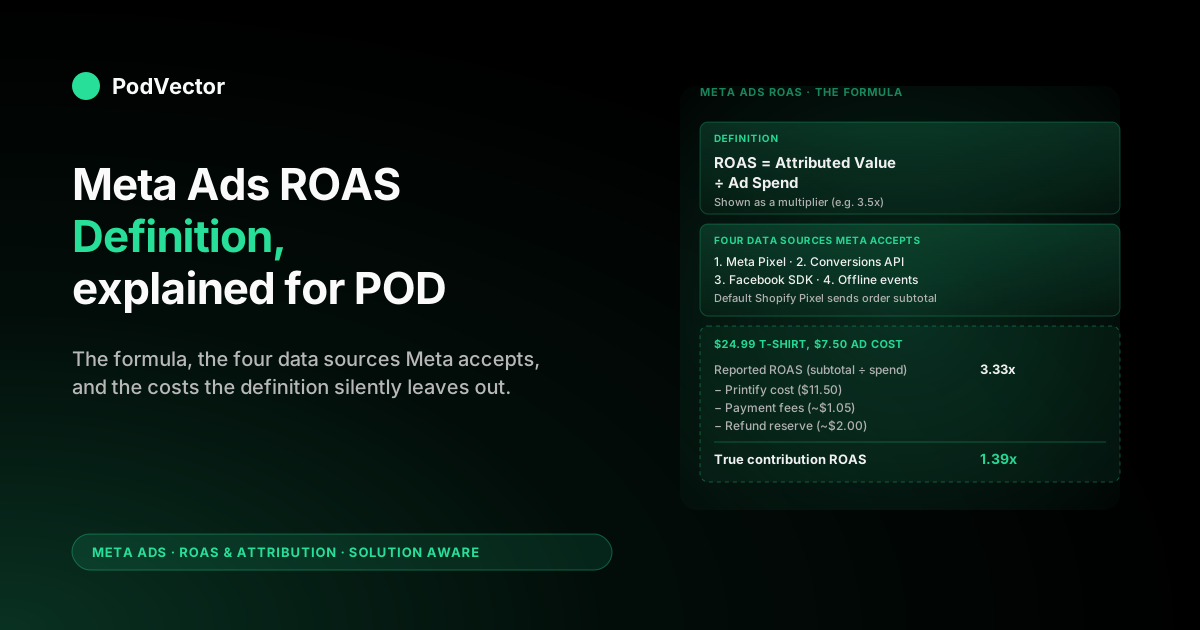
Quick Answer: The Meta Ads ROAS definition is simple: return on ad spend equals attributed purchase value divided by ad spend, expressed as a multiplier. A 3× ROAS means Meta recorded three dollars of attributed purchase value for every dollar of ad spend.
What the definition leaves out is the part print-on-demand sellers actually care about. "Purchase value" is whatever your Pixel sends — by default, the order subtotal. It does not subtract Printify or Printful supplier cost, payment fees, or refunds. So Meta's reported ROAS is a top-line ratio, not a profit metric.
This guide covers the formal definition, the formula behind it, the components Meta is and isn't measuring, how catalog ad creative formats (price overlays, rating badges, discount stickers) affect the number, and how POD sellers translate Meta's number into something that matches their bank statement.
The plain-English definition
ROAS in Meta Ads stands for return on ad spend. It answers one question: for every dollar I spent on Meta ads, how many dollars of attributed purchase value did I get back?
The answer is shown in Ads Manager as a multiplier. A 1.0 ROAS means break-even on revenue (not profit). A 2.5 ROAS means two dollars and fifty cents of attributed purchase value per dollar spent. A 5.0 ROAS means five dollars per dollar spent.
That ratio is the entirety of the formal definition. Meta's documentation phrases it as "the total return on ad spend from purchases," but the math is unchanged. Spend goes in the denominator, value goes in the numerator, the column shows you the ratio.
What makes the definition tricky for POD sellers isn't the math. It's that both inputs — the value Meta receives and the spend Meta records — leave out costs that determine whether you actually made money. We'll get to those gaps below.
The formula Meta uses
The ROAS formula is one line:
ROAS = Attributed Purchase Conversion Value ÷ Ad Spend
If you spent $200 on a Meta campaign and the campaign drove $700 of attributed purchase value, the ROAS column reads 3.5 ($700 / $200). The result is unitless — it's a ratio, not a dollar amount.
"Attributed" matters here. Meta only counts a purchase toward ROAS if the buyer's last qualifying touchpoint with your ad falls inside the campaign's attribution window. The 2026 default is 7-day click plus 1-day engaged-view plus 1-day view, but you can narrow it to 1-day click for cleaner signal. The narrower the window, the smaller the numerator, the lower the ROAS — for the same underlying performance.
For a side-by-side walkthrough of the calculation with worked examples, see how to calculate ROAS in Meta Ads (step-by-step).
What "value" means in the definition
"Purchase conversion value" is Meta's name for whatever number your tracking integration sends in the purchase event's value parameter. Meta accepts it as truth and divides ad spend into it.
For a Shopify store using Meta's default Pixel integration, that number is the order subtotal — line-item revenue before shipping and tax, but also before any cost. Meta does not see your Printify invoice, your payment processor's fee, or any refunds you issue later.
The same definition applies whether the value reaches Meta through the Pixel (browser-side JavaScript), the Conversions API (server-to-server), the Facebook SDK (mobile app), or an offline conversion upload. All four feed into the same ROAS calculation.
For POD, the relevant channels are Pixel and the Conversions API, both fired through Shopify's official Meta integration with deduplication via event ID. SDK and offline are typically irrelevant.
The honest read: Meta's ROAS definition is silent about what the value should represent. The default Shopify integration ships subtotal. If you don't override that, every campaign's ROAS reflects gross merchandise value, not contribution.
What "spend" means in the definition
"Ad spend" in the ROAS denominator is the amount Meta charged your ad account for delivering impressions or clicks. It's the simplest part of the definition and the part that's hardest to dispute.
What it doesn't include: creative production cost, agency fees, your own labor, software subscriptions for managing campaigns, or the supplier cost of fulfilling the orders the ads drove. None of that is in the denominator.
That's not a bug in the definition — it's a deliberate scoping choice. ROAS is the ratio between what Meta charged and what Meta saw. Adding off-platform costs would be a different metric (call it true contribution ROAS or net ROAS).
For POD specifically, the gap matters because supplier cost is a meaningful share of order value. A ROAS that ignores supplier cost can show a healthy multiplier while the underlying campaign is barely covering its costs.
Catalog ad creative formats and ROAS: price overlays, rating badges, discount stickers
A question POD sellers increasingly ask is which catalog creative format — price overlay, rating badge, or discount sticker — drives the best ROAS, and how to measure it. This is now a core topic in the current rankings, so it belongs in any complete treatment of Meta Ads ROAS for POD.
What each format does
According to Benly's 2026 Meta Catalog Ads guide, Meta's Ads Manager provides template customization options including frames, overlays, and promotional badges that can be layered on top of your product feed images. The three most relevant formats for POD fashion sellers are:
- Price overlays — show the price (or sale price next to a crossed-out original) directly on the product image. According to OMR Digital's Apparel ROAS Playbook, the visual contrast between an original and a discounted price drives impulse clicks from the feed, making price overlays particularly strong for clearance or seasonal pushes.
- Rating badges — surface star ratings or review signals on the creative, which can reinforce trust. According to Confect's catalog ads guide, testing whether your audience responds better to a discount badge or to a trust/rating signal is one of the most valuable A/B experiments you can run in Meta.
- Discount stickers / sale badges — highlight a percentage-off or "Sale" label. Benly notes that sale badges work well alongside price overlays for price-competitive products.
How to measure which format drives the best ROAS
The measurement approach matters as much as the creative choice. Here's a practical framework for POD sellers:
- Run Meta's native A/B test. Confect recommends duplicating your catalog ad sets and uploading versions with different overlay designs, then running a direct A/B test in Meta to compare performance. Keep budget, audience, and attribution window identical across variants so ROAS differences reflect the creative, not the setup.
- Use Advantage+ Creative if you can't split cleanly. Benly notes that Advantage+ Creative can automatically test different template variations and optimize toward the best performers — useful if your catalog is large and running separate ad sets per format is impractical.
- Separate retargeting from prospecting. According to Benly, a minimal template can outperform a heavily branded one for retargeting (warm audiences already know your brand), while stronger branding elements help prospecting campaigns build recognition. The same overlay may not win in both contexts — measure each separately.
- Check incrementality, not just ROAS. Benly warns that catalog retargeting often captures conversions that would have happened anyway, potentially inflating perceived ROAS. Lift studies and holdout testing reveal the true incremental value of each creative format.
- Keep creative clean. Cropink's Meta Catalog Ads guide recommends limiting each creative to two or three key elements — for example, price, logo, and promo — because too much design clutter hurts performance.
- Translate reported ROAS to true ROAS before scaling. Whichever creative format reports the highest ROAS in Meta, apply the contribution-margin translation described in the Reported ROAS vs true ROAS section below before increasing budget. A price overlay that lifts reported ROAS by boosting AOV is genuinely valuable. A discount sticker that lifts click volume but reduces margin per order may lower your true contribution ROAS even as Meta's column improves.
For Google Ads catalog formats, the measurement logic is the same but attribution is separate. Victor reads your Google Ads data alongside Meta and Shopify, so you can compare creative-format ROAS across channels in one place — though note that Google Ads write actions (such as pausing ad variants) are read-only for now. For a broader Google Ads strategy framework for POD, see Google Ads for your Shopify store: strategy for POD.
Once you know which overlay format wins, the natural next lever is AOV — raising average order value compounds ROAS improvement without requiring more ad spend. See how to increase AOV with AI for POD-specific tactics Victor can propose and execute on your Shopify store.
Reported ROAS vs true ROAS for POD
Meta-reported ROAS and true contribution ROAS are two different numbers. The definition only describes the first one.
Reported ROAS uses the value Meta received (typically order subtotal) divided by ad spend. It tells you how efficiently Meta's algorithm is converting your spend into revenue events.
True contribution ROAS uses contribution margin (revenue minus supplier cost, payment fees, refunds, and shipping pass-through) divided by ad spend. It tells you whether the campaign is making your business money.
For most POD stores, reported ROAS is materially higher than true ROAS — because supplier cost, payment processor fees, and refunds that Meta never sees all come out of the revenue the campaign appears to generate. The reported ROAS doesn't change; the profitability does.
According to Adamigo's 2026 fashion ecommerce ROAS benchmarks, top-performing fashion brands track return-adjusted ROAS separately from platform-reported ROAS because that's where margin lives or dies.
That's why POD operators who optimize purely against the Meta column tend to scale unprofitable campaigns by accident. The column says the campaign is winning. The bank statement says otherwise. The definition itself is honest — Meta never claimed the column measured profit. The disconnect is between the metric's definition and how it gets used.
For benchmarks on what a healthy reported ROAS actually looks like across POD, see what is a good ROAS for Meta Ads? and average ROAS Meta Ads explained for POD sellers. For net profit context, see net profit margin benchmarks for POD sellers.
ROAS vs ROI, CAC, and AOV
ROAS is one of several efficiency metrics POD sellers see in dashboards. Knowing how it differs from the others clarifies what the definition is and isn't claiming.
ROAS vs ROI. ROI (return on investment) accounts for all costs — supplier, fees, labor, overhead — and reports a profit-based ratio. ROAS only divides ad spend into ad-attributed revenue. ROI is what your accountant cares about. ROAS is what the bidding algorithm optimizes against.
ROAS vs CAC. CAC (customer acquisition cost) is ad spend divided by new customers acquired. ROAS is ad spend divided by attributed purchase value. CAC ignores order size; ROAS is sensitive to it. A campaign with a low CAC but small basket size can show a low ROAS, and vice versa.
ROAS vs AOV. AOV (average order value) is total revenue divided by order count. AOV is one of the levers that moves ROAS — at constant spend, raising AOV raises ROAS proportionally. The two metrics are linked but measure different things. For CRO techniques that lift AOV and therefore ROAS, see CRO techniques for POD sellers.
The takeaway: ROAS is a relative efficiency metric specific to ad spend and attributed revenue. It's not a profit metric, not a customer-acquisition metric, and not a basket-size metric. Reading it as any of those leads to wrong calls.
The ROAS metric vs the "Maximize ROAS" goal
As of 2026, "ROAS" shows up in two different places in Ads Manager, and POD operators conflate them constantly. One is the metric defined above — the reported column. The other is a bidding goal Meta rolled out account-wide: Maximize ROAS (also called setting a ROAS goal). They share a name and a formula but do different jobs.
The metric is a passive readout. It records what happened: attributed value divided by spend, after the fact.
The goal is an instruction to the delivery algorithm. You set a target and Meta bids to maximize the value of conversions relative to spend around that target. In practice it will throttle delivery, and sometimes underspend your budget, rather than buy conversions it predicts will miss the target. It optimizes toward the same "purchase value" the metric reports, so it inherits every gap in the definition.
That inheritance is the trap for POD. If your Pixel sends order subtotal, a Maximize ROAS goal is chasing a ratio on subtotal, not on contribution margin. Hit the goal exactly and you can still be underwater once supplier cost and fees come out — the same reported-vs-true spread from the section above, now baked into how Meta spends your money. Setting a ROAS goal does not make the number margin-aware; it just makes Meta optimize harder toward a top-line ratio.
The fix is the same as for the metric: feed Meta a margin-aware value via the Conversions API, or set the goal against a subtotal-based ROAS you've back-calculated to clear your true break-even. For the target-setting math, see what is a good ROAS for Meta Ads?
Translating Meta's ROAS for POD economics
The definition stays the same. What POD operators do is layer additional context on top of the reported number to recover business meaning.
Subtract supplier cost. Pull the SKU-level supplier cost from Printify or Printful and apply it to the orders Meta attributed. That gives revenue-after-COGS. Divide by ad spend to get a ROAS net of supplier cost.
Subtract payment fees. Apply your payment processor's per-transaction rate against attributed revenue before dividing by spend.
Subtract refunds. Refunds typically arrive days to weeks after the original purchase. Meta does not deduct them from the ROAS column unless you've configured CAPI to send refund events. Most stores haven't, so the reported ROAS persistently overcounts.
Lock the attribution window. Two campaigns at "the same ROAS" under different attribution windows are not comparable. Pick a window per account (1-day click is the cleanest for POD; 7-day click + 1-day view is the platform default) and stay with it for benchmarking.
The reported number is still useful — it's what Meta's algorithm optimizes against, so it drives delivery. The translated number is what tells you whether the campaign should keep running.
For a complementary view on checkout efficiency and where revenue gets lost before it ever reaches your ROAS calculation, see average checkout completion rate benchmarks for ecommerce. For the architectural angle on how to keep both reported and true ROAS visible without manual reconciliation, see the complete guide to Meta Ads ROAS and attribution for POD and the cluster hub at ROAS & Attribution.
Worked example: a t-shirt order
To make the definition concrete, here's a single t-shirt order driven by a Meta campaign.
Reported ROAS path. Say the order subtotal is $X. The Pixel fires the Purchase event with that subtotal as the value. Meta divides the ad spend it took to acquire that order into $X. The column shows the ratio — that's reported ROAS.
True contribution path. From $X, subtract the Printify or Printful supplier cost for the SKU, the payment processor fee, and an estimated refund/chargeback reserve. What remains is the net contribution. Divide that by the ad spend to get the true contribution ROAS.
Same order, two ROAS numbers. The reported figure reflects what Meta's definition measures. The contribution figure reflects what the order actually deposited net of cost. The gap between them is the spread POD sellers must understand before scaling any campaign.
For POD, that spread scales with supplier cost share. Higher-margin custom designs with strong AOV close the gap. Cheap-blank, high-volume catalogs widen it. The reported ROAS doesn't change; the interpretation does.
If you're comparing your store to integration paths that can send margin-aware values to Meta, see the Meta Ads Shopify integration guide for POD. And if pricing your blanks is where the margin gap starts, the Printful hoodie pricing full breakdown for POD sellers shows exactly how supplier cost stacks up before a single ad dollar is spent.
FAQs
What is the formal definition of ROAS in Meta Ads?
ROAS is the ratio of attributed purchase conversion value to ad spend, expressed as a multiplier. Meta calculates it by dividing the value of attributed purchases (received from your Pixel, Conversions API, SDK, or offline upload) by the amount your ad account was charged. Documented as "return on ad spend from purchases" in the Meta Business Help Center.
What's the formula?
ROAS = Attributed Purchase Conversion Value ÷ Ad Spend. If you spent $200 and Meta attributed $700 of purchase value to the ads, ROAS = 3.5×.
Is Meta Ads ROAS the same as profit?
No. The definition uses the value sent by your tracking integration — typically the order subtotal — divided by ad spend. It does not subtract supplier cost, payment fees, refunds, or shipping pass-through. For POD, reported ROAS is materially higher than true contribution ROAS once those costs are applied.
Why does Meta's ROAS show a higher number than my actual margin?
Because the value parameter on the default Shopify Pixel integration sends order subtotal, not contribution margin. POD economics include meaningful supplier cost, payment processor fees, and refund rates that don't flow back into Meta. The reported column treats every dollar of subtotal as revenue available to spend.
Which catalog creative format — price overlay, rating badge, or discount sticker — drives the best ROAS?
There's no universal answer — it depends on your audience, price positioning, and whether you're retargeting or prospecting. According to Confect, the only reliable way to know is to A/B test overlay variants directly in Meta. Run duplicate ad sets with different formats against the same audience, keep the attribution window identical, and let performance data guide the decision. According to Benly, a minimal design may outperform heavy branding for retargeting, while stronger branded elements help prospecting — so measure each audience type separately before drawing conclusions.
What does "attributed" mean in the definition?
It means the purchase fell inside the campaign's attribution window after a qualifying ad touchpoint (click or engaged view). Meta's 2026 default is 7-day click + 1-day engaged-view + 1-day view; many POD operators narrow this to 1-day click for cleaner signal. Different windows produce different ROAS numbers from the same underlying performance.
Does ROAS account for refunds?
Only if your Conversions API integration sends refund events back to Meta. The default Shopify-to-Meta channel does not. Without refund events, a refunded order's value stays counted in ROAS even after the customer has been refunded.
What's the difference between Meta's ROAS and ROI?
ROAS is ad spend divided into ad-attributed revenue. ROI accounts for all business costs (supplier, fees, refunds, labor, overhead) divided into profit. ROI is the accountant's metric; ROAS is the bid algorithm's metric. The two answer different questions.
Can I make Meta's reported ROAS reflect my actual POD profit?
You can narrow the gap by overriding the Pixel value field via the Conversions API to send a margin-aware figure, sending refund events to Meta, and reconciling against deposits monthly. Most POD operators take the simpler route: keep Meta's ROAS as a relative campaign-ranking signal and calculate true contribution offline against a unified data warehouse. For a phrase-by-phrase decode of Meta's official wording, see the ROAS definition Meta Ads Help Center explained for POD sellers.
Is "Maximize ROAS" the same as the ROAS metric?
No. The ROAS metric is the reported column — a passive readout of attributed value divided by spend. "Maximize ROAS" (setting a ROAS goal) is a bidding instruction that tells Meta's algorithm to optimize delivery toward a target ratio, throttling or underspending rather than buying conversions predicted to miss it. The goal uses the same purchase value the metric reports, so if your Pixel sends order subtotal, a ROAS goal chases subtotal — not contribution margin. It won't make the number profit-aware on its own.
Where does ROAS sit relative to other Meta Ads metrics?
ROAS rolls up below the campaign-level revenue and cost columns and above the per-ad-set efficiency view. For broader Meta Ads context across the funnel, see the Meta Ads topic hub.
How does fulfillment cost affect what ROAS target I should set?
Your ROAS target should be set high enough that — after subtracting supplier cost, payment fees, and refunds — the remaining contribution margin is positive. The lower your gross margin, the higher your required reported ROAS to stay profitable. See the Printful hoodie pricing breakdown for a concrete look at how fulfillment cost builds up, and the net profit margin benchmark for context on where healthy POD stores land.
Know what your real ROAS is, not just what Meta reports.
The Meta Ads ROAS definition divides attributed value by spend. Both inputs leave out the costs POD economics depend on — Printify or Printful supplier cost, Shopify payment fees, refunds that arrive weeks later.
Victor reads your Meta spend, Shopify revenue, Printify and Printful fulfillment data, and Klaviyo signals in one live data warehouse. Ask "which Meta campaigns are unprofitable after supplier cost?" in plain English. Victor returns the answer from your real data, not from the column Meta's docs describe — then proposes a next move (like repricing underperforming SKUs to a target margin) as an approval card you accept or reject.
and see your true contribution ROAS alongside the one Meta reports.
Try Victor free