
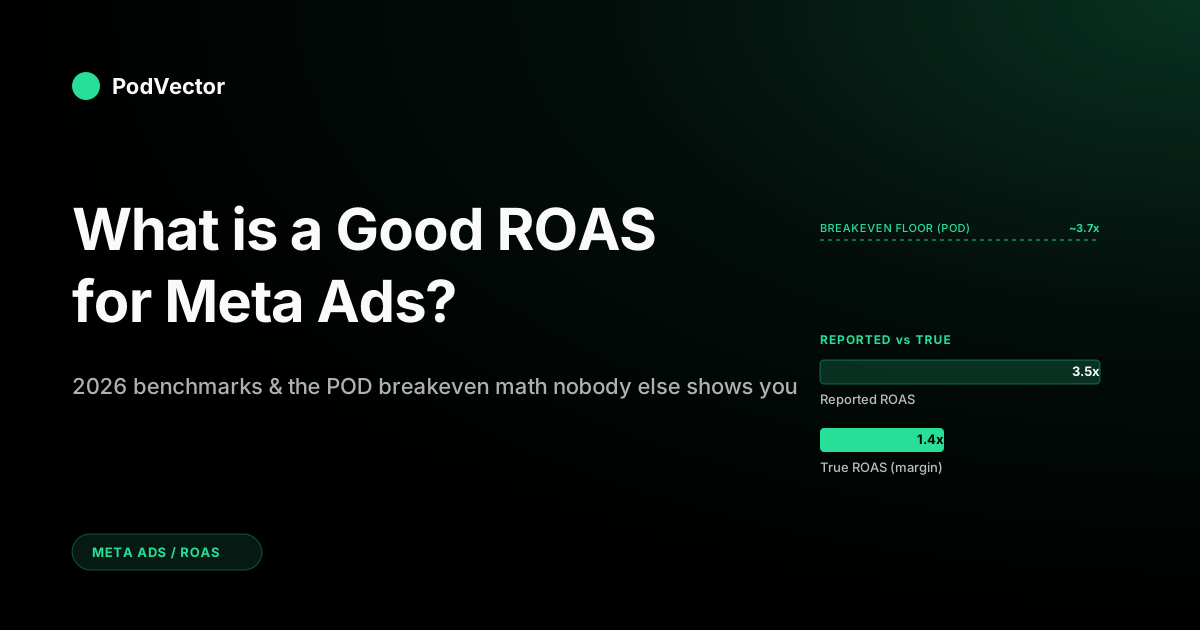
Quick Answer: A good ROAS for Meta Ads is usually 3.5x–5x reported ROAS for POD stores, because POD sellers need to clear supplier cost, shipping, refunds, fees, and overhead. The 2026 Meta Ads benchmarks most operators quote sit between 2.79x and 3.61x reported ROAS, with 3.5x–4.5x considered "good" for direct-to-consumer e-commerce.
None of those numbers tell a print-on-demand store whether it's profitable. POD's gross margin sits closer to 20%–35% versus the 50%–60% the SERP benchmarks assume, which makes the breakeven floor much higher.
The honest answer for POD: a "good" ROAS is whatever clears 1 ÷ your post-fulfillment margin, plus a buffer for refunds and overhead. For most POD stores that's 3.5x–5x reported, or roughly 1.3x–1.6x once you measure the true ROAS Meta doesn't show you.
What ROAS actually means in Meta Ads
ROAS, or Return on Ad Spend, is the revenue Meta attributes to your ads divided by the spend it cost to get it. A ROAS of 3.0 means $3 of attributed revenue for every $1 spent.
That's the easy part. The trap is that the number Ads Manager shows you is reported ROAS — Meta's best guess at attribution, using its own model and its own conversion windows. It is not the cash that hit your bank account.
For a print-on-demand store, the gap between reported ROAS and real-world margin is usually wider than for any other e-commerce category. We come back to that below. First, the benchmarks the rest of the internet uses.
2026 Meta Ads ROAS benchmarks
Across the major 2026 benchmark studies, the consensus shape is: average ecom Meta ROAS sits at 2.79x, with 3.5x–4.5x considered solid for DTC brands and anything above 4x placing you in the top quartile. Reasonable directionally — but only directionally.
Benchmarks shift hard by sub-niche. Beauty & personal care brands routinely run at 1.5x–2x because cold acquisition is expensive on saturated terms. Apparel and accessories — which is where most POD sits — is closer to the 2.5x–3.5x band on reported ROAS.
Here's the broad shape, expressed on Meta-reported ROAS:
| Segment | Below average | Average | Good | Top quartile |
|---|---|---|---|---|
| E-commerce blended | < 2.0x | 2.5x–3.0x | 3.5x–4.5x | > 5.0x |
| Apparel / accessories | < 2.0x | 2.3x–3.0x | 3.0x–4.0x | > 4.5x |
| POD (typical) | < 2.5x | 3.0x–4.0x | 4.0x–5.0x | > 5.5x |
| Beauty / personal care | < 1.3x | 1.5x–2.0x | 2.0x–3.0x | > 3.5x |
| Home & garden | < 1.8x | 2.0x–2.8x | 3.0x–4.0x | > 4.5x |
Notice POD's "good" sits one full point above ecom blended. That's not because POD ads are better — it's because POD margins are worse. You need a higher reported ROAS to break even.
Why the public benchmarks mislead POD sellers
Most ROAS benchmark articles assume a typical DTC margin of 50%–70%. They model break-even ROAS at roughly 1.5x–2x and conclude that anything above 3x is profitable.
POD economics don't work that way. A $24.99 t-shirt with a $13 supplier cost (Printify or Printful blank, print, and shipping included) leaves $11.99 of gross margin before payment fees. That's 48% gross — and it gets worse fast.
Subtract Shopify or Etsy fees (1.5%–6.5%), payment processing (2.9% + $0.30), expected returns (2%–5% in apparel), and the realistic post-fulfillment margin on that shirt is closer to 35%–40%. On an all-over-print product or a hoodie at higher supplier cost, it can dip to 20%–25%.
The benchmark articles assuming 50%–70% margin tell you 3.0x is fine. For a 30%-margin POD store, 3.0x reported ROAS is roughly breakeven. That's the gap nobody else covers.
The only number that matters: breakeven ROAS
Before judging whether your ROAS is "good," compute breakeven. The formula is simple:
Breakeven ROAS = 1 ÷ Post-fulfillment gross margin %
If your average order yields 30% margin after supplier cost, shipping, payment fees, and expected refunds, your breakeven on ad spend alone is 1 ÷ 0.30 = 3.33x.
Most operators stop there. They shouldn't. Add a buffer for the costs ad spend doesn't carry directly: app subscriptions, design fees, customer service time, and your own pay. A 0.4x–0.8x buffer is reasonable. So the real floor is closer to 3.7x–4.1x reported ROAS for a 30%-margin POD store.
For a deeper walkthrough with worked examples, see our complete guide to Meta Ads ROAS and attribution for POD and the cluster sibling best Meta Ads for maximizing ROAS, both of which cover the breakeven math in different framings.
Reported ROAS vs true ROAS for POD
Reported ROAS uses revenue. True ROAS uses contribution margin — what's actually left after the variable cost of fulfilling the order.
For a $50 hoodie order with $26 supplier cost and $2 in payment fees, the math runs:
- Revenue Meta attributes: $50
- Ad spend: $20
- Reported ROAS: $50 ÷ $20 = 2.5x
- Contribution margin: $50 − $26 − $2 = $22
- True ROAS on margin: $22 ÷ $20 = 1.1x
The 2.5x reported number looks fine. The 1.1x margin number says you're barely covering the ad and supplier cost — there's no room for app fees, returns, design, or your time.
This is the lever Meta optimisation sits on top of. If you pass revenue to Meta as your conversion value, Meta scales toward whichever creative drives the most revenue — even if those orders are the lowest-margin SKUs in your catalog. The fix is to send margin (revenue minus supplier cost) as the value parameter through the Conversions API (CAPI). Done correctly, the algorithm scales toward profitable orders, not just expensive ones.
"Good" ROAS by campaign stage
A single ROAS target ignores the role each campaign plays. A prospecting ad set acquiring new customers shouldn't be held to the same ROAS as a retargeting ad set selling to people who already added to cart.
| Campaign type | Reported ROAS target (POD) | Why this floor |
|---|---|---|
| Cold prospecting (broad) | 2.0x–3.0x | Acquiring new buyers; you're investing in lifetime value, not first-order profit |
| Cold prospecting (lookalikes) | 2.5x–3.5x | Higher intent than broad, lower than warm |
| Mid-funnel (engagers, viewers) | 3.5x–4.5x | Audiences already touched the brand; ad cost lower per conversion |
| Retargeting (cart abandoners) | 5.0x–8.0x+ | Highest intent; budget should be capped, not scaled |
| Advantage+ Shopping (blended) | 3.5x–5.0x | Mixes prospecting and retargeting inside one campaign |
For a deeper take on the campaign-type tradeoffs, see our cluster sibling on the best Meta Ads for maximizing ROAS.
What pushes ROAS up or down
Six things move POD ROAS more than anything else. Most are within your control.
1. Average order value (AOV). Higher AOV stretches every dollar of ad spend further. Bundles, multi-quantity discounts, and upsells move AOV by 15%–40% with no change to the ad itself.
2. Conversion rate. A 2% site conversion rate beats a 1% rate at half the cost per purchase. Page speed, hero copy, social proof, and checkout friction all show up in ROAS.
3. Creative quality and rotation. Meta's 2025–2026 creative-ranking systems reward variant volume. Shipping 8–12 fresh ads per month into a single ad set typically lifts ROAS 15%–25% versus a single static creative.
4. Tracking accuracy. CAPI implementation, deduplicated pixel events, and clean value parameters can lift attributed ROAS 10%–25% on the same campaigns. Without CAPI, iOS users disappear from your dashboard.
5. Audience saturation. Frequency above 3.5–4.0 in a 7-day window flattens ROAS hard. The fix is creative rotation, not more spend.
6. Niche competition. Apparel terms during Q4 cost 30%–60% more in CPM than Q2. Same campaign, same store — different "good" ROAS.
How to raise ROAS without lying to yourself
"Improving ROAS" is easy if you're willing to game the number. Run only retargeting, harvest existing demand, post 8x ROAS to LinkedIn, and watch revenue plateau. The harder, durable version:
Send margin signals to Meta, not revenue. Use CAPI to pass revenue minus supplier cost as the conversion value. The algorithm now optimises toward profitable orders, which raises true ROAS even if reported ROAS dips slightly.
Cull losing SKUs. POD catalogs accumulate dead products. The Pareto reality: 20% of SKUs typically drive 80% of profit. Cutting the bottom half often raises blended ROAS by 0.5x–1.0x because creative budget concentrates on winners.
Match campaign type to volume. Below 50 purchase events per ad set per week, value-based bidding can't learn. Use Highest Volume until you hit threshold, then graduate to Maximize ROAS.
Run AOV experiments before creative experiments. Adding a "Buy 2, get 10% off" prompt at cart often beats three weeks of new creative testing. Bundle math compounds with every campaign you already run.
Watch frequency, not just ROAS. If frequency is climbing past 4 and ROAS is sliding, the answer is new creative — adding budget makes it worse.
Tracking the right number
Meta Ads Manager shows you reported ROAS by campaign and ad set. It does not show you ROAS net of supplier cost, which is the only number that tells a POD seller whether to scale or kill a campaign.
The standard manual workflow: pull a Meta Ads Manager spend report, pull a Shopify orders export, pull Printify or Printful supplier costs, reconcile by date, divide. It works. It also takes 2–4 hours a week and falls apart the moment you run more than three concurrent campaigns.
That's the gap PodVector AI exists to fill. Victor — our AI agent for POD sellers — connects Meta, Shopify, and your fulfillment provider into a single live data layer, then answers questions like "which Meta campaigns are unprofitable after supplier cost and refunds last 30 days?" in seconds, not hours. The same questions media buyers waste afternoons on, asked plainly, answered from your actual data.
For the full architecture and what it changes about ROAS reporting, see our Meta Ads topic hub and the ROAS & attribution cluster.
FAQs
Is a 2x ROAS good for Meta Ads?
Not for print-on-demand. A 2x reported ROAS at 30% margin means roughly 0.6x on margin — you're losing money on every campaign. For a 70%-margin DTC brand, 2x can be acceptable. For POD, 2x is below the breakeven floor.
What's a realistic ROAS for a new POD store on Meta?
The first 60–90 days, expect blended ROAS in the 1.5x–2.5x range while Meta learns your account and you iterate on creative. The faster path to 3x+ is clean CAPI tracking from day one and a tight catalog of 5–10 SKUs rather than 50.
Why is my Meta-reported ROAS higher than my Shopify revenue suggests?
Meta uses a 7-day click + 1-day view attribution window by default. It also counts modeled (estimated) conversions from iOS users who opted out of tracking. Both inflate the reported number versus what Shopify recorded for the same window. The fix isn't to fight Meta — it's to track true ROAS after COGS in your own system as the source of truth.
Should POD sellers chase higher ROAS or lower CPA?
Neither in isolation. The right metric is contribution margin per ad dollar — what you keep, not what attributes. ROAS targets are a useful guardrail; profit per order minus ad cost is the answer.
How does Advantage+ Shopping affect "good" ROAS?
Advantage+ blends prospecting and retargeting inside one campaign, so its ROAS sits between the two — typically 3.5x–5x for POD when value tracking is set up correctly. If yours is lower, the most common cause is sending revenue (not margin) as the value parameter.
Does iOS 14+ still hurt Meta ROAS reporting in 2026?
Less than it did in 2022, but yes. Meta's modeled conversions and Aggregated Event Measurement have closed most of the gap on reported ROAS. The actual cash gap — what you can measure server-side via CAPI versus what shows in Ads Manager — remains 5%–15% for most apparel accounts.
What ROAS should I expect for retargeting vs prospecting?
Retargeting ROAS for POD typically runs 5x–10x, prospecting 2x–3.5x. The mistake is comparing them — retargeting can't scale (you can only re-show ads to people who saw them once), so its high ROAS is a ceiling, not a strategy.
Stop optimising on the wrong number
Meta-reported ROAS hides supplier cost, returns, and platform fees. PodVector AI connects Meta, Shopify, and Printify or Printful into a live data layer, so Victor can answer "which campaigns are actually profitable?" the way you'd ask a CFO.
Try Victor free