
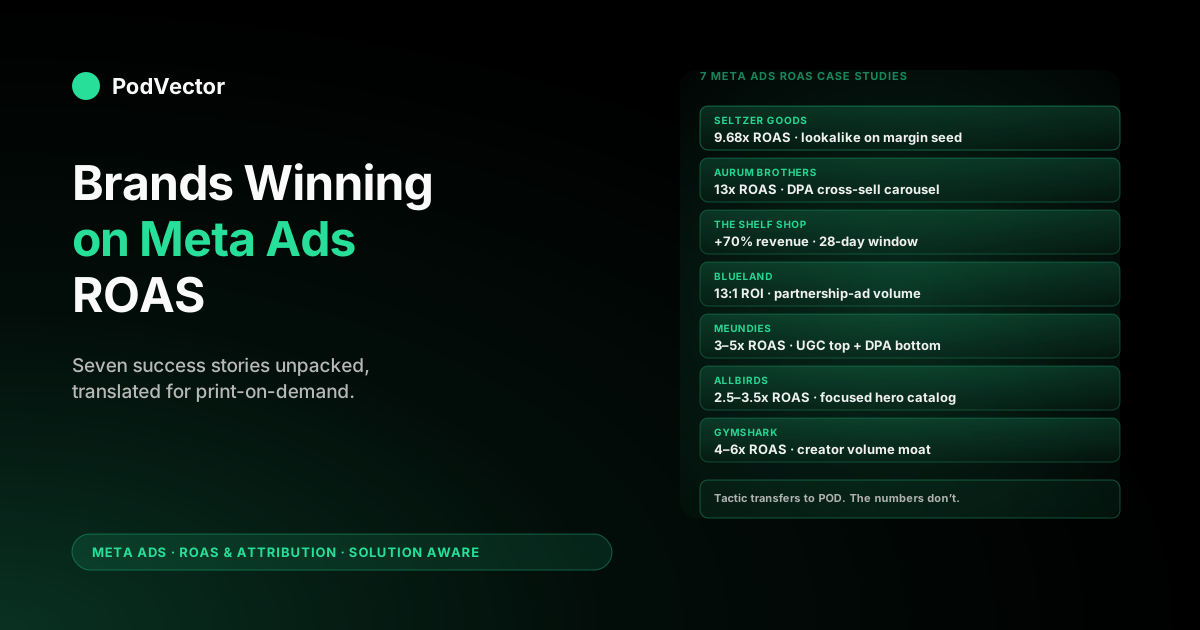
Quick Answer: The most-cited Meta Ads ROAS success stories come from seven brands — Seltzer Goods (9.68x), Aurum Brothers (13x), The Shelf Shop (+70% revenue), Blueland (13:1 with partnership ads), MeUndies (DPA + UGC), Allbirds (catalog scaling), and Gymshark (creator-led UGC). Each won on a different lever: lookalikes, retargeting, longer attribution windows, partnership ads, dynamic catalog, broad targeting, or creator volume.
None of those case studies measure ROAS after supplier base cost, shipping, or platform fees. For a print-on-demand store on Printify or Printful, that gap is 40–60% of revenue — a 5x reported ROAS often lands at 2x in the bank account.
Below: each success story unpacked, the POD-applicable lesson, and the one calculation that turns a vanity ROAS into a profit ROAS.
The pattern across every Meta Ads ROAS success story
Read enough case studies and the same five mechanics appear in different combinations. Lookalike audiences scoped on a high-value seed. Retargeting against warm catalog viewers. Creative volume that defeats fatigue. A signal-correct value parameter feeding Meta's optimizer. And a measurement window that captures the actual purchase cycle.
None of those mechanics is brand-specific. What changes is the unit economics underneath them. A direct-to-consumer skincare brand at 75% gross margin can run a 3x reported ROAS profitably. A print-on-demand apparel store at 35% margin cannot.
That is the lens to read every case study below. The tactic transfers; the math does not.
1. Seltzer Goods — 9.68x ROAS in 30 days
Seltzer Goods sells design-led puzzles, games, and small home goods. The widely-cited Inflow case study covers two Facebook ads that drove a 785% revenue increase in 30 days at a 4.5x raw ROAS and a 9.68x ROAS once Facebook attribution was applied.
The setup: lookalike audiences seeded from past purchasers, lifestyle-style single-image creative at a 1:1 ratio, and incremental 10–15% daily budget increases tied to a CPA threshold rather than a hard ROAS target.
What actually drove the lift was the seed. The lookalike was built on customers, not page viewers, and the creative spoke to the buyer's emotional pull — design as self-expression, not product as object.
POD takeaway: the lookalike seed matters more than the audience size. A 1% lookalike on 500 high-AOV repeat buyers outperforms a 1% lookalike on 10,000 one-time small-order buyers. POD stores that pipe contribution margin (not subtotal) into the seed get a sharper signal because Meta starts finding lookalikes of profitable customers, not all customers. That single change is the difference between Seltzer's lift and the typical "tried lookalikes, didn't work" experience. The deeper play is the same one the best Meta Ads operators for POD ROAS use across every campaign type.
2. Aurum Brothers — 13x ROAS on retargeting
Aurum Brothers is a men's bracelet brand that achieved a 13x ROAS and a 100% monthly sales increase via Meta retargeting. The campaign mix was Dynamic Product Ads (DPA) against page-viewers and add-to-cart audiences, with carousel formats showing the specific item viewed plus three lifestyle alternatives.
The reason the ROAS landed at 13x and not the more typical 5–8x for retargeting: the catalog feed included a "wear with" cross-sell shelf, so the carousel served the viewed product plus three complementary items. Average order value lifted ~30%, which lifted ROAS even though the click-through rate was identical.
The catch in this story — and every retargeting case study — is incrementality. A large share of Aurum's 13x ROAS came from buyers who would have purchased anyway. Independent incrementality studies on DPA retargeting place the truly incremental lift at 20–40% of the reported number.
POD takeaway: the cross-sell shelf is the transferable mechanic. A POD store running DPA with a single product per ad leaves AOV on the table. Build a feed that serves "viewed design + three complementary designs in the same niche," cap the retargeting window at 14 days, exclude past-30-day buyers, and your reported ROAS climbs without a creative refresh. The setup detail lives in the DPA Shopify strategy guide. Don't budget against the 13x number — budget against the 30–40% of it that's incremental.
3. The Shelf Shop — 70% revenue lift via longer windows
The Shelf Shop sells custom floating shelves online, a furniture product with a six-week consideration cycle. After launching from-scratch Meta campaigns, they posted a 70% revenue increase in Q3 and an 83% impression lift, off a 52% quarterly ROAS gain.
The strategic move was treating Meta's default attribution window as wrong rather than as truth. The default 7-day-click-1-day-view window cuts off at week one, which means a six-week purchase cycle never gets credited. The fix was extending the measurement to 28 days and pricing top-of-funnel campaigns against assisted conversions, not last-click ROAS.
The creative shift was secondary but mattered: problem-focused hooks ("Tired of living in a cluttered mess?") replaced product-photography spots. The hook qualified the audience before the product ever appeared.
POD takeaway: the consideration cycle for design-led apparel sits between 5 and 21 days, not the 1–3 days Meta's default attribution assumes. POD stores that judge top-of-funnel campaigns on day-1 ROAS turn off campaigns that would compound. Switch the analysis window to 28 days, and treat assisted conversions as real conversions on prospecting campaigns. The retargeting campaigns can stay on a tighter window because they're closing carts, not opening them. Pair this with the warehouse-side measurement in the complete Meta Ads ROAS guide for POD to keep the longer window from inflating false positives.
4. Blueland — 13:1 ROI with partnership ads
Blueland, a sustainable cleaning brand, ran a 211-creator Meta Partnership Ads campaign across three months. The result: 13:1 return on investment, ~$129,000 in attributed sales, and a creative library of 600+ partnership variants Meta could rotate against.
Partnership ads are different from boosted creator posts. The brand pays directly for distribution against the creator's own handle, which lifts trust signal and click-through over a brand-handle equivalent. Meta's algorithm reads partnership-ad engagement as higher-quality signal, which improves delivery efficiency.
The mechanic that drove the 13:1 was creative volume, not creator celebrity. A partnership-ad campaign with 5 creators saturates fast. One with 200+ creators delivers 40+ usable variants per month, which is more than enough to defeat fatigue across a six-figure ad spend.
POD takeaway: the partnership-ads format is underused for niche-design apparel. A POD store doesn't need 211 creators — 8–12 micro-creators in the niche is enough to get the 4–8 fresh variants per month most ad accounts need. The niche match matters more than the follower count. A 3,000-follower creator who lives the niche outperforms a 300,000-follower lifestyle generalist on POD ROAS by a wide margin. Slot partnership ads as the warm-audience builder feeding into DPA, the same pattern the best Meta Ads ROAS playbooks use to compound creator content into closing campaigns.
5. MeUndies — DPA + UGC at apparel scale
MeUndies is a subscription-leaning apparel brand that scaled past nine figures on a Meta-led acquisition stack. Public case studies place the blended ROAS at 3x to 5x at scale, with DPA retargeting at the high end and UGC-driven prospecting carrying the volume.
The combination is the lesson. UGC video in Reels and Stories carried prospecting at low CPMs. DPA against retargeted audiences closed the carts. Subscription billing extended LTV beyond the first order, which made the prospecting math work on a 3x reported ROAS that would not have been profitable at one-shot revenue.
The structural advantage MeUndies has — recurring revenue — does not transfer to single-purchase POD apparel. The mechanical playbook (UGC top, DPA bottom) does.
POD takeaway: the cleanest single-mode pattern for niche-design apparel is the MeUndies prospecting/retargeting split: 60–70% of spend on UGC Reels prospecting, 25–30% on DPA retargeting against viewers and add-to-cart audiences, the remainder on a small Engagement campaign feeding the warm-audience pool. The split assumes a contribution margin north of 30% and a target true ROAS above 2x. Below those thresholds, the math collapses no matter how good the creative is.
6. Allbirds — catalog-driven broad targeting
Allbirds is one of the most-cited Meta scaling cases of the last decade. The brand scaled past $100M on a Meta + Google split, with the Meta side built on broad-targeted Sales campaigns plus a tight catalog of 8–12 SKUs that the catalog-driven creative could rotate.
The lesson buried inside the case study is the SKU count. Broad targeting works because Meta can find the buyer; what makes it convert is a catalog with enough variety to interest different niches without diluting the brand signal. Eight to twelve hero SKUs is the sweet spot. Three is too few — broad audiences see a single product and bounce. Fifty is too many — the brand becomes generic and Meta can't optimize against a clear demand signal.
The reported ROAS at scale was 2.5x to 3.5x, which is below most case study headlines. At Allbirds' margin and LTV, that was profitable. At a thinner-margin operation, it would not be.
POD takeaway: the SKU-count ceiling is the most-ignored constraint in POD scaling. Stores with 200+ designs in the catalog confuse the algorithm. A focused 10–20 hero designs that match a tight niche outperforms an unfocused 200-design catalog at every spend tier. Pair the focused catalog with broad targeting and a value-based lookalike, the way the top companies boosting ROAS with Meta Ads structure their feeds, and the prospecting math starts working at a tier where it would otherwise collapse.
7. Gymshark — creator volume as the moat
Gymshark scaled to a billion-dollar valuation primarily on Instagram, but the Meta paid side carried a meaningful share of acquisition in the $50M–$500M revenue range. The case studies cite blended ROAS in the 4x to 6x band on a paid mix dominated by creator-content ads — ads built from content the creator network produced organically and the brand then promoted.
The mechanic was creator-content volume. Gymshark didn't run "influencer campaigns" on Meta. It promoted thousands of pieces of organic creator content at low individual budgets, which gave Meta's algorithm a near-infinite creative pool to test against.
The playbook is hard to clone at small scale because it depends on a brand strong enough to attract organic creator content. But the underlying principle — that creative volume is the durable moat, not any individual ad — transfers to any niche.
POD takeaway: the niche design itself is the creative-volume engine for POD. A store with 20 niche designs has 20 creative angles to rotate, plus the customer photos that come back from the buyers. Treat customer photos as creator content; pay for permission to run them as ads; rotate them through Dynamic Creative ad sets so Meta auto-mixes the variants. That single move turns a small POD store into a Gymshark-shaped creative pool at one-thousandth the budget.
What none of these stories tell you
Every case study above reports ROAS as Meta calculates it: revenue divided by ad spend, where revenue is order subtotal. None of them strip out the supplier cost, shipping, transaction fees, or app subscriptions that sit between the order and the bank account.
For a direct-to-consumer brand with 60–75% gross margin, that gap is small. The dashboard ROAS and the profit ROAS move together. For a print-on-demand store on Printify or Printful, that gap is 40–60% of revenue. A 5x reported ROAS becomes a 2x true ROAS once base cost, shipping, and fees come out.
The tactics from Seltzer, Aurum, Allbirds, and the rest do work for POD. The numbers don't transfer. A 9.68x case study repeated on a POD apparel store would land somewhere between 4x and 5x reported, which is a perfectly profitable result. Anyone benchmarking themselves against the headline number gets the wrong read on what's working.
The fix is to measure ROAS post-COGS from day one. That requires either piping contribution margin (not subtotal) to Meta as the value parameter, or pulling true ROAS from a unified data warehouse that joins ad spend to supplier cost. Most operators do neither. The Meta Ads ROAS definition Meta publishes is mathematically correct but financially incomplete for any pass-through-cost business model.
The POD-applied playbook
The seven case studies share five mechanics that transfer cleanly to POD apparel and home goods. Pull them together and you get a playbook that uses the success stories as a spec, not a daydream.
| Mechanic | Source case | POD application |
|---|---|---|
| Margin-weighted lookalike seed | Seltzer Goods | Pipe contribution margin as customer value before building the lookalike |
| Cross-sell DPA carousel | Aurum Brothers | Feed shows viewed design + 3 same-niche complements; 14-day window |
| Extended attribution window | The Shelf Shop | 28-day analysis window for prospecting; 7-day for retargeting |
| Partnership-ad creative volume | Blueland | 8–12 micro-creators in the niche; rotate 4–8 variants/month |
| UGC top + DPA bottom split | MeUndies | 60–70% UGC Reels, 25–30% DPA, ~10% Engagement |
| Focused hero-SKU catalog | Allbirds | 10–20 hero designs in tight niche; broad + value lookalike on top |
| Customer photos as creator content | Gymshark | Pay for permission, run through Dynamic Creative ad sets |
Sequence matters. A store under $5K/month should start with the partnership-ad creative volume and the focused hero catalog before touching DPA or lookalikes. The signal isn't there yet for the algorithm-heavy plays.
A store at $20K–100K/month runs the full playbook in parallel, with budget split per the MeUndies pattern. A store above $100K/month is mostly tuning the value parameter and the lookalike seed, because the rest of the mix is already running.
Worked example: what 5x reported looks like on Printify
A POD apparel store doing $50K/month on Printify pays roughly $24,000 in supplier base + shipping (48% pass-through), $1,500 in payment processing (3%), $400 in app subscriptions, and $10,000 in ad spend at a 5x reported ROAS.
Reported math: $50K revenue / $10K ad spend = 5.0x ROAS. Looks like a Seltzer-grade win.
True math: $50K revenue minus $24K supplier minus $1.5K processing = $24.5K contribution before ad spend. Divide by $10K ad spend: 2.45x true ROAS. Subtract the $400 app subscriptions and the operator's salary, and the actual margin is thin.
The diagnosis is not "the ad spend is wrong." The 5x reported ROAS is genuinely good. The issue is that the cost structure underneath needs the 5x to be a 5x, not a 3x. Most operators discover this only when scale magnifies the gap — at $200K/month on the same cost structure, a 0.5x miss on true ROAS is $20K/month in vanished profit.
The single move that closes the gap: feed Meta contribution margin instead of subtotal as the value parameter. Meta's optimizer starts pushing toward multi-item orders and higher-margin SKUs, which pulls the average order value up by 15–25% on most POD stores. A 5x reported ROAS on margin-weighted optimization typically nets 3.0x to 3.5x true ROAS instead of 2.45x — the difference between break-even and 25% net margin.
An AI employee sitting on top of a unified data warehouse can answer "which Meta campaigns are unprofitable after COGS this week?" in plain English, joining live Meta spend data to supplier costs from Printify or Printful and Stripe payouts. That is the full version of what the case studies above only solve half of. All ROAS and attribution articles in this cluster work the same problem from different angles.
FAQs
Are Meta Ads ROAS success stories transferable to print-on-demand?
The tactics transfer; the numbers don't. Lookalike audiences, DPA retargeting, broad targeting with focused catalogs, and UGC creative all work on POD apparel and home goods. The ROAS numbers reported in case studies for higher-margin brands are 1.5–2x what a POD store on Printify or Printful will see post-COGS. Benchmark against true ROAS, not reported.
What's a realistic Meta Ads ROAS target for a POD store?
Set the target on contribution margin, not subtotal. A POD store at 50% gross margin breaks even around a 4.0x subtotal-ROAS or 2.0x margin-ROAS. A profitable target is 5.0x subtotal or 2.5x margin. The case studies that report 9x–13x are mostly retargeting against warm audiences; on prospecting alone, 3x–5x is the realistic POD ceiling.
Which campaign type produced the highest ROAS in the success stories above?
Dynamic Product Ads against retargeting audiences post the highest reported ROAS — Aurum Brothers at 13x is representative. But most of that ROAS is non-incremental. Advantage+ Shopping (ASC) and broad-targeted Sales campaigns produce a lower reported number with a higher incremental lift, which is what compounds.
Did any of the success stories scale on a single creative?
Seltzer Goods scaled on two ads. Every other case study above scaled on creative volume — 8 to 600+ variants. The POD application is closer to the volume model than the two-ad model, because niche-design fatigue is faster than lifestyle-brand fatigue.
How long did these brands need before ROAS stabilized?
Seltzer Goods saw the lift inside 30 days. The Shelf Shop took a quarter. Most of the rest report 60–90 days to stable ROAS. The variance comes from the consideration cycle of the product and the creative volume the brand could deliver in that window.
Why is my Meta-reported ROAS higher than my Shopify ROAS?
Three reasons stack: Meta's default attribution window is 7-day-click-1-day-view (Shopify is usually last-click), Meta deduplicates poorly without CAPI, and Meta uses order subtotal whereas Shopify can use net revenue. The Shopify number is closer to truth, but neither matches contribution margin until you wire the value parameter to it.
Should POD stores use partnership ads like Blueland did?
Yes, but at smaller scale. Eight to twelve micro-creators in the niche delivers enough creative volume to defeat fatigue. The match between creator and niche matters more than the follower count. A 3,000-follower niche creator outperforms a 300,000-follower generalist on POD ROAS most of the time.
What's the biggest mistake POD stores make trying to copy these case studies?
Benchmarking against reported ROAS instead of true ROAS. A 5x reported on Printify is roughly a 2.5x true. A POD operator who chases the 9x or 13x headline numbers without fixing the value parameter and the COGS-aware measurement will scale a campaign that looks profitable on the dashboard and bleeds in the bank account.
The case studies stop at reported ROAS. Your bank account doesn't.
Meta's dashboard says 5x. Printify takes its base cost. Stripe takes its fees. The 5x became a 2x and you didn't see it.
Victor is the AI employee that joins your Meta ad spend to your Printify or Printful supplier costs in a unified data warehouse. Ask "which Meta campaigns are unprofitable after COGS this week?" in plain English and get the answer in seconds — true ROAS, not reported.
Try Victor free