
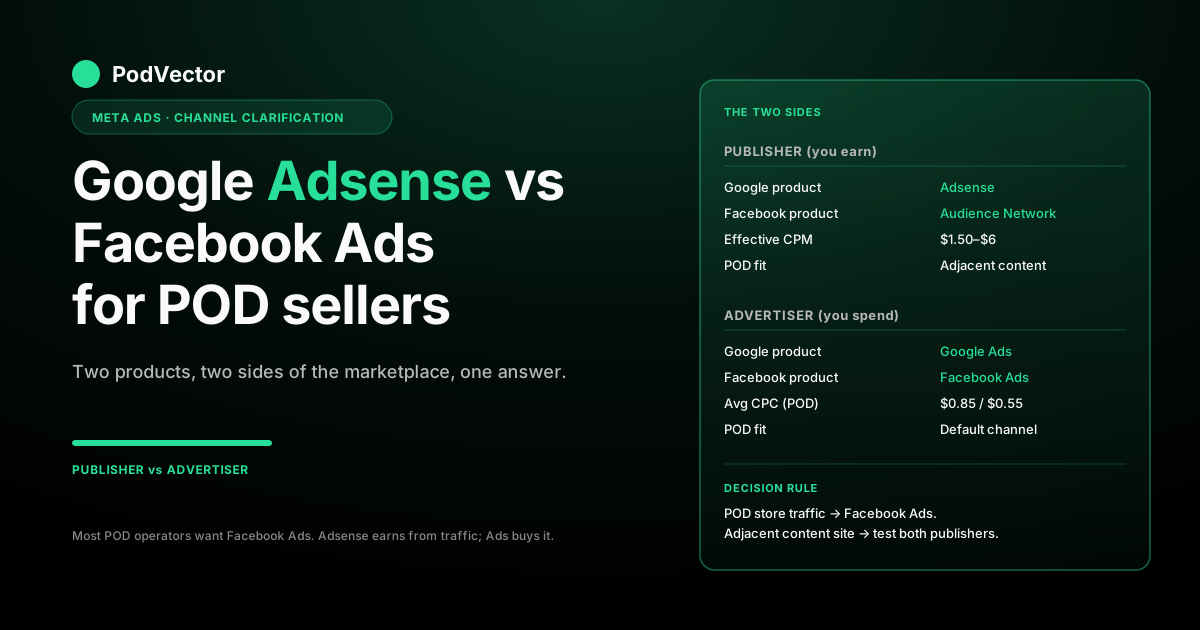
Quick Answer: "Google Adsense vs Facebook Ads" is a comparison of two different things. Adsense is a publisher product — Google pays you to display ads on a site you own. Facebook Ads is an advertiser product — you pay Facebook to show your ads to other people.
For print-on-demand sellers, the channel that drives sales is Facebook Ads (or Google Ads — the advertiser product, often confused with Adsense). Adsense only matters if you run a content site that sends readers to your POD store as a side strategy.
This guide clarifies the confusion, then runs the comparison most POD searchers actually need: Google Ads vs Facebook Ads through the lens of Printify and Printful supplier-cost math, plus the narrow case where Adsense earns a slot in a POD operator's stack.
Adsense vs Facebook Ads: the comparison most people mean
The phrase "Google Adsense vs Facebook Ads" gets searched a lot, and almost nobody who types it actually wants the publisher-vs-advertiser comparison those two products represent. They want one of two things.
The most common case: they mean Google Ads vs Facebook Ads — the two big advertiser networks — and have the product names slightly tangled. Adsense and Google Ads are sibling products inside Google's ad ecosystem, but they sit on opposite sides of the marketplace. One pays publishers; the other charges advertisers.
The less common case: they actually mean Adsense, because they run a blog or content site and are weighing publisher monetization (Adsense) against advertiser-paid promotion (Facebook Ads) as two ways to make money from the same audience.
For print-on-demand sellers, the answer to both versions of the question is the same: Facebook Ads is the channel you spend on, and Adsense is something you earn from only if a content site is part of your POD strategy. The rest of this guide handles each version in turn.
What Google Adsense actually is
Google Adsense is the publisher half of Google's advertising marketplace. You sign up as a website owner, drop a snippet of code on your pages, and Google auctions the ad slots on your site to advertisers running Google Ads campaigns. Google takes a cut, you get the rest, and a check arrives once you cross the $100 payout threshold.
For Adsense to produce real revenue, your site needs traffic — typically 10,000+ monthly pageviews before the math gets interesting. The average effective CPM (revenue per thousand pageviews) on Adsense ranges from $1 to $20 depending on niche, with most lifestyle and apparel-adjacent niches landing in the $2–$6 range.
That math matters for POD. A site doing 50,000 monthly pageviews in an apparel niche might earn $200–$300/month from Adsense. The same 50,000 pageviews routed to a POD store with a 1.5% conversion rate and $26 average order would produce ~$19,500 in gross revenue. The contrast is why no serious POD operator runs Adsense as a primary monetization layer.
Adsense also competes with your own funnel. Every Adsense impression on a page that could have linked to your store is an impression Google sold to somebody else's product — sometimes a direct competitor. The opportunity cost compounds the lower the Adsense CPM is.
What Facebook Ads actually is
Facebook Ads is the advertiser side of Meta's marketplace. You set a budget, pick targeting (interests, lookalikes, custom audiences from your customer list), upload creative, and Meta charges you each time the ad gets shown or clicked depending on the bid type.
The product covers Facebook, Instagram, Messenger, and Audience Network placements from a single campaign manager. Average CPC for POD apparel runs $0.55–$1.45 depending on niche and audience temperature; conversion rates on prospecting hover at 0.8–1.8% and on retargeting at 4.5–8%.
For POD, Facebook Ads is the default first paid channel for one structural reason: it manufactures demand. POD products live or die on whether somebody sees a design and feels something. Facebook puts the design in front of an interest-cluster lookalike scrolling Instagram, who didn't search for it but who responds to it.
Google's parallel product on this side of the marketplace is Google Ads — text search ads, Shopping ads, Performance Max, YouTube, and Display. That's the comparison most "Adsense vs Facebook Ads" searchers are actually after.
Google Ads vs Facebook Ads: the real comparison for POD
Once you map the question correctly, the substantive comparison is Google Ads (advertiser) vs Facebook Ads (advertiser). Both let you spend money to put a POD product in front of a buyer. They reach buyers in fundamentally different mental states.
Google Ads catches people who already typed a query — "german shepherd mom shirt," "vintage tractor hoodie." The buyer self-selected. Conversion rates are higher and the creative does less work because the search intent did most of it.
Facebook Ads catches people in scroll mode. They didn't ask for a t-shirt — your creative has to interrupt them and produce desire on its own. Conversion rates are lower per click, but Facebook can find buyers who never searched and never would have.
The structural matchup at-a-glance for POD apparel:
| Dimension | Google Ads (Search/Shopping) | Facebook Ads |
|---|---|---|
| Buyer intent | High (active search) | Low to none (passive scroll) |
| Avg CPC (POD apparel) | $0.85–$3.40 | $0.55–$1.45 |
| Prospecting conversion rate | 2.5–5.5% (Shopping) | 0.8–1.8% |
| Best for niches with | 5,000+ monthly searches | Identity, novelty, trends |
| Min. efficient daily spend | $50–$100 (Shopping) | $30 |
| Creative production load | Low (feed-driven) | High (8–15 creatives/week) |
| Attribution drift in 2026 | 5–20% | 15–40% (post-iOS) |
The simple rule: if your niche has measurable search demand, Google Shopping should be on first. If your designs are about identity, in-jokes, news cycles, or trends nobody searches for yet, Facebook Ads should be on first. If both apply, run both at minimum efficient spend and let CPA pick the budget split inside thirty days.
For the full breakdown of when each channel earns its slot at each MRR stage, the cluster's Google Ads vs Facebook Ads guide for POD sellers walks the rule by revenue stage.
POD unit economics on each channel
The reason POD sellers get the channel choice wrong is that most of them compare reported ROAS instead of contribution margin. The two numbers are very different on a thin-margin product.
Take a representative POD product: a $26 t-shirt with a $9 supplier base on Printify, $4.50 shipping, $1.10 payment processing, and a $0.40 Shopify platform fee. Contribution before ads is $11.
| Channel | CPC | Conv. rate | CPA | First-order contribution |
|---|---|---|---|---|
| Google Shopping (proven niche) | $1.65 | 3.4% | $48.53 | −$37.53 |
| Facebook prospecting | $0.85 | 1.2% | $70.83 | −$59.83 |
| Facebook retargeting | $0.55 | 4.5% | $12.22 | −$1.22 |
| Google Search branded | $0.40 | 8.0% | $5.00 | +$6.00 |
Two takeaways jump out. First, almost every cold acquisition channel is unprofitable on a single $26-AOV order after itemized supplier costs. POD is a repeat-purchase, LTV-driven game — not a first-click-profitable one.
Second, the platform-headline "Facebook is cheaper" argument inverts when you fold in conversion rate. Facebook prospecting's $70 CPA is the worst number in the table despite Facebook having the lowest reported CPC, because the conversion rate sits at 1.2% versus Shopping's 3.4%.
This is the math that POD sellers don't see because they read platform dashboards instead of reconciling against bank-deposit revenue. The cluster's Google Ads vs Facebook Ads cost guide for POD walks the cost arithmetic in more granular detail.
Where Adsense actually fits a POD operator
The narrow case where the literal Adsense-vs-Facebook-Ads comparison matters is the content-led POD operator. You run a niche blog (or a YouTube channel, or a Pinterest content account) that pulls organic traffic, and you're deciding how to monetize.
You have two reasonable plays: monetize the traffic with Adsense and let advertisers pay you, or route the traffic to your own POD store and convert it to product sales. Almost always, the second wins.
Run the math on a 50,000-pageview-per-month niche blog adjacent to a POD store:
- Adsense path. $3 effective CPM × 50 = $150/month gross. Net after content costs: usually under $100/month.
- POD store path. 50,000 pageviews × 4% click-through to product pages = 2,000 sessions × 1.5% conversion = 30 orders × $11 contribution = $330/month from a single month's traffic, plus retargeting list growth, plus email list growth, plus repeat-purchase LTV.
The POD path produces 3–5x more first-order revenue and compounds via retargeting and email. Adsense produces a flat dollar number that stops the second a reader leaves the page.
The only context where Adsense makes sense for a POD operator is on content pages that are clearly off-topic from your store — a recipe blog adjacent to an apparel store, for instance — where the visitor isn't a buyer and routing them to your store would be a waste. Even then, Adsense competes with affiliate offers and email-list opt-ins, both of which usually outperform display ad CPMs.
If you're already running a content site and weighing Adsense against Facebook Ads, the related cluster guide on Google Ads vs Facebook Ads for ecommerce covers the advertiser-side comparison from a store-traffic angle.
Facebook Audience Network: the closer Adsense competitor
If the question really is publisher vs publisher, Adsense's actual competitor isn't Facebook Ads — it's Facebook Audience Network. Audience Network is Meta's publisher product: app and mobile-web placements that let you, as a content publisher, monetize traffic by displaying ads sourced from Meta's advertiser pool.
For a POD operator running a content site, the realistic comparison looks like this:
| Factor | Google Adsense | Facebook Audience Network |
|---|---|---|
| Traffic type | Web (any platform) | Mobile-first (apps + mobile web) |
| Effective CPM (apparel niche) | $2–$6 | $1.50–$5 |
| Setup complexity | Low (snippet) | Medium (mobile-focused setup) |
| Reporting depth | Detailed dashboard | Less granular |
| Use case fit for POD | Adjacent content pages | POD operator's own app (rare) |
For most POD operators, neither publisher product is the right monetization layer. The traffic is more valuable routed to a store than sold to advertisers. Audience Network only earns its slot if you've built a content app or a high-traffic mobile property as a top-of-funnel asset, which is a different business from running a POD store.
The decision rule by what you actually meant
The right call depends on which of three questions you actually had:
- If you meant Google Ads vs Facebook Ads (most likely). Run Facebook Ads first if you have less than $2K MRR or your designs are identity- or trend-driven. Add Google Shopping once you have proven SKUs and a niche with measurable search volume. Above $10K MRR, run both with attribution reconciled against bank-deposit revenue.
- If you meant literal Adsense vs Facebook Ads. Run Facebook Ads. Adsense is monetization for traffic you can't convert directly; Facebook Ads is acquisition for store traffic you want. They serve opposite goals.
- If you meant Adsense vs Facebook Audience Network for a content site. Test both with a 70/30 ad-network split for thirty days. Whichever produces a higher effective CPM in your niche, run that one as primary. But also run a calc on whether routing the same traffic to a POD store would beat both.
For the structured walk through every channel POD operators actually consider — including Google Shopping, TikTok, Pinterest, and the integrated cross-channel playbook — the cluster's pillar guide on Meta Ads vs alternatives for POD covers the full landscape.
Five mistakes POD sellers make in this comparison
Across hundreds of POD sellers, five mistakes show up over and over when somebody types "Adsense vs Facebook Ads" and tries to act on the answer.
- Treating Adsense and Google Ads as interchangeable. They're opposite sides of the same marketplace. Adsense pays you for traffic you have. Google Ads charges you to buy traffic. POD sellers need the second.
- Running Adsense on store pages. Putting display ads on a product page sells the visitor's attention to a competitor for cents while costing you a conversion worth $11+ in contribution. Never run Adsense on commerce pages.
- Comparing Facebook reported ROAS to Adsense CPM as if they're the same metric. One is "revenue out per dollar in," the other is "revenue per thousand impressions." They aren't comparable without a full funnel calc that includes traffic source, conversion rate, and supplier-cost-net contribution.
- Picking one channel and refusing to test the other. Past $5K MRR, Google Ads and Facebook Ads cover different funnel stages. Refusing to add the complement leaves money on the table that competitors who run both will capture. The Shopify breakdown covers the multi-platform case in ecommerce context as a useful complement to this POD-specific take.
- Underestimating Meta's creative-volume burden. Stores benchmarking Meta against Google on dollars-in-dollars-out frequently exclude the labor cost of producing 8–15 creatives a week. When that cost gets folded into per-design profitability, Google often wins outright in searched niches.
For the full Meta-side economics including which ad formats actually work on Facebook for POD, the complete guide to Meta ad types for POD sellers covers what each Facebook format does in production. The Meta Ads topic hub indexes every supporting article in this cluster.
FAQs
Is Adsense the same as Google Ads?
No. They're opposite sides of Google's ad marketplace. Google Ads is the advertiser product — you pay Google to show your ads to people elsewhere on the web. Adsense is the publisher product — Google pays you to display advertisers' ads on your site. POD sellers buying paid traffic to a store want Google Ads, not Adsense.
Can a POD seller use Adsense to make money from store visitors?
Technically yes, practically no. Putting Adsense on commerce pages cannibalizes your own conversions to earn cents per click for somebody else. The math doesn't work — a Shopify visitor is worth $0.30–$1.50 in contribution if they buy, versus an Adsense click worth $0.10–$1.50 in publisher revenue at typical CPMs. Don't run Adsense on pages where you'd rather the visitor buy from you.
Should I start with Facebook Ads or Google Ads for my POD store?
Start with Facebook Ads if you have less than $2K MRR and no proven design winners. The minimum efficient daily spend is lower (~$30 vs Google Shopping's $50–$100), and Facebook's creative-discovery feedback loop helps you find winning designs faster than Google can capture searches you don't yet have. Add Google Shopping once you have proven SKUs and a niche with measurable search volume.
What's the realistic ROAS to expect on Facebook Ads vs Google Ads for POD?
For POD apparel and accessories in 2026, prospecting Meta campaigns typically report 1.6x–2.4x ROAS, retargeting reports 4.5x–8x, Google Shopping in proven niches reports 2.8x–4.2x, and Performance Max post-learning reports 2.4x–3.6x. Reported numbers overstate true ROAS by 15–40% on Meta and 5–20% on Google. Your real contribution-margin ROAS is whatever those numbers minus drift, divided by your true CAC including itemized Printify or Printful supplier costs.
Is Facebook Audience Network better than Adsense for monetizing a niche site?
It depends on niche and traffic source. For mobile-heavy traffic in apparel-adjacent niches, Audience Network often produces 80–120% of Adsense's CPM with simpler setup. For desktop-heavy traffic and content-niche sites, Adsense usually wins on reporting depth and ad-format flexibility. Test both with a 70/30 split for thirty days before committing. But also run a calc on routing the same traffic to a POD store — for most POD operators, the store wins both.
Can I run Adsense and Facebook Ads at the same time?
Yes, but they target different parts of the business. Adsense earns money from existing organic traffic on a content site you own. Facebook Ads pays for new traffic to your POD store. They don't compete for budget, they compete for time and attention. If you're a POD seller without an existing high-traffic content site, focus on Facebook Ads first; the time spent building Adsense-worthy traffic is almost always better spent on store growth.
Why is "Google Adsense vs Facebook Ads" such a common search if it's the wrong comparison?
Mostly because Google Ads and Adsense have similar names and live under the same brand, and beginners conflate them. Search-engine result pages for the term lean toward Google Ads vs Facebook Ads content because Google's own search algorithm treats the queries as related. The practical result is that anyone landing on this page looking for "Adsense vs Facebook Ads" content almost always wants the advertiser comparison instead.
Pick the channel that actually pays — based on real contribution margin, not platform dashboards.
Most POD sellers can't tell whether Facebook Ads or Google Ads is more profitable for their store because they're reading platform-reported ROAS instead of bank-deposit revenue minus itemized supplier costs. Victor connects directly to Shopify, Printify, Printful, Meta, and Google ad accounts, runs the reconciliation in a live data warehouse, and answers "which channel earned me a dollar today?" in plain English. And see your real channel-level profit before your next ad-budget decision.
Try Victor free