
Quick Answer: For most print-on-demand sellers under $10K MRR with original designs, start with Facebook. POD-niche demand has to be manufactured before any platform can capture it, and Facebook is the only system that finds buyers who weren't searching.
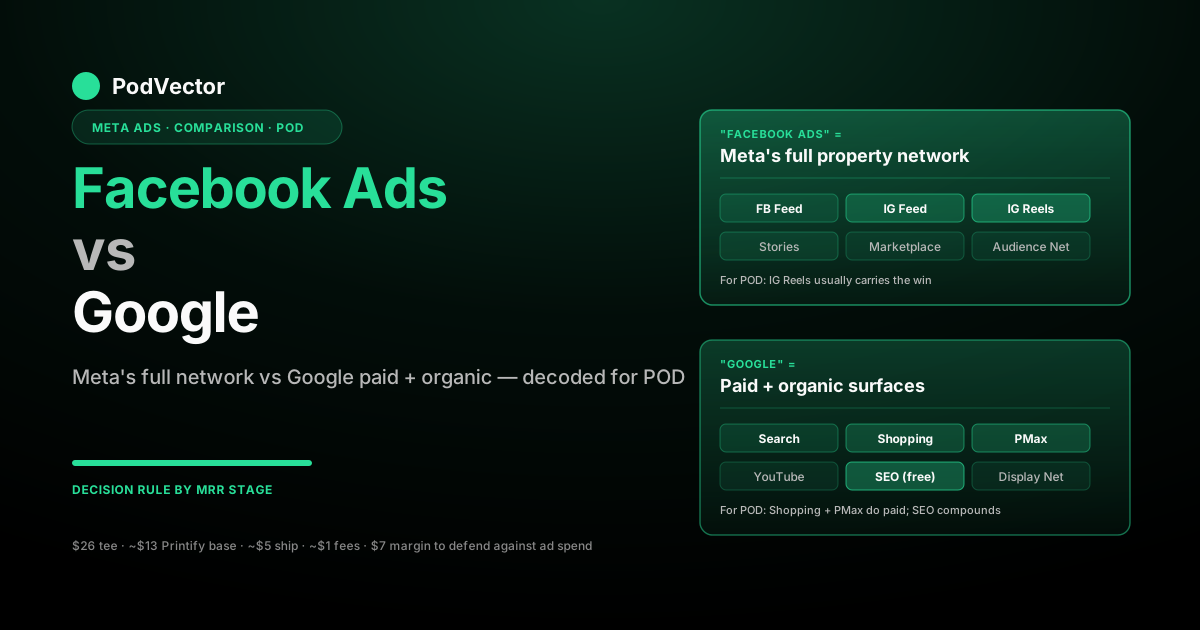
"Facebook Ads" here means Meta's full property network — Instagram, Reels, and Stories included. "Google" is wider than most operators realize too: paid Search, Shopping, and Performance Max, plus the organic results your store can rank inside for free.
Once you cross $10–15K MRR with stable creative, layering Google Shopping (paid) and SEO content (organic) on top of Facebook produces blended efficiency neither side hits alone. Below that, splitting budget across both just keeps each one stuck in the learning phase.
This guide compares Facebook against the full Google ecosystem on the dimensions that decide POD margin survival — cost at thin margins, demand type, creative workload, attribution honesty, and the rule for when each one earns the next dollar.
"Facebook Ads" is shorthand for Meta's full network
Almost no one running "Facebook ads" today is running ads only on Facebook.com. The term has drifted to mean Meta's entire ad network — and for POD specifically, that distinction changes the math.
The placements inside a single Meta campaign include Facebook Feed, Facebook Marketplace, Facebook Stories, Instagram Feed, Instagram Reels, Instagram Stories, Messenger, and Audience Network (third-party apps that monetize through Meta's ad tech).
For visual product categories like apparel, mugs, and posters, Instagram Reels usually carries the win inside that mix. The "Facebook ad" your competitor brags about is probably mostly running on Reels.
When this article says "Facebook," it means Meta's full network the way operators actually use the term. You're not comparing one feed to Google. You're comparing a five-or-six-surface delivery system.
"Google" is bigger than Google Ads alone
The other half of the comparison hides even more surface area. Most "Google vs Facebook" articles silently shrink Google to "Google Ads," but the title of this comparison is broader on purpose. POD operators picking between channels should know the full Google footprint:
- Google Search Ads — text ads on the search results page, keyed to keyword queries.
- Google Shopping — product cards rendered from your Shopify Merchant Center feed, surfaced for product-specific queries.
- Performance Max (PMax — Google's all-in-one auto-targeted campaign type) — spans Search, Shopping, Display, YouTube, Gmail, and Discover from one campaign.
- YouTube Ads — pre-roll, mid-roll, and in-feed video, bought through Google Ads but a fundamentally different surface.
- Google Display Network (GDN) — banner ads on third-party publisher sites.
- Organic Search (SEO) — blog posts and product pages that rank for free in the regular search results.
- Google Maps and Local — irrelevant to most ecommerce-only POD stores, but real if you have a physical pop-up.
For POD specifically, Google Shopping and PMax do most of the paid work because they're feed-driven. Search defends branded queries. SEO is the asset most POD operators ignore — it compounds for years and Facebook can't touch it. YouTube and GDN rarely earn POD margins.
So when you read "Facebook vs Google" below, the practical comparison is Meta DPAs and Advantage+ Shopping versus Google Shopping plus PMax plus a content-SEO motion. Treating Google as only the paid side undersells what it can do for a POD store at scale.
The at-a-glance comparison for POD
Numbers below are 2026 ranges from public benchmarks combined with our own POD-operator client cohort. POD-specific ranges are tighter than the generic ecommerce ranges most articles cite, because Printify and Printful margins force a narrower viable window.
| Dimension | Facebook (Meta) | Google (paid + organic) | POD verdict |
|---|---|---|---|
| Average CPC | $0.55–$1.45 | $0.85–$2.30 (paid) | Facebook cheaper at the click |
| Average CPM | $10–$22 | $25–$45 (paid) | Facebook far cheaper to fill impressions |
| Average CTR | 1.0–1.9% | 3.5–5.0% (paid Search) | Google's intent shows in clicks |
| Conversion rate | 0.9–2.1% | 2.5–5.5% (paid Shopping) | Google's intent edge |
| Demand type | Generated — algorithm-keyed | Captured — query-keyed | Facebook for original designs |
| Min. efficient daily spend | $25–$50 | $50–$100 (paid) | Facebook lower starting floor |
| Time to first conversion | 7–14 days (learning phase) | 24–72 hours (paid) | Google for fastest read |
| Creative workload | High — fresh creative weekly | Low — feed images suffice (paid) | Google for solo operators |
| Compounding asset | None — spend stops, traffic stops | SEO content compounds for years | Google wins long term |
| Attribution honesty | View-through inflates 25–40% | Last-click bias inflates Google | Both flatter themselves |
Two things stand out for POD readers. Facebook's lower CPC narrows considerably once you adjust for Google's higher conversion rate. And the bottom row — compounding asset — is the row most "vs" articles ignore. Every dollar of Facebook spend evaporates the moment you pause campaigns. SEO content keeps earning long after the last edit.
For the paid-Google-only version of this comparison broken down across Google's five ad products, see our Google Ads vs Facebook breakdown.
POD margin reality: the math that breaks generic advice
Most "Google vs Facebook" articles assume you have a 50–75% contribution margin to play with. POD operators don't. The single fact of supplier-fulfilled apparel changes which platform survives the math.
The POD margin starting point
A $26 unisex t-shirt sold through Printify carries roughly $11–13 in supplier base cost, $4.50–5.50 in shipping, and $1.20 in Shopify platform fees. Contribution margin is $5.50–9.30 before any marketing dollar goes out the door.
That $5.50–9.30 is the budget you have for ad spend, returns, free shipping, and customer support combined. It's not a discretionary acquisition pool — it's the entire window.
What that does to Facebook's math
At a $0.55–$1.45 Facebook CPC and a 1.5% conversion rate, your cost per acquired customer lands around $37–97. That sounds catastrophic against a $7 contribution margin.
The reason Facebook still wins for most POD operators is multi-purchase behavior. A Meta-acquired POD customer typically buys 1.4–1.8 items per order at higher AOV — driven by collection ads and Dynamic Product Ads (DPAs — Meta's auto-personalized product carousels) that put four or six related designs in one impression.
That blended AOV is what funds the acquisition. Sellers measuring single-order ROAS will declare Facebook unprofitable; sellers measuring blended-AOV cohort margin will see it working.
What that does to Google's math
At a $0.85–$2.30 Google Shopping CPC and a 3.5% conversion rate, you're paying $24–66 per acquired customer. That looks better at the unit level — until you realize Google Shopping customers usually buy the single SKU they searched for and leave.
Google Shopping starts working for POD when AOV crosses ~$35, where customers tend to add a second item or pick a higher-margin SKU like a hoodie or sweatshirt. Below that, Google bleeds margin even at headline-positive ROAS. For the cost-only deep dive with itemized supplier math, see our cost-focused comparison.
Demand creation vs demand capture (and where SEO sits)
This is the framing most operators get wrong on the first pass. Picking the wrong demand model burns months of ad budget before the lesson hits.
Facebook generates demand
A Meta impression happens because the algorithm decided a scroller looks like past converters. Nobody asked to see your ad. Most won't care. The 1–2% who do are people who didn't know they wanted your design until it appeared in their Reels feed.
The constraint is creative fatigue. The same ad shown to the same people stops working in 2–4 weeks. Sustained demand creation requires a creative pipeline that produces fresh variants continuously.
Google captures demand that already exists
A Google Shopping click happens because someone typed a product-relevant query into a search box. That person already knows what they want. They've completed most of the buying journey before the ad ever shows. Google just charges you to be the storefront they pick.
The constraint is search volume. If your niche has 1,200 monthly searches across all relevant queries, you can buy maybe 500 of those clicks before the auction floor rises. There is no "scale Google to $500/day" for niches without search demand.
Why this is brutal for original POD designs
Nobody Googles "ironic tarot card cat shirt." Original POD designs are almost never searched for by name — that demand has to be manufactured before any platform can capture it. Branded merchandise (sports team gear, licensed apparel, named graphic styles) is the exception and behaves more like normal ecommerce.
If your designs are original and your niche lacks named search demand, Google Shopping has nothing to match against. Facebook's behavior-keyed algorithm is the only system that can find your buyers cold.
Where SEO sits in this picture
Organic Google sits in a different category from both. SEO content (your blog posts, collection pages, design-style explainers) ranks for the discovery queries your designs don't have, but the categories around them do. "Best gym mom shirts," "funny dad birthday gifts," "minimalist tarot apparel" — these are searched, even when no individual design is.
SEO is the only POD growth lever that compounds without ongoing spend. Facebook spend stops, Facebook traffic stops. SEO content written today still earns clicks two years later. Most POD operators under $20K MRR underweight this badly because the payback period (4–9 months) is longer than ad payback (same week). Both motions are needed at scale.
Creative pipeline: the hidden cost of "cheap" Facebook
This is the line item most POD operators miss when they pick Facebook based on "cheaper CPC." The platforms have very different creative pipeline requirements, and the cheap CPC assumes the pipeline is built.
Google's creative load: low
Google Shopping pulls images directly from your Shopify product feed. Your existing product photos and mockups are the ad creative. PMax adds some headline and asset variants but accepts default copy.
A solo POD operator can launch a Google Shopping campaign in an afternoon and run it for months without touching the creative. The only ongoing work is feed hygiene — fixing disapprovals, updating titles, cleaning out out-of-stock SKUs.
Facebook's creative load: high
Facebook DPAs use product feed images too, but pure DPA performance plateaus quickly. To scale on Meta you need short-form video — Reels-style 9:16 vertical clips, hook-led product showcases, UGC-style testimonials. The creative must refresh every 2–4 weeks because the algorithm degrades reused assets.
Sustained Meta scaling on POD typically requires 8–15 fresh ad variants per week. That's a creative pipeline — either an in-house designer/editor, an agency retainer at $1.5–4K/month, or AI video tools producing variant batches.
If you're a solo operator without creative capacity, Google Shopping (in a niche with search demand) is the lower-friction starting point. If you have or can build a creative pipeline, Facebook unlocks scale that Google can't reach. For more on the creative side, see our Facebook Ads course breakdown for POD operators.
Attribution: how each side over-claims credit
Sum Facebook's reported revenue and Google's reported revenue for any week and the total typically exceeds your actual Shopify revenue by 40–80%. Both platforms claim credit for the same conversions. Knowing how each one cheats helps you read the dashboards honestly.
Facebook's overstatement: view-through credit
Facebook's default attribution window is 7-day click and 1-day view-through. The view-through window credits Facebook for any purchase made within 24 hours of seeing an ad, regardless of whether the user clicked. That inflates Facebook's reported ROAS by 25–40% on most stores.
Switching to 7-day click only in Ads Manager will drop your reported ROAS sharply but show you the number that actually correlates with revenue.
Google's overstatement: data-driven attribution and last-click bias
Google's default model is data-driven attribution (DDA — Google's machine-learning attribution that distributes credit across the touchpoints it can see). The catch is that Google can only see Google touchpoints. So DDA over-weights Search, Shopping, and PMax interactions because that's the only data Google has.
If a customer first discovered your brand on Instagram, then later searched your brand name on Google to buy, Google reports the full sale. The Instagram contribution is invisible to Google.
The honest fix lives in your warehouse
Both platforms over-credit because each only sees its own data. The only honest cross-platform attribution lives in your live data warehouse — Snowflake, Redshift, BigQuery, Databricks, or whatever your stack uses — where Shopify orders, Google Ads spend, Facebook Ads spend, and Printify or Printful supplier costs all join on a single key.
That's the architecture serious POD operators move to once they cross $20–30K/month in ad spend. For the Meta-specific attribution deep dive, see our complete guide to Meta Ads ROAS and attribution for POD.
The decision rule by MRR stage and design type
Generic "which one" advice ignores where you are. The right answer depends on revenue stage, design originality, and creative capacity.
Stage 1: $0–5K MRR, original designs, no creative pipeline
Run Facebook only. Start at $25/day on a single Advantage+ Shopping campaign with your existing product images. Use the first 30 days to find one or two creative angles that work. Don't touch Google paid until you have a stable cost-per-acquired-customer number.
Stage 2: $0–5K MRR, designs in a search-demanded niche
Run Google Shopping only. Branded apparel, licensed designs, or sports team gear can have real search volume. Start at $50/day on Shopping with PMax disabled, run a 30-day learning period, then add PMax once you have 50+ conversions of signal.
Stage 3: $5–15K MRR, growing
Continue with whichever platform launched you. Don't add the second one yet — a $5–15K business doesn't have the operational bandwidth to run two ad systems honestly. This is also the right stage to start writing SEO content for your top 5 collection categories. The payback is slow; that's why you start now.
Stage 4: $15K+ MRR, stable creative, working pixel and CAPI
Add the second paid platform at a 70/30 or 80/20 ratio. If Facebook is your launcher, add Google Shopping for branded defense and to capture the search demand your Facebook brand-building creates. If Google is your launcher, add Facebook for top-of-funnel demand creation. SEO content should be live and indexing.
Stage 5: $50K+ MRR
Both paid platforms running, organic compounding, attribution unified in your warehouse. The platform-reported numbers are no longer the source of truth — your blended marketing efficiency ratio (MER — total revenue divided by total ad spend across all channels) is what you optimize against.
Stacking the two: Facebook for cold, Google for warm
Once you cross Stage 4, the question stops being "which one" and starts being "what does each one do in the funnel." Facebook and Google specialize in different parts of the customer journey.
Facebook's job: cold prospecting
Meta's behavior-keyed algorithm is uniquely good at finding people who look like buyers but haven't yet declared intent. Run Facebook for cold prospecting — Advantage+ Shopping, lookalike audiences off your top customers, broad-targeting demand creation. Treat reported ROAS as inflated and watch the blended MER instead.
Google paid's job: warm capture
Once Facebook has put your brand in someone's head, that person eventually searches "[your brand name] hoodie" or "[your design phrase]." Google Shopping and branded Search exist to make sure the next click belongs to you, not a competitor or a marketplace. Both branded defense and high-intent product queries belong here.
SEO's job: compound capture
Organic Google content captures category-level discovery queries that neither paid Facebook nor paid Google can buy efficiently. "Funny dad birthday gifts," "minimalist gym apparel," "tarot card lover gift ideas" — these queries pre-exist in search volume and convert well when your collection page is the answer. Pure margin once it ranks.
The de-duplication problem
Both paid platforms claim 100% credit for the same conversion when run together. The de-duplication has to happen in your warehouse: ingest both platforms' raw conversion logs, match against Shopify's order ID, apply a multi-touch model (typically time-decay or position-based) to redistribute credit.
Without that, you'll over-spend on whichever platform reports higher ROAS — usually Google, because last-click bias is more flattering than view-through inflation. For broader cross-channel context, see our Meta Ads vs alternatives complete comparison.
Six mistakes POD sellers make picking between them
1. Picking Facebook because "it's cheaper" without a creative pipeline
Facebook's $0.55 CPC is meaningless if your single ad creative dies after 10 days and you can't replace it. The cheap CPC assumes ongoing creative refresh. Without that, you'll watch CPM climb and ROAS collapse over 4–6 weeks.
2. Picking Google because "search intent converts better" in a niche with no search
Google Shopping's 3.5% conversion rate assumes there's actually intent traffic to capture. If your niche has 200 monthly searches and Google's bid floor is $1.50, you'll spend $300/month on 200 clicks for two sales. The conversion rate looked great. The volume killed you.
3. Forgetting that "Google" includes free traffic
POD operators who frame Google as a paid channel only miss the highest-margin source of traffic available to them. SEO content for category queries doesn't compete with Facebook's prospecting reach — it compounds underneath it. Skipping SEO because the payback is slow leaves growth compounding on a competitor's blog instead.
4. Comparing platform-reported ROAS without normalizing attribution
Facebook's default 1-day view-through inflates ROAS 25–40%. Google's DDA over-weights Google touchpoints. Comparing the raw dashboard numbers is comparing two different accounting standards. Switch Facebook to 7-day click only and Google to last-non-direct-click before drawing conclusions.
5. Optimizing on revenue when POD requires optimizing on margin
A campaign at 3.0x reported ROAS can lose money once supplier cost is netted out. Margin-aware optimization requires sending an enriched conversion event with your contribution-margin number, which neither platform's stock integration does. Build it server-side or use an agent that builds it for you — that's what Victor handles by default.
6. Adding the second platform too early
Two ad systems running in parallel under $15K MRR usually means neither one gets enough budget to converge. The algorithm needs ~50 conversions in 30 days to learn. Splitting a $1,500/month budget across both platforms gives each one ~25 conversions — both stay in learning phase forever.
FAQs
Which is cheaper, Facebook Ads or Google?
Facebook is cheaper at the impression and click level (CPM $10–22 vs $25–45, CPC $0.55–1.45 vs $0.85–2.30). Once you adjust for Google's higher conversion rate, the cost-per-customer gap narrows considerably. For POD specifically, Facebook usually wins on cost-per-customer because POD designs lack the search demand that makes Google's intent advantage pay off.
Should I start with Facebook or Google as a beginner POD seller?
If your designs are original and you have any creative capacity, start with Facebook (Meta) at $25/day. The lower starting floor and demand-creation mechanic suit beginner POD better. If your niche has named search demand (licensed merchandise, sports gear, branded apparel), start with Google Shopping at $50/day instead.
Does "Google" include SEO in this comparison?
Yes — and that's a real edge for Google over Facebook for POD long-term. Organic search content (collection pages, blog posts, gift-guide articles) compounds for years after publication and costs only the time to write. Facebook has no equivalent compounding asset. At Stage 3+, an SEO motion alongside paid is one of the highest-margin growth levers POD has.
Can I run both on a small budget?
Under $1,500/month total ad spend, no. Splitting a small budget across both platforms means neither gets the ~50 conversions per month that smart bidding needs to converge. Pick one, fund it properly, prove the unit economics, then add the second once you can fund both above the learning threshold.
How long until I see results on each?
Google Shopping can produce conversions within 24–72 hours because it's capturing existing intent. Facebook takes 7–14 days to exit the learning phase, then another 1–2 weeks of stable spend before you have enough data for a real ROAS read. Plan for a 30-day evaluation window on either paid platform. SEO is 4–9 months to first-page rankings on competitive queries.
Does Instagram count as Facebook in this comparison?
Yes. "Facebook" in operator shorthand means Meta's full property network — Facebook Feed, Marketplace, Instagram Feed, Instagram Reels, Stories, Messenger, and Audience Network. For most POD apparel and accessory categories, Instagram Reels actually outperforms pure Facebook placements within the same campaign.
What about iOS 14.5 and the privacy changes?
They hurt Facebook more than Google because Facebook depended more on third-party signal. Meta has rebuilt with the Conversions API (CAPI — Meta's server-side event-forwarding system that complements the browser pixel), Aggregated Event Measurement, and Advantage+ campaign types that lean on first-party data. Facebook is back to roughly 80–90% of its pre-iOS-14.5 effectiveness if your CAPI is configured correctly. Google was less affected because most of its conversion signal was already first-party.
How do I know if my POD niche has Google search demand?
Use Google Keyword Planner or a tool like Ahrefs to check monthly search volume for your top 20 product-relevant queries. If the combined volume is above ~5,000 monthly searches, Google Shopping is structurally viable. Below ~1,000 monthly searches, you don't have enough intent traffic to fund Google Shopping — go Facebook-only and lean on SEO for the discovery queries that exist around (not on) your designs.
Where can I see the raw numbers behind these comparisons?
Most cited benchmarks come from public ad-platform reports and third-party studies like AgencyAnalytics' Google Ads vs Facebook Ads breakdown. POD-specific ranges are tighter than the broader ecommerce ranges those reports use; we triangulate them against our own client cohort and adjust for Printify/Printful margin reality.
What's the link to the broader Meta Ads context?
The Meta Ads comparison cluster hub has the full set of platform-vs-alternative breakdowns. The Meta Ads topic hub covers strategy, attribution, integrations, and ad types in depth. The Meta Ads playbook for POD sellers is the strategic counterpart to this comparison piece.
Let Victor run both sides and move the budget to whichever earns
Facebook says one. Google says another. Your Shopify P&L only confirms one customer paid you.
Victor runs your Meta and Google campaigns off one live data layer that joins Shopify orders, Printify or Printful supplier costs, and ad spend on a single key. He reallocates budget toward the channel earning real margin and pauses the losers — asking your approval before each move.
Because he optimizes on margin-weighted numbers instead of the inflated platform-reported ones, POD operators using Victor cut wasted spend 2–3 weeks earlier than they would reading dashboards by hand.
Try Victor free