
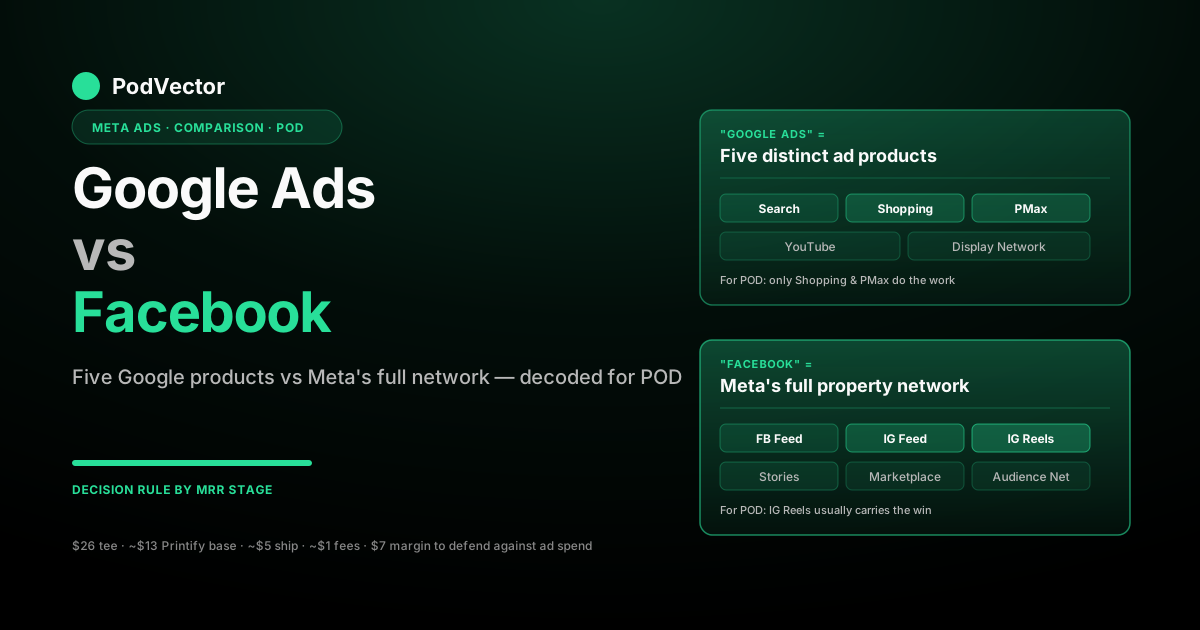
Quick Answer: Google Ads captures people already searching for what you sell. "Facebook" — really Meta's full property network including Instagram, Reels, and Stories — creates new demand by putting your designs in front of people who didn't know they wanted them.
For most print-on-demand sellers under $10K MRR, Facebook wins because original POD designs lack the named search demand that makes Google Shopping work. Once your store crosses $10–15K MRR with stable creative and a working pixel, running both at a 70/30 Facebook-lead split produces better blended efficiency than either alone.
This guide compares the two on the axes that matter for POD specifically — cost at thin margins, audience type, creative workload, attribution honesty, and the decision rule by MRR stage and design type.
"Facebook" is not one ad surface anymore
The biggest beginner-side confusion in this comparison is the word "Facebook." When most POD sellers say "Facebook ads," they don't mean ads on Facebook.com — they mean the entire Meta advertising network.
That network includes Facebook Feed, Facebook Marketplace, Facebook Stories, Instagram Feed, Instagram Reels, Instagram Stories, Messenger, and Audience Network (third-party apps that monetize through Meta). A single "Facebook ad" can run across all of these surfaces depending on placement settings.
For POD specifically, this matters because Instagram Reels and Instagram Feed often outperform actual Facebook placements for visual product categories like apparel and accessories. The "Facebook ad" your competitor is running is probably mostly running on Instagram.
The shorthand "Facebook" in this article means Meta's full surface network, the way operators actually use the term. Just know that you're comparing Google Ads against a five-or-six-surface delivery system, not against a single feed.
"Google Ads" is not one ad product either
The other half of this comparison hides similar complexity. "Google Ads" is the umbrella label for at least five distinct ad products that behave very differently for POD:
- Google Search — text ads on the search results page, keyed to keyword queries. The original search-ad product.
- Google Shopping — product cards rendered from your Merchant Center feed, surfaced for product-specific queries.
- Performance Max (PMax) — Google's all-in-one auto-targeted campaign type that spans Search, Shopping, Display, YouTube, Gmail, and Discover.
- YouTube Ads — pre-roll, mid-roll, and in-feed video ads on YouTube, bought through Google Ads.
- Google Display Network (GDN) — banner and image ads on third-party publisher sites in Google's ad network.
For POD sellers, Google Shopping and PMax do most of the work because they're feed-driven and product-led. Search drives branded defense and high-intent terms. YouTube and GDN rarely make sense at POD margins.
So when you see "Google Ads vs Facebook," the practical question is usually Google Shopping/PMax vs Meta DPAs/Advantage+ Shopping. The rest of this guide compares them through that lens.
The at-a-glance comparison for POD
Numbers are 2026 ranges from public benchmark data and our own POD-operator client cohort. POD-specific ranges are tighter than the broader ecommerce ranges most articles cite.
| Dimension | Google Ads (Shopping/PMax) | Facebook (Meta DPA/Advantage+) | POD verdict |
|---|---|---|---|
| Average CPC | $0.85–$2.30 | $0.55–$1.45 | Facebook cheaper at the click |
| Average CPM | $25–$45 | $10–$22 | Facebook far cheaper to fill impressions |
| Conversion rate | 2.5–5.5% | 0.9–2.1% | Google's intent edge |
| Demand creation | Weak — captures existing search | Strong — generates new interest | Facebook for original designs |
| Min. efficient daily spend | $50–$100 | $25–$50 | Facebook lower starting floor |
| Time to first conversion | 24–72 hours | 7–14 days (learning phase) | Google for fastest read |
| Creative workload | Low — feed images suffice | High — fresh creative weekly | Google for solo operators |
| Attribution honesty | Last-click bias inflates Google | View-through credit inflates Facebook | Both flatter themselves |
Two things stand out for POD sellers reading this table. Facebook's lower CPC closes considerably once you adjust for conversion rate. And Facebook's lower starting floor matters when you're under $5K MRR and can't fund a $100/day Shopping budget for the four weeks it takes Google's smart bidding to converge.
For the margin-overlay version of this table broken out across Google's five ad products, see our deeper Google vs Facebook breakdown.
Cost at POD margins: where the math actually lands
Most "Google vs Facebook" articles assume your contribution margin sits between 50% and 75%. For POD, it doesn't. That single fact changes which platform survives the math.
The POD margin reality check
A $26 unisex t-shirt sold through Printify carries roughly $11–13 in supplier base cost, $4.50–5.50 in shipping, and $1.20 in Shopify platform fees. Contribution margin is $5.50–9.30 before any ad spend at all.
That's the budget you have for customer acquisition, returns, free shipping, and support — not just ads.
What that means for Google Ads
At a $0.85–$2.30 Google Shopping CPC and a 3.5% conversion rate, you're paying $24–66 per acquired customer. On a single $26 sale with $7 contribution margin, that's lethal.
Google Shopping starts working for POD at AOV above ~$35, where customers tend to add a second item or pick a higher-margin SKU like a hoodie or sweatshirt. Below that AOV, Google Shopping bleeds money even at decent reported ROAS.
What that means for Facebook
At a $0.55–$1.45 Facebook CPC and a 1.5% conversion rate, you're paying $37–97 per customer at the same single-order math. That sounds even worse. The reason Facebook still wins for most POD operators is multi-purchase.
A Facebook-acquired POD customer typically buys 1.4–1.8 items per order at higher AOV — driven by collection ads and DPA cross-sells that put four or six related designs in the same impression. A Google Shopping customer usually buys the single SKU they searched for and leaves.
For the cost-only deep dive with itemized POD margin math, see our cost-focused comparison.
Intent capture vs demand creation
This is the single most important framing in the whole comparison. POD sellers who pick wrong here lose months of ad budget before they figure out why.
Google captures existing demand
A Google Shopping click happens because someone typed a product-relevant query into a search box. That person already knows what they want. They've completed most of the buying-journey work before they ever see your ad. Google just charges you to be the storefront they pick.
The constraint: traffic volume is capped by search volume. If your niche has 1,200 monthly searches across all relevant queries, you can buy maybe 500 of those clicks before saturating the auction. There is no "scale Google to $500/day" for niches without search demand.
Facebook creates new demand
A Facebook impression happens because Meta's algorithm thinks the scroller looks like past converters. Nobody asked to see your ad. Most won't care. The 1.5% who do are people who didn't know they wanted your design until it appeared in their Reels feed.
The constraint: creative fatigue. The same ad shown to the same people stops working in 2–4 weeks. Demand creation requires a creative pipeline that produces fresh variants continuously.
Why this matters for POD specifically
Original POD designs are almost never searched for by name. Nobody Googles "ironic tarot card cat shirt" — that demand has to be created. Branded merchandise in established niches (Marvel-licensed apparel, sports team gear, named graphic styles) does have search demand and can run on Google.
If your designs are original and your niche lacks named search demand, Google Shopping has nothing to match against. Facebook's behavior-keyed algorithm is the only system that can find your buyers.
Audience: search demand vs scroll discovery
The audience-shape difference shows up clearly when you look at what triggers an impression.
Google's audience: searchers
Google Search has roughly 8.5 billion daily queries. Of those, the slice relevant to your POD niche might be 10,000–500,000 monthly searches. You pay for the intersection of those searches with your bidding strategy.
The reach feels enormous in aggregate, but for any specific design, the addressable audience is whoever happens to search a relevant term that day. You can't expand it.
Facebook's audience: scrollers
Meta's properties have roughly 3.7 billion monthly active users. Anyone in your demographic and interest target is reachable, regardless of whether they're actively shopping. The addressable audience for any given POD niche is typically 5–50 million users.
That's why Facebook scales differently. You can grow spend from $25/day to $250/day and the algorithm has more lookalikes, more behavior-similar users, more inventory to sell you. Google's auction floor rises sharply once you exhaust your pure intent traffic.
The creative workload nobody warns POD beginners about
This is the hidden cost most POD sellers underestimate when they pick Facebook. The platforms have very different creative pipeline requirements.
Google's creative workload: low
Google Shopping pulls images directly from your Shopify product feed. Your existing product photos and mockups are the ad creative. PMax adds some headline and asset variants but accepts default copy.
A solo POD operator can launch a Google Shopping campaign in an afternoon and run it for months without touching the creative. The only ongoing work is feed hygiene — fixing disapprovals, updating titles, cleaning out out-of-stock SKUs.
Facebook's creative workload: high
Facebook DPAs use feed images too, but pure DPA performance plateaus quickly. To scale on Meta you need short-form video — Reels-style 9:16 vertical clips, hook-led product showcases, UGC-style testimonials. The creative must refresh every 2–4 weeks because the algorithm degrades reused assets.
Sustained Facebook scaling on POD typically requires 8–15 fresh ad variants per week. That's a creative pipeline — either an in-house designer/editor, an agency retainer at $1.5–4K/month, or AI video tools producing variant batches.
What this means for picking
If you're a solo operator without creative capacity, Google Shopping (in a niche with search demand) is the lower-friction starting point. If you have or can build a creative pipeline, Facebook unlocks scale that Google can't reach.
For more on the creative workload reality, see our guide to Facebook Ads courses for POD operators.
Attribution: which platform overstates more
If you sum Facebook's reported revenue and Google's reported revenue for the same period, the total typically exceeds your actual Shopify revenue by 40–80%. Both platforms claim credit for the same conversions. Knowing how each one cheats helps you read the dashboards honestly.
Google's overstatement: data-driven attribution and last-click bias
Google's default model is data-driven attribution (DDA — Google's machine-learning attribution that distributes credit across the touchpoints it can see). The catch is that Google can only see Google touchpoints. So DDA over-weights search, Shopping, and PMax interactions because that's the data Google has.
If a customer first discovered your brand on Instagram, then later searched your brand name on Google to buy, Google reports the full sale. The Instagram contribution is invisible to Google.
Facebook's overstatement: view-through and 7-day click windows
Facebook's default attribution window is 7-day click and 1-day view-through. The view-through window credits Facebook for any purchase made within 24 hours of seeing an ad, regardless of whether the user clicked. That inflates Facebook's reported ROAS by 25–40% on most stores.
Switching to 7-day click only in Ads Manager will drop your reported ROAS sharply but show you the number that actually correlates with revenue.
The honest fix: a single source of truth
Both platforms over-credit because they only see their own data. The only honest cross-platform attribution lives in your live data warehouse — Snowflake, Redshift, BigQuery, Databricks, or whatever your stack uses — where Shopify orders, Google Ads spend, Facebook Ads spend, and Printify or Printful supplier costs all join on a single key.
That's the architecture serious POD operators move to once they cross $20–30K/month in ad spend. For the Meta-specific attribution deep dive, see our complete guide to Meta Ads ROAS and attribution for POD.
The decision rule by MRR stage and design type
Most "which one" advice ignores where you are. The right answer depends on revenue stage, design originality, and creative capacity.
Stage 1: $0–5K MRR, original designs, no creative pipeline
Run Facebook only. Start at $25/day on a single Advantage+ Shopping campaign with your existing product images. Use the first 30 days to find one or two creative angles that work. Don't touch Google until you have a stable cost-per-acquired-customer number.
Stage 2: $0–5K MRR, designs in a search-demanded niche
Run Google Shopping only. Branded apparel, licensed designs, or sports team gear can have real search volume. Start at $50/day on Shopping with PMax disabled, run a 30-day learning period, then add PMax once you have 50+ conversions of signal.
Stage 3: $5–15K MRR, growing
Continue with whichever platform launched you. Don't add the second one yet — a $5–15K business doesn't have the operational bandwidth to run two ad systems honestly. Focus on creative iteration (if Facebook) or feed optimization (if Google).
Stage 4: $15K+ MRR, stable creative, working pixel and CAPI
Add the second platform at a 70/30 or 80/20 ratio. If Facebook is your launcher, add Google Shopping for branded defense and to capture the search demand your Facebook brand-building creates. If Google is your launcher, add Facebook for top-of-funnel demand creation.
Stage 5: $50K+ MRR
Both platforms running, with attribution unified in your warehouse. The platform-reported numbers are no longer the source of truth — your blended marketing efficiency ratio (MER — total revenue divided by total ad spend across all channels) is what you optimize against.
Running both: when and how
Once you cross Stage 4, the question stops being "which one" and starts being "what ratio."
The starting split
For most POD stores moving from one platform to two, start with 70% on the launcher and 30% on the new addition. Facebook-led stores: 70% Facebook, 30% Google Shopping for branded terms and high-intent product searches. Google-led stores: 70% Google, 30% Facebook for prospecting and retargeting.
The shift trigger
Track the share of revenue coming from organic search. When organic search exceeds 25% of total revenue, your niche has matured into searchable demand and you can shift toward 50/50. Below 15% organic search share, your niche still depends on demand creation and Facebook should stay the lead.
De-duplicating attribution
Both platforms claim 100% credit for the same conversion when run together. The de-duplication has to happen in your warehouse: ingest both platforms' raw conversion logs, match against Shopify's order ID, apply a multi-touch model (typically time-decay or position-based) to redistribute credit.
Without that, you'll over-spend on whichever platform reports higher ROAS — usually Google, because last-click bias is more flattering than view-through inflation. For broader cross-channel context, see our Meta Ads vs alternatives complete comparison.
Five mistakes POD sellers make picking between them
1. Picking Facebook because "it's cheaper" without a creative pipeline
Facebook's $0.55 CPC is meaningless if your single ad creative dies after 10 days and you can't replace it. The cheap CPC assumes ongoing creative refresh. Without that, you'll watch CPM climb and ROAS collapse over 4–6 weeks.
2. Picking Google because "search intent converts better" in a niche with no search
Google Shopping's 3.5% conversion rate assumes there's actually intent traffic to capture. If your niche has 200 monthly searches and Google's bid floor is $1.50, you'll spend $300/month on 200 clicks for two sales. The conversion rate looked great. The volume killed you.
3. Comparing platform-reported ROAS without normalizing attribution windows
Facebook's default 1-day view-through inflates ROAS 25–40%. Google's DDA over-weights Google touchpoints. Comparing the raw dashboard numbers is comparing two different accounting standards. Switch Facebook to 7-day click only and Google to last-non-direct-click before drawing conclusions.
4. Optimizing on revenue when POD requires optimizing on margin
A campaign at 3.0x reported ROAS can lose money once supplier cost is netted out. Margin-aware optimization requires sending an enriched conversion event with your contribution-margin number, which neither platform's stock integration does. Build it server-side or use an agent that builds it for you — that's what Victor handles by default.
5. Adding the second platform too early
Two ad systems running in parallel under $15K MRR usually means neither one gets enough budget to converge. The algorithm needs ~50 conversions in 30 days to learn. Splitting a $1,500/month budget across both platforms gives each one ~25 conversions — both stay in learning phase forever.
FAQs
Which is cheaper, Google Ads or Facebook?
Facebook is cheaper at the impression and click level (CPM $10–22 vs $25–45, CPC $0.55–1.45 vs $0.85–2.30). Once you adjust for Google's higher conversion rate, the cost-per-customer gap narrows considerably. For POD specifically, Facebook usually wins on cost-per-customer because POD designs lack the search demand that makes Google's intent advantage pay off.
Which one should I start with as a beginner POD seller?
If your designs are original and you have any creative capacity, start with Facebook (Meta) at $25/day. The lower starting floor and demand-creation mechanic suit beginner POD better. If your niche has named search demand (licensed merchandise, sports gear, branded apparel), start with Google Shopping at $50/day instead.
Can I run both on a small budget?
Under $1,500/month total ad spend, no. Splitting a small budget across both platforms means neither one gets the ~50 conversions per month that smart bidding needs to converge. Pick one, fund it properly, prove the unit economics work, then add the second platform once you can fund both above the learning threshold.
How long until I see results on each?
Google Shopping can produce conversions within 24–72 hours because it's capturing existing intent. Facebook takes 7–14 days to exit the learning phase, then another 1–2 weeks of stable spend before you have enough data for a real ROAS read. Plan for a 30-day evaluation window on either platform.
Does Instagram count as Facebook in this comparison?
Yes. "Facebook" in operator shorthand means Meta's full property network — Facebook Feed, Facebook Marketplace, Instagram Feed, Instagram Reels, Instagram Stories, Messenger, and Audience Network. For most POD apparel and accessory categories, Instagram placements (especially Reels) actually outperform pure Facebook placements within the same campaign.
What about iOS 14.5 and the privacy changes?
They hurt Facebook more than Google because Facebook depended more on third-party signal. Meta has rebuilt with the Conversions API (CAPI — Meta's server-side event-forwarding system that complements the browser pixel), Aggregated Event Measurement, and Advantage+ campaign types that lean on first-party data. Facebook is back to roughly 80–90% of its pre-iOS-14.5 effectiveness if your CAPI is configured correctly. Google was less affected because most of its conversion signal was already first-party.
How do I know if my POD niche has Google search demand?
Use Google Keyword Planner or Ahrefs to check monthly search volume for your top 20 product-relevant queries. If the combined volume is above ~5,000 monthly searches, Google Shopping is structurally viable. Below ~1,000 monthly searches, you don't have enough intent traffic to fund a Google Shopping campaign — go Facebook-only.
Do I have to use both eventually?
Most POD stores above $25K MRR run both, because the marginal cost of adding the second platform at that scale is low and the diversification protects against single-platform algorithm changes. Below $25K MRR, single-platform focus usually outperforms diversified-but-underfunded.
Where can I see the raw numbers behind these comparisons?
Most cited benchmarks come from public ad-platform reports and third-party studies like Shopify's Google vs Facebook Ads comparison. POD-specific ranges are tighter than the broader ecommerce ranges those reports use; we triangulate them against our own client cohort and adjust for Printify/Printful margin reality.
What's the link to the broader Meta Ads context?
The Meta Ads comparison cluster hub has the full set of platform-vs-alternative breakdowns. The Meta Ads topic hub covers strategy, attribution, integrations, and ad types in depth.
Stop guessing which platform earned the order
Google says it earned the conversion. Facebook says it earned the conversion. Your Shopify P&L only confirms one customer paid you.
Victor unifies your Shopify orders, Printify or Printful supplier costs, Google Ads spend, and Facebook Ads spend, then answers "which platform actually deserves the next dollar?" with margin-weighted numbers, not the inflated platform-reported ones.
POD operators using Victor cut wasted spend on losing campaigns 2–3 weeks earlier than dashboard-only operators.
Try Victor free