
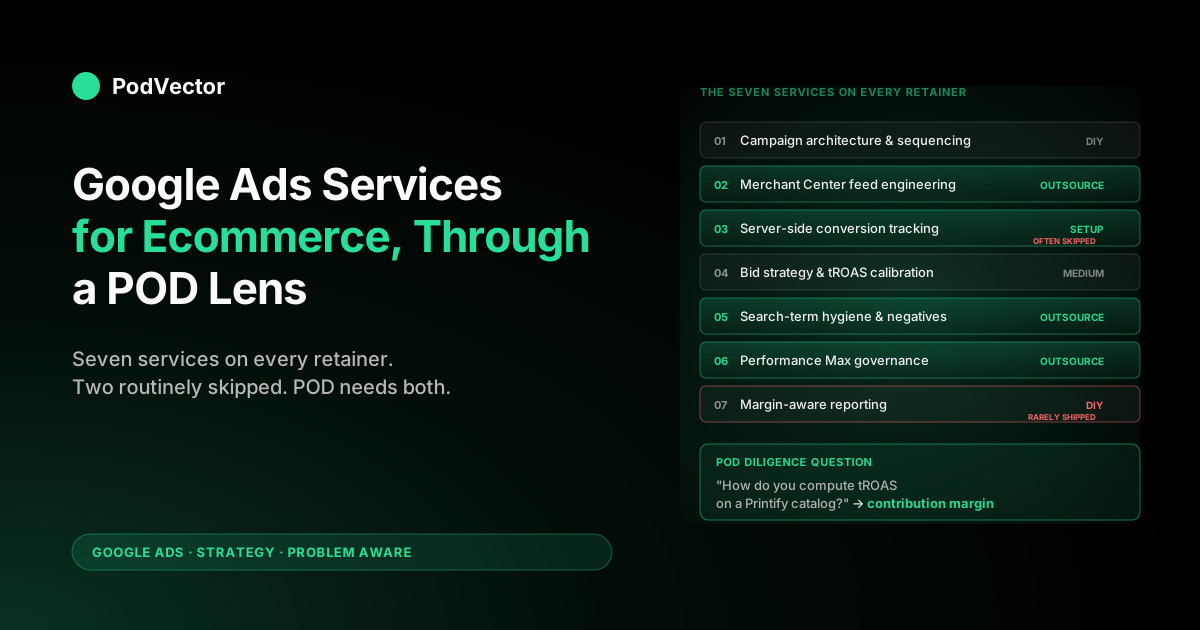
Quick Answer: "Google Ads services for ecommerce" usually packages seven distinct deliverables — campaign architecture, Merchant Center feed engineering, conversion tracking, bid strategy, search-term hygiene, Performance Max governance, and margin-aware reporting — sold as one retainer. For print-on-demand stores, only three of the seven are reliably worth outsourcing (feed engineering, server-side tracking, and PMax governance), one is non-negotiable but trivial to do in-house (campaign architecture once), and the remaining three only earn their fee if the agency reconciles Google-reported revenue against Shopify-confirmed revenue and joins it to Printify or Printful unit cost. Most agencies don't, which is why most POD stores on managed Google Ads run reported ROAS that looks healthy and bank balances that quietly drift down.
What "Google Ads services for ecommerce" actually covers
The phrase "Google Ads services" gets used loosely. A freelancer offering it and an agency offering it are usually selling work at completely different scopes, and one of the cleanest ways to lose money on a managed retainer is to assume the deliverables are standardized when they're not. Before evaluating any service — or scoping the work yourself — it helps to break the term into its constituent deliverables.
At the operator level, an ecommerce Google Ads service almost always packages some subset of these seven items:
- Campaign architecture and launch sequencing — building the right mix of Branded Search, Standard Shopping, Search non-brand, Performance Max, and remarketing, in a launch order that lets each layer feed signal to the next.
- Merchant Center feed engineering — turning the raw Shopify product feed into something Google's Shopping algorithm can rank: GTIN coverage, variant grouping, custom labels, image hygiene, and the diagnostics-page review cadence.
- Conversion tracking and attribution — installing the Google & YouTube Shopify channel app, enabling Enhanced Conversions, deploying server-side tagging through GTM Server-Side, and reconciling Google's reported revenue against Shopify's confirmed revenue.
- Bid strategy and tROAS calibration — choosing between Manual CPC, Maximize Clicks, Maximize Conversions, Maximize Conversion Value, and Target ROAS, and setting per-campaign tROAS values that reflect the store's actual contribution margin.
- Search-term hygiene and negative keyword management — the weekly review that pulls high-cost search terms from each campaign, identifies the irrelevant ones, and adds them as account-level negatives before they compound.
- Performance Max governance — running PMax inside guardrails: Brand exclusions to keep it off branded search, asset-group segmentation by margin tier, and the "PMax Insights"-to-search-term reconciliation that surfaces opaque spend.
- Margin-aware reporting — joining Google Ads spend and revenue to Shopify orders and to Printify or Printful unit cost, then reporting per-SKU and per-campaign contribution margin rather than reported ROAS.
Notice what's not on the list: ad copy writing, A/B testing of headlines, audience research presentations, monthly slide-deck reviews, and "creative refresh" cycles. Those are services agencies often charge for, but they sit second-order to the seven items above.
An ecommerce Google Ads account that gets the seven core deliverables right but never refreshes its ad copy will still outperform an account that constantly refreshes copy without nailing the seven core deliverables. Spend the budget where the math is.
Print-on-demand intersects each of these seven services in a way that changes which ones are critical, which ones are nice-to-have, and which ones actively need a POD-specific lens or they go wrong. The next section walks each one.
The seven services on every retainer — and how POD stresses each one
The seven deliverables behave differently on a POD store than they do on a typical 60%-margin DTC brand. Some of them get harder, some get easier, and a few become outright dangerous when delivered with generic-ecommerce defaults. Here's the breakdown.
1. Campaign architecture and launch sequencing
The architecture itself doesn't change for POD: you still want Branded Search → Standard Shopping → Search non-brand → Performance Max → Display remarketing, launched in sequence so each layer accumulates conversion signal before the next gets handed an automated bid strategy. What changes is the launch budget and the patience.
A 60%-margin DTC brand can launch all five campaigns simultaneously at $50/day each and the math forgives early experimentation. A POD store at 28–35% contribution margin can't — every day of broken targeting compounds losses faster than the conversion data accumulates.
The right POD launch starts with $5/day Branded plus $30–$40/day Standard Shopping and stays there for two to four weeks before adding Search non-brand. PMax doesn't enter until 30+ Shopping conversions per month and 60+ days of conversion history exist.
This is a one-time service (the architecture itself doesn't change month over month) so most stores either pay an agency for the initial setup and then bring it in-house, or follow a documented playbook like the complete Google Ads playbook for print-on-demand sellers and skip the agency fee entirely. The architecture is the cheapest service to insource because it's not recurring work — it's a launch project plus a quarterly review.
2. Merchant Center feed engineering
This is the service where POD economics most violently diverge from generic ecommerce. A standard DTC store has 50–500 SKUs in Merchant Center; a POD store with 50 designs across 5 product types, 4 colors, and 6 sizes has 6,000 variants — and 70–80% of them shouldn't be eligible for ads because they cluster around marginal sizes (4XL, 5XL), near-duplicate color mockups, and price points that hide better-margin alternatives.
The feed-engineering work that pays for itself within a month on POD:
- GTIN coverage audit. Printify and Printful's integrations should populate
gtinautomatically; if they don't, fix that before launch. Listings without GTINs lose 15–30% of impressions to the manufacturer-identity ranking signal. - Variant grouping with
item_group_id. Every size of every color of every design should share anitem_group_idso Google treats them as one product, not 24 duplicates competing for the same impression. - Margin-band suppression. 4XL and 5XL hoodies typically cost $4–$6 more at the same retail price. Either price them up or exclude them from the feed using a custom label and feed rule. Otherwise they drag the campaign tROAS average down quietly.
- Mockup curation. Multiple chest-print angles of the same color trigger Google's image-similarity penalty. Pick the strongest mockup per color and hide the rest from the feed.
- Diagnostics page weekly review. "Disapproved" and "Limited performance" buckets compound. POD feeds routinely accumulate 200–800 items in Limited Performance because of low-traffic variants. Either fix the underlying issue or remove the item.
This is the highest-leverage service to outsource on a POD store because the work is both ongoing and POD-specific, and most agencies don't know to do it. If a vendor's pitch deck doesn't mention item_group_id, custom labels, GTIN, or the diagnostics review cadence, they aren't doing this work — they're letting Shopify's default sync run and hoping. For the implementation walkthrough, see Shopify Google Merchant Center strategy for print-on-demand.
3. Conversion tracking and attribution
Tracking is non-negotiable: every other decision in the account runs on the data tracking produces, and bad data produces confidently wrong answers. The 2026 baseline for any Shopify ecommerce store has three layers stacked, and POD stores need every layer because their margin can't absorb a 25% attribution gap.
- Google & YouTube channel app installed in Shopify, with conversion tracking enabled. Free, takes 15 minutes, no campaign should run without it.
- Enhanced Conversions for Web turned on inside Google Ads (Tools → Conversions → your purchase conversion → "Turn on enhanced conversions"). Recovers 12–25% of conversion volume lost to attribution gaps.
- Server-side conversion tracking via Google Tag Manager Server-Side or a Shopify-compatible service. Recovers another 15–30% of conversions that iOS 17, Safari ITP, and ad blockers strip from client-side tags. For stores spending $50/day or more, the highest-ROI infrastructure investment available.
The reconciliation test that exposes whether the service is working: pull Shopify's Sales by Source filtered to Google Ads for the last 30 days, then compare to Google Ads' "Conv. value" for the same window. If the two numbers are within 10%, tracking is healthy.
If Google reports 25%+ more revenue than Shopify confirms, the account has over-attribution and every ROAS-based decision in the last quarter is suspect. If Google reports 25%+ less than Shopify, Smart Bidding is being starved of conversions it would otherwise optimize on.
This is the second highest-leverage service to outsource because server-side tagging is fiddly to set up correctly and an agency that does it weekly will install it faster and more reliably than a store doing it once. For the cross-cluster deep dive on attribution math, see the complete guide to Google Ads ROAS and attribution for POD.
4. Bid strategy and tROAS calibration
Bid strategy is where ecommerce Google Ads services most often go wrong on POD, because the default tROAS targets they apply are calibrated for higher-margin DTC. The "3x ROAS to be profitable" rule is a generic-ecommerce assumption built on 60% gross margin. On a 28–35% POD margin, 3x is breakeven on the marginal sale and net negative once Shopify subscription, processor fees, and refund reserve come out.
The breakeven math, line by line, on a $34 POD hoodie order:
| Line item | Amount | Notes |
|---|---|---|
| Order revenue | $34.00 | What Shopify and Google both report |
| Printify base cost | −$18.00 | Garment + print, average across sizes |
| Shipping subsidy | −$3.00 | Above what the customer pays |
| Payment processor | −$1.30 | Shopify Payments at 2.9% + 30¢ |
| Platform allocation | −$0.80 | Shopify subscription amortized per order |
| Refund reserve | −$1.70 | 5% of revenue, conservative for POD |
| Contribution margin | $9.20 | 27% of revenue — what's available for ads + profit |
Breakeven ad spend is $9.20 per order, mapping to a breakeven ROAS of 3.7x. For a 10% post-ads profit margin, target ROAS lifts to roughly 5.9x. This is why a service applying a generic 3–4x tROAS to a POD account looks like it's "performing" while quietly losing money on every marginal sale.
The calibration that holds up across POD stores:
- Conservative (cash-positive immediately): tROAS 600% (6x). Profit per order around $1.50–$3.00.
- Balanced (most POD stores): tROAS 500% (5x). Roughly breakeven on the marginal sale, growing audience and conversion data.
- Aggressive (well-capitalized growth): tROAS 400% (4x). Slight loss per marginal order, justified only when LTV from repeat customers covers the gap.
This service is medium-leverage to outsource: an agency that calibrates tROAS to actual contribution margin earns its fee here; one that applies a generic 3x default actively destroys margin. The diligence question to ask any vendor before signing: "How do you compute the tROAS target on a POD account?" If the answer doesn't include Printify base cost, payment fees, shipping subsidy, and refund reserve, walk away.
5. Search-term hygiene and negative keyword management
This is the most labor-intensive recurring service and the one where agency fees are most often justified. Search-term hygiene is the weekly review that pulls each campaign's Search Terms report, sorts by cost descending, and adds account-level negatives for irrelevant queries.
Done weekly, it saves 5–15% of spend per quarter. Done never, the account quietly funds search-term clusters that will never convert (informational queries, competitor brand searches, "free" modifiers).
POD-specific patterns to negate that generic-ecommerce services often miss:
- "Wholesale," "bulk," "supplier" queries — POD doesn't fulfill at wholesale margins; these clicks never convert profitably.
- "Cheap," "free," "generic" modifiers — buyers using these terms aren't the audience that pays for licensed designs.
- "How to make," "DIY," "design my own" — informational, not commercial.
- Competitor brand names if you're not actively running a conquest strategy — high CPCs, low conversion, poor Quality Score downstream.
- Adjacent vertical queries the variant images accidentally match — a hoodie with a cat design pulled into "cat toys" searches, etc.
The hygiene review is high-leverage to outsource only if the agency commits to a documented weekly cadence with the negative-keyword diff visible in their reporting. "We watch the search terms" without a weekly diff is unfalsifiable. Ask for the last four weeks of negative keyword additions before signing — if they can't produce them, the work isn't happening.
6. Performance Max governance
Performance Max is Google's most aggressive automation: one campaign that spans Shopping, Search, YouTube, Discover, Gmail, Maps, and Display, with the algorithm allocating budget across all of them based on signal it builds in real time. For a 60%-margin DTC brand with $5K+/month ad budget, it works extraordinarily well. For POD, it has three failure modes a service has to govern around or it bleeds margin invisibly.
Failure mode 1: brand cannibalization. PMax bids on branded queries by default and reports them as new conversions. The fix: account-level negative keywords for brand terms or the "Brand exclusions" setting (Settings → Brand exclusions) so a dedicated Branded Search campaign captures those queries at lower CPCs.
Failure mode 2: variant funneling. PMax optimizes toward whatever variant converts cheapest, which on POD is usually the worst-margin variant (a small mug, baby onesie, the discounted color). The fix: asset groups segmented by margin tier, with separate campaign budgets per tier rather than a unified pool.
Failure mode 3: signal opacity. PMax doesn't tell you which placement, query, or audience drove a conversion. The "Insights" tab and search-term reports surface partial visibility. The deeper truth is PMax is the wrong tool when the goal is learning what works and the right tool only after the foundation is built and the goal is scaling what works.
This service is high-leverage to outsource because most stores get all three failure modes wrong on first launch. An agency that ships PMax with Brand exclusions enabled, asset groups segmented by margin tier, and a documented weekly Insights review earns the fee. One that hits "create Performance Max campaign" with default settings and reports the resulting ROAS as a win is destroying value.
7. Margin-aware reporting
Margin-aware reporting is the difference between an account that scales profitably and one that scales until cashflow breaks. It's the work of joining Google Ads spend and revenue to Shopify orders and to Printify or Printful unit cost, then reporting per-SKU and per-campaign contribution margin rather than reported ROAS.
The data join, in plain language: every Google Ads conversion has an order_id; every Shopify order has line items with SKUs and Printify or Printful product_ids; every product_id has a unit cost that varies by size and color. Joining these three sources on a daily cadence produces the per-SKU contribution margin per campaign.
Without that join, the account optimizes toward revenue that may or may not produce profit. With it, the account optimizes toward profit directly.
Almost no general-purpose ecommerce Google Ads service performs this join, because it requires three integrations (Google Ads, Shopify, Printify or Printful), a data warehouse to join them in, and a willingness to report numbers that may make the agency's reported ROAS look worse. For POD specifically, this is the service where the work and the answer most diverge from generic ecommerce — and it's the service most likely to be missing from a managed retainer that otherwise looks complete.
The full evaluation framework for choosing a vendor on this dimension lives in the Google Ads services for POD buyer's guide. For the strategic backdrop, the Google Ads for ecommerce strategy for print-on-demand sibling article frames the cluster context.
The two services most agencies skip (and why POD needs them most)
Of the seven services above, two get systematically under-delivered by ecommerce Google Ads agencies — and they happen to be the two with the largest impact on POD profitability. Understanding which ones lets a store either scope them in deliberately during vendor selection or do them in-house regardless of who manages the rest.
Skipped service A: margin-aware reporting. The data join across Google Ads + Shopify + Printify or Printful is technical work most agencies don't have the engineering bandwidth for, and it's also work that would surface uncomfortable answers ("Campaign X has 4.2x reported ROAS but loses $1.30 per order after Printify cost"). The combination of effort plus inconvenient findings means the service rarely ships. The shortcut some agencies attempt — uploading a manual cost-of-goods spreadsheet to Google Ads — partially helps but only at the SKU-aggregate level, not per-order, and not after refunds.
Skipped service B: server-side conversion tracking. Server-side tagging through GTM Server-Side or a Shopify-compatible service is the highest-ROI infrastructure investment a Shopify ecommerce store can make in 2026, and it's also genuinely fiddly to set up. The tagging container needs deploying, the conversion events need re-mapping, the test events need verifying in real-time.
An agency that hasn't done this work before will quote it as a separate project with a separate fee, or skip it entirely and rely on Enhanced Conversions alone. Stores that don't ask for it explicitly often don't get it, and the 15–30% attribution gap that follows compounds for as long as the account runs.
Both skipped services share a property: their absence isn't visible in the monthly reporting deck the agency sends. Reported ROAS still shows up.
Conversion volume still shows up. The only way to detect the missing services is the reconciliation: "What does Shopify say we made?
What does Printify say it cost? What's the per-SKU profit?" If the answer comes back as a slide saying "we don't track that," those services aren't being delivered.
Build vs. buy: which services to outsource and which to keep in-house
Not every service on the list of seven justifies an agency fee. The right split for most POD stores looks like this:
| Service | Outsource leverage | Recommended posture |
|---|---|---|
| Campaign architecture & launch sequencing | Low (one-time) | In-house with a documented playbook; pay for the launch project only if no internal expertise |
| Merchant Center feed engineering | High | Outsource if vendor knows POD specifics (item_group_id, GTIN, margin-band suppression) |
| Conversion tracking & attribution | High (setup), low (ongoing) | Outsource the server-side setup project; reconciliation review in-house weekly |
| Bid strategy & tROAS calibration | Medium | Outsource only if vendor calibrates against contribution margin; otherwise in-house |
| Search-term hygiene | High (recurring) | Outsource with a documented weekly negative-keyword diff requirement |
| Performance Max governance | High | Outsource — most stores ship PMax with default settings and lose |
| Margin-aware reporting | Very high (most don't ship it) | In-house unless a specialized POD-aware vendor is available |
The pattern that emerges: the services worth paying an agency for are the ones with weekly recurring work on POD-specific patterns (feed engineering, search-term hygiene, PMax governance), plus the one-time technical setups that benefit from agency repetition (server-side tagging). Everything else is either too one-time to justify a recurring fee or too margin-sensitive to trust to a generic-ecommerce playbook.
If you're earlier in the decision and weighing whether to outsource at all, see Google Ads company for ecommerce strategy for print-on-demand. For the broader strategic context, the Google Ads strategy cluster hub indexes every supporting article.
The minimum viable service stack for a $1K/month POD store
A $1K/month ad budget on POD doesn't justify a full agency retainer; the fees would consume too much of the actual ad spend. The minimum viable stack at this budget is closer to "DIY with strategic outsourcing" than "managed services."
The split that works:
- One-time agency or contractor project ($1,500–$3,500): initial campaign architecture launch + server-side tracking setup + Merchant Center feed audit and rebuild. This is one-time work, doesn't recur, and gets you over the foundation hump without a monthly retainer.
- Self-managed ongoing ($0–$200/month in tools): weekly Search Terms review, weekly Merchant Center diagnostics review, monthly tROAS recalibration, monthly Shopify-Google revenue reconciliation. This is 2–4 hours per week of operator time once the foundation is built.
- Optional reporting tool ($50–$200/month): a Shopify-Printify-Google data join. Either build it once (custom dashboard or spreadsheet model) or pay for an analytics tool that ingests the three sources.
Total cost: $1,500–$3,500 once, plus $50–$400/month ongoing tools, plus operator time. Compare to a typical $1,500–$2,500/month managed retainer with no margin-aware reporting and the math is straightforward — at this budget tier, the project-plus-DIY split saves 60%+ of fees while delivering a more accurate picture of profitability.
The scaling stack for $5K+/month POD stores
The math changes once monthly ad spend crosses roughly $5K. At that scale, recurring outsourced work compounds: weekly search-term hygiene saves more dollars per hour than self-managing, PMax governance failures cost more in margin than the agency fee, and the operator's time is better spent on product development and design refresh than on keyword negation.
The stack that holds up at $5K+/month spend:
- POD-aware managed Google Ads retainer ($1,500–$4,000/month) covering feed engineering, search-term hygiene, PMax governance, and tROAS calibration against contribution margin. The diligence question for vendor selection: "How do you reconcile reported revenue against Shopify-confirmed revenue, and do you adjust bidding when the gap exceeds 15%?" If they don't, keep looking.
- Server-side tracking either bundled into the retainer or a one-time setup fee ($500–$1,500). Should already exist before the retainer starts; if not, scope it in upfront.
- Margin-aware reporting either in-house or via specialized POD analytics ($100–$500/month). The agency probably won't do this; you do, or the data is missing.
- Quarterly architecture review with the agency or a separate consultant. Campaign structure ages — what worked at $2K/month doesn't always scale to $10K/month, and a quarterly review catches drift before it becomes a rebuild.
Total cost: $2,000–$5,000/month all-in. The break-even threshold where this saves money over self-managing is roughly $6K/month in ad spend, where the operator's saved time + the prevented margin leaks exceed the retainer fee.
Evaluating an ecommerce Google Ads service against POD economics
The seven-service framework also serves as the evaluation rubric. When a vendor pitches a managed Google Ads service for an ecommerce store, the diligence questions that separate POD-capable agencies from generic ones:
- Feed engineering: "Walk me through how you handle
item_group_id, GTINs, and margin-band suppression on a Printify-Shopify catalog with 6,000 variants." If they can't, they don't do this work. - Conversion tracking: "Do you set up server-side tagging through GTM Server-Side, and if so, is it included in the retainer or a separate project?" If they don't know what server-side tagging is, the engagement starts with a 25% attribution gap.
- tROAS calibration: "How do you compute the tROAS target on a POD account?" If the answer doesn't include contribution margin (Printify base cost + payment fees + shipping subsidy + refund reserve), they're applying generic-ecommerce defaults that don't survive POD math.
- PMax governance: "How do you set up PMax — Brand exclusions, asset-group segmentation by margin tier, weekly Insights review?" If they say "we just launch it and let the algorithm do its thing," walk away.
- Margin-aware reporting: "Do you join Google Ads data to Shopify and Printify cost data, and if so, what's the cadence?" Most won't. The ones who do are charging a premium that's usually worth paying.
- Search-term hygiene: "Show me the last four weeks of negative keyword additions on a comparable POD account." If they can't produce them, the work isn't happening.
- Reconciliation: "When Google-reported revenue and Shopify-confirmed revenue diverge by 25%, what's your response?" The right answer is "we pause the affected campaign until we identify the cause." A wrong answer is "we trust Google's numbers."
An agency that answers all seven well is worth a premium fee. An agency that answers four well is worth a standard fee with a written addendum on the missing three. An agency that answers two or fewer is a generic-ecommerce service being sold into a POD context, and the fee will exceed the value delivered.
For external comparison on benchmarks and tooling, Store Growers' guide to Google Ads for ecommerce covers the campaign-architecture side at depth and is a reasonable cross-reference for any service evaluation.
Anti-patterns: services that look productive but drain POD margin
The patterns below are the most common ways an ecommerce Google Ads service quietly destroys value on a POD account. Each one is something agencies do; each one looks reasonable in isolation; each one bleeds money over a quarter.
- Reporting reported ROAS without Shopify reconciliation. Over-attribution turns 4x reported ROAS into roughly 3.2x Shopify-confirmed ROAS, which on POD margin is a small loss per order. The deck looks healthy; the bank account doesn't.
- Running PMax as the only campaign. Maximum algorithmic flexibility, minimum operator visibility. Roughly 60% of "PMax conversions" are usually branded searches you'd have closed organically.
- Applying a unified tROAS across all SKUs. Mug margin and hoodie margin differ by 2x. A unified tROAS subsidizes the worst SKUs at the expense of the best.
- Shipping the Shopify-Google sync untouched. Variant explosion, near-duplicate mockups, missing GTINs, margin-eroding 4XL/5XL leaks — all the same issues every POD store has, all left untouched because the default sync "is integrated."
- Skipping Branded Search because "they'd find us anyway." Maybe. They'll also find a competitor's ad above your organic listing. $5/day on Branded is the cheapest insurance in PPC; the agency that doesn't run it doesn't understand defensive-search economics.
- Running creative refreshes monthly without weekly negative-keyword review. The agency activity log looks productive — three new ad variants, two new creatives — while the campaign budget continues funding "wholesale t-shirts" and "free design templates" search clusters.
- Daily reporting cadence on weekly-cadence numbers. POD conversion volume is too low for daily numbers to be reliable. Daily reporting creates the appearance of attentiveness while inviting noise-chasing decisions that degrade Smart Bidding optimization.
FAQs
What's the difference between Google Ads services and Google Ads management?
"Services" is the broader term and usually packages the full set of seven deliverables (campaign architecture, feed engineering, tracking, bid strategy, search-term hygiene, PMax governance, reporting). "Management" is sometimes used as a synonym, but more often refers to the recurring portion only — search-term hygiene, bid adjustments, PMax oversight — and assumes the foundation services (architecture, feed, tracking) were done elsewhere. When evaluating a vendor, confirm which of the seven they're including in the fee and which they're billing separately.
How much do Google Ads services cost for an ecommerce store?
For a $1K–$3K/month ad spend store, expect $1,500–$3,500 for a one-time setup project plus $50–$400/month in tools (project-plus-DIY tier). For $5K+/month spend, $1,500–$4,000/month for a managed retainer plus $100–$500/month in reporting tools. Below $1K/month spend, agency fees consume too much of the budget — DIY with documentation is usually the better path until cashflow supports the fee.
Are Google Ads services worth it for a small print-on-demand store?
For a one-time foundation project — campaign architecture, server-side tracking setup, Merchant Center feed rebuild — yes, even at $1K/month spend. The setup work is high-skill, one-time, and benefits from agency repetition.
For ongoing recurring management, the math doesn't pencil until $5K+/month ad spend, where the operator's saved time and prevented margin leaks exceed the retainer fee. Below that, project-plus-DIY is the better split.
What should I ask a Google Ads agency before hiring them for a POD store?
Six diligence questions: (1) How do you handle item_group_id, GTINs, and margin-band suppression on a 6,000-variant Printify catalog? (2) Do you set up server-side tagging? (3) How do you compute tROAS — does the calculation include Printify cost, payment fees, shipping subsidy, and refund reserve? (4) How do you set up Performance Max — Brand exclusions, asset groups segmented by margin tier? (5) Do you join Google Ads data to Shopify and Printify cost data, and at what cadence? (6) When Google-reported revenue and Shopify-confirmed revenue diverge by 25%, what's your response? An agency that answers all six well is worth the fee.
Can I use Google Ads services and still keep control of my account?
Yes — and you should. Best practice is to own the Google Ads account directly (your billing account, your ownership level) and grant the agency Standard or Admin access.
This means you can pull the agency's access at the end of the engagement, your campaign history doesn't transfer to the agency's MCC, and your conversion data, audiences, and tracking are portable. Avoid arrangements where the agency owns the account and grants you access — that creates lock-in that's expensive to unwind.
Why does my Google Ads service report 4x ROAS but my bank account shows a loss?
Two reasons stacked. First, "ROAS" usually means Google-reported revenue divided by Google-reported spend, and Google over-attributes by 15–35% on Shopify stores in the post-iOS-17 era — so 4x reported is roughly 3.2x Shopify-confirmed.
Second, the calculation ignores Printify base cost, shipping subsidy, payment fees, and refunds, which together consume 65–72% of POD revenue. A 4x reported ROAS on POD math is a small loss per marginal order. The fix is reconciling Google numbers to Shopify numbers monthly and computing per-SKU contribution margin against Printify or Printful cost data.
Do I need a Google Ads service if I'm already running ads myself?
Probably not for ongoing management, possibly yes for one-time projects. The services that genuinely benefit from outsourcing are server-side tracking setup (technical, one-time), Merchant Center feed engineering (POD-specific, recurring weekly review), and PMax governance (high-failure-mode if done with defaults). If you're running campaigns yourself and getting target ROAS but spending more than 4 hours per week managing the account, a project-tier engagement to systematize the recurring work usually pays back within two months.
The reporting service most agencies don't ship — built into Victor
The hardest service to find on a managed Google Ads retainer is the one that joins Google Ads spend to Shopify orders and to Printify or Printful unit cost, and reports per-SKU contribution margin instead of reported ROAS. That's what Victor does by default. Connect your Google Ads, Shopify, and Printify or Printful accounts, ask "which Google Ads campaigns are losing money after Printify cost?" and get a real answer with the underlying numbers attached. — connects in five minutes, no credit card.
Try Victor freeFurther reading: BigCommerce's Google Ads for ecommerce overview and Ecorn's 2026 Google Ads ecommerce guide for additional cross-platform context on services, benchmarks, and tooling.