
Quick Answer: A "Google Ads company for ecommerce" is an agency or freelancer that manages your campaigns end-to-end — keywords, bids, creative, feed, reporting — typically charging $1,500–$5,000/month or 10–20% of ad spend. For print-on-demand, the catch is that almost none of them know POD unit economics: they optimize toward Google's reported ROAS, which double-counts revenue and ignores Printify base cost, so a campaign that looks profitable on their dashboard is breakeven (or worse) on yours. The right strategy is to either hire a POD-aware operator who works against contribution margin, or run campaigns yourself with an analytics layer that pulls live Printify cost into your ROAS calculation.
What a Google Ads company actually does for an ecommerce store
"Google Ads company" is loose shorthand for three different service tiers, and conflating them is how most POD sellers overpay. The market splits cleanly:
- Freelancer / solo PPC manager. Usually a former in-house ecommerce marketer who runs 4–8 client accounts. Charges $1,200–$2,500/month or 10–15% of ad spend. Hands-on with the account daily. The right pick for stores spending under $300/day.
- Boutique agency. 5–25 person shops, often Google Premier Partners, with a paid-media specialist plus a dedicated account manager. Charges $2,500–$6,000/month plus a percentage on spend over $20K/month. Brings copy, creative, and feed-management resources the freelancer doesn't have. Right for $300–$2,000/day spend.
- Full-service ecommerce agency. 50+ employees, includes Google Ads inside a broader retainer covering Meta, TikTok, email, and CRO. Charges $8,000–$25,000/month. Built for $5K+/day spend and larger DTC brands. Almost always the wrong fit for POD because the minimums dwarf POD margins.
What every tier delivers is roughly the same scope: keyword research, campaign build (Search, Shopping, Performance Max), Merchant Center setup, conversion tracking implementation, weekly bid optimization, monthly reporting, and quarterly strategic review. The deliverable isn't the work itself — it's the judgment about when to scale, pause, or restructure campaigns. That's what you're paying for, and that's also where POD economics break the standard playbook.
For the broader ecommerce playbook before deciding whether to outsource, see Google Ads for ecommerce strategy for print-on-demand. For the cluster context, the complete Google Ads playbook for POD sellers covers everything end-to-end.
Why most Google Ads companies misfit POD ecommerce
The standard agency engagement is built on three assumptions, and POD breaks all three.
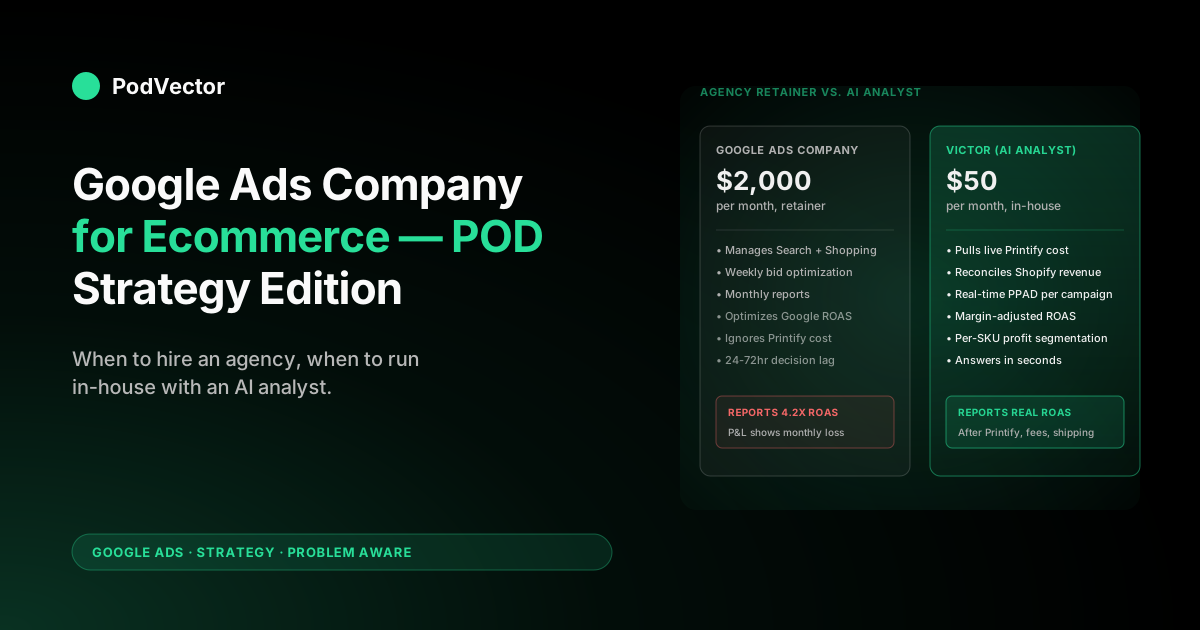
Assumption 1: Reported ROAS is real ROAS. Google Ads attributes revenue using data-driven attribution and view-through credit. For a DTC brand with 60–70% gross margin, that's mostly fine — the reported number is directionally correct, and even a 30% over-attribution still leaves the campaign profitable. For POD, where contribution margin sits around 30–35% after Printify cost, payment fees, and shipping subsidy, a 30% over-attribution turns "profitable" into "underwater." The agency reports 4.2x ROAS, your bank account shows a $1,800 monthly loss, and the agency genuinely doesn't understand the disconnect.
Assumption 2: Margin is a static % the client tells them. Most agency intake forms have a single field: "What's your gross margin?" The seller fills in 35%, the agency builds tROAS targets around 35%, done. POD margin is not 35%.
It's 28% on a black hoodie in size XL, 41% on a white tee in size M, 19% on a mug after first-order shipping subsidy, and the mix shifts every time a different ad creative wins. Optimizing against a fixed 35% means scaling the worst-margin SKUs because they convert at the lowest CPCs, and quietly killing the high-margin SKUs because they look "expensive."
Assumption 3: Ad spend is the only variable cost. Standard agency reporting subtracts media spend from revenue to compute "profit." For POD that's wrong by an order of magnitude. A $34 hoodie order produces $34 of reported revenue, $9.71 of ad spend at 3.5x ROAS, and the agency reports $24.29 "profit." Reality: $34 minus $18 Printify, $1.30 payment, $3 shipping, $0.80 platform allocation, $9.71 ads = $1.19 actual profit, before refunds. The same campaign that the agency calls a winner is breakeven.
The fix is straightforward in principle: feed the agency live Printify and Printful cost data per SKU, and require them to bid against contribution margin instead of revenue. In practice, almost no off-the-shelf agency tooling supports this — they'll quote a custom integration project at $8K–$15K, which doesn't pencil for a POD store doing $30K/month.
Pricing models: retainer, % of spend, performance, hybrid
Four pricing structures dominate, and the right one depends on how predictable your ad spend is.
| Model | Typical range | Best for POD when… | Watch out for |
|---|---|---|---|
| Flat retainer | $1,500–$5,000/month | Spend is steady ($150–$500/day) | Agency under-services if you scale; over-services and bills in slow months |
| % of ad spend | 10–20% of spend | You're scaling fast and want aligned incentives | Incentive to spend more, not better; floor minimums hide the rate |
| Performance / CPA | $8–$25 per attributed sale | Never. POD margins can't support this profitably | Agencies set CPA so they always win; you can't audit attribution |
| Hybrid (retainer + bonus) | $1,500 base + 5% over target ROAS | You have a clear margin-aware ROAS target and can verify it | Bonus calculated on Google-reported ROAS, not yours |
For POD specifically, flat retainer with an audit clause is usually the cleanest. % of spend creates a perverse incentive at the exact moment you need discipline (the agency makes more if you spend more on losing campaigns). Performance pricing sounds aligned but the CPA targets agencies will accept are always set above POD breakeven — they're protecting their margin, not yours.
How to vet a Google Ads company before signing
Standard agency-vetting checklists (case studies, Google Premier Partner status, references) are necessary but not sufficient for POD. The four POD-specific questions to ask, in order of how quickly they expose unfit agencies:
- "Walk me through how you'd compute ROAS for a Printify hoodie sold at $34." If they answer "revenue divided by ad spend," they don't understand POD. The right answer involves pulling supplier cost per SKU, subtracting payment processor fees and shipping subsidy, and computing margin-based conversion value before bidding.
- "What's the variant explosion problem in Merchant Center, and how do you handle it?" Real POD experience surfaces immediately — they'll talk about curating which sizes/colors ship to GMC, image-uniqueness penalties on similar mockups, and whether you should use
item_group_id. Generic agencies will improvise. - "Show me a POD account where you reduced spend and grew profit." Almost every agency has case studies showing revenue or ROAS growth. POD-aware agencies have at least one case where they cut spend on a phantom-profitable campaign and the client's actual P&L improved. The presence of this case proves they think in profit terms.
- "How do you reconcile Google-reported revenue with Shopify-reported revenue?" POD stores routinely see 15–35% over-reporting in Google Ads vs. Shopify, especially after iOS 17 attribution changes. Agencies that have a documented reconciliation method (or use server-side conversions with a deduplication ID) are operating in the post-2024 reality. Agencies that say "it's usually within 5%" are reading their own dashboards uncritically.
The contract itself should require Shopify-confirmed revenue (not Google-reported) as the denominator for any performance bonus, and should commit to monthly reconciliation between the two numbers. If the agency pushes back on this, walk.
For the agency-comparison angle on agency selection beyond pricing, see Google Ads services for POD: the complete buyer's guide.
When in-house with an AI employee beats hiring
For POD stores spending under $200/day, the math against agency engagement gets hard to defend. A $2,000/month agency on a $6,000/month ad budget represents 33% of spend allocated to management — eating most of the margin the campaigns produce. The decision tree:
- Under $100/day spend: Almost always run it yourself. The campaigns are simple enough that POD-tuned guides plus a few hours of weekly review handle it. Agency overhead doesn't pencil.
- $100–$300/day spend: Gray zone. A freelancer at $1,500/month can be worth it if they bring real POD experience. Otherwise, in-house with analytics tooling beats it.
- $300–$1,000/day spend: A boutique agency starts to earn its keep — the volume justifies the retainer, and the time saved is real.
- $1,000+/day spend: You need either a senior in-house marketer or a serious agency. Self-managed at this scale leaves money on the table.
The reason "in-house" used to mean "hire someone for $80K/year" is that the operator job is dominated by analytics work — pulling Printify orders, joining them to Google Ads campaigns, reconciling Shopify revenue, computing per-SKU margin, deciding which campaigns to pause. That's the work that stops most solo POD sellers from running their own ads competently. It's also the work that AI employees now do faster than humans for under $100/month.
Victor — the AI agent in the PodVector AI platform — connects directly to Printify, Printful, Shopify, and Google Ads, then answers questions like "which Search campaign has lost money in the last 14 days after Printify cost" or "what's my real ROAS on the Halloween hoodie cluster vs. Google's reported ROAS" using live data from those sources. The economic shift is straightforward: the AI employee layer that justified an agency retainer at $2,000/month is now $50/month software, and the operator decisions (pause this, scale that, reallocate budget) move back to the founder. For the deeper agentic angle, see agentic AI for ecommerce.
The hybrid strategy: agency for setup, in-house for profit
The pattern that's working for most POD stores in the $200–$800/day band: hire an agency for a one-time setup engagement (60–90 days, fixed fee around $4K–$8K), then take ongoing management in-house with analytics support.
The setup engagement covers the work where agency expertise compounds:
- Merchant Center implementation with curated variant feed
- Conversion tracking with server-side tagging and deduplication IDs (this is where most DIY setups quietly break)
- Initial keyword research and campaign architecture (Search tiers, Shopping segmentation, when to enable PMax)
- Ad copy and asset library for Performance Max (the part founders don't have time to make)
- Audience and exclusion lists in Google Ads
Once the foundation is right, ongoing management is mostly bid and budget decisions, which a margin-aware analytics layer surfaces in minutes per day. The store keeps the $24K–$60K/year that would have gone to retainer fees, and the founder builds operator instinct instead of outsourcing it.
The risk in this model is that 60-day setups don't always end clean — agencies often try to extend into ongoing retainer. The contract should specify deliverables and a hard end date, with optional pay-by-the-hour support after.
What a POD-aware SLA should require
Whether you hire an agency for setup-only or full-service, the SLA needs to encode POD economics into the engagement. Standard agency SLAs don't, and you'll spend the first six months arguing about whose ROAS number is real.
The non-negotiables to put in the SLA:
- Margin-aware conversion value. The agency must implement enhanced conversions with
valueset to contribution margin (revenue minus supplier cost minus payment fees), not order subtotal. If they push back ("Google's optimization works best with revenue"), they're optimizing for Google's bidding model, not your P&L. - Per-SKU cost ingestion. They must accept a daily cost feed from Printify/Printful (or build the integration), keyed by variant SKU. Without this, every margin calculation is a static estimate, and POD margins aren't static.
- Shopify-confirmed revenue baseline. Monthly reporting must show Google-reported revenue side-by-side with Shopify-confirmed revenue, with a documented variance. If variance exceeds 15%, the agency owes you a reconciliation memo before billing.
- No view-through credit on Display/PMax. Click-through only for attribution. View-through revenue is fine for Google's algorithm to optimize against; it's not fine for your P&L reports.
- Pause authority transparency. The SLA must state who can pause campaigns and how fast (24-hour SLA on emergency pauses). When a campaign goes underwater, you don't want to wait three days for a Slack reply.
For the funnel-stage perspective on which articles in this cluster to send to teammates while reviewing SLA terms, see Shopify Google Ads strategy for POD.
KPIs to put in the contract
Standard agency contracts measure media metrics: ROAS, CPC, CTR, conversion rate. For POD ecommerce, those are leading indicators at best and noise at worst. The KPIs that actually predict whether the engagement is profitable:
- Profit per ad dollar (PPAD). Total contribution margin from ad-attributed orders divided by ad spend. PPAD > 1.0 means the campaign is paying for itself; under 1.0 means it's burning runway. Should be reported weekly per campaign.
- Margin-adjusted ROAS. Revenue × margin% ÷ ad spend. For a POD store at 32% margin, target margin-adjusted ROAS > 1.0 (which equals 3.1x reported ROAS).
- Reconciliation variance. (Google-reported revenue − Shopify-confirmed revenue) ÷ Shopify-confirmed revenue. Should stay under 15%. Trending up means attribution is breaking and decisions are being made on bad data.
- Loss-making campaign exposure. Total spend in the last 14 days on campaigns where PPAD < 1.0. This is the number that tells you how much money is actively bleeding while the agency is "optimizing."
- Time-to-pause. Median hours between a campaign crossing the loss threshold and the agency pausing it. Should be under 48 hours. Anything longer means weekly check-ins are too slow.
The honest version of this conversation: most agencies will not contractually commit to PPAD because they don't know your real margin and don't have tooling to compute it. That's fine — the alternative is to require they accept a feed of margin data from your analytics layer and bid against it. Either way, the metric the contract measures has to be a profit metric, not a Google metric.
For deeper attribution work that backs these KPIs, the cluster has the complete guide to Google Ads ROAS and attribution for POD.
A 90-day evaluation framework
Whether you hire or run in-house, the first 90 days are the only period where you can change course without sunk-cost bias. Use this evaluation framework, calibrated for POD:
Days 1–30: Foundation and baseline. Whoever is running ads (agency or in-house) builds Merchant Center with curated variants, server-side conversion tracking with margin-based value, and three campaigns: brand defense, category-bottom-funnel Search, and Standard Shopping. No PMax yet. By day 30, you should have 30+ purchases with margin-based conversion values flowing back to Google Ads, and a baseline PPAD across the three campaigns.
Days 31–60: Optimization within structure. Same campaigns, more discipline. Agency or operator should be pruning negative keywords (POD especially: exclude "free," "template," "PNG," "DIY," "vector"), refining shopping product groups by margin tier, and starting to build search query reports that segment by SKU profitability.
PPAD should be trending toward 1.2+ on the strongest campaign and clearly identifying which campaign isn't paying its way. By day 60, you should have written evidence (a memo, not a verbal "yeah it's working") that PPAD is improving and reconciliation variance is under 15%.
Days 61–90: Scale or restructure. By now, you know whether the engagement (or the in-house process) is producing profit. The two failure modes to watch: (1) PPAD flat or declining despite increasing reports of "optimization," meaning the optimization is happening against Google metrics not yours; (2) reconciliation variance widening, meaning the attribution model is degrading and the recent ROAS numbers are increasingly fictional. Either signal is grounds to either reset the SLA terms or move to in-house with analytics support.
For the more general 90-day campaign-build version of this framework (without the agency-evaluation lens), see Google Ads for ecommerce strategy for POD.
FAQs
How much should a POD store pay a Google Ads company?
For stores spending $100–$500/day on Google Ads, $1,500–$3,500/month is the realistic range. Below $100/day, agency overhead eats the margin — run it in-house with analytics tooling.
Above $500/day, $3,500–$6,000/month at a boutique agency is reasonable. The percentage-of-spend rule of thumb is that management fees should not exceed 15–20% of ad spend; above that and you're paying more for the manager than the channel justifies.
Will a Google Ads agency understand Printify margins?
Most won't, out of the box. Standard agency intake assumes a single gross-margin percentage; POD has variable margins per SKU, per variant, and per shipping zone.
Ask in the first interview how they'd compute conversion value for a Printify hoodie. If they don't immediately mention pulling per-SKU base cost and subtracting payment and shipping fees, they don't have POD experience. You can either pay to teach them (expensive and slow) or use an in-house analytics layer that surfaces margin-aware ROAS yourself.
What's the difference between a Google Ads company and a full ecommerce agency?
A Google Ads company specializes in Search, Shopping, and Performance Max — about 40–60% of POD ecommerce media spend. A full ecommerce agency manages Google Ads inside a broader engagement that includes Meta, TikTok, email, SMS, and CRO.
The full-service version costs 2–4× more and is rarely worth it for POD until total ad spend exceeds $5K/day across channels. For most POD stores, a Google Ads specialist plus separate Meta operator beats a one-stop agency.
Can I switch from agency to in-house mid-year without losing momentum?
Yes, with a 60-day overlap. Have the agency document campaign architecture, exclusion lists, audience signals, and conversion-tracking implementation in writing.
Run a parallel period where you take over Search first (simplest), then Shopping, then PMax. Most disasters happen when founders inherit a PMax campaign without understanding how the bid signal was tuned and watch ROAS collapse in week three. A documented handoff plus an analytics layer that surfaces real-time PPAD per campaign reduces that risk.
Do Google Premier Partner agencies actually perform better?
For POD, not reliably. Premier Partner status is awarded based on spend volume managed and certifications passed, not POD-specific competence.
A Premier Partner agency that's never managed a Printify-driven account will burn through your budget the same way a non-partnered agency would. The credential is a baseline, not an outcome. Vet on POD experience and reconciliation methodology, not on tier.
What if my Google Ads company refuses to integrate Printify cost data?
That's a hard signal to switch. The refusal usually comes with the explanation that "Google's algorithm works best with revenue values" — which is technically true for the algorithm and false for your P&L.
The agency that won't integrate margin data is optimizing for Google's bidding model, not your business. Either move management in-house with an AI employee that handles the margin layer, or find an agency that will.
Get the AI employee layer without the retainer
The work that used to require a Google Ads agency — pulling Printify cost, computing real ROAS per campaign, surfacing which campaigns are profitable after supplier and shipping — is exactly what Victor does. Connect your Printify, Shopify, and Google Ads accounts and ask "which campaigns lost money this week after Printify cost?" Get the answer in seconds, not in a monthly report. And run profitable Google Ads without an agency retainer.
Try Victor free