
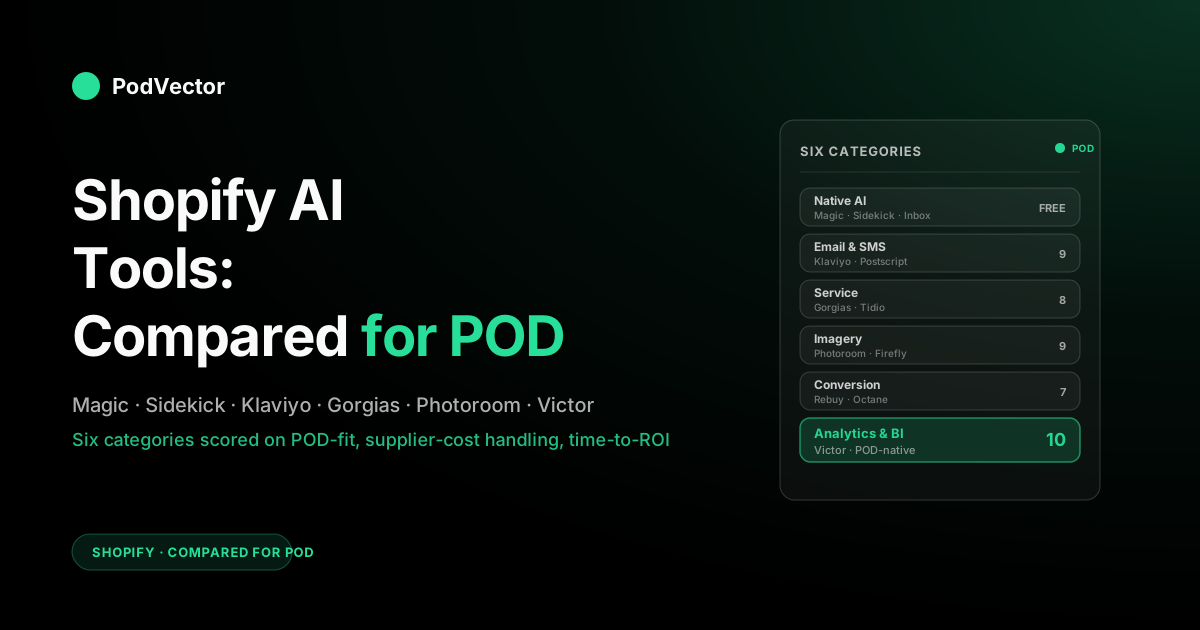
Quick Answer: Shopify AI tools in 2026 fall into six categories: native AI (Shopify Magic, Sidekick, Inbox AI — free with the platform), email/SMS (Klaviyo AI, Postscript AI), customer service (Gorgias AI, Tidio AI), imagery and design (Photoroom, Adobe Firefly), conversion and merchandising (Rebuy, Octane AI, Searchspring), and analytics (Triple Whale, Lifetimely, Victor by PodVector AI).
For Shopify stores fulfilling through Printify, Printful, or Gelato, the comparison flips in two categories. Most analytics tools can't handle variable supplier costs, so margins look right at the brand level but wrong at the SKU level.
And most "AI agents" still can't read your live store data without a manual export. This guide compares the options category by category, flags where POD breaks the default assumption, and lands on three stack picks at the end.
What Counts as a "Shopify AI Tool" in 2026
The phrase "Shopify AI tool" got hollow somewhere around mid-2025 — every app on the App Store added the AI label whether or not the underlying product changed. For this comparison, a tool earns the label if it does at least one of three things: it generates content using a foundation model, it makes predictions or decisions on store data without explicit rules, or it runs an action on your behalf in response to a natural-language prompt.
By that bar, a lot of "AI-powered" Shopify apps are really conditional logic with a chat widget. The list below filters those out and ranks the survivors on what they actually deliver to a Shopify operator running an inventory-light store.
If you're earlier in the research process, the wider best AI tools for Shopify ranked comparison goes deeper on the top picks. The best AI tools for ecommerce comparison covers cross-platform options, and the tools cluster is the index page for every comparison guide on the site.
The Six Categories That Matter
The categories aren't arbitrary — they map to the six places AI actually moves the needle for a Shopify store right now. Outside these six, AI features are either nice-to-haves or rebrands of older automation:
- Native AI — free with your Shopify plan; covers product copy, basic imagery, FAQ generation, chat reply suggestions, and admin-side answers. The floor every other tool has to beat.
- Email and SMS — predictive sends, subject-line generation, segment auto-build, and product-recommendation blocks inside flows. Highest measurable revenue lift of any category for most stores.
- Customer service — autonomous resolution of order-status, return, and policy questions. Cost reducer first, retention play second.
- Imagery and design — background removal, lifestyle scene generation, mockup variations, and on-brand creative scaling. The category most useful to POD because new designs ship constantly.
- Conversion and merchandising — quizzes, AI-powered upsells, dynamic search, and personalized PDP recommendations. Pays back fast on stores already doing $30K+/month.
- Analytics and BI — natural-language queries against store data, anomaly detection, predictive LTV, and attribution modeling. The category most often broken for POD operators because supplier costs aren't in Shopify's data model.
The broader "best Shopify AI" roundups stretch to 16-plus tools across a dozen niche jobs — AI for ad creative (AdCreative.ai, Pencil), SEO (Surfer, SEOAnt), translation (Transcy), chargeback recovery (Chargeflow), competitor-price tracking (Intelis), and social scheduling (Outfy). They're real, but they're either not Shopify-specific or too niche to anchor a stack around, so they're called out at the end rather than ranked alongside the six categories that actually move revenue for a POD store. The point of a comparison is to tell you where to spend first, not to list every app with an AI label.
Comparison Table: Shopify AI Tools by Category
Each tool is scored on four things: integration depth (does it connect directly to Shopify, or do you need extra setup work), pricing floor (does the starting price fit the size of store that needs it), POD compatibility (can it handle changing supplier costs and no on-hand inventory), and time-to-ROI (does it pay for itself within 60 days for most users).
| Category | Tool | Job | Starting price | POD fit |
|---|---|---|---|---|
| Native | Shopify Magic | Generation across admin | Free with Shopify | 9 |
| Native | Shopify Sidekick | Admin-side AI assistant | Free with Shopify | 7 |
| Native | Shopify Inbox AI | Chat reply drafting | Free with Shopify | 7 |
| Email/SMS | Klaviyo AI | Predictive segments & subject lines | Free to ~250 contacts | 9 |
| Email/SMS | Postscript AI | SMS conversation flows | From $100/mo | 7 |
| Service | Gorgias AI | Helpdesk ticket resolution | From $10/mo + $0.90/AI fix | 8 |
| Service | Tidio AI (Lyro) | Live chat resolution | From $29/mo | 7 |
| Imagery | Photoroom | Product photo generation | From $7.50/mo | 9 |
| Imagery | Adobe Firefly | Brand-trained generative imagery | From $9.99/mo | 8 |
| Imagery | OnModel | AI on-model apparel photography | From ~$19/mo | 8 |
| Conversion | Rebuy | AI upsells & cart logic | From $99/mo | 7 |
| Conversion | Octane AI | Quizzes & product discovery | From $50/mo | 7 |
| Conversion | Searchspring | AI search & merchandising | Custom (~$599/mo) | 6 |
| Analytics | Triple Whale | DTC attribution & dashboards | From $129/mo | 5 |
| Analytics | Lifetimely | LTV & cohort reporting | From $34/mo | 6 |
| Analytics | Victor by PodVector AI | POD-native AI employee | Free tier; paid plans | 10 |
The POD-fit column is the differentiator. A tool can be category-leading for a generic DTC brand and still misfit on a Printify or Printful store because its data model assumes you own inventory and pay one wholesale price per SKU. The categories below explain the why behind each score.
Category 1: Native Shopify AI
The bar every other tool has to beat. Shopify shipped 150+ AI features into the admin between Winter and Spring Editions 2026 — at zero additional cost on every paid plan. Before paying for any Shopify AI app, exhaust what's already in the box.
Shopify also shipped an AI Toolkit in 2026 that lets outside AI tools connect to the platform directly — the early scaffolding for agentic commerce, where AI shops and transacts on a buyer's behalf. For a store operator, the takeaway is that Shopify is making its own data more accessible to AI, not less. The tools that win this next phase are the ones that read your live store data and act on it without a manual export — the exact gap most "AI agents" still trip on today.
Shopify Magic — generation across the admin
What it does: product description writing with brand-voice adaptation, automatic email subject lines in Shopify Email, image background editing in the photo editor, FAQ block generation on product pages, store policy drafting, and Shopify Inbox reply suggestions. Magic is also the layer that powers admin search and the "ask Shopify" experience.
POD fit: 9/10. Magic handles the design-led copy that POD needs (one tagline, one product story, one care-instruction line per design) without breaking when a SKU has zero on-hand inventory. The only gap is bulk operation — generating 200 unique descriptions at once is faster in a dedicated tool, but for the dripfeed of new designs most POD stores ship, Magic is enough.
Shopify Sidekick — the admin-side AI agent
What it does: answers natural-language questions about your store ("which products had the biggest revenue jump last month?"), creates draft discount codes for specific segments, drafts product collections, and helps with bulk admin actions. Sidekick is now included free on every Shopify plan — you reach it from the purple glasses icon in the admin, no setup required.
POD fit: 7/10. Sidekick reads Shopify's data model, which means it knows your sell prices and order volume but not your supplier costs.
Ask it "which products are most profitable?" and you'll get an answer based on Shopify's revenue data, not your true margin after Printify or Printful fulfillment costs. Useful for ops questions; misleading for margin questions. The AI agents for Shopify deep dive walks through where Sidekick stops being safe to trust on POD numbers.
Shopify Inbox AI — chat reply drafting
What it does: drafts replies in Shopify Inbox using context from the customer's cart, order history, and the message they sent. Free.
POD fit: 7/10. Works fine for "where's my order" and "how do I return this" — the bread and butter of POD support tickets. Falls short on sizing questions and design-specific questions because Shopify Inbox doesn't have access to your product variant matrix or your design library. Still beats not having a draft button.
Category 2: Email and SMS Marketing AI
Email and SMS is the highest-leverage AI category for most Shopify stores — predictive sends, AI-generated subject lines, and auto-built segments routinely lift revenue 15–25% within 60 days, well above what you'll see from any single AI feature in another category.
Klaviyo AI — predictive everything
What it does: predictive customer lifetime value, predictive next purchase date, predictive churn risk, AI-generated subject lines, automated segment building, AI-suggested product recommendation blocks, and form-conversion analysis. Klaviyo's AI features are bundled into every paid tier, including the free tier up to 250 contacts.
POD fit: 9/10. Klaviyo's predictive models work fine on POD because they only need order data — not inventory data.
The one caveat: predictive LTV is calibrated against revenue, not contribution margin. A Klaviyo "high-value customer" might be buying products with thin POD margins; the customer who looks worth $400 in Klaviyo might be worth $80 to your bank account. For most stores this still produces useful targeting; for stores with very different margins across product lines, treat predictive LTV as a directional signal, not a ROAS gate.
Postscript AI — SMS conversation flows
What it does: AI-driven SMS conversations that respond to replies in flows, AI-generated message variants for split-testing, and an AI agent that handles two-way customer texts (order lookups, swap requests, abandoned-cart recovery via natural conversation).
POD fit: 7/10. Same caveat as Klaviyo — Postscript can't see Printify or Printful production-stage data, so its order-status replies stop at "your order has shipped" rather than the more granular "your shirt is in production at Printify Charlotte." For stores where SMS is the primary channel (apparel POD selling to younger demographics), Postscript's conversational AI is well worth the floor.
Category 3: Customer Service AI
Customer service AI sells itself: every ticket an AI resolves is a ticket your team doesn't have to. The catch is integration depth — an AI helpdesk is only as good as the data it can read, and the data POD operators need (Printify production status, Printful shipping carrier, design metadata) lives outside Shopify.
A newer sub-category is AI voice and phone support — tools like Ringly that answer customer calls autonomously, with vendors quoting roughly $0.40 per resolved call against $2-plus for a human agent. The per-call economics are real, but for most POD stores email and chat still carry the ticket volume, so voice is a later add than the two helpdesks below; treat it as the next frontier rather than a day-one buy.
Gorgias AI — autonomous resolution
What it does: AI Agent autonomously answers tier-1 customer support questions ("where's my order," "what's your return policy," "do you ship to X"), draft replies for tier-2 tickets, and intent classification for routing. Pricing is per-AI-resolution ($0.90 each on top of the helpdesk plan).
POD fit: 8/10. Gorgias has direct Printify and Printful integrations that pull production-stage data into ticket context, which most other AI helpdesks don't.
That alone makes it the default for POD stores. The only friction is the per-resolution pricing — $0.90 × 1,000 tickets = $900/month on top of the base plan, which can move faster than the labor savings if you're not careful.
Tidio AI (Lyro) — live chat resolution
What it does: Lyro is Tidio's autonomous AI chat agent that answers customer questions in real time, hands off to humans on detected intent, and integrates with Shopify product and order data. Includes a quoted resolution count per plan.
POD fit: 7/10. Tidio is meaningfully cheaper than Gorgias for stores under 300 tickets/month, but the Printify and Printful integrations are shallower — you'll need extra setup work to show order status inside chat replies. The best AI chatbots for Shopify ranked comparison goes deeper on the trade-off between Tidio, Gorgias, and Shopify Inbox for support volume tiers.
Category 4: Imagery and Design AI
Imagery is one of the categories where POD operators have a structural advantage — every new design is a new product page, a new email, a new ad creative, and a new social post, so the marginal value of an imagery AI compounds. Two tools own this category for Shopify stores, with a fast-growing third option (on-model AI photography) worth watching for apparel.
Photoroom — product photo generation at scale
What it does: background removal, lifestyle background generation (put your t-shirt on a model in a Lisbon café), batch processing for variant images, and one-click resizing for every Shopify image slot (PDP, social, ad, hero). Pricing scales with monthly export volume.
POD fit: 9/10. Photoroom's mockup-on-model generation closes a real gap for POD operators — Printify and Printful's built-in mockups are clean but generic, and lifestyle photography for every design is cost-prohibitive at scale.
Photoroom lets you ship a believable lifestyle hero shot for every new design in under five minutes. The closest alternative is Adobe Firefly, but Firefly's generation is more general-purpose; Photoroom is purpose-built for product photography.
Adobe Firefly — brand-trained generative imagery
What it does: generative image creation, generative fill, vector generation, and brand-style training that lets the model match your design system. Embedded into Photoshop, Illustrator, and Express; standalone web app available.
POD fit: 8/10. Firefly is the right tool when the imagery you need is more conceptual than literal — hero illustrations, brand visuals, social-first creative.
For raw product photography, Photoroom wins. For everything else around product photography, Firefly is the next layer up. Stores that already pay for Adobe Creative Cloud get Firefly credits included, which makes the cost calculus easy.
OnModel — AI fashion model photography
What it does: generates photorealistic on-model shots of apparel from a flat product image — swap model, pose, ethnicity, and background without a photoshoot. It's the imagery sub-category showing up most in 2026 Shopify roundups, and it targets exactly the gap apparel POD feels hardest.
POD fit: 8/10. For apparel-heavy POD stores, OnModel-style tools close the on-model-shot gap that Printify and Printful mockups leave open — a real lifestyle model wearing your design, generated per variant. Photoroom now does a version of this too, so treat OnModel as the specialist option when on-model apparel shots are the bottleneck and Photoroom's results aren't convincing enough. The cost only pays back once you're shipping enough new apparel designs to need model shots at volume.
Category 5: Conversion and Merchandising AI
Conversion AI — upsells, cross-sells, AI search, quizzes — pays back fastest on stores already doing $30K+/month, where a 5% lift in average order value is real money. Below that floor, the monthly cost outruns the revenue lift.
Rebuy — AI upsells and cart logic
What it does: AI-driven product recommendations on PDP, cart, and post-purchase pages; smart cart with built-in upsells; AI-generated bundle suggestions; data-driven A/B testing of cart configurations.
POD fit: 7/10. Rebuy's recommendation engine works fine on POD because it operates on product taxonomy and order patterns — it doesn't care that you don't own the inventory.
The downside: bundle pricing logic in Rebuy assumes a single COGS per product, which doesn't match how Printify and Printful price (per-variant, per-supplier). For most stores this isn't a dealbreaker, but the bundle margin model is worth double-checking before launching aggressive bundle promotions.
Octane AI — quizzes and product discovery
What it does: AI-generated product quizzes that route shoppers to relevant products based on stated preferences, AI-driven Klaviyo segment building from quiz answers, and AI conversation flows for Facebook Messenger and Instagram.
POD fit: 7/10. Quizzes work especially well for POD stores selling across many design themes — a "find your perfect t-shirt design" quiz routes shoppers to specific collections more reliably than collection-page navigation. The pricing floor matches stores in the $30K–$100K/month range comfortably.
Searchspring — AI search and merchandising
What it does: AI-powered product search, autocomplete, faceted navigation, and merchandising rules that learn from on-site behavior.
POD fit: 6/10. Powerful but priced for stores with deep catalogs and operational maturity. For most POD stores under $1M ARR, Shopify's native search plus a lighter conversion app gets the job done at a fraction of the cost.
Category 6: Analytics and BI AI
This is the category where the POD-vs-DTC gap is widest. Most analytics AI tools were built for inventory-owning DTC brands and assume your COGS is a number you set per product in Shopify. POD COGS is variable per supplier, per region, per product variant — and most analytics tools handle that by ignoring it.
Triple Whale — DTC attribution and dashboards
What it does: ad attribution across Meta, Google, TikTok, and Klaviyo; real-time profit dashboards; AI-powered insights and anomaly alerts; mobile dashboard ("Moby") for daily operator check-ins. Pricing scales with revenue and ad spend.
POD fit: 5/10. Triple Whale is category-leading for DTC brands that own inventory; for POD it's only as good as the COGS number you give it, which means manually keeping every Printify and Printful base cost in sync with every variant in Triple Whale.
Possible, but operationally painful. Stores that don't keep COGS perfectly current end up with profit dashboards that look right and aren't.
Lifetimely — LTV and cohort reporting
What it does: customer LTV reports, cohort analysis, repeat purchase forecasting, and a daily P&L view that includes ad spend and shipping.
POD fit: 6/10. Same supplier-cost limitation as Triple Whale, but Lifetimely's LTV math is independent of COGS, so the customer-value half of the product is reliable for POD. The P&L half needs the same manual upkeep.
Victor by PodVector AI — POD-native AI employee
What it does: Victor is an AI employee you chat with. He does the work other tools only show you — he moves ad spend between Meta and Google, updates your Shopify listings, and acts on Printify and Printful orders, with your approval before each change. Victor sees your Shopify sales, your Printify and Printful costs, and your ad spend together, so every change he suggests is based on your real profit, not just Shopify revenue.
Ask "what's my true margin on the top 20 SKUs after Printify base costs and shipping?" and Victor returns the number with the breakdown — then offers to act on it (pause the loss-makers, shift budget to the winners) on your go-ahead. Design-level rollups, Printify-vs-Printful supplier-cost differentials on the same product, and proactive anomaly flags are part of the same loop.
POD fit: 10/10. Victor is the only tool on this list designed from day one around variable supplier costs and zero on-hand inventory.
Victor handles both: he answers questions about the store and executes the changes the answers imply — against the merchant's explicit go-ahead. The agentic AI for ecommerce explainer covers the trajectory in more detail. The best AI tools for ecommerce data analysis comparison ranks Victor against Triple Whale and Lifetimely on the AI-employee-for-POD job specifically.
Where the Defaults Break for POD
Three places where the standard "best Shopify AI tool" advice misroutes POD operators:
Margin math at the SKU level
Generic Shopify advice tells you to track product profitability inside Shopify (or a tool like Triple Whale that reads from Shopify). That advice assumes you set a COGS number on each product when you create it.
POD doesn't work that way — your true cost on a given variant is the Printify or Printful base cost on that specific shirt color, in that specific size, fulfilled from that specific supplier region, plus shipping. None of those numbers live in Shopify by default. Tools that don't pull them directly from Printify and Printful APIs end up showing margin on a number you typed in months ago, which has drifted with every supplier price change since.
Inventory and "out of stock" logic
A surprising number of Shopify AI tools — especially in the conversion and merchandising category — assume "out of stock" is a meaningful state. POD products are never technically out of stock; they're either available from a supplier (production-active) or they're not (variant deprecated, supplier outage). Tools that hide products on Shopify's "out of stock" signal can end up suppressing your entire catalog during a temporary supplier issue. POD apps for Shopify like Printify and Printful handle this gracefully; some of the AI conversion layers on top do not.
Customer service deflection limits
POD support is structurally different from DTC support — a meaningful share of tickets are design-related ("can I get this in a different color," "is this design coming back," "can you make a hoodie version") rather than fulfillment-related. AI helpdesks that resolve fulfillment tickets in their sleep can't autonomously resolve design tickets, because the answer requires merchant judgment. Plan for higher human-touch ticket rates than the Gorgias or Tidio default benchmarks suggest.
Three Shopify AI Stacks for POD Operators
Starter stack — under $50/month all-in
- Native Shopify AI — Magic, Sidekick, Inbox AI. Free.
- Klaviyo AI — free tier up to 250 contacts.
- Photoroom Pro — $7.50/month for product photography at scale.
- Victor by PodVector AI — free tier for the analytics layer.
This stack closes the four highest-leverage gaps (copy, email, imagery, margin analysis) for under $50 total. The right starting point for any POD store under $30K/month.
Growth stack — $250–$500/month all-in
- Native Shopify AI — same.
- Klaviyo AI — Email + SMS plan ($45–$200/month depending on contacts).
- Gorgias AI — $60–$300/month + per-resolution.
- Photoroom Business — $20/month for batch processing.
- Victor by PodVector AI — paid plan for cross-platform analysis and supplier-cost tracking.
- Optional: Octane AI — $50/month if quizzes fit your design taxonomy.
This is the right stack for stores between $30K and $250K/month. Every line item should pay back in 60 days at this revenue range; if any of them don't, drop them.
Scale stack — $1,000+/month all-in
- Native Shopify AI — same.
- Klaviyo — full email/SMS at scale tier.
- Gorgias AI — Pro plan with autonomous resolution at volume.
- Photoroom + Adobe Firefly — for product photography and brand creative respectively.
- Rebuy — AI upsells once AOV pays back the floor cost.
- Victor by PodVector AI — Scale plan for full cross-supplier analytics, anomaly detection, and the early agentic features.
At this revenue level, every category covered above pays for itself. The bottleneck stops being which tool you pick and starts being how cleanly the data flows between them.
FAQs
Is Shopify Magic enough on its own?
For brand-new stores under $5K/month, yes — Magic plus Klaviyo's free tier covers the four highest-leverage AI jobs (copy, email, imagery basics, FAQs) without any additional cost. Most stores outgrow this around $20K/month, when imagery volume and segmentation needs exceed what Magic and free Klaviyo can handle.
What's the single best paid Shopify AI tool for POD?
For most stores under $100K/month, Klaviyo AI at the paid tier — the predictive features and segment automation produce more measurable revenue lift in the first 60 days than any other paid AI tool. For stores where margin clarity matters more than acquisition (anyone running tight on Printify or Printful base costs), Victor by PodVector AI at the paid tier produces decisions that Klaviyo can't.
Should I buy one all-in-one AI tool or several specialized ones?
For POD, specialized beats all-in-one in every category except margin. The 2026 crop of "all-in-one Shopify AI" platforms is broad but shallow — decent at three jobs, best-in-class at none — and the gaps show up exactly where POD is hardest (variable supplier costs, design-led support). The stacks above are deliberately built from category leaders for that reason. The one place to consolidate is the analytics-and-action layer, because true margin only works if one tool reads Shopify, Printify, Printful, and your ad spend together — which is the job Victor by PodVector AI is built for.
What about AI voice and phone support for a POD store?
AI voice agents (Ringly and similar) that answer calls autonomously are the fastest-growing service sub-category in 2026, and they quote a per-call cost — roughly $0.40 per resolved call versus $2-plus for a human agent — well under a live rep. For most POD stores, though, email and chat still carry the ticket volume, and POD's design-led questions ("can you make a hoodie version") need merchant judgment a voice bot can't supply. Treat voice as a later add once call volume justifies it — not a day-one buy ahead of the email, imagery, and margin layers.
Why aren't general-purpose chatbots like ChatGPT on this list?
General-purpose AI chatbots are assistants, not Shopify tools — they don't read your store data, don't deploy changes, and don't follow Shopify's permission model. They're great for drafting copy, brainstorming product names, and answering operator questions in the abstract, but they don't replace any of the integrated tools above. The cross-platform AI tools comparison covers where general-purpose AI fits in the stack.
Can I run a Shopify store with only free AI tools?
Up to roughly $10K/month in revenue, yes. Shopify Magic plus Sidekick plus Klaviyo's free tier plus Victor's free tier cover most jobs. Past $10K, you'll usually see a clean payback on adding Photoroom and a paid Klaviyo plan first; Gorgias AI usually pays back later, around $30K/month when ticket volume justifies it.
Does any AI tool handle Printify and Printful supplier costs natively?
Among the tools in this comparison, only Victor by PodVector AI pulls Printify and Printful supplier costs through their APIs and matches them to the corresponding Shopify variants automatically. Triple Whale, Lifetimely, and Shopify's own Sidekick all rely on a COGS number you maintain manually — which works as long as you keep it current and breaks the moment you don't.
How do I evaluate a new Shopify AI app I haven't seen before?
Four questions: Does it install through the Shopify App Store and follow the standard permission model? Is the floor pricing realistic for the floor revenue of stores that need the tool?
Does it expose its actual model output, or just a chat widget over conditional rules? And — the test most apps fail — does it handle stores that don't own inventory? If the answer to any of those is no, the app is probably better off skipped until it matures.
Are AI store builders worth it for a POD store?
AI store builders (Storebuild.ai, Shopify's own storefront generation, and the page-builder apps) get you a passable theme and starter copy in minutes, which is a real time-saver for launch day. Broader roundups like this 16-tool comparison rank them highly for getting off zero.
For POD specifically, the build is the easy part — the hard part is margin and fulfillment, which no store builder touches. Use one to launch fast, then put your tooling budget into the email, imagery, and margin layers that actually move revenue once you have traffic.
Hand off Meta + Google + Shopify + Printify ops to an AI employee
Most Shopify AI tools see half of a POD store and stop at showing you a chart. Victor by PodVector AI looks at your Shopify store, your Printify and Printful costs, and your ad platforms all together — then actually does the work: moving ad spend, updating listings, and fixing the margin math every other tool gets wrong. Every change waits for your approval first.
Try Victor free