
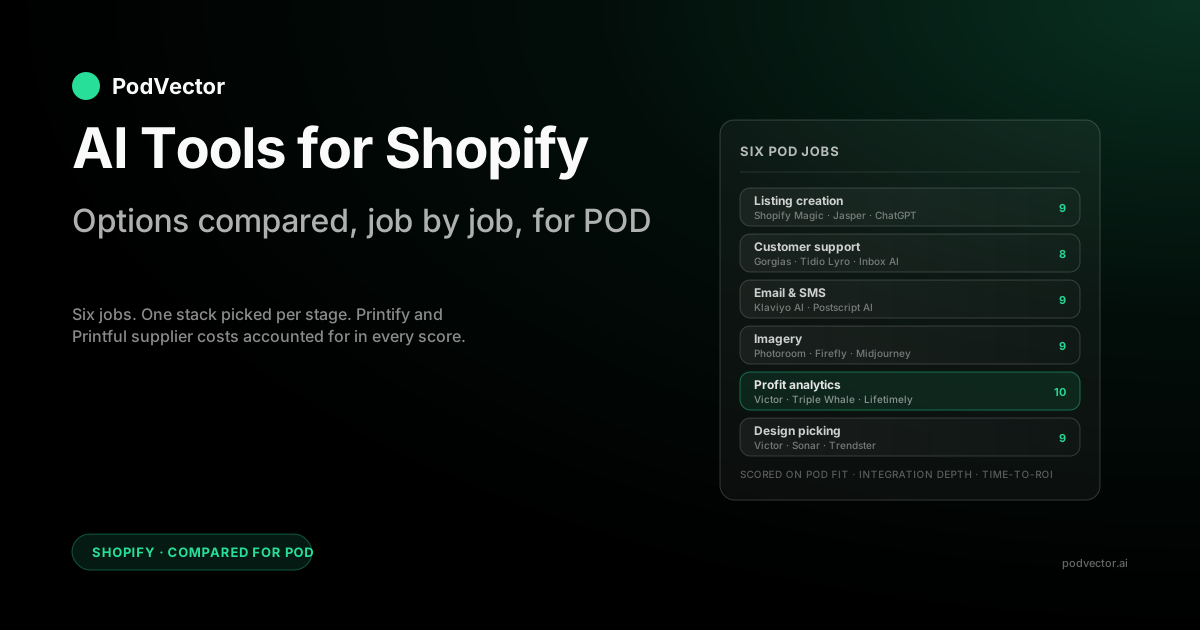
Quick Answer: For a Shopify store running print-on-demand with no inventory, the best AI tools by job are Shopify Magic for listings (free), Gorgias AI for support, Klaviyo AI for email and SMS, Photoroom for imagery, and Victor by PodVector AI for margin-aware pricing and scaling decisions. Six jobs, one default pick each — the full scoring is below.
The catch for POD: most AI tools assume Shopify knows your cost of goods. It doesn't — your supplier cost lives in Printify or Printful. So pick tools that either ignore COGS entirely (chat, copy, imagery) or explicitly pull supplier-side data (margin, pricing).
That gap is why the margin job matters most. Victor is the one AI employee here that reads your true Printify and Printful order-side costs and acts on them — proposing price tests and collections with your approval — instead of just charting numbers Shopify can already see.
Why "Job-to-Be-Done" Beats Tool Lists
Most AI-tools-for-Shopify roundups are organized like a vendor showroom — tool A, tool B, tool C, with a short paragraph each. That works if you already know what you need. It fails if you're a print-on-demand operator trying to figure out which of fifty AI tools actually moves your specific numbers.
A POD store is structurally different from a stocked DTC store. You hold no inventory. Your cost of goods is variable per SKU and lives in your supplier's system, not Shopify's. Your margin per shirt is thin enough that a five-dollar misattribution flips a winning ad set to a loser. Your design library doubles every quarter, so anything that costs human time per listing slows growth.
Those constraints mean the right way to compare AI tools is by the job they do for you, not by the category the vendor put themselves in. The six jobs below are the ones that move revenue or save hours for a POD operator on Shopify. Tools that don't map cleanly to one of these jobs are noise — useful for somebody, just not for you in the next ninety days.
If you're newer to the category, the best AI tools for small ecommerce stores compared is a good primer before diving into the POD-specific comparison here. For a broader look at automating your whole store with AI, the POD seller's guide to AI-automated Shopify stores covers the full landscape. The tools cluster is the index of every comparison guide on the site, and the AI analytics topic hub covers the broader analytics angle.
If your channel mix goes beyond Shopify, the AI tools for small ecommerce stores applies the same job-first lens store-wide.
Summary Table: Tools by Job, Scored for POD
Each tool is scored on three axes specific to print-on-demand: POD fit (does it handle variable supplier cost or zero on-hand inventory without a workaround), integration depth (native Shopify app vs. duct-tape webhook), and time-to-ROI (does it pay back inside 60 days for a mid-five-figures-a-month store). Scores are out of 10 and weighted toward POD operators, so a perfect-for-DTC tool can score lower here.
| Job | Top pick | Starting price | POD fit | Integration |
|---|---|---|---|---|
| Listing creation | Shopify Magic + Jasper | Free + paid tier | 9 | Native |
| Customer support | Gorgias AI | Low base + per-AI-fix fee | 8 | Native |
| Email and SMS | Klaviyo AI | Free to low contact count | 9 | Native |
| Imagery | Photoroom | Low monthly fee | 9 | App + API |
| Margin & scaling | Victor by PodVector AI | Free trial | 10 | Native (warehouse) |
| Design picking | Victor + Triple Whale | Free trial / paid tier | 9 | Native |
The picks above are the defaults — not the only option, just the one that usually wins for a POD operator on Shopify. Each section below explains the runners-up and the cases where you'd choose them instead.
Job 1: Turn a Design into a Live Listing in Minutes
This is the highest-leverage AI job for any POD operator because new designs ship constantly and every minute of human listing time is a tax on your design throughput. A working stack here cuts listing time from around twenty minutes per SKU to well under ten.
Shopify Magic and Sidekick — the floor
Shopify Magic is the suite of AI features built directly into Shopify Admin: product description generation from a few bullet points, FAQ generation from product attributes, email subject lines, image background editing, and store policy drafting. It's free with every Shopify plan, which means it's also the floor every paid tool needs to beat. For most POD listings, Magic's output is good enough as a first draft — the gap is brand voice and SEO depth, both of which it doesn't try to optimize.
Shopify Sidekick sits alongside Magic as a conversational AI assistant built into the admin. According to Shopify's own 2026 comparison, Sidekick "has direct access to store data" and can "generate accurate product descriptions, edit your Shopify theme design, build custom apps, and surface helpful recommendations through Sidekick Pulse." Both Magic and Sidekick are now included free with every Shopify plan — Sidekick was previously gated to higher tiers. Sidekick is more useful for operators new to Shopify admin workflows; Magic is more useful for high-volume listing creation.
In 2026 Shopify pushed Magic further with the AI Store Builder — type a few descriptive keywords and it generates full store layouts with images and copy — and the developer-facing Shopify AI Toolkit, which lets agents build and validate apps against Shopify's own API schemas. Useful context, but neither touches the POD margin problem: a store the AI builds still has no idea what your Printify base cost is.
A whole category of third-party AI store builders now ranks alongside these — tools that generate product pages or full-store layouts from a product link or brief. Either way they're a one-time-to-occasional, upstream job: they spin up or restyle a store, they don't run one. If you already have a Shopify store fulfilling through Printify or Printful, full-store builders aren't a tool you reach for again — and like Magic's builder, none of them model supplier cost.
Pair Shopify Magic with Shopify Inbox AI suggestions for chat replies and you've covered the basic generation surface for free. If you're doing under fifty listings a month, Magic alone is probably enough. Past that, you start wanting a tool with brand voice memory.
Jasper — the brand-voice upgrade
Jasper is one of the most-cited paid copywriting tools in 2026 SERPs because of its brand voice training (packaged as "Brand IQ") and multi-step marketing agents that chain a campaign across copy, email, and ad variations. For a POD store with a distinct brand voice — niche-specific, irreverent, conservative, whatever — Jasper produces drafts that sound like you wrote them, which Magic does not. The integration is via Shopify app and browser extension; it's not native, but the workflow is fast.
The case for Jasper over plain ChatGPT is consistency at scale. ChatGPT will write a great single description; Jasper will write a thousand consistent descriptions across categories without you re-prompting voice each time.
If you have under five SKUs a week, ChatGPT is fine and free-tier-cheap. If you have fifty, Jasper saves enough hours to pay for itself.
ChatGPT and other general chatbots — the all-purpose backstops
A general-purpose AI chatbot covers the long tail of one-off content jobs: ad copy, email subject brainstorms, niche research summaries, and any prompt-engineered task that doesn't fit a specialized tool. They pair with Shopify via copy-paste rather than direct integration. For deeper context on how AI shopping assistants are changing the way buyers discover products, see the POD seller's guide to Shopify AI shopping assistants.
Surfer AI and SEO writers — the search-depth upgrade
The 2026 roundups now rank a dedicated AI SEO category that the older lists skipped — tools that write product and blog copy scored against what already ranks for your target keyword. For POD, this matters on the collection pages and blog content that pull organic traffic, not on individual SKU descriptions where Magic is already enough. Treat it as a Job-1 upgrade only if organic search is a channel you're actively working. If you're all paid social, skip it — it solves a problem you don't have yet.
AI fashion content tools — the 2026 entrant for no-inventory fashion shops
The current SERP for no-inventory fashion shops increasingly surfaces tools built specifically for fashion content at scale. On-model AI image tools (Botika and similar) let merchants generate on-model photos and swap backgrounds directly from Shopify Admin. For POD, these sit upstream of Job 4 — they produce the creative inputs, while Photoroom handles the product-page lifestyle layer.
What to pick
For under fifty SKUs a month: Shopify Magic + ChatGPT. For more than fifty: add Jasper, and add an AI SEO writer only if organic search traffic is a channel you're scaling. Skip every "AI product description generator" Shopify app that's a thin wrapper on a general-purpose model — they cost more than going direct to ChatGPT and lock you into one vendor.
Job 2: Resolve Order-Status Tickets Without Hiring
POD support volume scales with order volume, and the majority of tickets are the same three questions: where's my order, what's the return policy, and can I change the size or shirt color. AI handles all three without escalation if you set it up right.
Gorgias AI — the helpdesk pick
Gorgias AI is the most common pick for Shopify stores doing substantial ticket volume each week. It reads your help center, your past replies, and the live order data from Shopify, then answers customer questions autonomously. For POD specifically, it pulls the live tracking number from your Printify or Printful order without you wiring anything custom — that's the killer feature, since "where's my order" is the majority of POD tickets and the answer needs the supplier-side tracking.
What it doesn't do well: anything that requires a refund decision, a custom cancellation, or a sizing recommendation. Those still need a human, but the routing is automatic so a human only sees what they need to. Note also that Gorgias bills per AI resolution and double-counts: according to Zipchat's June 2026 ranking, with Gorgias "an AI resolution is also billed as a ticket," so model your worst-case ticket week before committing.
Tidio AI (Lyro) — the lower-volume alternative
Tidio's Lyro AI is a viable alternative if your ticket volume is moderate and you want more predictable pricing. According to AIHive's August 2026 technical comparison, Tidio's Growth plan starts at around $49/month and "native Shopify actions including order tracking, cart recovery, and product cards become available" at that tier, while it "works best for stores doing under 500 tickets monthly." The tradeoff is that its AI automation depth doesn't match Gorgias for complex multi-step workflows. The integration is a Shopify app; it doesn't have the same depth on POD-specific data as Gorgias but it's more affordable at low volume.
Shopify Inbox AI — the free baseline
Shopify Inbox includes free AI-powered reply suggestions for the on-site chat widget. It's not autonomous resolution — a human still hits send — but it cuts response time meaningfully if your support is one founder doing chat in tabs. Use it as the floor before paying for anything. According to Zipchat's June 2026 comparison, Shopify's native AI "does not cover customer-facing conversational AI, and Shopify itself recommends pairing with a third-party chatbot" — so treat Inbox AI as a bridge, not a destination.
All-in-one agentic support tools — the 2026 entrant
The current top SERP increasingly leads with all-in-one agentic support tools that sync your full product catalog natively and run as a digital sales assistant — answering product questions, looking up orders, starting returns, and adding items to cart autonomously rather than just suggesting replies. According to the Quickchat AI May 2026 comparison, product discovery is the 2026 differentiator: "In 2026, it is product discovery: which tool actually recommends products instead of only answering FAQs." Multilingual coverage across dozens of languages is now a baseline expectation in this tier, not a premium add-on.
The 2026 roundups also push pricing model as a key buying axis. According to Zipchat's June 2026 ranking, there are three main models: flat per-reply tiers (predictable ceiling even during peaks), per-conversation billing (causes bill shock during spikes like BFCM), and per-resolution billing (aligns incentives but gets expensive at scale). For a POD store whose ticket volume swings with ad spend, model your worst-case ticket week before you pick a billing model. None of these tools touch the COGS gap, so they sit firmly in the "ignore supplier cost" column: safe to adopt for support, irrelevant to your margin math.
Siena AI is one AI-native customer service platform built for DTC ecommerce that handles multi-intent tickets in one pass — useful context if your store sells across categories and ticket complexity is high. Rep AI ships native integrations with Klaviyo, Gorgias, Zendesk, and Yotpo, making it a natural fit if you're already on that stack. SmartBot from SkyPilot is focused on AI-powered sales follow-up and product highlights with a free tier that does not cap AI chats, only catalogue size — rare in this comparison tier.
Helpdesk incumbents adding AI — the safe-default tier
The other pattern across 2026 roundups is established support desks bolting AI onto what you may already run — Freshdesk with AI ticket triage and knowledge-base answers, LiveChat with reply suggestions and product cards, and Crisp as an affordable omnichannel inbox for early stores. None are POD-aware and none read supplier cost, but if you're already on one of these for email and live chat, turning on its AI layer is the lowest-friction way to automate tier-1 before you migrate to a Shopify-native agent. Treat them as the incumbent default, not the POD-optimized pick.
Voice and phone AI — the newest entrant
2026 roundups increasingly rank AI phone-support tools that answer customer calls and read live Shopify order data aloud. For most POD stores this is still overkill: POD support is overwhelmingly chat and email, and phone volume rarely justifies the price. It's worth knowing the category exists, but for apparel-and-accessories POD it's almost never the first paid support tool you reach for. If you're curious about voice as an emerging ecommerce channel more broadly, see the POD seller's guide to voice AI for ecommerce.
What to pick
Low ticket volume: Shopify Inbox AI free. Moderate volume: Tidio Lyro or an all-in-one agentic agent like Zipchat or SmartBot. High volume or where order-tracking depth matters: Gorgias AI. If you're weighing how far to let a support agent act on its own, the POD seller's guide to AI personalization for ecommerce covers the autonomy and personalization question for POD sellers.
Job 3: Run Email and SMS That Knows Your Customers
Email and SMS is consistently the highest-revenue-impact AI category for ecommerce stores in 2026, and it's also the category where Shopify's native AI has the smallest footprint. You will need a third-party tool here.
Klaviyo AI — the default for a reason
Klaviyo is the default email/SMS pick for Shopify across the SERP for good reason. Its AI features include predictive lifetime value, smart-send timing, AI-generated subject lines, AI-generated email copy with brand voice, predictive segments, and "best product to recommend" blocks inside flows. The Shopify integration is native and deep — Klaviyo gets every order, every product view, every cart event without you wiring anything. Victor pulls in everything that happens in Klaviyo, so he can schedule Klaviyo email campaigns and build Klaviyo lifecycle flows — abandoned-cart, welcome, and post-purchase — with your approval, so the two tools compound rather than compete.
For POD: Klaviyo's AI works without modification because it doesn't try to compute margin. It's optimizing for revenue and engagement, both of which Shopify already knows. Use it confidently. The one POD-specific tweak: build a separate flow per supplier shipping zone if you fulfill from Printify, Printful, and Gelato to different geographies, because the "your order has shipped" timing varies and Klaviyo's predictive timing improves when the underlying delays are consistent.
Postscript AI — the SMS-first option
Postscript is the SMS-first alternative if your audience converts on text rather than email. Its AI handles two-way conversations — a customer texts back "do you have this in 2XL?" and Postscript answers from product data. POD audiences in apparel-heavy niches tend to overperform on SMS versus email; if that's you, Postscript pays back fast. TxtCart is the lower-volume conversational-SMS alternative if Postscript's floor is too high for your stage.
On-site personalization and zero-party data — the list-quality layer
The 2026 SERP increasingly ranks a category the older roundups skipped: AI tools that capture zero-party data on-site and personalize the storefront. Octane AI builds AI quizzes ("find your fit") that ask buyers what they want and feed those answers straight into Klaviyo segments; Alia runs AI-optimized opt-in popups that grow the email and SMS list you then market to. For POD this matters because your email AI is only as good as the data feeding it — a quiz that captures niche, size, and style preference makes every downstream Klaviyo flow more accurate without touching your supplier-cost math. Treat these as data-capture upstream of Job 3, not as standalone wins: they improve the inputs, the email/SMS engine still does the revenue work.
What to pick
Default: Klaviyo AI. Add Postscript only if SMS is already a meaningful channel for you. Add an on-site quiz tool like Octane AI once your list is big enough that better segmentation beats simply growing it. Don't pay for an AI email tool from a non-Klaviyo vendor unless you have a specific reason — Klaviyo's data depth on Shopify is unmatched.
Job 4: Generate Lifestyle Mockups at Design Velocity
POD lives or dies on imagery. A mediocre design with a great lifestyle mockup outsells a great design with a flat product shot, and you ship designs faster than you can hire a photographer. AI imagery is the leverage point.
Photoroom — the practical pick
Photoroom handles the boring majority: background removal, scene generation, batch lifestyle mockup creation from a flat product photo, and bulk image variations for ads. It has a Shopify app for direct push and an API for automation. For POD specifically, Photoroom pairs with Printify and Printful's mockup generators by adding the lifestyle layer — the supplier gives you a clean t-shirt mockup, Photoroom puts it on a person in a coffee shop. This is the workflow most POD stores actually need.
On-model AI image tools — the 2026 upgrade
The fashion-specific imagery category has expanded significantly in 2026. Botika positions itself around Shopify merchants who want AI fashion model generation inside their store workflow and is available directly from the Shopify App Store, letting merchants generate on-model photos and swap backgrounds without leaving their store admin. WearView offers a complete suite including virtual try-on, flat-lay-to-model conversion, AI ghost mannequin, and AI video generation — a broader surface than Photoroom for stores that want to consolidate imagery tools. For no-inventory fashion POD, these on-model tools close the gap between a flat supplier mockup and a brand-quality product photo.
Adobe Firefly — the brand-trained generator
Adobe Firefly generates brand-trained imagery — you train it on your existing brand photos and it produces new images in that style. For POD operators with a strong visual identity, this is the upgrade path past Photoroom. Firefly's commercial-safe training data also matters because POD imagery often runs in paid social, where unclear AI image rights are a real liability.
Midjourney — the creative tool
Midjourney is for creative ideation and ad creative, not product photos. It produces visually striking imagery that converts in social ads but isn't right for product page hero shots. Most POD operators end up using Midjourney for ads and Photoroom for product pages — different jobs, different tools.
Runway and AI video — the newest ad-creative entrant
2026 lists increasingly rank AI video tools that turn a still product mockup into short motion clips for paid social. Creatify wins attention in 2026 fashion AI roundups for URL-to-video automation, batch mode, and competitive per-tier pricing. For POD this is genuinely useful: video ad creative converts where static images stall, and you can spin variations per design without a video editor. It sits in the same "ignore COGS" column as the rest of imagery — it makes the ad, it doesn't price the product. Pair it with Midjourney for stills and you cover the full ad-creative surface.
What to pick
Default: Photoroom + Midjourney. The combined cost covers both jobs. Add an on-model AI tool like Botika if product-page conversion is your bottleneck and supplier mockups aren't good enough. Add Runway or Creatify once video ads are a channel you're testing, and add Firefly only if you have a brand identity strong enough that visual consistency justifies the training overhead.
Job 5: See Real Margins After Supplier Cost
This is the category where most generic Shopify AI tools fail POD operators silently. Triple Whale, Lifetimely, Polar Analytics, and the rest of the DTC analytics stack are built on the assumption that your cost of goods is a number Shopify knows. For a stocked DTC store, that's true. For a POD store, COGS is your supplier invoice, and Shopify doesn't see it.
Where the default tools break
A t-shirt selling at a typical POD price point with a Printify base cost, Shopify fees, ad spend, and shipping can look like a strong gross margin in Triple Whale — because Triple Whale only sees the Shopify side. The real number after supplier cost is often a fraction of that figure. If you scale spend on a product showing inflated margin in your dashboard, you'll be unprofitable before you notice. POD operators who hit revenue plateaus often blame the market when the real cause is bad cost data feeding bad scaling decisions.
Victor by PodVector AI — built for this exact gap
Victor is the AI employee built specifically for the POD margin gap. Victor reads live data from your Shopify store and your Printify or Printful account, so he knows the exact supplier cost of every order and can show you the real margin numbers — not the inflated figure Shopify-only tools show.
But Victor doesn't stop at the number. He acts on it: proposing repricing moves on products that are thin after supplier cost, creating or updating collections to surface high-margin designs, and queuing price and listing changes — each one waiting on your approval before it goes live. Victor can reprice single or bulk products, create or update discounts (including buy-X-get-Y, free shipping, and customer-specific discounts), create collections, and raise the free-shipping threshold. He can also draft and schedule Klaviyo email campaigns and build Klaviyo lifecycle flows. All Shopify-side writes, all approval-gated.
That approval gate is the point. You stay in control of every material action; Victor does the watching, the math, and the execution so you don't have to babysit a dashboard. If you're weighing Printify Premium as part of your cost structure, see the POD seller's guide to AI-automated Shopify stores — understanding your base cost is the prerequisite before any margin AI can do useful work.
A few honest limits to know: Victor doesn't generate new design artwork from scratch, and he can't remember things from past chats. He also can't pull in data from Etsy or Amazon, process refunds, or edit your theme pages. With your approval, he can create and change campaigns in Google Ads and Meta Ads, build and manage Klaviyo flows, and act on Printify and Printful orders and products — every change shows up as a card and nothing runs until you say yes. His one proactive update is the Weekly Health Report every Monday morning; everything else is answered when you ask.
For a deeper look at what Victor does for POD analytics today, see the POD seller's guide to AI for ecommerce document checks. To understand how improving CPC feeds into margin, see how to improve CPC for POD.
Triple Whale — useful with a caveat
Triple Whale is a strong pure-DTC analytics tool. It does attribution, dashboards, and natural-language queries well, and it's what most non-POD Shopify stores end up on. For POD specifically, you'd run it alongside Victor — Triple Whale for ad attribution and creative analysis, Victor for the actual profit-after-supplier number. Don't run Triple Whale alone if your fulfillment is POD; the numbers will mislead.
Dynamic pricing AI — where the COGS trap bites hardest
The current SERP also ranks AI repricing tools that auto-adjust your prices against competitors. For a stocked store that's fine; for POD it's the COGS trap with the stakes turned up, because the tool is moving the one number your margin depends on while blind to your Printify or Printful base cost. An AI that drops your price to match a competitor can quietly push a thin-margin shirt underwater, and you won't see it in a Shopify-only dashboard. This is exactly the decision Victor handles differently: he runs price tests against your real after-supplier margin and queues each change for your approval before it goes live. For a structured approach to testing price points, see how to improve ROAS for POD.
What to pick
POD-first stack: Victor for profit, Triple Whale for attribution. POD-only stack at earlier revenue stages: Victor alone. Skip standalone competitor-repricing AI unless it can read your supplier cost — most can't.
Job 6: Pick Winners Before You Scale Ad Spend
The hardest decision in POD isn't what to design — it's which design to scale. Most operators have ten designs running and one of them is the actual winner; the question is which one and how fast you can tell. AI helps by spotting the pattern earlier than human eyes would.
Victor's winner detection
Because Victor sees your full Shopify and supplier history, he can spot designs showing early winner-pattern signals — strong return on ad spend on initial spend, repeat purchase signals from first buyers, and organic search traffic emerging without you targeting it. This is the kind of pattern that's obvious in hindsight and invisible in real time unless someone is connecting your orders, ads and costs as they happen. Victor surfaces the pattern and proposes actions — with your approval on every change. For improving the underlying ad efficiency that feeds this signal, see how to improve ROAS and how to improve CPC.
Triple Whale Sonar — the DTC equivalent
Triple Whale's Sonar ad-creative AI does adjacent work: it analyzes which creative variations are converting and recommends scaling the winners. It doesn't account for POD margin, so cross-reference its picks with Victor's profit data before you multiply the spend.
Niche research and trend tools
For finding new niches before competitors, the AI tools that work are the ones reading marketplace trend data — tools like Trendster and Sellthe, and the AI features inside Helium 10. None are Shopify-native, but they're how POD operators identify niches early. Use them upstream of design, not at the listing stage.
What to pick
Default: Victor for profit-aware winner detection. Add Triple Whale Sonar if you're running significant paid social spend. Use trend tools as input, not as decision tools.
What the 2026 Lists Add — and What POD Can Skip
The current top roundups for this query rank several categories the older lists didn't. Some are genuinely useful for POD; most are solving a problem your business model doesn't have. Here's the fast sort.
Worth a look: AI page builders and CRO
AI landing-page builders and revenue-based heatmap tools now rank in the big 15-tool lists. For POD they're safe adopts — they sit entirely on the Shopify side, ignore COGS, and earn their keep once you're driving real paid traffic to design-specific landing pages. Adopt them after your ad spend reaches a meaningful scale. Below that, the default Shopify product page isn't your bottleneck.
Worth a look: product discovery as the 2026 differentiator
The Quickchat AI May 2026 comparison notes that product discovery has become the key differentiator in 2026: tools that actively recommend products to shoppers (not just answer FAQs) drive meaningfully better conversion than reactive FAQ bots. For POD, this means the chatbot you pick for support should be evaluated on whether it can recommend "you might also like this design in a different colorway" — not just confirm the shipping timeline.
Worth a look: AI-search visibility (GEO)
The category the 2026 roundups add most aggressively is generative engine optimization — getting your store cited when a shopper asks ChatGPT, Perplexity, or Google's AI Overviews "best [niche] t-shirts." Buyers now start product research inside an AI answer, not a blue-link search page, so tools that track and optimize whether your brand surfaces there are moving from novelty to a real organic channel. For POD it's a genuine adopt if organic and brand search are channels you're working — a design niche you own in AI answers compounds the same way a ranking blog post used to. It's a skip if you're pure paid social. Like the rest of the content-and-SEO surface, GEO tools sit entirely on the Shopify side and never touch supplier cost, so they're safe to test without margin risk.
Worth a look: virtual try-on for no-inventory fashion stores
The 2026 fashion AI roundups have elevated virtual try-on as a meaningful conversion lever for no-inventory apparel stores. For POD specifically, virtual try-on tools reduce size-related returns without requiring you to hold stock — but they carry enterprise-tier pricing that most POD operators won't clear. File under "monitor, not yet adopt" unless you're doing significant revenue and returns are eating your margin.
Skip: AI inventory forecasting
AI inventory-forecasting tools are the clearest skip on the 2026 lists. They predict what stock to reorder — and a POD store holds no stock. Your supplier prints on order, so a forecasting AI is solving a problem your fulfillment model already solved. Don't confuse it with margin tracking, though. You skipped the inventory problem, not the cost problem — supplier cost still needs its own layer (Job 5).
Skip for now: visual search and enterprise UGC
Visual search AI lets shoppers search your catalog by image — built for enterprise catalogs with thousands of near-identical SKUs, overkill for a POD store organized by niche and design. AI review platforms are similarly enterprise-priced; a lightweight Shopify review app covers the same job at POD scale. Neither hurts you. They just consume budget and setup time that Jobs 1–6 pay back faster.
Where Generic AI Lists Steer POD Sellers Wrong
Most "best AI tools for Shopify" lists in 2026 — including the top-ranking use-case roundups for that query — share five blind spots when read by a POD operator. Knowing them upfront saves a few months of wrong-tool spending.
Trap 1: Recommending Klaviyo without flow tweaks. Klaviyo is right for POD, but the default flows assume one shipping origin and consistent transit times. Multi-supplier POD stores need to clone flows per supplier-shipping-zone or the AI's send-time optimization fights the underlying delivery variance.
Trap 2: Recommending Triple Whale or Lifetimely as the analytics pick without flagging the COGS gap. Both tools are great. Both will mislead you on POD margins because they don't see your supplier invoice. Generic lists never mention this.
Trap 3: Recommending Shopify-app AI product description generators that wrap a general-purpose model. They cost more than going direct to ChatGPT, and most POD listings need product-specific context (material, fit, washing instructions) that the generic apps don't model well. The native Shopify Magic is better and free.
Trap 4: Treating "AI" as one category. The tools that actually help your POD store don't share a category — chat is one job, copy is another, profit analytics is a third. Lists that rank "the best AI tool" are answering the wrong question.
Trap 5: Trusting "profit-driven" AI marketing apps that never see your supplier cost. A wave of all-in-one Shopify apps market themselves as "profit-driven, no-prompt" AI that auto-runs your ads and campaigns. The copy generation and audience work are fine, but the "profit" claim is the same COGS trap as Trap 2: an app optimizing toward Shopify-side revenue is blind to your Printify or Printful base cost, so its idea of a profitable campaign isn't yours. Use these for content if you like the workflow; don't let one decide spend on margin it can't actually see.
Trap 6: Choosing per-resolution chatbot billing without stress-testing the peak cost. This is what the 2026 chatbot comparisons add that older lists skipped. Per-resolution tools like Gorgias spike hard during sales events or viral drops. Model your worst ticket week — not your average one — before committing to a billing model. For a POD store whose ticket volume tracks ad spend, that week can be five times the baseline.
For comparison, Shopify's own practical AI tools roundup is a strong general overview but lands the first five traps for POD operators — useful for context, not a buying guide if you're fulfilling through Printify or Printful.
Three POD Stacks by Store Stage
The right stack depends on revenue stage. The 2026 roundups converge on the same buying advice — start with your biggest revenue leak, run three or four tools max, and test on free tiers before paying — so each stack below stays deliberately small. Three concrete builds:
Starter stack (early-stage): minimal monthly cost
- Shopify Magic + Sidekick for listings and admin Q&A (free)
- Shopify Inbox AI for chat (free)
- Klaviyo free tier for email
- ChatGPT free tier for ad copy and miscellany
- Photoroom free tier for product photos
- Victor free trial for margin-aware decisions
This stack covers the full AI leverage surface at essentially zero recurring cost. Don't add anything else until one of these tools is genuinely the bottleneck.
Growth stack (mid-stage): modest monthly investment
- Shopify Magic + Jasper for listings
- Tidio Lyro or Zipchat for support (flat billing, no spike risk)
- Klaviyo paid tier (volume-priced at this stage)
- Photoroom + Midjourney for imagery
- Victor for profit and design picking
This is where most POD operators end up at a solid mid-five-figures monthly. The big change from starter is adding profit visibility before scaling spend, because the cost of bad scaling decisions exceeds the cost of the tools.
Scale stack (high-volume): broader toolset
- Shopify Magic + Jasper Business for listings
- Gorgias AI for support (high-volume depth justifies per-resolution cost)
- Klaviyo + Postscript for email and SMS
- Photoroom Pro + Adobe Firefly + Midjourney for imagery
- Victor + Triple Whale for profit and attribution
At this stage, the constraint is decision-making speed, not tool cost. Adding a tool that gives you meaningfully more confidence on a scaling decision is worth it. For a structured approach to the scaling decisions themselves, see how to improve ROAS and how to improve CPC.
FAQs
Are AI tools for Shopify worth it for a small POD store?
The free ones are unambiguously worth it — Shopify Magic, Inbox AI, Klaviyo's free tier, and the Victor free trial cover the highest-leverage jobs at zero cost. Paid tools become worth it when you can name the specific bottleneck they solve: "I'm losing two hours a day on listings" justifies Jasper, "I can't tell which products are profitable" justifies Victor's paid tier, and so on. Don't pay for a tool that doesn't have a named hour or dollar it's saving.
Does Shopify Magic replace ChatGPT?
For Shopify-specific generation tasks (product copy, FAQs, email subject lines, store policies), Magic is faster because it's already in the admin. For everything else — ad copy, niche research, brainstorming — a general-purpose AI chatbot like ChatGPT is more flexible. Most POD operators use both: Magic for the in-admin tasks, a general chatbot for the rest. They're complements, not substitutes.
What's the best AI tool for Printify or Printful sellers specifically?
For supplier-cost-aware decisions, Victor is the only AI employee we know of that reads Printify and Printful order-side cost data alongside Shopify and acts on the result — proposing repricing moves and queuing changes with your approval. For other jobs (chat, copy, email), the same tools that work for any Shopify store work for POD — but you need a layer that handles the supplier-cost data, because the standard analytics tools don't.
Is Shopify Sidekick the same as Shopify Magic?
No. Shopify Magic is the suite of generation features inside the admin (product copy, image edit, etc). Shopify Sidekick is a conversational assistant inside the admin that answers operational questions and increasingly takes admin actions on your behalf. According to Shopify's own 2026 comparison, Sidekick "has direct access to store data" and can surface recommendations through Sidekick Pulse based on store performance. Both are now included free with every Shopify plan — Sidekick was previously gated to higher tiers and went universal in 2026. Sidekick is more useful for operators new to Shopify; Magic is more useful for high-volume listing creation.
Which chatbot billing model is safest for a POD store?
Flat per-reply tiers give the most predictable ceiling even during sales spikes. Per-resolution billing (Gorgias, Intercom Fin) aligns incentives but can spike hard during a viral drop or BFCM — and with some platforms, an AI resolution also counts as a ticket, so you can be billed twice. Per-conversation billing (Tidio Lyro) falls in between but also swings at peak. The 2026 chatbot comparisons are consistent on this: model your worst-case ticket week, not your average one, before you choose a billing model.
Can AI replace a Shopify support agent?
For the large majority of POD support volume — order status, return policy, shipping timing, sizing — yes, completely. For refund decisions, custom cancellations, and escalations involving supplier issues (lost packages, defective prints), no. The right setup is AI handling tier-1 autonomously and a human handling the long tail. Gorgias and Tidio both do this well; the difference is mostly pricing model and volume threshold.
Which AI tools integrate natively with Printify and Printful?
Native integrations are still rare. Printify and Printful publish APIs but most AI tools haven't built against them yet. The exceptions worth knowing: Victor reads supplier-side order cost and fulfillment data into a unified analytics layer; Photoroom can push back to Shopify product images that originated as Printify mockups; Gorgias pulls live supplier tracking numbers into ticket replies. For everything else, you're either using the AI tool on the Shopify side and accepting the COGS gap, or doing manual data work to bridge it.
Do AI tools for Shopify require technical skills?
The tools in this guide install as native Shopify apps in a few clicks — no code, no developer. The setup work is configuration, not engineering: connecting your help center to Gorgias, training Jasper on your brand voice, wiring Klaviyo flows. The one exception is API-level automation (batch imagery pipelines, custom webhooks), which is optional at every stage covered here.
How many AI tools should a POD store run at once?
Three to five. Every credible 2026 roundup warns against tool bloat, and the warning is right — overlapping tools mean overlapping subscriptions, conflicting recommendations, and setup time that never pays back. The stage-based stacks above stay inside that range on purpose. Add a tool only when you can name the bottleneck it removes, and drop one whenever two tools claim the same job.
What's the cheapest viable AI stack for a POD Shopify store?
Free Shopify Magic + free Shopify Inbox AI + Klaviyo free tier + ChatGPT free tier + Photoroom free tier + Victor free trial. Total cost: nothing upfront. This stack covers listing creation, chat, email, copy, imagery, and profit visibility — most of the AI leverage available — at zero recurring cost. Add paid tools only when you can name the specific bottleneck they're solving.
How do I know if an AI tool's "profit optimization" actually accounts for my POD costs?
Ask one question: does it read your Printify or Printful order invoices, or does it take cost data from Shopify's product cost field? If the answer is the Shopify cost field, it's reading a number you probably left blank — or filled in once and never updated. That's the COGS trap. Victor reads order-side cost from Printify and Printful directly, which is why his margin numbers are the real numbers. Everything else in this guide that touches "profit" is working from the Shopify side only, which is fine for the jobs those tools do — it just isn't the margin number you need for scaling decisions.
Hand your POD ops to an AI employee that knows your margins
Most AI tools for Shopify ignore your supplier costs and stop at a chart. Victor by PodVector AI reads live data from Shopify and your Printify or Printful account, then acts on it — proposing repricing moves on thin-margin products, creating collections around your best designs, drafting Klaviyo campaigns, and queuing every change for your approval before it goes live. No credit card required.
Try Victor free