
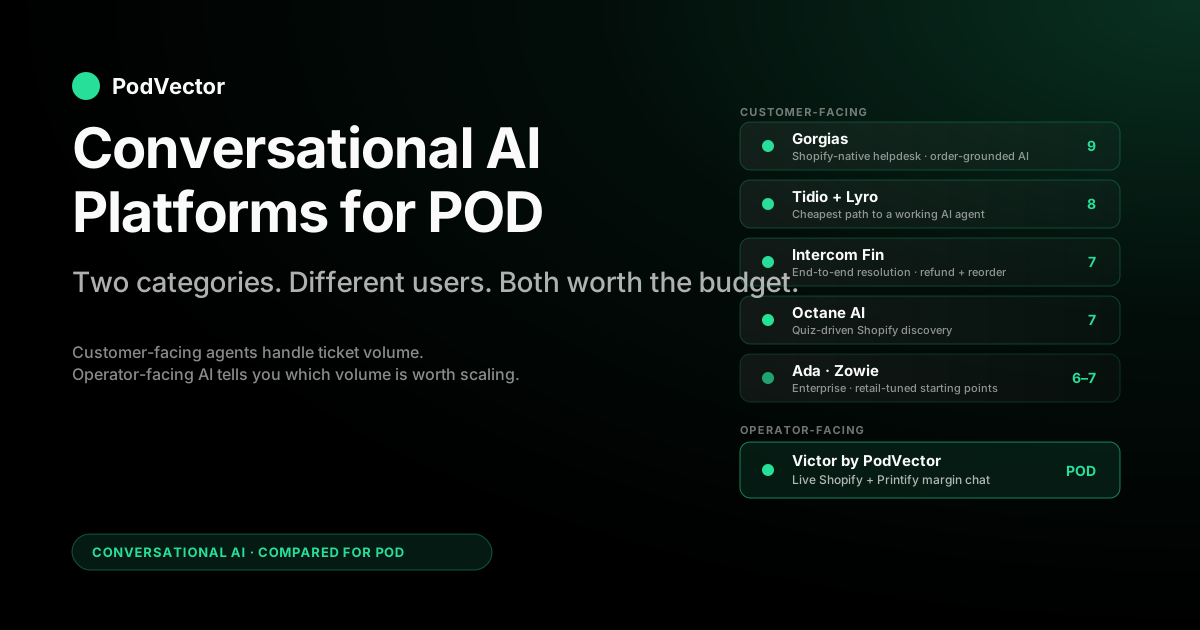
Quick Answer: The conversational AI platforms that actually fit a print-on-demand operator are Gorgias (Shopify-native helpdesk with order-grounded AI replies), Tidio + Lyro (cheapest path to a working AI agent under 50 conversations a day), Intercom Fin (resolution-priced, executes refund and reorder actions end-to-end), Octane AI (Shopify quizzes that double as a conversational discovery layer), Ada (enterprise NLP at the high end), and Zowie (retail-specific pre-training). On the operator side — the conversation you have with your own data, not your customers — Victor by PodVector AI is the only conversational AI built for POD's specific unit economics, with live Shopify, Printify, and Printful data feeding plain-English margin questions.
The hard part isn't picking a platform. It's separating the customer-facing conversational AI category from the operator-facing one, then weighting the customer-facing pick against POD-specific quirks: multi-leg Printify and Printful tracking, supplier print-error refund logic, variant-heavy product catalogs, and per-order shipping cost variability that breaks generic "where's my order" templates.
Two Categories Hide Inside "Conversational AI for Ecommerce"
Most "best conversational AI platform for ecommerce" roundups fold two genuinely different products under one heading. The first is customer-facing conversational AI — the chat layer that answers shipping questions, recommends products, recovers abandoned carts, and resolves refund requests on behalf of the brand.
That layer no longer lives only in a storefront widget. The platforms now meet customers on WhatsApp, Instagram, email, and increasingly voice — one AI agent across every channel rather than a bot per surface. And it's a genuine step past the old rule-based chatbot: instead of decision-tree menus, it reads the question in natural language and grounds the reply in live order data.
That's the category Gorgias, Tidio, Intercom Fin, Ada, and Zowie compete in. The current top Google results for the term all stay inside this lane — Gorgias now brands its own homepage as "the conversational AI platform for ecommerce", and the two strongest explainers ranking alongside it (the Flowcall complete guide for 2026 and the Voiceflow use-case guide) frame the whole category as customer-facing support and discovery.
For scale: the conversational-AI-for-commerce market is roughly $8.8B in 2025, projected near $32.6B by 2035 (~14.8% CAGR), and AI agents now resolve 70–86% of repetitive tickets versus 40–60% for the old rule-based bots — while dropping the cost per handled query from $5–10 to well under $1. Those benchmarks are real, but they're all measured on the customer side of the conversation.
The second category is operator-facing conversational AI — the chat interface you, the seller, use to ask questions of your own store data. "Which designs from the last 30 days are above $8 gross margin per unit?" "What's the difference between the green and navy variant in repeat-purchase rate?" "Which Printify product line has the highest refund rate this quarter?" That's a different shape of conversational AI: the user is the operator, the conversation is private, the data source is a warehouse on top of Shopify and supplier feeds, and the success metric is decision speed rather than ticket deflection.
Most generic ecommerce roundups never separate the two, which is why they end up recommending the same five customer-support chatbots regardless of what problem you actually have. POD operators in particular need both: customer-facing conversational AI to handle "where's my order" volume that scales linearly with order count, and operator-facing conversational AI to handle the margin and design-decision questions that Printify and Printful integration never quite solve in a dashboard. This guide picks across both.
For the higher-altitude framing of how AI categories fit together in a POD stack, the complete guide to AI tools for POD sellers is the pillar. The tools cluster hub indexes every comparison guide on the site, and the AI analytics topic hub is where the operator-facing question — the one most customer-facing platforms don't touch — gets answered.
The Scorecard: Customer-Facing Platforms Through a POD Lens
The four use cases the generic guides agree on — order tracking (30–40% of ticket volume), returns and refunds, abandoned-cart recovery (up to ~35% recoverable), and guided product discovery — all matter for POD too. But a POD store's version of each is harder: "where's my order" spans a multi-leg Printify route, a refund hinges on a supplier print-error photo, and discovery has to route across hundreds of design variants. So the scorecard weights the POD-specific axes, not the generic feature checklist.
Scores out of 10 weighted on POD-specific axes: depth of Shopify integration, ability to ground replies in Printify or Printful order data (not just a knowledge base), pricing model fit for high-refund-question categories, and onboarding time before the AI agent actually handles tickets unsupervised.
| Platform | Best for | POD fit | Starting cost/mo | Pricing model | Time-to-live agent |
|---|---|---|---|---|---|
| Gorgias | Shopify POD past 500 orders/mo | 9 | $10–$300+ | Per-ticket tiers + AI add-on | 1–2 weeks |
| Tidio + Lyro | POD under $30K/mo doing own support | 8 | $0–$68 | Conversation tier + AI add-on | 2–3 days |
| Intercom Fin | Multi-store, deeper SaaS infra | 7 | $39+ seat + $0.99/resolution | Resolution-priced | 1–3 weeks |
| Octane AI | Shopify quizzes + discovery | 7 | $50+ | Flat tier | Hours (quiz-first) |
| Ada | Enterprise; 100+ language stores | 6 | Custom | Enterprise contract | 4–8 weeks |
| Zowie | Retail-flavored mid-market | 7 | Custom | Volume tiers | 2–4 weeks |
The picks below cover what each platform actually does in a POD context, where it earns its subscription, and where the seam is between automation and the next decision the operator still has to make manually.
Gorgias
Pricing: $10/mo Starter (50 tickets), $50/mo Basic (300 tickets), $300/mo Pro (2,000 tickets); AI Agent (formerly Auto-Respond) is a metered add-on.
Best for: Shopify POD stores past 500 orders a month with high "where's my order" volume.
Gorgias is the default conversational AI platform for Shopify-flavored ecommerce because it was built for Shopify from day one. Order data, customer history, refund actions, and tracking links surface inside the support inbox automatically — which means the AI Agent isn't reading a static knowledge base, it's reading live order context for the customer who's asking. That's the right architecture for POD specifically because most questions are order-specific ("did my Printify order ship yet, and why does the tracking show it leaving Latvia?") rather than policy-specific.
For the multi-leg shipping path that defines a Printify or Printful order — supplier produces, hands to a regional carrier, hands to the destination postal service, sometimes with a 5-day handoff gap that looks broken to the customer — Gorgias's Auto-Respond can pull the supplier's tracking number and explain the leg the order is currently on, instead of returning the generic "your order is in transit" boilerplate that Tidio's free tier defaults to. The trade-off is cost: per-ticket pricing penalizes high-refund-question categories (and POD has those — supplier print errors, sizing issues, and "wrong color shipped" account for 15–25% of all tickets in most stores I've seen).
Cost-per-shirt math: at $50/mo Basic + AI Agent metering, an automated reply that resolves a "where's my order" without operator touch is replacing about 4 minutes of operator time. Payback at $25/hour operator cost lands inside 30 automated tickets per month, which any store past 200 orders/mo will hit on the first day.
Tidio + Lyro
Pricing: Free up to 50 conversations/mo; $29/mo Starter; $59/mo Growth; Lyro AI add-on from $39/mo.
Best for: Solo POD operators under $30K/mo handling their own support.
Tidio's Lyro AI agent is the cheapest path to a working customer-facing conversational AI that resolves at meaningful rates. Lyro reads your help center, FAQ, and past transcripts and reliably handles ~70% of repetitive low-emotion questions — shipping timelines, sizing charts, return policy, order status — without escalation. For a POD store under 200 orders/mo, that's enough to make the operator-time math work even on the cheapest paid tier.
Where Tidio sits on the POD spectrum: it's the right pick when ticket volume is real but not yet "I need a Shopify-native helpdesk with refund automation" levels. The Lyro agent has shallower order-data grounding than Gorgias's AI — it can quote your knowledge base and your past replies, but it doesn't natively pull live Printify status the way Gorgias does. For most "where's my order" questions that's fine because the answer comes from the Shopify order page; for "the supplier shipped the wrong size" questions the agent has to escalate to operator.
Onboarding is the fastest in the category — knowledge-base import, FAQ training, and a few rounds of test conversations get a Lyro agent live in 2–3 days. Compared to a 4–8 week Ada implementation, that matters when you're a single operator picking your first AI agent and you don't have a six-week training budget.
Intercom Fin
Pricing: $0.99 per resolution (usage-based); requires Intercom subscription from $39/seat.
Best for: Multi-store operators or POD brands with deeper SaaS infrastructure.
Fin is the most capable end-to-end resolver in the customer-facing category. Where Gorgias and Tidio mostly answer questions, Fin can act — issue a refund, update an order, trigger a reprint, send a discount code — when given the right backend access. For POD that capability is most valuable on the supplier-error side: a customer sends a photo of a misprinted shirt, Fin verifies against the Printify order, triggers a reprint or refund, and closes the loop without operator touch.
The trade-off is cost predictability. Resolution-priced models look cheap in the spec sheet ($0.99 per resolution sounds great) but POD product categories with high supplier-error rates blow through usage projections.
A store doing 1,500 orders a month with a 6% support-contact rate and 80% Fin-resolution rate is paying ~$71 in resolution fees on top of seat licenses — comparable to Gorgias Basic but with much higher variance month to month. The model works best when ticket volume is predictable and steady, less well when a viral design lands and triple-volumes a category overnight.
Fin is also the platform with the longest implementation runway for POD: 1–3 weeks of backend integration to give it the action permissions that justify the premium pricing. For a single-operator store the math rarely works; for a brand running multiple stores or a managed-services model it does.
Octane AI
Pricing: $50/mo Pro; higher tiers above.
Best for: Shopify POD stores using product quizzes for design discovery.
Octane AI is the platform that actually deserves the "conversational commerce" label rather than the "conversational support" label. The product is a Shopify-native quiz and conversational discovery layer — a customer lands, answers 4–6 questions about who they're shopping for, and Octane recommends specific designs from your catalog. For POD stores with high SKU and design variety (which is most of them), that's a real conversion lever that the customer-support category doesn't touch.
Where Octane fits in the broader category is closer to "smart product finder" than "AI agent" — it's not resolving tickets or grounding replies in order data, it's collecting first-party preference data and routing customers to the right SKU. For a POD store with 200 designs across 40 product variants, that routing problem is the single biggest conversion opportunity nobody else's tool solves cleanly. The trade-off is that Octane doesn't replace any of the support-side tools above; it sits alongside Gorgias or Tidio rather than competing with them.
The deeper Octane comparison — and which Shopify-specific picks fit alongside it — is in the best AI chatbot for Shopify comparison, and the broader Shopify-side framing is in Shopify AI chatbot for POD sellers.
Ada
Pricing: Custom enterprise contract.
Best for: Enterprise POD brands selling in 100+ languages with global support teams.
Ada is the upper end of the customer-facing category — NLP-driven support deflection at scale, multilingual out of the box, with brand-voice tuning controls and quality-monitoring dashboards that justify the enterprise price tag. For a POD operator the platform is mostly overkill; the rare exception is a brand with serious international SKU volume where the language depth (and the tooling around translated knowledge bases) earns out against simpler tools.
The numbers Ada quotes in case studies — 70%+ deflection rate, ROI inside 12 months on managed-budget contracts — are real, but they assume an enterprise support operation with dedicated training and tuning. For a single-operator POD store, the same deflection rate is reachable with Gorgias AI or Tidio Lyro at a fraction of the cost and a tenth of the implementation time. Ada earns its slot when you're past the "single operator" stage by an order of magnitude.
Zowie
Pricing: Custom volume tiers.
Best for: Mid-market retail-flavored ecommerce brands with rapid onboarding needs.
Zowie's positioning is retail-specific pre-training — the platform comes with a model already tuned on ecommerce conversation patterns, which compresses the implementation timeline relative to a from-scratch enterprise platform. For POD that means Zowie can be live in 2–4 weeks rather than 4–8, with FAQ templates that already understand "where's my order," "wrong size," and "refund please" without you teaching them.
The platform competes with Gorgias and Intercom Fin on the same axis: order-grounded replies and end-to-end action capability. The differentiator is the retail-tuned starting point, which matters most for brands without a deep support-content backlog to import.
For a POD operator who's been running for a year with 500+ resolved tickets in the inbox, Gorgias's transcript training catches up quickly. For a launch or rebrand with no historical data, Zowie's pre-training is the lever that gets you to live faster.
Operator-Facing Conversational AI: The Category Most Roundups Miss
Every customer-facing platform above answers the customer. Operator-facing conversational AI answers the operator — the same paradigm, different user, different data, different decision shape.
This category is barely covered in the top-3 SERP for "conversational AI platform for ecommerce" because most generic guides assume the operator's question is solved by a dashboard. For POD it isn't.
The questions a POD operator actually asks of their own data: which designs from the last 30 days have the highest gross margin per unit? Which Printify product variant has the highest refund rate this quarter?
Which ad creative drove the highest LTV cohort? Which adjacent niche should I enter next based on what my repeat customers are also buying?
Generic dashboards often don't give you those answers at all, or you need a dozen clicks of filtering to find them. A simple chat tool that reads your live Shopify and supplier data is a much faster way to get the answer you need.
Victor by PodVector AI
Pricing: Free trial; paid tiers for production stores.
Best for: POD operators on Shopify with Printify or Printful at any scale.
Victor is PodVector AI's AI employee, built just for print-on-demand stores. The big difference: Victor connects directly to Shopify, Printify, and Printful, and pulls in the real supplier cost for every order — not a guessed average, but the exact cost Printify or Printful charged, including shipping based on the variant and destination. This is what makes POD margin so different from regular stores that keep stock. You ask a question in plain English, and Victor answers in seconds using your live store data, not an old export.
Victor works in two ways. First, he looks up details straight from your live store and supplier data. Second, he can run the calculations POD sellers need most, like margin per design, changes in supplier costs, or revenue by customer group. Victor decides which approach fits your question, then gives you a plain answer. It's the same idea used for customer-facing chat tools, just pointed at your business decisions instead of customer questions.
Victor answers your questions and acts on those answers — with your approval — kill underperforming listings automatically, scale ad spend on winners, surface niche gaps before you've manually noticed them. That's the layer the customer-facing conversational AI stack feeds into: the support tools handle volume, the operator-facing tool decides which volume is worth scaling. The deeper coverage of how live margin analytics fits is in the complete guide to AI analytics for print-on-demand and the complete guide to AI agents for ecommerce analytics.
Picks by Store Stage
The right conversational AI stack changes with revenue. What works at $2K/month is wrong at $50K/month and vice versa.
Stage 1 — First 100 orders ($0–$30/mo)
Customer-facing: Tidio free tier (50 conversations/mo) or Shopify Inbox.
Operator-facing: Shopify dashboard + manual Printify cost spot-checks.
Trade-off: You handle most tickets yourself and your margin visibility is rough. Once weekly orders crack 25 and a niche is producing repeat buyers, upgrade.
Stage 2 — Profitable side store ($60–$120/mo)
Customer-facing: Tidio Starter + Lyro AI ($68/mo) or Gorgias Basic ($50/mo) with Auto-Respond.
Operator-facing: Victor by PodVector AI for live Shopify + Printify + Printful margin questions.
Trade-off: Customer questions are mostly automated and you've stopped guessing on which designs are profitable. At a $24 retail / $11 supplier cost / $13 gross margin profile, the stack pays back inside 10 shirts/month above unautomated baseline.
Stage 3 — Scaled operator ($300–$700/mo)
Customer-facing: Gorgias Pro or Intercom Fin (resolution-priced) for end-to-end action capability.
Discovery: Octane AI for Shopify quiz-driven product discovery on a 200+ design catalog.
Operator-facing: Victor by PodVector AI + supplemental BI as needed.
Trade-off: Every conversational layer that compounds at scale is automated, and the operator-facing AI tells you which subscriptions are paying back per cohort. At this stage the full stack costs less than two days of paid acquisition on a single underperforming campaign.
Where Conversational AI Still Doesn't Reach for POD
Even after a full customer-facing and operator-facing stack purchase, the hardest decisions in a POD operation aren't yet automated.
Multi-channel margin attribution. A design that breaks even on Shopify with Meta ads may be profitable once you factor in Google Ads attribution. Customer-facing conversational AI doesn't model this; operator-facing tools are starting to (Victor's three-tool agent can answer per-channel margin questions today on connected channels, but the cross-channel synthesis is still operator-driven).
Supplier-cost variability inside a single conversation. Printify and Printful both have shipping cost that varies by product, color, size, and destination — sometimes by 40% on the same SKU between two orders. Most customer-facing AI agents quote a flat shipping promise; the right answer is "your shipping cost was $X for this order, here's why." That gap closes when the customer-facing platform integrates with the live supplier data feed, which only Victor exposes today and most customer-facing platforms don't pull from.
Niche gap detection through conversation. "Which adjacent niche should I enter next?" is a question every operator has and no customer-facing tool answers (correctly — they're not the right user). Operator-facing conversational AI is starting to: the data exists (Shopify customer purchases + Printify product taxonomy + ad audience overlap), the synthesis is what's still being built. Agentic AI for ecommerce analytics is where this is heading; we cover the landscape in the agentic AI for ecommerce explainer and the conversational AI chatbot platform for POD sellers piece.
For broader category context, the AI tools for ecommerce automation comparison and best AI chatbots for ecommerce guides cover the surrounding decision space, and the conversational AI chatbot for POD sellers framing covers the customer-facing implementation detail.
FAQs
What is a conversational AI platform for ecommerce?
A conversational AI platform is software that uses natural language understanding and generation to handle either customer-facing conversations (support, product discovery, refund requests) or operator-facing conversations (margin questions, design-performance analysis, decision support) on top of an ecommerce store's data. The customer-facing category is dominated by Gorgias, Tidio, Intercom Fin, Octane AI, Ada, and Zowie. The operator-facing category, which is barely covered in generic ecommerce roundups, is where Victor by PodVector AI built specifically for POD operators sits.
Which conversational AI platform is best for a print-on-demand store on Shopify?
For customer-facing support, Gorgias is the strongest pick once you're past 500 orders a month because of native Shopify integration and order-grounded AI replies. Below that volume, Tidio + Lyro is the cheapest path to a working agent at $68/mo total. For operator-facing conversational AI — the layer that answers "which designs are actually profitable after live Printify cost?" — Victor by PodVector AI is the only platform purpose-built for POD's unit-economic profile. The two categories don't compete; most stores past the first 100 orders need both.
How does conversational AI for POD differ from generic ecommerce conversational AI?
Two big differences. First, POD product questions involve supplier-specific tracking (multi-leg Printify and Printful shipping that looks broken to customers), variant-heavy catalogs (200 designs across 40 product types creates routing problems generic agents don't solve), and supplier print-error refund logic that requires the AI to verify against the supplier's order record, not just the customer's claim.
Second, POD operators have a margin-visibility problem that no customer-facing platform addresses — per-order Printify or Printful cost varies by product, color, size, and destination, so flat-COGS dashboards are wrong by 20–40% per unit. Operator-facing conversational AI on top of live supplier data is the right shape; Victor was built specifically for this.
What's the cheapest conversational AI stack for a new POD store?
Around $0–$15/mo for the first hundred orders. Tidio's free tier handles 50 conversations/mo, Shopify Inbox handles overflow, and the operator-facing question (margin per design) gets answered with manual Printify cost spot-checks until weekly order volume crosses ~25 orders. Past that, $68/mo for Tidio + Lyro plus Victor's free tier for operator-facing analytics is the cheapest stack that actually does both jobs reasonably well.
Can a single conversational AI platform handle both customer support and operator analytics?
Not in 2026, and probably not by design. The two categories optimize for opposite things: customer-facing platforms tune for high-volume low-latency replies grounded in a knowledge base, with brand-voice constraints and ticket-routing logic.
Tools built for store owners are made for a few careful questions on live data, not thousands of quick customer chats. They need deep answers and the ability to dig into real numbers. The same AI model can technically do both jobs, but the tools around it — what it connects to, how it reads your numbers, and how it helps you decide — are very different. Most stores that grow past the early stage use two separate tools instead of one that tries to do everything.
How long does it take to deploy a conversational AI platform for a POD store?
Tidio + Lyro is the fastest at 2–3 days. Gorgias with AI Agent is 1–2 weeks of setup including order-data integration, knowledge-base import, and 50–100 test conversations to tune the response patterns.
Intercom Fin and Zowie are 2–4 weeks. Ada is 4–8 weeks for an enterprise rollout. On the operator-facing side, Victor connects to Shopify, Printify, and Printful in under an hour and starts answering live margin questions the same day; the depth of historical analysis improves as more a warehouse history accumulates over the first few weeks.
What integrations should a conversational AI platform have for POD specifically?
For customer-facing: Shopify (native, not connector-based), Printify and Printful order data (so the AI can quote real tracking and supplier-error context, not generic shipping boilerplate), the messaging channels your buyers actually use (WhatsApp, Instagram, and email, not just the on-site widget), and a way to surface refund and reorder actions to the agent. Gorgias and Intercom Fin score highest here.
For store owners, what matters is: direct connections to Shopify and your suppliers (Printify and Printful, with the real per-order cost), fast answers instead of waiting on a dashboard to refresh, and plain-English questions about the numbers that matter to you. Victor is the only tool that brings all of this together for POD stores specifically; you can read more about the wider landscape in the conversational AI chatbot service for POD sellers article.
Pick the right conversational layer for the right user.
Customer-facing chat tools handle your support tickets. Victor, PodVector AI's AI employee, helps you decide which products and ads are worth scaling. He connects directly to Shopify, Printify, and Printful, pulls in the real supplier cost for every order, and answers your margin questions in plain English so your decisions match your real numbers.
Try Victor free