
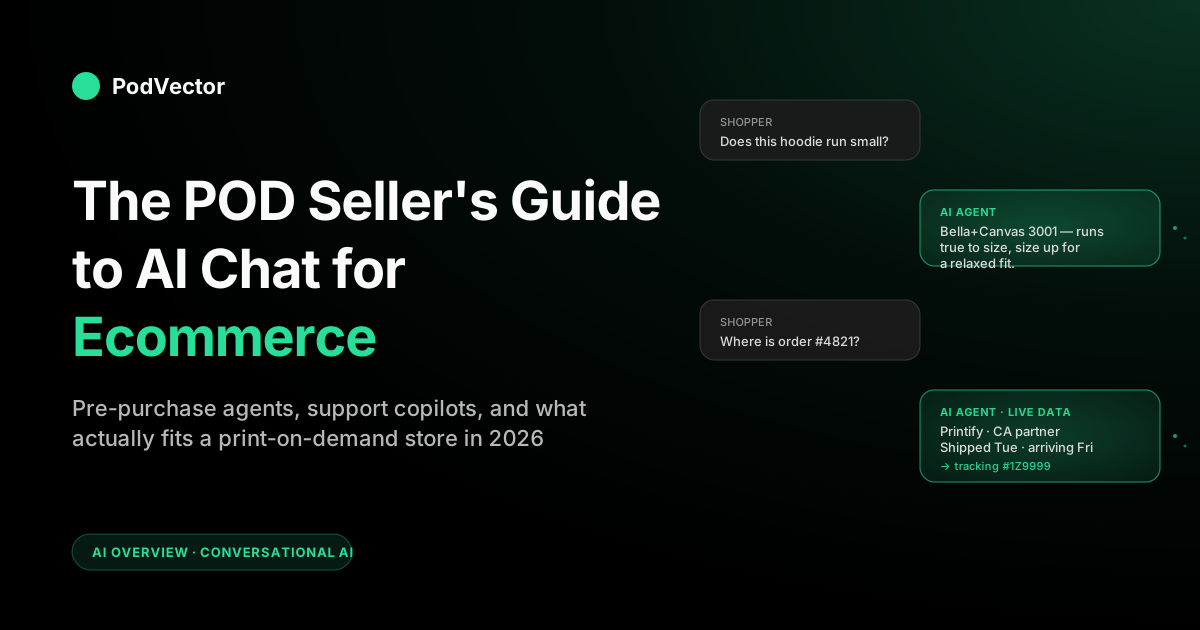
Quick Answer: AI chat for ecommerce is the category of conversational AI tools — chatbots, sales agents, support copilots — that sit on a storefront and either answer shopper questions or take actions on their behalf. In 2026 the category has split into two archetypes: ecommerce-native AI sales agents (Tolstoy, Zipchat AI, Rep AI) built for conversion, and AI helpdesks (Gorgias, Intercom, Tidio, Ada) built for support.
The bigger shift is from answer-only bots to agentic AI — agents that don't just reply but apply discounts, open returns, recommend products, and resolve tickets without a human. Zipchat, Gorgias, and Rep AI all now lead with "it acts, not just chats."
For print-on-demand specifically, the right pick depends on whether your bottleneck is pre-purchase confidence (sizing, design printability, color accuracy on mockups) or post-purchase support (where is my order, can I change the design, return policy on a custom item). POD has chargeback risk and supplier-routed shipping ETAs that generic guides ignore. This article walks through what AI chat actually does for a POD store, which platforms fit, and what to look for before paying for one.
What "AI chat for ecommerce" actually means in 2026
Two years ago, "AI chat" on a storefront usually meant a rule-based bot answering "where is my order" by pulling a tracking link from Shopify. In 2026 the category looks different.
Most shoppers landing on an AI chat widget today are talking to a large language model that has read your product catalog, your help docs, your shipping policy, and recent order history. The good ones answer in your brand voice. The best ones take small actions — applying a discount, recommending a product, opening a return — without escalating.
What matters for POD sellers is that the category has split into two real archetypes. Pre-purchase AI — sometimes called "AI sales agents" or "shopping concierges" — focuses on conversion: answering "does this fit a 6-year-old," recommending designs, surfacing discounts, capturing emails. Post-purchase AI — usually called "AI helpdesk" or "support copilot" — focuses on deflection: answering shipping questions, processing returns, escalating edge cases. Most platforms do both, but they're built around one or the other. Picking the right archetype for your bottleneck is the single highest-leverage decision in the category.
On pricing, the market has moved firmly to per-resolution billing. According to Ringly.io's 2026 platform comparison, almost every major chat platform now bills per resolution, with rates ranging from around $0.90 to $2.00 per resolved conversation on top of a base subscription. That math scales directly with your support volume, so understanding your ticket load before picking a platform is essential.
Why POD changes the requirements
Generic AI chat guides are written for storefront brands with held inventory, fixed SKUs, and a single fulfillment center. Print-on-demand inverts almost every assumption in that model.
If you read a list of "best AI chatbots for ecommerce" and pick by raw popularity, you'll end up with a tool that's bad at the specific questions your shoppers actually ask. The POD-specific gaps fall into four buckets.
Shipping ETAs depend on which supplier fulfills
A wholesale brand ships from one warehouse with one carrier. A POD store ships through Printify or Printful, which route the same product to different production partners depending on stock, geography, and load.
The ETA on a Printify hoodie shipping from California is not the same as the identical hoodie shipping from a Latvian production partner — and the AI chat widget needs to know that. A generic chatbot that answers "5–7 business days" because that's what your help doc says will be wrong about a third of the time, and angry shoppers create chargebacks. The platforms that work for POD pull live order data from Printify or Printful and answer with the actual production-partner ETA on each specific order.
Sizing questions get harder, not easier, with mockup-based catalogs
POD products show on mockups, not photographs. A shopper asking "how does this t-shirt fit, runs small or true to size" wants a real answer, but the answer depends on the underlying blank — Bella+Canvas 3001 fits differently than Gildan 64000.
A good AI chat agent for POD knows the blank behind each design and can answer with garment-specific size guidance. A generic agent reads "100% cotton" off the product page and tells the shopper that.
Chargeback risk is asymmetric
POD chargebacks hurt twice: you already paid the supplier to print and ship the item, and the customer keeps the shirt. AI chat that catches refund requests, sizing complaints, or "I never got it" tickets early — and resolves them with a goodwill discount or a fast reprint — saves real money.
Generic AI helpdesks will route those tickets the same way they route a "what's your phone number" inquiry. The POD-aware ones flag risk-laden conversations differently. For background on POD-specific risk patterns, see our guide to AI for fraud detection in ecommerce.
Designs are the SKU, and there are thousands of them
A 50-SKU wholesale brand can fit every product description, every fit note, every care instruction into a help doc the AI reads. A POD store with 800 designs across 12 product types and 10 colors has a catalog the size of a small encyclopedia, and most of it is auto-generated.
AI chat that retrieves accurately at that scale needs real semantic search over the catalog, not keyword matching on titles. Cheaper platforms quietly fall apart at design-level retrieval.
The 10 AI chat platforms POD sellers consider in 2026
Below are the ten platforms POD sellers most often evaluate. The list isn't ranked best-to-worst — the right pick depends on whether your store is conversion-bottlenecked or support-bottlenecked, and whether you're on Shopify (most POD stores) or somewhere else. Each entry covers the platform's archetype, what it's actually good at, and where it fits or doesn't fit POD specifically.
1. Tolstoy — AI sales agent built around video and product Q&A
Tolstoy positions itself as an "AI shopper" — a pre-purchase conversion agent that reads your product catalog and answers buyer questions in real time. Its strongest feature for POD is product Q&A: a shopper looking at a hoodie design can ask "does this come in black for adults" and the agent answers from the catalog without dropping them out of the design page.
Native Shopify integration, designed for DTC and POD-shaped stores. Best fit when your conversion rate is below average and you suspect shoppers are bouncing because product pages don't answer their questions.
2. Zipchat AI — ecommerce-native AI sales agent built for conversion
Zipchat is one of the AI chat tools that has risen fastest in the ecommerce-native category, and it's built around the same pre-purchase conversion job as Tolstoy: read the catalog, answer buyer questions in real time, recover abandoning carts, and nudge the sale. It proactively opens the conversation based on shopper behavior rather than waiting to be clicked, which is where most of its conversion lift comes from on POD product pages.
Native Shopify integration and a strong fit when your problem is shoppers bouncing before they buy. Like every SaaS platform here, it reads Shopify order data but not Printify or Printful supplier routing, so per-order shipping ETAs still come from your policy page unless you wire in custom data.
3. Rep AI — agentic AI concierge that blends sales and support
Rep AI positions itself as an agentic commerce platform: an AI concierge that handles pre-purchase conversion and post-purchase support in one agent, and that takes actions rather than just answering. It leans harder into the agentic framing than most of the list — detecting buying intent, intervening on hesitation, and resolving support questions in the same conversation.
Good fit for a growing POD store that wants one agent across the whole funnel instead of separate sales and helpdesk tools. The POD caveat is unchanged: it's not supplier-aware out of the box, so misprint and supplier-ETA scenarios need custom configuration.
4. Tidio — chat plus AI agent (Lyro) for support automation
Tidio is the most common AI chat tool installed on small Shopify POD stores, partly because the free tier is usable and the Lyro AI agent handles the obvious deflection cases (shipping status, returns policy, sizing) without much setup. It pulls order data from Shopify, but does not natively read Printify or Printful supplier routing — meaning shipping ETAs are based on what your store's policy says, not on which production partner actually has the order.
According to Alhena's 2026 AI chatbot pricing breakdown, most ecommerce businesses end up spending roughly $100–$150 per month on Tidio's Lyro and Flows add-ons combined, making it a good entry point for smaller stores but one that gets expensive at scale. For the deeper breakdown, see AI chatbot for ecommerce: what it looks like for POD sellers.
5. Gorgias — ecommerce helpdesk with Shopify-native AI actions
Gorgias is the dominant ecommerce helpdesk on Shopify, and its AI agent takes Shopify-native actions: editing orders, applying discounts, processing refunds, all from within the chat conversation. For POD stores with real ticket volume, it's usually worth the cost.
Per Alhena's 2026 pricing analysis, Gorgias helpdesk plans run from a Starter tier through Basic ($60/month), Pro ($360/month), and Advanced ($900/month), with the AI Agent billed at $0.90–$1.00 per interaction — and importantly, each AI interaction counts as both an AI charge and a helpdesk ticket charge, so model the full cost before committing. Limitations are the same as every other platform: not POD-aware out of the box. You'll need to add custom macros for Printify/Printful-specific scenarios. More detail on the Shopify-native angle here.
6. Intercom — AI agent (Fin) for support at scale
Intercom's Fin AI agent is one of the most capable LLM-powered support agents in the category. Reads your help center, your past conversations, and (with custom integrations) order data.
According to Ringly.io's 2026 platform comparison, Intercom Fin charges $0.99 per resolved outcome on top of Intercom's seat pricing. At high volumes that adds up fast — per Alhena's analysis, at 2,000 monthly resolutions Fin costs around $1,980/month in AI fees alone. Best fit for POD stores doing significant volume with a small support team. Strong reporting on resolution rate and CSAT, which matters when you're accountable to investors or partners.
7. Ada — omnichannel AI for customer service automation
Ada targets enterprise ecommerce: brands handling enormous ticket volumes who need omnichannel (chat, email, voice, social) coverage. According to Ringly.io, Ada fits organizations managing more than 300,000 conversations per year with the budget for an enterprise contract. Most POD stores never get big enough to need Ada, and even at significant annual revenue the implementation effort doesn't pay back compared to a Gorgias or Intercom setup. Listed for completeness; rarely the right answer for a POD operator.
The same goes for two names you'll see in 2026 roundups but rarely on a POD store: LivePerson, an enterprise conversational-AI suite built for large-contact-center deployments, and Angle, a newer Shopify-native shopping agent. Both are real tools; neither is supplier-aware, and Ada's logic applies — enterprise overhead with no POD-specific payback.
8. Drift / Salesloft — conversational AI for B2B-ish lead qualification
Drift (now part of Salesloft) is built for B2B SaaS lead qualification, not B2C transactional ecommerce. Occasionally a POD store running corporate / wholesale / promo product as a side channel adopts Drift for that B2B segment. For the consumer side of a POD store, it's the wrong tool — too oriented toward "book a demo" workflows.
9. ManyChat — chat automation for social commerce
ManyChat is dominant in Instagram and Facebook Messenger automation. Less of an AI chat tool in the LLM sense and more a flow-builder with AI assistance, but it's the right tool when most of your traffic is social and shoppers DM you on Instagram before buying. POD stores with strong organic Instagram presence often run ManyChat alongside whatever they have on the storefront — different surfaces, different jobs. More on social-commerce AI for POD here.
10. Botpress — open-source AI chatbot framework
Botpress is the platform you pick when you want to build, not buy. Open-source, deeply customizable, can be wired to whatever data sources you can expose via API — including Printify and Printful endpoints if you want a truly POD-aware bot.
Real engineering work required. Right answer for technical POD operators or agencies serving POD clients; wrong answer for solopreneurs who just want something installed by Friday.
Comparison: which platform fits which POD store
The table below condenses the platform notes above into a fast-pick view. Pricing tiers are drawn from vendor documentation and third-party analyses current as of mid-2026 — verify directly with each vendor before committing, as these change frequently.
| Platform | Archetype | Best for POD store stage | POD-aware out of box | Starting price |
|---|---|---|---|---|
| Tolstoy | Pre-purchase sales agent | Conversion-bottlenecked stores at any size | Partial (Shopify-native, not POD-specific) | ~$99/mo |
| Zipchat AI | Pre-purchase sales agent | Conversion-bottlenecked Shopify stores | Partial (Shopify-native, not POD-specific) | ~$49+/mo |
| Rep AI | Agentic sales + support concierge | Growing stores wanting one full-funnel agent | Partial (Shopify-native, not POD-specific) | ~$39+/mo |
| Tidio | Support + light sales | Smaller stores, lower ticket volume | No | Free / paid tiers |
| Gorgias | Helpdesk with AI actions | Stores with meaningful ticket volume | No (custom macros needed) | ~$60+/mo + per-interaction |
| Intercom (Fin) | Support at scale | High-volume stores | No | Per-resolution pricing |
| Ada | Enterprise omnichannel | Rarely fits POD | No | Custom |
| Drift / Salesloft | B2B lead qualification | POD wholesale side channel only | No | Custom |
| ManyChat | Social DM automation | Instagram-driven POD stores | No | Free / $15+/mo |
| Botpress | DIY framework | Technical operators / agencies | If you build it | Free / pay-as-you-go |
The table answers two questions at once: what stage of POD store the platform fits, and whether you'll need to do custom integration work to make it POD-aware. None of the major SaaS platforms ship with native Printify or Printful awareness — that's a gap the category hasn't filled. For most POD operators, the right move is to pick the platform that fits your stage and accept that supplier-aware shipping ETAs and sizing intelligence will need either custom macros or a separate analytics layer.
Essential features to look for as a POD seller
Reading product pages, you'll see the same feature checklist on every vendor: "natural language understanding," "Shopify integration," "AI-powered." That checklist tells you almost nothing about whether the platform actually works for POD. The features below are the ones that filter the category.
Live order data, not policy-page lookup
When a shopper asks "where's my order," the AI must read the actual order's tracking record — including supplier and production partner — and answer with a real ETA. A platform that answers from your shipping policy page is wrong on a third of POD orders. Verify in the demo: ask a question about a specific order and see whether it returns supplier-specific information.
Catalog-aware semantic search
POD stores have hundreds to thousands of designs. The AI needs to find the right one when a shopper says "the cat shirt with the typewriter" — that's semantic search over titles, descriptions, and tags. Test it during the trial: ask vague descriptive questions and see whether the agent finds the design.
Visual product discovery and try-on
The 2026 roundups all push "virtual try-on and sizing visualization" as a headline feature, and for apparel-heavy POD it earns the hype. An agent that can show the design on the right garment color, surface size charts mid-chat, and pull up matching products turns a vague "got anything in green?" into a tap-through to checkout.
For POD the caveat is the mockup problem: try-on overlays render the print, not the real fabric drape. Treat visual discovery as a conversion aid, not a fit guarantee — pair it with blank-specific size guidance below.
Discount and refund actions inside the conversation
For deflection to work, the AI has to actually resolve the conversation, not just route it. That means applying a small goodwill discount, processing a return, swapping a size — all inside the chat, without bouncing to a human.
Gorgias and Intercom Fin do this natively. Tidio handles a subset. Tolstoy is more focused on pre-purchase, so post-purchase actions are limited.
Brand voice control
An AI that answers in stock corporate prose breaks the brand on a creative-led POD store. Look for a system prompt or "voice" configuration that lets you specify tone, vocabulary, and personality. The good platforms let you upload examples of how you write; the cheap ones give you a single dropdown.
Conversation handoff that doesn't lose context
When the AI escalates to a human (and it will), the human should land in the conversation with full context — what was asked, what was answered, what's been tried. Platforms that hand off as a "new ticket" force the human to re-read everything, which kills the time savings.
Reporting that surfaces what's actually happening
You need to see resolution rate, CSAT, escalation reasons, and topics that broke the AI. Without that feedback loop, the agent never gets better. Gorgias and Intercom report well. Tidio's reporting is functional. Smaller platforms often skimp here.
5 high-leverage AI chat use cases for POD
1. Sizing and fit questions on garment-based products
The single highest-volume pre-purchase question on POD apparel stores. An AI that knows the blank behind each design — Bella+Canvas, Gildan, Next Level, AS Colour — can give garment-specific fit guidance instead of generic "true to size" copy. Conversion lift on garment categories is meaningful when the AI gets this right.
2. Design availability across products
"Do you have this design on a hoodie too?" "Does this come in adult sizes?" "Is it available in white?" A POD store with one design across ten product types and six colors has a combinatorial answer space the shopper can't navigate by clicking. AI chat collapses that into a question.
3. Where-is-my-order with supplier-aware ETAs
The single highest-volume post-purchase question on every POD store. An AI that pulls live tracking from the Printify or Printful order, identifies the production partner, and gives an honest ETA reduces ticket volume meaningfully and prevents the angry shopper from filing a chargeback. This is also where most generic AI chat tools quietly fail at POD.
4. Goodwill discount as a chargeback prevention tool
When a shopper writes in unhappy — slightly off color, fit issue, late delivery — the cheapest resolution is a small partial refund or a discount on the next order, applied inside the chat. AI agents authorized to issue bounded goodwill discounts (capped at, say, a small fixed amount per order) resolve those tickets in seconds without human escalation, and prevent chargebacks that would otherwise eat the full order plus supplier cost. See also: how to get contribution margin — knowing your contribution margin tells you exactly how much goodwill you can extend before a resolution destroys the order's profit.
5. Returns and reprints on damaged or misprinted items
POD reprints are routine: the supplier ships occasional misprints, the AI confirms with a photo, and the order gets reprinted automatically through the supplier's claim flow. Building this into the AI's action set turns one of the most painful CS workflows into an automated one.
How to roll out AI chat without breaking your store
Step 1: Audit your real ticket and chat volume
Before picking a platform, look at your current support and chat volume by category. If the majority of your tickets are pre-purchase questions (sizing, fit, design availability), you want a pre-purchase AI like Tolstoy.
If the majority are post-purchase (where's my order, returns), you want a helpdesk AI like Gorgias or Tidio. Buying the wrong archetype is the most expensive mistake in this category.
Step 2: Connect order and catalog data first
The AI is only as good as what it can read. Connect your Shopify orders, your product catalog, your shipping policy, and — critically — any documentation you have about which blanks underlie which products. If you don't have that documentation, write it: a one-page reference that the AI can read is worth ten hours of conversation tuning later.
Step 3: Set narrow action bounds
Configure what the AI is allowed to do without escalation. Common starting bounds: discounts up to a small fixed threshold, refunds up to a modest cap, no order modifications past 24 hours from purchase, no actions on orders flagged for fraud review. Expand the bounds only after you've seen 30 days of clean conversation logs.
Step 4: Run it in shadow mode for a week
The good platforms let you run the AI in "shadow" — it suggests responses, but a human approves each one before it goes out. A week of shadow operation surfaces every place the AI is wrong before any shopper sees a wrong answer. Then turn on full automation for the categories that performed cleanly.
Step 5: Review weekly, retire macros monthly
Once it's live, review the AI's conversations weekly: what escalated, what got bad CSAT, what broke. Update the underlying knowledge base monthly. AI chat that doesn't get reviewed degrades — the catalog changes, the policies change, the shopper questions evolve, and the AI has to be re-grounded against current reality.
Mistakes POD sellers make with AI chat
Picking by feature checklist instead of archetype
Every platform's marketing page lists the same features. The real question is whether the platform is built for pre-purchase conversion or post-purchase support — and whether your bottleneck matches. A pre-purchase tool installed on a store that's actually support-bottlenecked produces no win.
Ignoring the per-resolution pricing cliff
The 2026 market has moved to per-resolution pricing across most major platforms. As Ringly.io's platform analysis notes, your AI bill scales directly with volume under this model. And as Alhena's breakdown points out, Gorgias double-bills — each AI interaction counts as both an AI charge and a helpdesk ticket charge. Model the full cost at your expected peak monthly volume before committing to any platform.
Ignoring supplier-aware shipping data
The single biggest gap in generic AI chat for POD is shipping ETAs that don't account for which supplier and production partner actually fulfilled the order. Generic tools answer from your shipping policy page.
POD-aware setups read the live order. If you can't make your platform answer with supplier-specific ETAs, expect a steady stream of chargebacks from late deliveries that the AI promised would arrive on time. Understanding your cash position matters here too — chargebacks that pile up fast can affect your access to growth capital.
Letting the AI promise things you can't deliver
Without bounds, an AI will commit to "your order will ship by Tuesday" or "we offer free returns" because those are common ecommerce defaults. Set strict guardrails: the AI must only state policies you can actually deliver, and it must default to "I'll have a teammate confirm that for you" on anything outside its knowledge base.
Not measuring deflection vs. CSAT together
It's easy to optimize an AI chat tool for high deflection (the AI handled it, no human needed) and end up with terrible CSAT (the AI handled it badly, the customer is now angry). Measure both. A lower deflection rate with strong CSAT is much better than a high deflection rate with poor CSAT.
Treating it as a one-time install
AI chat is a system that needs maintenance. The catalog changes, the policies change, the customer base changes, and new edge cases keep appearing. Plan for an hour a week minimum on review and tuning. Stores that "set and forget" their AI chat are the ones whose CSAT quietly drops over six months.
FAQs
What is the best AI chat for ecommerce in 2026?
For most POD sellers on Shopify, the practical answer is: Tidio for smaller stores with lower ticket volumes, Gorgias for stores with meaningful ticket load, Intercom Fin or Ada for stores at significant scale. If your bottleneck is conversion rather than support, an ecommerce-native sales agent — Tolstoy, Zipchat AI, or Rep AI — is the right answer instead. None of the major platforms are POD-aware out of the box, so plan for some custom configuration regardless of which you pick.
Can I use ChatGPT as an AI chat agent on my Shopify POD store?
Not directly — ChatGPT is a general-purpose model, not a deployable agent. What you can do is build a custom integration using the OpenAI or Anthropic API as the underlying model, hosted inside a framework like Botpress, that reads your store data and conducts conversations.
That's a real engineering project. For most POD operators, an off-the-shelf platform is the better tradeoff. Background on ChatGPT-style integrations: our guide to ChatGPT for Shopify.
How much does AI chat for ecommerce cost?
The market has moved firmly toward per-resolution pricing in 2026. According to Ringly.io's platform comparison, most major platforms bill between $0.90 and $2.00 per resolved conversation on top of a base subscription. Tidio offers a free tier for very low-volume stores, then paid tiers for higher AI conversation volumes. Gorgias helpdesk plans start around $60/month (Basic tier) with AI interactions billed additionally at $0.90–$1.00 each, per Alhena's 2026 pricing analysis. Intercom Fin charges per resolution on top of seat pricing. Enterprise platforms (Ada, large Intercom contracts) are custom-quoted. The right way to budget: estimate your monthly chat volume, multiply by the per-conversation cost at each platform's rate, and compare to the labor cost of handling that volume by hand.
Will AI chat replace human support entirely on a POD store?
No, and you don't want it to. AI chat handles the high-volume, low-complexity questions: shipping status, sizing, returns initiation.
Humans handle the high-stakes edge cases: angry chargeback threats, complex custom requests, anything novel. The win is shifting the ratio from majority-human-handled to majority-AI-handled — the remaining human-handled conversations are where retention is actually built.
Does AI chat work for B2C and B2B POD stores the same way?
The pre-purchase agent works well in both contexts. The post-purchase agent matters more in B2C (where ticket volume is high).
B2B / wholesale POD often benefits from a hybrid setup: AI handling the initial qualification and product Q&A, then handing to a human for quote generation. Drift fits the B2B side better than any of the consumer-focused tools.
What about AI chat on platforms other than Shopify?
Most POD stores run on Shopify, where every major AI chat platform integrates well. WooCommerce / WordPress POD stores have a narrower selection — Tidio and Botpress are the most reliable picks. Etsy doesn't permit third-party chat agents on listings; for Etsy-driven POD, AI chat lives off the marketplace, on your own follow-up communications.
Does AI chat for ecommerce work across WhatsApp, SMS, and social — or just the website widget?
The on-site widget is still where most POD conversions happen, but the 2026 platforms are increasingly omnichannel: the same AI agent answers on your storefront, over WhatsApp, by SMS, and inside Instagram or Facebook DMs, carrying context across all of them. For POD specifically, the channel that matters most depends on where your traffic comes from. If you sell mainly through paid social and organic Instagram, a shopper's first question often arrives as a DM, so social-channel coverage (ManyChat, or a platform with native Instagram support) earns its keep. If your traffic lands on the storefront first, prioritize the on-site widget and treat extra channels as a later add-on rather than a launch requirement.
How does AI chat fit alongside the rest of my AI stack?
Chat is the customer-facing layer. The merchant-facing layer — business intelligence, profit tracking, anomaly detection — is a separate category.
Both matter, but they solve different problems. Chat lifts conversion and deflects support. Merchant-side AI tells you which designs and campaigns are actually profitable. Tools like understanding your Shopify Capital eligibility or reading your Printify t-shirt cost and profit breakdown give you the margin context your AI chat layer can never surface on its own. For the broader picture of where chat fits in the overall AI stack, see the POD seller's guide to AI for ecommerce or, for the analytics side specifically, the complete guide to AI analytics for print-on-demand.
Where is AI chat for ecommerce heading next?
Toward agents that take more than one action per conversation. Today's leaders can apply a discount or process a return.
The next generation will route an order between suppliers if one is overloaded, draft a follow-up a week later, or surface ad creative that's driving angry support tickets so you can avoid ad fatigue before it becomes a support problem. The agentic shift in commerce is real — for the merchant-side picture, see the complete guide to AI agents for ecommerce analytics. The chat layer will absorb a lot of that capability over the next 18 months. Tolstoy's roundup of the chat platform landscape is a useful current snapshot of where the leaders are.
Want the merchant-side AI employee that pairs with your chat layer?
AI chat lifts conversion and deflects tickets on the storefront. Victor sits on the other side: the operator-facing AI that reads your live Shopify, Printify, Printful, Meta Ads, and Google Ads data and proposes and executes Shopify-side actions — repricing products, setting up discounts, organizing collections — under your approval, so you know which designs and campaigns the chat layer is actually driving sales for.
Try Victor free