
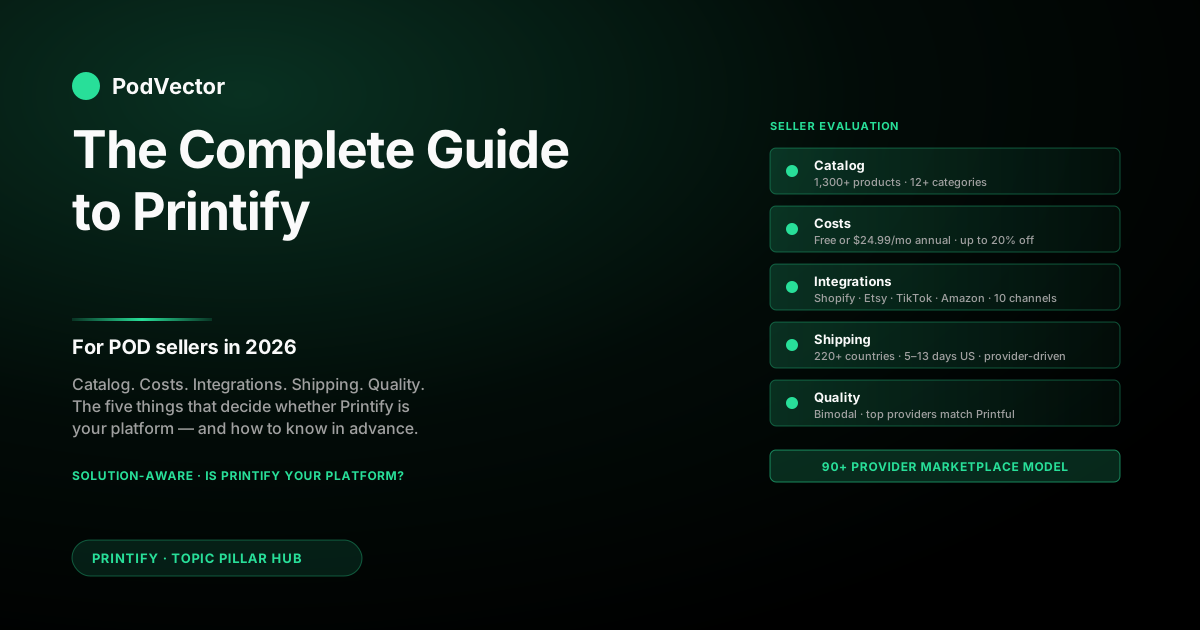
Quick Answer: Printify is the largest marketplace-style print-on-demand platform — 90+ third-party providers, 1,300+ products, integrations with Shopify, Etsy, eBay, Amazon, TikTok Shop, Walmart, Wix, Squarespace, WooCommerce, and BigCommerce. For a POD seller in 2026, Printify is best understood as a sourcing platform rather than a "printer": you pick a product, then pick which provider in Printify's network fulfills it, and that provider choice changes 10–30% of your landed cost.
The Free plan is genuinely free with no order limits; Premium is now $39/month or $24.99/month annual (after the February 17, 2026 price increase) and unlocks up to 20% off base costs. Printify is a strong fit for sellers who want maximum optionality, are willing to actively pick providers per SKU, and want to scale across multiple sales channels.
It's a poor fit for sellers who want a single-supplier "set it and forget it" experience (Printful is closer to that), or for sellers who refuse to do any provider-level sourcing work. This guide is the seller's master orientation: how Printify works, what it costs, who it fits, what its weak spots are, and where to go deeper on each cluster.
Why "Printify for sellers" is its own question
Most "Printify guide" content on the internet answers a different question than the one a real seller is asking. The high-traffic pages are either Printify's own onboarding funnel (which is conversion-optimized for "click sign up"), affiliate-driven reviews (which optimize for "click my Printify link"), or pricing breakdowns that stop at "$39/month, 20% off." Those resources answer "what is Printify?" reasonably well. They do not answer the seller's actual question, which is closer to: given my niche, my channel, my volume, and my margin tolerance, is Printify the right platform for me — and if it is, what do I need to set up to keep my margin honest?
This pillar is the seller-decision lens. It assumes you already know POD is real, you already know Printify is one of the major platforms, and you're trying to figure out whether it fits your specific situation.
If you want the platform-mechanics-only view ("what is Printify and how does it work mechanically"), the dedicated explainer sits at the complete Printify guide: what it is and how it works. If you want the pricing-only view, see the complete guide to Printify costs, fees, and discounts. This guide ties it all together for someone who's about to commit a year of their POD store to a platform decision.
The Printify decision in 60 seconds
If you only read one section of this article, read this one. The Printify decision is rarely as nuanced as long-form reviews make it sound. Most sellers fall into one of three buckets:
- Bucket A — Printify is the right call. You want a wide catalog, you're willing to learn provider-level sourcing, you sell across more than one channel (or plan to), and you care about landed cost more than about a single integrated supplier experience. Most Etsy/Shopify/TikTok-Shop sellers doing 30+ orders/month land here.
- Bucket B — Printful is the right call. You want one supplier, one shipping origin, one quality bar, and a slightly more polished customer experience. You're willing to pay 10–20% more on base cost for that consistency. New sellers and brand-first operators often start here.
- Bucket C — Gelato or a regional specialist is the right call. Your customers are predominantly in Europe, Asia, or Australia, and shipping costs/times from US-anchored providers eat your margin. Gelato's regional production network beats both Printify and Printful for non-US-heavy stores.
Most "Printful vs Printify" debates conflate these three buckets and turn into apples-to-oranges arguments. The honest answer is: each platform wins clearly for a defined seller archetype. The full head-to-head with realistic numbers lives in Printify alternatives: the complete comparison for POD sellers.
If you're in Bucket A, the rest of this guide gets you operationally productive. If you're in Bucket B or C, this guide is still worth skimming — Printify shifts often enough that re-evaluating annually is reasonable.
The five things sellers actually evaluate
Strip away the marketing copy and a Printify evaluation comes down to five questions. Every section that follows in this guide is one of these five expanded into operational depth.
| Question | Why it matters | Where Printify wins / loses |
|---|---|---|
| Can I sell what I want? | Catalog breadth determines niche optionality. | Wins. 1,300+ products, deepest catalog among major POD platforms. |
| What does it actually cost me per order? | Base cost + shipping + fees + plan fees compound across thousands of orders. | Wins on Premium with active provider sourcing. Loses on Free with default routing. |
| Will it plug into my sales channel? | Manual order entry is a death sentence at scale. | Wins. 10 native integrations covering ~95% of POD channels. |
| How long until my customer gets the product? | Production + shipping time = customer satisfaction and review velocity. | Mixed. Best US-provider speeds match Printful. Worst routes are slower. |
| What's the quality going to be like? | Variable quality kills repeat customers and triggers refund spikes. | Mixed. Top-tier Printify providers match Printful. Bottom-tier do not. |
Notice that Printify's wins are categorical (catalog, integrations, ceiling) and Printify's losses are operational (mixed quality, mixed speed). This is the central tension in the entire platform: Printify gives you the most levers, and the seller who pulls them carefully wins; the seller who doesn't pulls a random lever and gets a random result.
Catalog: what you can sell on Printify
Printify's 2026 catalog spans roughly a dozen top-level categories. Apparel still dominates — t-shirts, hoodies, sweatshirts, tanks, long sleeves, leggings, baby/kids apparel — and is also where the most provider competition lives, which keeps base costs sharp. Beyond apparel, the catalog covers drinkware (mugs, tumblers, water bottles), wall art (posters, canvas, framed prints), home goods (pillows, blankets, doormats, shower curtains), accessories (hats, bags, phone cases, jewelry), pet products, kids/baby, and a heavily seasonal lineup that Printify pushes hard in Q4 (ornaments, stockings, calendars).
The categorical breadth matters in two ways. First, it lets you build cross-sell bundles inside the same supplier ecosystem (a tee + a matching mug, a poster + a throw pillow).
Second, it lets you respond to seasonal demand without onboarding a second platform — a Q4 ornament drop is a few clicks, not a new vendor relationship. The trade-off is that quality variance widens with category breadth: Printify's top apparel providers are excellent, while Printify's mid-tier home-goods providers can be inconsistent. The right strategy is to pick three or four categories you'll go deep on, identify two or three providers per category that hit your quality bar, and ignore the rest.
The full breakdown of which products actually drive seller revenue, with provider-level recommendations, lives in the complete guide to Printify's most profitable products. For mockup tooling and design workflow inside Printify (Product Creator, AI image generation, mockup variants), see the complete guide to Printify tools and mockups.
Costs and margin reality
Printify costs are easy to misread because the marketing copy stops at "free to start" and the deeper math is buried. The honest accounting has four layers:
- Base product cost — what Printify (via the provider) charges you per unit. This varies 10–20% across providers for the same SKU.
- Shipping cost — charged per order, sometimes per item, varying by provider and destination. US-to-US ranges $4–$8 for first item; international $8–$18.
- Plan fee — $0 (Free), $39/month or $299/year (Premium), custom (Enterprise).
- Hidden costs — payment processing fees on Printify's charge-back to you, occasional currency-conversion spread, and reprint costs if you didn't enable auto-replacement for damaged orders.
For a $24.99 t-shirt sold on Etsy fulfilled by a typical Printify provider on the Free plan, the realistic landed cost is around $11–$14 (base) + $4.50 (shipping) = $15.50–$18.50, which leaves a gross margin of $6.50–$9.50 before Etsy's 6.5% transaction fee, $0.20 listing fee, payment processing (~3%), and any ad spend. Net margin per tee on the Free plan often comes in at $3–$5, before ad spend.
On Premium with active provider selection that same shirt can land closer to $13–$15.50 total cost, lifting net margin to $5–$8 per unit. The 20% discount sounds modest until you multiply it by a year of orders.
The full cost decomposition — base cost ranges by category, shipping tables by region, the Premium break-even calculation, and an itemized worked example — lives in the complete guide to Printify costs, fees, and discounts. The single most important thing to internalize is that Printify pricing is not a fixed cost; it's a function of the provider you pick, which means margin is partly an operational discipline rather than a platform fact.
Premium: when the math works
Printify Premium is the paid plan that unlocks up to 20% off the base cost of every product in the catalog, raises connected store limits from 5 to 10, and as of February 2026 bundles in Sellers Club Pro (community, monthly AMAs, niche playbooks). Pricing is now $39/month or $299/year (about $24.99/month) after the February 17, 2026 monthly-price increase from $29 to $39. Annual pricing was held flat through the change, which made the monthly-vs-annual gap large enough that the right answer for almost any committed Printify seller is annual.
The break-even logic is simple in form and slippery in practice. If your average order has $1.50–$2.00 of base cost in it that Premium would discount, you need ~13 orders/month to justify annual Premium and ~20 orders/month to justify monthly Premium.
But the average order varies wildly by what you sell — a high-margin, all-over-print or embroidery product gets you to break-even faster than a basic DTG tee, because the discount is a percentage of base cost and high-base-cost products generate larger absolute savings per unit. A multi-channel seller (Shopify + Etsy + TikTok Shop) hits break-even much faster because Premium discounts apply to every order from every connected store while you only pay one subscription fee.
The full Premium decision matrix — break-even by product category, the cancellation/downgrade mechanics, the distinction between Premium and Enterprise, and how to actually track whether Premium is paying off in your store — is in the complete guide to Printify Premium for POD sellers.
Integrations: where Printify plugs in
Printify's native integrations cover essentially every channel a POD seller cares about: Shopify, Etsy, eBay, Amazon (requires platform approval), TikTok Shop, WooCommerce, Wix, Squarespace, BigCommerce, and Walmart Marketplace. Connections are OAuth-based — minutes to set up, no API keys to manage.
Once connected, listings flow from Printify to the channel, and orders flow from the channel back to Printify. There is no manual order entry in steady state.
Three integration nuances are worth knowing before you commit:
- Free plan caps you at 5 connected stores. Premium raises that to 10. Enterprise is unlimited. Most single-brand sellers never approach the Free limit; multi-brand operators outgrow it quickly.
- Amazon and Walmart require platform-side approval. Printify's connector works fine, but Amazon and Walmart gatekeep new sellers separately. Plan a few weeks of approval lead-time on both.
- Cross-channel inventory is not unified. If a provider runs low on a variant, Printify doesn't proactively pull the listing across channels — you can ship out-of-stock orders and only catch the issue at fulfillment. Operationally, this is the most common surprise for new Printify multi-channel sellers.
The full integrations breakdown — channel-by-channel quirks, how the order-flow works for each, and how to design your store ID structure to avoid downstream pain — lives in the complete guide to Printify integrations for POD sellers.
Shipping and fulfillment timelines
Shipping is where Printify's marketplace model creates its widest variance. A US customer ordering a t-shirt from a Michigan-based Printify provider sees production + shipping totals of 5–8 business days end-to-end.
The same customer ordering the same shirt from a Latvian provider in Printify's network sees 14–25 business days. The customer doesn't know which provider you picked. The customer just knows it took three weeks.
Printify's averages, marketed as "5–13 business days US, 9–32 business days international," are honest in the aggregate but obscure the per-provider truth. The seller's job is to filter for providers whose stated production time + ship-from country create predictable delivery windows for the customers in your dominant geography. Most US-targeted sellers should default to US-based providers even if the base cost is slightly higher, because the customer-experience downside of a 3-week delivery (negative reviews, refund requests, reduced repeat purchase rate) outweighs a few cents of margin on each order.
The full shipping playbook — provider-by-region recommendations, how to handle international shipping cost-effectively, and how to set customer-facing delivery promises that match reality — is in the complete guide to Printify shipping for POD sellers.
Quality, profitability, and what to expect
Print quality on Printify is bimodal. The top tier of providers (Monster Digital, SwiftPOD, Print Geek, Marco Fine Arts, certain Bella+Canvas-licensed printers) produce results indistinguishable from Printful's in-house production — sharp DTG, accurate color, solid registration, durable wash performance. The bottom tier produces the kind of inconsistent print that fuels every "Printify quality is bad" review on Reddit.
You can pick which tier you ship from. Most beginners don't, and then attribute the result to "Printify."
The structural takeaway is that Printify's quality reputation is downstream of provider selection. If you treat picking providers as a one-time setup task — order a sample from your top three candidates per product, evaluate them as a real customer would, lock in the winner, and never use the others again — you eliminate the bottom of the distribution from your store entirely.
This is the same logic Amazon FBA sellers apply to supplier selection. Most POD sellers skip it.
For the deeper view of margin realities, profitability benchmarks by category, and how successful Printify sellers structure their economics, see is Printify profitable? The complete analysis for POD sellers and the complete Printify review: quality, costs, and real margins.
How Printify compares to Printful and Gelato
The three platforms most often weighed against Printify are Printful, Gelato, and Gooten. The shorthand:
| Platform | Model | Best for | Trade-off |
|---|---|---|---|
| Printify | 90+ provider marketplace | Catalog breadth, lowest landed cost with active sourcing, multi-channel scaling | Provider variance, requires sourcing discipline |
| Printful | Vertically integrated, in-house production | Brand-first sellers, single-supplier consistency, polished UX | 10–20% higher base costs |
| Gelato | Regional production network (32+ countries) | Non-US-heavy stores, EU/APAC customers, sustainability angle | Smaller catalog, less retail-ready integrations |
| Gooten | Curated supplier network with concierge enterprise focus | Mid-market and high-volume sellers, custom workflows | Higher operational lift, less self-serve than Printify |
Most sellers don't need to do head-to-head trial runs across all four. The pattern that works is to pick the platform whose model matches your operating style, learn it deeply, then add a second platform only when a specific gap forces you to (an EU customer base outgrowing US shipping, a category Printify doesn't carry, etc.). The full multi-platform comparison with realistic landed-cost math sits in Printify alternatives: the complete comparison for POD sellers.
Who Printify is right for (and not for)
Three seller archetypes describe most of the people for whom Printify is the right answer:
- The Etsy-anchored designer. Sells 50–500 orders/month across one or two niches. Designs in Kittl/Procreate/Illustrator. Operates lean, often solo. Premium pays back inside the first 30 days. Value driver: Printify's catalog depth lets the designer expand from tees into mugs, totes, posters without onboarding a second platform.
- The Shopify scaling brand. Built a brand identity, runs paid ads, expects 200–2,000 orders/month at maturity. Cares deeply about landed cost (because ads are expensive) and about consistent quality (because brand reputation is the asset). Premium is non-negotiable, provider sourcing is treated as ongoing operations.
- The multi-channel operator. Sells the same designs across Shopify, Etsy, TikTok Shop, and increasingly Amazon. Wants one supplier-side platform feeding all of them. Hits Premium break-even on the first channel and captures the multi-channel discount stack on every additional channel for free.
Three archetypes for whom Printify is the wrong answer:
- The first-time tester. Hasn't validated a niche, doing 0–5 orders/month, just exploring. Default to Free, but honestly, Printful's free tier is also fine here, and the slightly more polished UX may be worth the cognitive overhead saved during the learning phase. Either way, don't pay Premium yet.
- The brand purist. Wants every order to be visually identical, packaging-identical, every time. Printful's vertical integration produces this; Printify's marketplace model fundamentally cannot, even if you pick a single provider, because that provider can run out of stock and Printify will silently re-route.
- The non-US-dominant seller. If 60%+ of your customers are EU/APAC, Gelato's regional production beats both Printify and Printful on landed cost and shipping speed. Printify can serve EU customers (its EU-based providers are fine), but its strongest margin advantage is in US-to-US fulfillment.
The point of an archetype framework isn't to box anyone in — it's to short-circuit the universal "is Printify good or bad" debate that consumes a lot of seller-forum airtime. Printify is excellent for some sellers and wrong for others, and which side you're on is mostly knowable in advance.
The hidden complexity: visibility into your real margin
The deepest unsolved problem with Printify is not pricing, not quality, not shipping. It's visibility.
Printify shows you the gross transaction — what the customer paid, what the base cost was, what shipping cost. It does not show you your real per-order profit, because the real per-order profit lives at the intersection of Printify (cost), your sales channel (transaction fees, returns, refunds), your ad platform (spend, attribution), and your tax/VAT layer. Most sellers stitch this together once a month in a spreadsheet, and the stitching is so painful that the spreadsheet usually lags six weeks behind reality.
This visibility gap is the operational ceiling on Printify scaling. Sellers who genuinely understand their margin per SKU, per channel, per ad campaign make compounding decisions — they double down on winning SKUs, kill losing ones, raise prices where elasticity is low, and switch providers where landed cost has drifted.
Sellers who don't have that visibility flatten out. They ship products that are losing money and don't know it; they kill products that were quietly profitable and don't know that either.
Building a reliable margin tracker is its own multi-month engineering project that most POD sellers don't have time for. PodVector's AI agent Victor sits on top of Printify, your sales channels, and your ad spend, and answers margin questions against live data — what was my net margin on the Bella+Canvas tees on Etsy last week, which provider has gotten more expensive over the last 90 days, what's the actual ROAS on the TikTok Shop video that supposedly converted twelve orders.
The data layer is the same set of joins every successful seller eventually builds. Victor just builds it once for everyone. (For the underlying tracking architecture, see Printify + Shopify profit tracking: automating your analytics and PodVector pricing, features, and profit tracking for Shopify + Printify sellers.)
The Printify roadmap signal sellers should watch
Three Printify trajectories worth tracking through the rest of 2026 and into 2027 — each of them changes the seller calculus:
- Provider consolidation. Printify has been quietly tightening its provider network for the last 18 months — fewer providers, higher quality bars, more uniform print specs. This is good news for quality consistency and bad news for the deepest-discount sourcing strategies that depend on exotic low-cost providers.
- The Premium-as-floor pricing strategy. The February 2026 Premium price hike (from $29 to $39 monthly) without a matching annual increase is a clear push toward annual subscriptions. Expect more bundling into Premium (Sellers Club Pro was the first; expect more) and continued pressure on monthly billing as the "test" tier rather than the steady-state tier.
- AI-native creator tooling. Printify's AI image generator, AI title/description generator, and emerging "AI store builder" features are the platform's most active investment area. None of them are best-in-class today, but the trajectory is toward a Printify dashboard that handles more of the design/listing workflow internally rather than requiring external tools.
None of these trajectories changes the fundamental shape of the Printify decision in 2026, but each of them adjusts where the platform leans on the margins. A seller picking Printify in Q2 2026 should expect 2027 Printify to look modestly different on UX, slightly more consolidated on supply, and noticeably more expensive on monthly billing.
FAQs
Is Printify free to use?
Yes. The Free plan has no monthly fee, no credit card required at signup, and no order limit. You only pay Printify when an order is fulfilled (base product cost + shipping + payment processing). Premium ($39/month or $24.99/month annual) is optional and unlocks up to 20% off base costs.
Does Printify charge me or my customer?
Printify charges you, the seller. Your customer pays the retail price you set on your sales channel (Shopify, Etsy, etc.); Printify charges your connected payment method for the base cost, shipping, and any fees at the moment of fulfillment. The difference is your gross margin. The full breakdown is in does Printify charge you or the customer?.
How long does Printify take to ship?
Production takes 2–7 business days depending on the provider; shipping adds 3–10 business days domestic (US) and 7–21 business days international. The variance comes from which provider you pick — Printify's network spans Michigan, California, Latvia, the UK, China, and elsewhere. See how long does Printify take to ship for the full provider-by-region table.
Does Printify cost money to get started?
No. Free plan signup is genuinely $0 with no credit card. The first cost happens when you fulfill an order (base + shipping). You can build your entire store, design products, and connect your sales channels without spending anything. Detail in does Printify cost money to get started.
How much does Printify charge per shirt?
Base cost ranges $8.50–$11.50 for popular tees (Bella+Canvas 3001, Gildan 5000, Next Level 3600) on the Free plan, and roughly $7–$9.50 on Premium. Shipping adds $4–$5 for the first US item.
Specialty providers (heavyweight tees, organic cotton, all-over-print) run higher. The full per-shirt breakdown is in how much does Printify charge per shirt and Printify cost per sale: what sellers should expect.
Does Printify ship internationally?
Yes — Printify ships to 220+ countries. International shipping cost and time depends on which provider you pick and which corridor. EU customers ordered from EU-based providers see fast, affordable delivery; US-to-EU shipping from a US provider is slower and pricier. Full guide: does Printify ship internationally.
Where does Printify ship from?
Printify itself doesn't ship — its 90+ providers do, from facilities in the US (Michigan, California, North Carolina, Texas, Florida), Latvia, the UK, Czech Republic, China, Australia, and elsewhere. The shipping origin is determined by which provider fulfills the order. See where does Printify ship from for the full map.
How does Printify make money?
Printify earns the spread between what providers charge for base products and what Printify charges sellers, plus Premium subscription fees. Free-plan sellers subsidize Printify's revenue through the un-discounted base price; Premium sellers pay a flat fee in exchange for the discount. Walkthrough in how does Printify make money — and how can you.
Is Printify Premium worth it?
Yes if you're consistently doing 25+ orders/month, run higher-margin products, or operate multiple stores. No if you're testing a niche or doing under 10 orders/month. Full break-even math in is Printify Premium worth it for POD sellers.
How much does Printify cost overall?
Three layers: $0 plan fee on Free or $39/month (or $24.99/month annual) on Premium; per-order base cost ($8.50–$55+ depending on product); per-order shipping ($4–$18 depending on origin and destination). Full cost decomposition in the complete guide to Printify costs, shipping, Premium, and profitability.
How is Printify different from Printful?
Printify is a marketplace of 90+ third-party providers; Printful is vertically integrated and runs its own production facilities. Printify wins on catalog breadth and landed cost; Printful wins on consistency and a more polished single-supplier experience.
Most sellers will be best served by one, not both. Head-to-head in Printify alternatives: the complete comparison for POD sellers. For external context, the Merch Titans 2026 Printify review goes deep on per-product quality if you want a second perspective before committing.
Can I use Printify with multiple sales channels at once?
Yes — and this is one of Printify's strongest plays. Free supports 5 connected stores, Premium supports 10, Enterprise is unlimited. The same Premium discount applies to every order from every connected store, so multi-channel sellers hit Premium break-even much faster than single-channel sellers.
What's the catch with the Free plan?
None operationally — it's genuinely free, no order limits, no time limits. The "catch" is economic: you pay non-discounted base costs, which on volume becomes more expensive than the Premium subscription fee. Free is the right plan for testing, learning, and validating; Premium is the right plan for serious operations.
Ready to know what Printify is actually making (and losing) you?
Printify shows you base cost. Your sales channel shows you transaction fees. Your ad platform shows you spend. Your bank shows you what's left. Stitching them together to get a real per-order, per-SKU, per-channel margin is the work nobody has time for. PodVector's AI agent Victor connects your Printify account, your Shopify/Etsy/TikTok sales, and your ad spend, then answers margin questions against live data — instantly, in plain English, on demand.
Try Victor free