
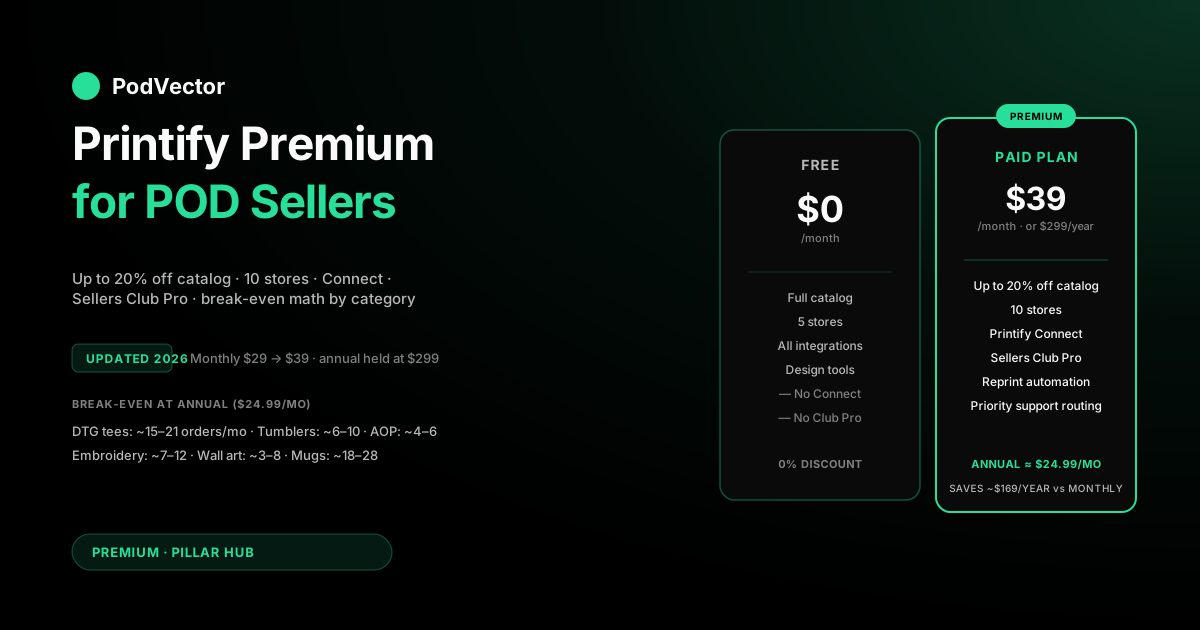
Quick Answer: Printify Premium is Printify's paid plan: $39/month after the February 17, 2026 price hike, or $299/year (about $24.99/month) if you pay annually — annual pricing was held flat through the increase. You get up to 20% off the entire Printify catalog, support for 10 stores, the Printify Connect customer-service tool, and as of 2026, Sellers Club Pro is bundled in (community + coaching + events).
Break-even on monthly billing is roughly 20 orders/month if you average $1.50–$2.00 of base-cost savings per order; on annual billing it's closer to 13 orders/month. Premium is worth it if you're consistently doing 25+ orders/month, run higher-margin products (mugs, tumblers, all-over-print, embroidery), or operate multiple stores.
It's not worth it if you're testing a niche, doing under 10 orders/month, or only selling DTG tees from the cheapest blanks. The decision matters less than the per-SKU margin tracking it requires — most Premium subscribers can't actually answer "did Premium net out positive last month" because their data lives in five places. That tracking gap is the real upgrade.
What Printify Premium is in 2026
Printify Premium is the paid tier of Printify's two-plan structure (Free and Premium). Enterprise is a separate, invitation-only third tier reserved for sellers doing roughly $1M+/year in Printify volume — the average POD seller never touches it. So in practical terms, "Premium" is the only paid plan most readers will ever consider.
Premium's positioning is simple: pay a monthly fee in exchange for a flat percentage discount on the base cost of every Printify product, plus a handful of operational features (more stores, the Printify Connect customer-service layer, and now community/coaching access). It's a margin-improvement subscription.
Unlike Printful's Growth plan — which Printful turns into a free tier once you cross $12K in trailing 12-month sales — Printify Premium does not become free at any volume threshold. You pay until you cancel, no matter how big you get. (Enterprise, again, is a separate negotiation.)
If you're earlier in the Printify research process and want the parent context, the broader picture lives in the complete Printify guide: what it is and how it works. For a head-to-head against Printify's main competitor and how Premium compares to Printful's tiered plans, read the complete guide to Printful Premium, Plus, and Pro memberships. For the full cost picture beyond just Premium — base prices, shipping, transaction fees — see the complete guide to Printify costs, fees, and discounts.
Premium pricing: monthly, annual, and the February 2026 change
Here's the pricing structure as of April 2026:
| Plan | Price | Effective per-month | Note |
|---|---|---|---|
| Free | $0 | $0 | Up to 5 stores, full catalog at standard base prices |
| Premium (monthly) | $39/month | $39 | Increased from $29 on February 17, 2026 |
| Premium (annual) | $299/year | ~$24.99 | Held flat through the 2026 price change — best value |
| Enterprise | Negotiated | Custom | Invitation-only, $1M+/year in volume, dedicated account team |
The annual-vs-monthly gap widened sharply with the February 2026 increase. Before the change, the $29 monthly was about $48/year more expensive than annual. After the change, the $39 monthly is about $169/year more expensive than annual — a $14/month penalty for the flexibility of paying month-to-month. If you've decided Premium makes sense at all, the annual plan is the obvious move; the monthly plan is now mostly a trial-extension tool for sellers who want a few months to confirm the math before committing for a year.
Printify positioned the monthly increase as funding the 2026 expansion of Premium benefits (Sellers Club Pro inclusion, Printify Connect upgrades, expanded discount range on certain SKUs). Whether the new value matches the new price depends entirely on your category mix, which the break-even math below digs into.
What you actually get with Premium
Premium's benefit list is short, which is good — there's nothing buried in fine print. Here's everything that switches on when you subscribe:
| Benefit | What it means | Free | Premium |
|---|---|---|---|
| Catalog discount | Up to 20% off base cost on most products | 0% | Up to 20% |
| Store limit | Number of connected sales channels (Shopify, Etsy, etc.) | 5 | 10 |
| Printify Connect | Customer-facing order portal — reprints, tracking, reviews | — | Included |
| Sellers Club Pro | Private community, expert AMAs, exclusive events (added 2026) | — | Included |
| Self-serve support | Help center, chat for order issues | Yes | Yes (priority routing) |
| API access | Full Printify API, webhooks, integrations | Yes | Yes |
A few notes on the discount mechanic, because the "up to 20%" wording trips people up:
- "Up to" is real. The 20% is the ceiling, not the average. Apparel from Printify's most popular providers (Monster Digital, MWW, Sensaria) hits the full 20%. Some providers and SKUs land in the 10–18% range. Premium pricing is shown alongside Free pricing in the catalog, so you can verify per-SKU before you commit.
- The discount applies to base product cost only. Shipping is unchanged. Provider-specific add-ons (folded packaging, certain inserts) are unchanged.
- Provider matters more than category. Two suppliers offering the "same" Bella+Canvas 3001 tee can have different Premium discount percentages depending on their pricing arrangement with Printify. The published tier is the floor; per-SKU is the truth.
Printify Connect is the most-overlooked benefit. It's a customer-facing portal that lives at a Printify-hosted URL your buyers can use to track orders, request reprints, or leave reviews — it removes a significant chunk of buyer-facing support work for stores that don't have their own customer-service infrastructure.
For solo sellers running 50–200 orders/month, the operational savings can outweigh the discount savings. For sellers already running Gorgias or Zendesk, Connect is mostly redundant.
What's new in 2026: Sellers Club Pro and beyond
The 2026 Premium overhaul did three things:
- Bundled Sellers Club Pro into every Premium subscription. Sellers Club Pro had previously been a separate community/coaching product Printify ran for higher-volume sellers. As of February 2026, every Premium subscriber gets it included: private community access, monthly AMAs with operators doing $1M+ in POD revenue, niche-specific playbooks, and exclusive event invitations. The standalone retail price of Sellers Club Pro before the bundle was around $20/month — Printify's framing of the price increase is essentially "we raised Premium by $10 and added something previously valued at $20."
- Expanded the discount range on certain SKUs. A handful of high-volume blank apparel SKUs got Premium discounts pushed from the standard tier into a deeper tier (sometimes labeled "33% off new items" in Printify's marketing) — typically newly added catalog items or SKUs Printify is trying to push volume through. The 20% headline figure still describes most of the catalog.
- Upgraded Printify Connect with reprint-flow automation. Connect now handles the full reprint conversation end-to-end (claim submission, photo upload, approval, fulfillment trigger) without requiring seller intervention for clean cases. For a store doing 100+ orders/month with a 3% reprint rate, this saves several hours per week of customer-service triage.
What didn't change: the discount structure on standard apparel, the store limit (still 10), and the absence of any priority fulfillment or guaranteed production-time benefit. Premium is still a discount-and-tooling subscription, not a fulfillment-priority one.
Free vs Premium: the line-by-line comparison
The cleanest way to think about Free vs Premium is per-order economics. Take three representative SKUs and walk the math:
| SKU | Free base | Premium base | Saved per order | Orders to break even (annual) |
|---|---|---|---|---|
| Bella+Canvas 3001 tee (Monster Digital, US) | $8.65 | ~$6.95 | $1.70 | ~147/year (~13/month) |
| 11oz ceramic mug (District Photo) | $6.10 | ~$4.90 | $1.20 | ~209/year (~18/month) |
| 20oz tumbler with handle (Underground Printing) | $15.20 | ~$12.20 | $3.00 | ~83/year (~7/month) |
| All-over-print hoodie (Subliminator) | $29.50 | ~$23.60 | $5.90 | ~42/year (~4/month) |
| Embroidered cap (MyLocker) | $11.90 | ~$9.50 | $2.40 | ~104/year (~9/month) |
The pattern jumps out: the higher the base cost, the faster Premium pays off. Sellers focused on cheap-blank DTG tees need volume; sellers running tumblers, all-over-print, or embroidery hit break-even with a third of the orders.
Two practical implications most pricing guides skip:
- Premium changes which products are worth listing. A 22oz insulated bottle that's break-even on Free (after ad spend and platform fees) becomes profitable on Premium because the $4–5 base savings compounds over a campaign's order count. Some sellers expand their catalog after subscribing rather than just discounting existing SKUs.
- Multi-store sellers compound the savings. If you run a Shopify storefront, an Etsy shop, and a TikTok Shop, the same SKU sold on three channels accrues three times the Premium savings — but you only pay one $39 (or $24.99) subscription. The store-limit jump from 5 to 10 is mostly cosmetic for solo operators, but the per-order discount stacking across stores is the real hidden ROI.
For a more granular per-shirt cost breakdown, the dedicated piece is how much does Printify charge per shirt. For the focused "is the upgrade worth it" question with shorter math, see is Printify Premium worth it for POD sellers and the deep-dive at how much is Printify Premium.
The break-even math by product category
The simplest break-even formula is:
orders_to_break_even = subscription_cost ÷ savings_per_order
At the $24.99/month annual rate, that's:
| Category | Typical savings/order | Monthly orders to break even | Profit-positive at... |
|---|---|---|---|
| DTG t-shirts (cheap blanks) | $1.20–$1.70 | 15–21 | 25+ orders/month |
| DTG t-shirts (premium blanks like AS Colour) | $2.00–$2.80 | 9–13 | 15+ orders/month |
| Mugs (11oz, 15oz) | $0.90–$1.40 | 18–28 | 30+ orders/month |
| Tumblers (insulated, 20–30oz) | $2.50–$4.00 | 6–10 | 12+ orders/month |
| All-over-print apparel | $4.00–$7.00 | 4–6 | 8+ orders/month |
| Embroidered hats and polos | $2.00–$3.50 | 7–12 | 15+ orders/month |
| Phone cases | $2.20–$3.50 | 7–11 | 15+ orders/month |
| Wall art (canvas, framed posters) | $3.00–$8.00 | 3–8 | 10+ orders/month |
At $39/month (monthly billing), every break-even number above multiplies by ~1.56. A DTG-tees seller needs 24–33 orders/month at monthly billing where they'd need 15–21 at annual. The case for annual billing is strongest in exactly the categories where the discount itself is weakest.
One trap: these numbers assume you actually capture the discount on every order. If you launch Premium on day one of the month and your campaign doesn't land until day 18, you're paying for the subscription against a half-month of discounted orders.
Premium is not a free upgrade — it's a margin improvement on orders you were going to get anyway. If your existing monthly order count is below break-even, wait.
How to decide whether to upgrade
The honest five-line decision matrix:
| If you are... | The right move is... |
|---|---|
| New seller, fewer than 10 orders/month, testing niches | Stay on Free. Spend the $25–$39/month on ad testing instead. |
| 10–25 orders/month, mostly DTG tees, single store | Borderline. If your category mix skews toward higher-base SKUs (tumblers, AOP), upgrade to Premium annual. If pure cheap-blank tees, wait. |
| 25+ orders/month, any product mix | Premium annual. Break-even is locked in within the first three weeks; the rest of the year is margin. |
| Selling tumblers, all-over-print, or embroidery at any volume | Premium annual. Per-order savings hit break-even in 4–10 orders depending on category. |
| Running 6+ stores | Premium annual. The 5-to-10 store limit alone justifies it before discount math even enters the equation. |
| Selling on Printify, Etsy, Amazon, and TikTok Shop with the same SKUs | Premium annual. Multi-channel discount stacking compounds — same subscription, multiple times the savings. |
| Doing $80K+/year through Printify | Premium annual now. Ask Printify support about Enterprise once you're consistently above $1M trailing 12-month. |
Two anti-patterns to avoid:
- Subscribing to Premium before you have consistent order volume. The 3-day or 30-day promotional trial sounds like enough time to decide, but a brand-new store with no proven traffic is betting on orders that may not materialize. Hit a baseline of 15–20 orders/month on Free first, then upgrade to lock in the savings.
- Staying on Free past 30 orders/month "just in case." At 30 monthly orders across a typical product mix, you're leaving roughly $30–$80/month of margin on the table by not subscribing. The opportunity cost compounds — six months of "I'll upgrade next month" is $200–$500 of vanished margin.
For a focused decision read on the same question framed for product-aware shoppers, see Printify Premium: is it worth it? and is Printify Premium worth it?.
Free trials, promo codes, and how to test Premium without committing
Printify doesn't publicly advertise a standing free trial for Premium, but in practice three trial paths exist:
- The 3-day in-app trial. When you click "Upgrade to Premium" inside the dashboard, some accounts see a 3-day trial offer. It's enough to verify the discount applies to your actual catalog and to test Printify Connect on a live order. Not long enough to verify break-even math.
- 30-day promotional codes. Codes like FP30 (and seasonal variants Printify pushes through email and partner blogs) extend the trial to 30 days. These rotate — what worked in Q1 2026 may not work in Q3. Search Printify's official social channels and partner content for the current code rather than trusting unmaintained third-party lists.
- Annual plan as a "trial." Counterintuitive, but the cleanest way to test Premium honestly is to start on monthly billing, run for 60 days while you measure actual savings, then either downgrade or move to annual. The $39/month for two months ($78 total) is your test budget. If month-1 and month-2 both show clear net-positive economics, switch to annual and capture the lower per-month cost going forward.
What to measure during a trial: per-SKU base-cost savings against actual orders that month, change in customer-service ticket volume if you turn on Printify Connect, and whether the 6th–10th store slots actually unlock new channel revenue or just more places to maintain the same products. The "store limit jump" benefit is theoretical until you fill the slots.
Cancellation, downgrades, and what happens to your stores
Cancelling Premium is a one-click operation in Settings → Plan. A few mechanics worth knowing:
- Mid-cycle cancellation. You stay on Premium through the end of the current billing period (month or year), then drop to Free. Discounts revert immediately on the rollover date.
- Annual plan cancellation. You don't get a refund for unused months on annual. You can cancel future renewal but you keep Premium access until the year ends.
- What happens to stores 6–10. If you have more than 5 stores connected when you drop to Free, your existing stores stay connected, but Printify will eventually require you to either remove the over-limit stores or upgrade back to Premium. There's a grace period (typically 30 days) but it's not guaranteed long-term.
- Printify Connect. Goes dark on Free. Existing customer order links continue working for in-flight orders but new orders won't generate Connect URLs.
- Sellers Club Pro access. Revoked at end of billing period. Community membership is tied to active Premium status.
- Products and listings. All your designs, mockups, integrations, and product listings remain intact. The plan affects pricing and limits, not your data.
For the step-by-step cancellation walkthrough including how to handle the over-limit stores, see how to cancel Printify Premium (step-by-step).
What Premium doesn't fix
Premium improves unit economics. It doesn't solve the things that actually break POD stores:
- Slow shipping. Premium has no priority-fulfillment benefit. A Premium order and a Free order from the same provider go through the same production queue.
- Bad ad economics. A 20% cheaper base on a Shopify DTG tee is meaningless if your CAC exceeds retail price minus the new base. Premium discounts can't fix unprofitable traffic.
- Returns and reprint costs. Premium doesn't reduce reprint base costs (though Printify Connect reduces the labor cost of handling them). A 5% misprint rate eats the same dollars on Free or Premium.
- Platform fees. Etsy's 9–12% transaction fees, Shopify's $29–$399/month, Amazon's 15% referral, TikTok Shop's 5–8% — none of these are affected by your Printify plan. For the broader platform-cost picture, see the complete guide to Printify integrations for POD sellers.
- Pricing pressure from competitors. A 20% lower base is also 20% of room to underprice your competitors — and a lot of Premium subscribers spend the discount to drop retail rather than keep margin. That's a strategy choice, not a Premium feature.
- Per-order margin visibility. This is the one most directly undermines Premium's value: if you can't see Printify base + ad spend + platform fee stacked against a specific order's retail, you can't tell whether Premium is paying for itself on that order. Most POD dashboards show revenue. Few show margin at item level.
Tracking whether Premium is paying off
The question every Premium subscriber should be able to answer in under 30 seconds is: "did Premium's discounts exceed the $24.99 (or $39) fee this month?" In practice almost no one can. The data is spread across Printify's cost reports, your channel's payout reports (Shopify Payments, Etsy deposits, TikTok Shop settlements, Amazon disbursements), ad-platform invoices, and any add-on fees.
Stitching that together once per month is a spreadsheet exercise that gets postponed until quarter-end. Stitching it together per order to know which products are actually profitable is infrastructure work most stores never do.
This is the gap Victor, PodVector AI's AI employee, closes. Victor sees your real Printify costs, your sales from every channel, your ad spend down to the product, and your platform fees, all together in one place. That means he can answer margin questions with real numbers instead of rough guesses. "Did Premium's 20% discount net out positive in March?" becomes a one-question answer instead of a spreadsheet build. "Which of my SKUs would still be profitable if I downgraded back to Free?" gets answered just as fast. He can also break the numbers down store by store, so you can see exactly where stacked discounts across channels are costing you money.
Victor answers; he can also act on the answer with your approval — pause unprofitable Meta ad sets automatically, flip SKUs to a cheaper provider when the Premium discount tightens, or trigger a creative refresh when a category's repeat-purchase curve suggests fatigue rather than a traffic problem. The Premium subscription is one input to the profit equation.
Most sellers optimize the input in isolation. The sellers who scale optimize the whole equation.
If you want the broader profit-tracking context before Premium specifically, the cluster pillar at the complete Printify guide sets the stage, and Printify alternatives covers where Premium sits competitively. For the original announcement of the 2026 Premium changes from Printify themselves, see Printify's own Premium overview.
FAQs
How much does Printify Premium cost in 2026?
$39/month (monthly billing) or $299/year (annual billing, equivalent to about $24.99/month). The monthly price increased from $29 on February 17, 2026; the annual price was held flat through the change.
Is Printify Premium worth it?
It depends on your monthly order volume and product mix. At 25+ monthly orders across a typical mixed catalog, annual Premium pays for itself by about week three of the year.
Below 15 monthly orders on cheap-blank DTG tees only, it doesn't. Higher-base products (tumblers, all-over-print, embroidery) hit break-even faster — sometimes in fewer than 10 orders/month.
What's the difference between Free and Premium?
Premium gives you up to 20% off the entire Printify catalog, raises the connected-store limit from 5 to 10, includes Printify Connect (the customer-facing order portal), and bundles Sellers Club Pro (community + coaching). Free gives you the full catalog at standard prices, 5 stores, full API access, and the design tools — everything except the discount and the Connect/Club layer.
Does Printify Premium have a free trial?
Sometimes. A 3-day in-app trial appears for some accounts when they click "Upgrade to Premium." Promotional codes (e.g., FP30 in past cycles) have offered 30-day trials in specific campaigns. Both rotate and aren't guaranteed. The cleanest way to test Premium without commitment is one or two months on monthly billing, then evaluate.
Does Premium include faster shipping?
No. Premium has no priority-fulfillment or production-time benefit. Shipping speed is determined by product, provider, and carrier — not by your subscription tier.
Can I cancel Premium anytime?
Yes. Monthly subscribers stay on Premium through the end of the current month and drop to Free at rollover. Annual subscribers can cancel future renewal but keep Premium until the year ends — there's no partial-year refund.
What happens to my extra stores if I downgrade?
Free is capped at 5 stores. If you have 6–10 connected when you downgrade, Printify gives a grace period (typically about 30 days) to either remove the over-limit stores or re-upgrade. Existing orders continue processing during the grace period.
Does Premium discount apply to shipping?
No. Premium's "up to 20% off" applies to base product cost only. Shipping rates are unchanged on Free and Premium.
Is Sellers Club Pro really included now?
Yes, as of the February 2026 Premium update. Every active Premium subscriber gets Sellers Club Pro access bundled at no additional cost — community access, monthly AMAs, niche playbooks, and event invitations. It was previously a separate paid product.
Should I pay monthly or annually?
Annual, almost always, if you've already decided Premium makes sense. The annual plan ($299/year, or about $24.99/month) is roughly $169/year cheaper than monthly billing at the new $39 monthly rate. The only reason to choose monthly is if you're using the first month or two as an honest test.
Does Premium work across multiple sales channels?
Yes — and this is where the math gets interesting. The Premium discount applies to every order from every connected store, but you only pay one subscription. A seller running the same SKUs on Shopify, Etsy, and TikTok Shop captures the discount three times for one $24.99–$39 monthly fee, which is why the multi-channel break-even is dramatically lower than the single-store calculation suggests.
What's Printify Enterprise and how is it different?
Enterprise is Printify's third tier — invitation-only, designed for sellers doing roughly $1M+/year in Printify volume. It includes deeper discounts, dedicated account management, custom payment terms, and SLAs that Premium doesn't offer. Pricing is negotiated. The average POD seller never reaches Enterprise; Premium is the practical ceiling for most stores.
Want to know if Printify Premium is actually paying off in your store?
Premium saves money on paper. The question is whether it's saving money on your orders, against your ad spend, on your channels. PodVector AI's AI agent Victor connects your Printify account, your Shopify sales, and your Meta and Google ad spend, then answers margin questions against live data — per order, per SKU, per channel. Stop stitching reports together once a month.
Try Victor free