
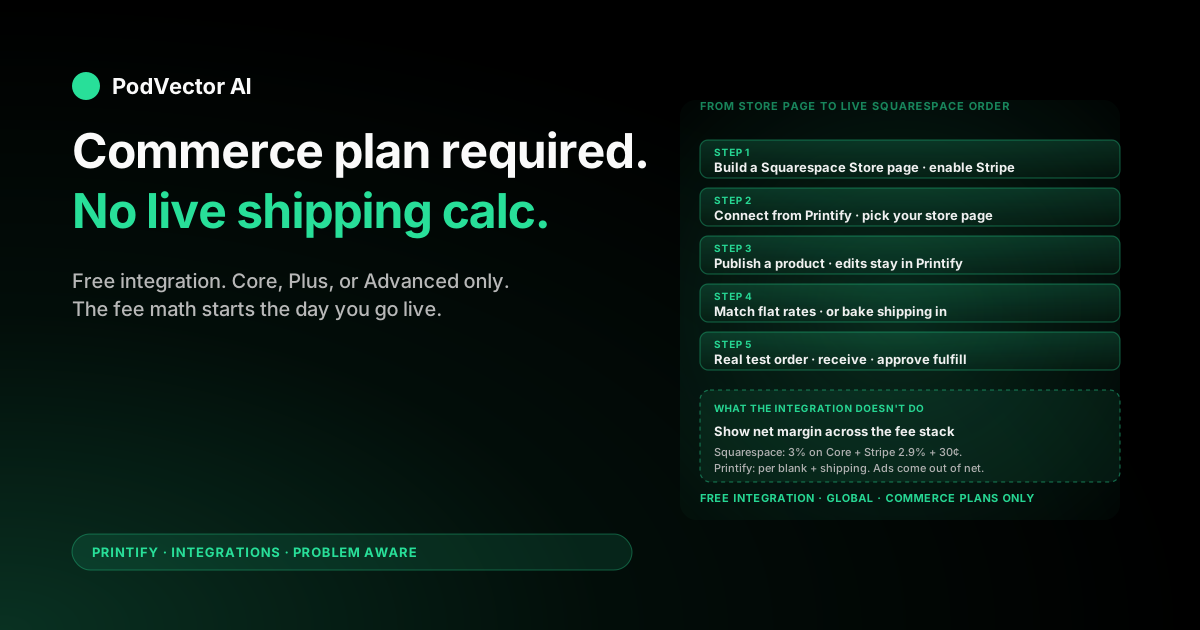
Quick Answer: Connecting Printify to Squarespace is free, but it only works on a commerce-tier Squarespace plan (Core, Plus, or Advanced under current naming — Business, Basic Commerce, or Advanced Commerce under the legacy plans). The handshake itself takes about 15 minutes once your store page is built.
The setup is straightforward. The part that catches first-time sellers is that Squarespace handles checkout and payments while Printify handles production — and the two systems don't share a single source of truth for shipping rates, transaction fees, or per-order margin.
This guide walks through the plan choice, the connection, your first product, shipping, a live test order, and what to track once orders start flowing.
What the Printify–Squarespace integration actually does
The integration is the official link between a Squarespace storefront and Printify's print-on-demand network. Once connected, Printify becomes the production back-end for any product you publish into your Squarespace store.
It does three things. It pushes products you build in Printify into Squarespace as live store items with images, variants, and prices. It listens for orders on those items and routes them to the print provider you picked. It pushes tracking back to Squarespace so the buyer sees normal Squarespace order-status emails.
Squarespace owns the customer experience. Your storefront design, checkout, payments, email list, and analytics all live on the Squarespace side. Printify never touches the buyer — they only see Squarespace branding. Whether that division of labor is the right tradeoff for your store is a separate question from whether the mechanical setup works.
If you're still deciding between Printify and other POD platforms, our comparison of other sites like Printify and other places like Printify cover the alternatives in more detail.
Before you connect: plan choice and prerequisites
This is the part most guides hand-wave on. Squarespace integration only works on certain plans, and picking the wrong one means the Printify connect button silently fails.
Here's the list:
- A commerce-tier Squarespace plan. Under current Squarespace naming: Core, Plus, or Advanced. Under legacy naming you may still see: Business, Basic Commerce, or Advanced Commerce. The cheapest "Personal" plan does not support third-party commerce integrations.
- A Squarespace store page already created. The integration connects to a specific Store page within your site, not to your site as a whole. You build the page first, then connect.
- A Squarespace payment processor enabled. Stripe is the default; PayPal is supported as a second option. Without a payment processor, your checkout loads but rejects every order.
- A Printify account. Free to create. Free plan supports up to 5 connected stores; Premium supports 10.
- A payment method on file in Printify. Credit card or PayPal. Printify charges this card per order when production starts — it's separate from how you get paid in Squarespace.
- One design and one product ready. Don't connect a blank store. Have a starter product so you can test the full pipeline end-to-end within an hour of connecting.
On the Squarespace plan question: if your store is doing under $5K/month, Core (or Business under legacy naming) is fine. The 3% Squarespace transaction fee on Core hurts at higher volume — Plus and Advanced drop that to 0%, and the math flips somewhere around $3–5K monthly revenue depending on your average order value.
If you're already on Wix, Etsy, or Shopify and weighing Squarespace, sleep on it before switching — migrating product listings between platforms is annoying and breaks SEO. The integration itself is free either way.
Step 1: Build your Squarespace store page
Printify needs an existing Store page to connect to. You can't skip this step and create the page during the handshake.
- Log into Squarespace. Open the website you'll be using for your POD store.
- Add a Store page. Click the + button next to your main navigation, scroll the page types until you see Store, and click it. Squarespace creates an empty Store page.
- Configure store details. Click the gear icon on the new page to open settings. Set the storefront name, URL slug, page status (publish or draft), and category structure. Fill in the SEO title and description while you're there — Squarespace pulls these directly into the page metadata, and rewriting them later is tedious.
- Enable a payment processor. Go to Selling → Payments and connect Stripe (or PayPal). Without this, the connection to Printify still works but live orders fail at checkout.
- Set your store currency. Squarespace stores are single-currency only — pick the one your buyers pay in. Changing currency later is a manual rebuild.
Total time: 10–15 minutes if you have your branding and SEO copy decided. Longer if you're designing the store page from scratch.
Step 2: Connect Printify to Squarespace
With your Squarespace store page live, the actual integration is the shortest part of the whole process.
- Log into Printify. Go to printify.com and sign in. If you don't have an account, sign up — it's free.
- Open the store menu. Click the dropdown in the top-left of the Printify dashboard and select Manage my stores.
- Click "Add new store." A list of integration options appears — Shopify, Etsy, eBay, WooCommerce, Squarespace, TikTok Shop, and others.
- Pick Squarespace. Click the Connect button under the Squarespace card.
- Authorize access. Squarespace shows a permission prompt asking whether to grant Printify access to your account. Click Allow.
- Select your store. The next screen shows a dropdown of every store page across every site on your Squarespace account. Pick the store page you built in Step 1.
- Confirm. Click Continue. Printify shows the store now connected in Manage my stores.
If the dropdown is empty, you skipped the Squarespace Store page setup or you're on a non-commerce plan. Go back to Step 1.
If you'd rather skip Squarespace entirely and host on a different storefront, our Printify + Etsy setup guide covers the Etsy path end-to-end.
Step 3: Publish your first product
The connection is live, but Squarespace still shows zero products. You need to push one through to confirm the data path actually works.
- Open the Printify catalog. From the dashboard, click Catalog. Pick a starter — a unisex T-shirt is fastest because shipping rates are well-defined for most regions.
- Pick a print provider. Each provider has its own cost, shipping speed, and quality profile. Sort by location closest to your target buyers; international shipping is where margins die quietly.
- Upload your design. Drag a PNG with a transparent background onto the mockup. Keep file size under 500 MB — Squarespace enforces that limit and Printify will reject anything larger at publish time.
- Add product information. Title, description, and tags. Don't skip the description — both Squarespace's internal search and Google's index pull from it.
- Set retail price. Printify shows your production cost; you set the retail price. The default 40% margin is a starting point, not a strategy — see the fee section below for what to actually price for.
- Click "Publish to Squarespace." The product syncs to your Squarespace store. Default visibility is Visible — flip it to Hidden first if you want to review the Squarespace-side listing before going live.
- Verify in Squarespace. Within a minute or two, the product appears under your Store page in Squarespace with all variants and images synced.
If the product doesn't show within 5 minutes, the usual cause is a missing required field on the Printify side. Re-open the product, check that every required field (especially the product description) is filled, and republish.
Once edits land on the Squarespace side, do not edit them in Squarespace. The integration is one-way for product updates: Printify → Squarespace. Editing in Squarespace creates a sync mismatch that breaks the next push. Make changes in Printify and republish.
Step 4: Set up shipping rates
This is the setting that quietly kills more POD stores than any other. Squarespace charges the buyer whatever your shipping rates say at checkout. Printify charges you whatever its real shipping cost is per order. If those numbers don't line up, you eat the gap on every sale.
Unlike Shopify, Squarespace does not support a live shipping calculator from Printify. You only have two options.
Option 1: Match Printify's flat rates inside Squarespace
Read Printify's regional flat-rate table for the product type you're selling, then rebuild those rates in Squarespace under Selling → Shipping. Buyers see flat rates per region (e.g., $4.99 for US standard, $12.99 for Canada, $16.99 international). Your checkout charges that. Printify charges you the same.
Best for: stores selling one or two product categories where Printify's rates are reasonably stable across SKUs.
Option 2: Bake shipping into the product price
You set Squarespace shipping to "free" (or a flat token amount like $2) and absorb the real Printify shipping cost into your retail price. Buyers see "free shipping" at checkout, which converts better than seeing a separate line item.
Best for: stores already pricing above the bare-minimum Printify cost and willing to do the math per SKU. Risky for non-US-bound orders, because international Printify shipping can hit $10–15 even on light goods — run the math on your worst-case destination before flipping this on.
Whatever you pick, write the rates down somewhere you'll see them again. Printify updates its shipping tables a few times a year, and a $1 increase on a US flat rate quietly turns into a $1-per-order margin loss until you notice.
Step 5: Place a real test order
Do not run ads before a real test order has gone through your Squarespace checkout and produced a tracking number from Printify. The most expensive way to find a broken integration is to find it from a refund request.
- Add the test product to cart on your live Squarespace store. Use a real address — your own.
- Check out and pay. Use a real card. You'll refund yourself later.
- Confirm Squarespace shows the order paid. Within seconds, the order should appear under Selling → Orders.
- Confirm Printify received the order. Within a minute, the order should appear in Printify under My orders with status "Awaiting payment" or "In production." If it's not there after 5 minutes, the order didn't sync — fix that before doing anything else.
- Approve production. Some configurations require manual approval; flip the auto-fulfill setting on once you're past testing.
- Wait for the tracking number. Printify pushes tracking back to Squarespace when the print provider hands off to the carrier. Squarespace emails the buyer automatically.
- Receive the product. Hold it. Verify the print quality matches the mockup. The first physical sample tells you more about your print provider than any review will.
How orders flow once you're live
Once the integration is live, the order flow is automatic — but knowing each step matters when something breaks.
- Buyer checks out on your Squarespace store.
- Squarespace captures payment via Stripe or PayPal.
- Squarespace pushes the order to Printify.
- Printify charges your payment method on file for production + shipping cost.
- The print provider produces and ships the order.
- Printify pushes the tracking number back to Squarespace.
- Squarespace emails the buyer their tracking number.
You're paid via Squarespace (less Stripe's transaction fees, less any Squarespace transaction surcharge on your plan). You pay Printify out of band, via the card on file. The gap between what you collect and what you pay is your gross margin — before ad spend.
That out-of-band charging is what makes margin tracking hard. Squarespace shows revenue. Printify shows production cost in a different system. Neither shows the other.
The fee stack: what Squarespace and Printify each take
Run this math on every product before you list it. Most first-time sellers price for Printify's cost only and discover Squarespace's cut on their first $1K month.
| Cost | Who charges it | Typical rate (2026) |
|---|---|---|
| Squarespace subscription | Squarespace | ~$23/mo (Core) → ~$99/mo (Advanced), annual billing |
| Squarespace transaction fee | Squarespace | 3% on Core/Business; 0% on Plus and Advanced |
| Stripe payment processing | Stripe (via Squarespace) | 2.9% + 30¢ per US card transaction |
| Printify production cost | Printify | Per-item, varies (e.g., ~$9.30 for a Bella+Canvas 3001 T-shirt) |
| Printify shipping | Printify | $4–8 US, $10–20+ international |
| Printify Premium (optional) | Printify | $14.99/mo for a 20% production discount |
| Ad spend | Meta, Google, TikTok, etc. | Whatever you spend — not in Squarespace or Printify |
A worked example: you sell a $24.99 T-shirt on Squarespace Core. Stripe takes $1.02 (2.9% + 30¢). Squarespace's 3% Core transaction fee takes $0.75. Printify charges $9.30 production + $4.99 shipping = $14.29. Your gross margin before ads is $24.99 − $1.02 − $0.75 − $14.29 = $8.93. If your average ad cost per sale is $8, you net $0.93 per shirt. If it's $10, you're losing money on every order — and spending more on ads makes the bleeding worse, not better.
None of those numbers live in one place by default. That's the next problem.
Running the business after the integration is live
Once orders are flowing, the day-to-day work splits into three jobs that no setup guide explains.
Sync monitoring. Printify-to-Squarespace sync fails occasionally. A product image times out, a variant mapping breaks, an order stalls in "Awaiting payment" because your card was declined. Each failure is recoverable if you catch it fast — and silent if you don't. Most stores find out about sync failures from a customer email three days later.
Margin tracking across sources. Squarespace has your revenue and Squarespace fees. Printify has your production and shipping costs. Meta and Google have your ad spend. Your accountant has your Squarespace subscription cost. No single screen shows you net margin per SKU, per day, per ad campaign.
The default answer is a Sunday-night spreadsheet that reconciles four sources. The next-step answer is to dump all four into a unified data warehouse — Snowflake, Redshift, Databricks, or equivalent — and query margin there. Even then, somebody has to ask the questions and act on the answers.
Listing and ad operations. Top-converting variants need more ad spend. Slow movers need to be paused or repriced. New designs need Squarespace listings, Printify mockups, and ad creative across two or three platforms. This is the work that pays the rent, and it's also the work that gets put off when the operator is reconciling spreadsheets on Sunday.
Troubleshooting common issues
The Squarespace store dropdown is empty during the connection step
Either you skipped creating a Store page in Squarespace, or you're on the Personal plan (which doesn't support commerce integrations). Go to your Squarespace site, build the Store page, confirm your plan is Core, Plus, or Advanced (or Business/Basic Commerce/Advanced Commerce under legacy naming), then retry the Printify connect.
Products don't appear in Squarespace after publishing
The usual cause is a missing required field on the Printify side. Re-open the product in Printify, fill any blank required fields (title, description, at least one variant), and republish. Second cause: the product is published to Squarespace with visibility set to Hidden. Open the listing in Squarespace and flip it to Visible.
Orders sync to Printify but never go to production
Your Printify payment method failed. Check Printify → Payment settings. A declined card moves orders into "Action required" and they sit there until you fix the card. Add a backup payment method so a single declined transaction doesn't pause every order.
Shipping charges at checkout don't match Printify's real cost
Squarespace doesn't have a live Printify shipping calculator the way Shopify does, so your Squarespace flat rates and Printify's actual cost can drift apart whenever Printify updates its rate tables. Re-check Printify's shipping page every quarter and rebuild your Squarespace rates if they've changed.
Tracking numbers don't appear in the customer email
Check that order fulfillment notifications are enabled in Squarespace (Selling → Customer Notifications → Order Fulfilled). Then verify in Printify that the order moved to "Shipped" status — Printify only pushes tracking after the print provider scans the package to the carrier, which can lag 12–24 hours after "Production complete."
Edits made in Squarespace get overwritten on the next Printify publish
The integration is one-way for product updates — Printify is the source of truth, and the next Printify republish overwrites whatever you edited on the Squarespace side. Always make product edits in Printify and republish. The exception is Squarespace-only fields (custom categories, page positioning) that don't exist in Printify; those stay.
Disconnecting and reconnecting
To disconnect: Printify → Manage my stores → click the store → Disconnect. Reconnecting later re-syncs your Printify product list — existing Squarespace listings stay, but you may end up with duplicate product entries if you republish without first deleting the originals.
FAQs
Is the Printify–Squarespace integration free?
Yes. The integration itself costs nothing. You pay Squarespace's subscription (~$23+/mo on Core annual billing), the 3% Squarespace transaction fee if you're on Core, Stripe's 2.9% + 30¢ payment processing, plus Printify's per-order production and shipping costs. Printify Premium ($14.99/mo) is optional and gives a 20% production discount.
Which Squarespace plan do I need?
Any commerce-tier plan: Core, Plus, or Advanced under current naming; Business, Basic Commerce, or Advanced Commerce under legacy naming. The Personal plan does not support third-party commerce integrations like Printify.
How long does the full setup take?
About 30–45 minutes of active work to build the Squarespace store page, connect Printify, publish a first product, and configure shipping. Add another 5–10 business days if you're waiting on a physical sample before going live.
Can I connect multiple Squarespace stores to one Printify account?
Yes. The free Printify plan supports 5 connected stores; Premium supports 10. Each Squarespace store page gets its own entry in Manage my stores with separate product lists and order feeds.
Can I sell in multiple currencies on Squarespace?
No. Squarespace stores are single-currency only. If you need multi-currency, Shopify is the usual alternative — see our Printify + Etsy setup steps for the Etsy alternative, or our Printify integrations hub for the full list of storefronts Printify supports.
Do I need to edit products in Squarespace or in Printify?
Always in Printify. The integration is one-way — Printify pushes updates to Squarespace, not the other way around. Edits made in Squarespace get overwritten on the next Printify republish. Title, description, variants, price, images: all edited in Printify, then republished.
What's the Printify Pop-Up Store, and is it different from this integration?
Yes. The Pop-Up Store is a separate Printify product — Printify hosts a minimal storefront for you, and you can attach a Squarespace domain to it. That's a different integration path than connecting Printify to an existing Squarespace site, and it's worth considering only if you don't already have a Squarespace store built. For sellers who already pay for Squarespace, the direct integration covered in this guide is the right path.
What happens if I cancel my Squarespace subscription?
Squarespace pauses your storefront and orders stop reaching Printify. Your Printify account stays active, and you can connect a new front-end (Shopify, Etsy, WooCommerce, TikTok Shop) without losing your product designs or order history.
Can I import existing Squarespace products into Printify?
No. The integration only syncs products built in Printify. If you already have hand-fulfilled or other-POD-provider products in Squarespace, they stay where they are — Printify doesn't touch them. You can run multiple fulfillment paths in one Squarespace store; just don't try to retrofit existing listings into Printify.
Does the integration work for non-US sellers?
Yes. The Printify–Squarespace integration is global — sellers in any region Squarespace supports can connect to Printify. Your Printify print provider options depend on your buyers' region, not yours.
Related reading
For the broader Printify integration set, see our Printify integrations hub and the Printify topic page. Etsy is the other major front-end most POD sellers run alongside or instead of Squarespace — our Printify + Etsy integration setup guide covers that side, with a setup-focused variant and a step-by-step walkthrough. For Printify's official Squarespace landing page, see printify.com/squarespace.
Hand off the operations to Victor
You connected Printify to Squarespace. You published your first product. You picked your shipping strategy. Now you have revenue in Squarespace, production cost in Printify, ad spend in Meta and Google, and no shared view of which SKUs actually make money.
Victor is an AI employee built for POD sellers. He reads every source into one live data warehouse, answers questions in plain English ("which Squarespace products lost money after fees and shipping last week?"), and — with your approval — reallocates ad spend, pauses unprofitable variants, updates Printify listings, and adjusts Squarespace pricing. You stay in control; Victor does the busywork.
Stop reconciling four dashboards every Sunday.
Try Victor free