
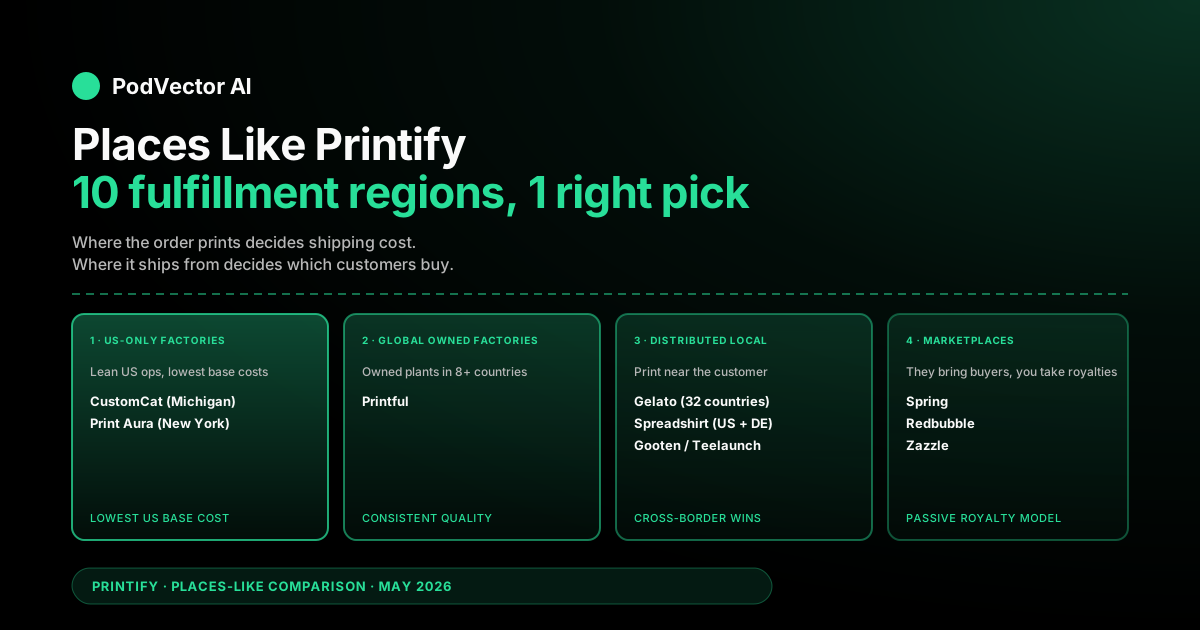
Quick Answer: The strongest places to fulfill print-on-demand orders outside Printify are Printful (global owned factories), Gelato (distributed printing in 32 countries), CustomCat (a single low-cost US factory), and Gooten (a partner network strong on home and lifestyle).
Beyond the big four, Spreadshirt and Spring handle European and creator-platform fulfillment, Redbubble and Zazzle bring buyers to their own marketplaces, and Print Aura and Teelaunch fill niche US production needs.
This guide profiles 10 places like Printify, grouped by where the orders actually print — because geography decides shipping cost, delivery speed, and which customer base you can reach profitably. For more on the same question, see our Printify topic hub and Printify comparison cluster.
Why geography matters more than features
Most "Printify alternatives" lists rank places by feature count, dashboard polish, or catalog size. Those are surface differences. The structural one is where the order actually prints.
A blue tee printed in Pennsylvania and shipped to Berlin costs $12–$18 in shipping and arrives in 10–14 days. The same tee printed in Berlin costs €4 to ship and arrives in 3–5 days. Same garment, same design, same Shopify checkout. The "place" decides whether the order is profitable or a refund waiting to happen.
That's the lens this guide uses. Each of the 10 places below is profiled by where it prints, who it ships well to, and which seller it's actually built for. (For a vendor's view of the same set, Printful's roundup of Printify alternatives covers the same names from a different angle.)
Skip to the comparison table if you want the side-by-side. Read the profiles if you're picking which one to test first.
1. Printful — global owned factories
Printful runs print facilities in Charlotte (NC), Los Angeles, Toronto, Riga (Latvia), Birmingham (UK), Tijuana, and more. The footprint matters because Printful's routing engine picks the closest qualifying factory to the destination — a New York order prints in Charlotte, a Berlin order prints in Riga.
That ownership translates into tighter quality control. You won't get one tee printed sharp and the next one printed muddy, the way an aggregator network sometimes does. The trade-off is base cost — Printful runs $4–$8 higher than Printify on common SKUs like Bella+Canvas 3001 tees or Gildan hoodies.
Integrations cover Shopify, Etsy, WooCommerce, Wix, Squarespace, Amazon, eBay, and Big Cartel. Branding options are the deepest in the category — inside labels, packaging inserts, custom packing slips, all without enterprise minimums.
Best for: sellers who want consistent print quality and global routing without managing multiple suppliers. The merger of Printify and Printful in 2021 means both brands now share a parent, but they still operate as independent places to print.
2. Gelato — distributed local production
Gelato is the place that rewrote international POD economics. Headquartered in Oslo, it operates a network of 130+ print partners across 32 countries. A German order prints in Germany, a Japanese order prints in Japan, an Australian order prints in Australia.
For US-only sellers, Gelato's pricing sits between Printify and Printful with no special advantage. For anyone selling 20%+ internationally, the math flips. Local production drops shipping costs by 60–80% and delivery times from 14 days to 3–5.
The catalog leans into posters, framed prints, photo books, and apparel basics. Oddball SKUs (custom socks, all-over-print hoodies) may not be available — check before switching. Free at base, with Gelato+ ($24/month) and Gelato+ Gold ($119/month) unlocking discounts and premium support.
Best for: sellers with significant international order share, especially in the EU. See our Shopify vs Printify breakdown for context on how Gelato fits alongside a Shopify-only setup.
3. CustomCat — single US factory
CustomCat operates from one Michigan facility. That single-location model is the entire pitch — a lean operation that passes savings to sellers. Base prices typically beat Printify by $2–$4 on common tees and hoodies.
For a US seller pushing volume on standard apparel, that gap compounds. On 500 monthly orders, $3 of saved base cost is $1,500 of additional margin — enough to cover Shopify, an ad-platform sub, and most of a Klaviyo bill.
The trade-offs are real. The catalog is narrower (mostly apparel, mugs, hats). International shipping is non-competitive because everything ships from Michigan. Design tooling and mockups are dated next to Printify or Printful.
Integrations include Shopify, Etsy, WooCommerce, BigCommerce, and a direct API. A $30/month CustomCat Premium plan unlocks additional volume discounts. Best for US-only sellers running volume on standard SKUs where margin per unit decides the business.
4. Gooten — US-heavy partner network
Gooten is the breadth play. New York–headquartered, the company aggregates a network of print partners similar to Printify, but its catalog leans into categories Printify is weakest in — bedding, bath, pet products, custom home goods, and oversized wall art.
If your store sells beyond apparel (duvet covers, dog bandanas, shower curtains, large canvas prints), Gooten often has SKUs Printify doesn't carry at all. Quality varies by partner, same caveat as Printify — testing samples is non-optional.
Base costs are competitive with Printify on overlapping SKUs. Apparel is a wash. Home goods and lifestyle pricing is where Gooten typically beats the field.
Integrations cover Shopify, Etsy, WooCommerce, BigCommerce, and a Gooten API. The dashboard is functional but less polished than Printify's. Best for sellers expanding beyond apparel into home, lifestyle, and pet categories.
5. Spreadshirt — US plus German production
Spreadshirt is the German place that doesn't quite fit the supplier-network mold. Founded in Leipzig in 2002, Spreadshirt runs three connected products: a POD service for your own store, a hosted Spreadshop storefront, and the Spreadshirt consumer marketplace.
Production runs from Pennsylvania, Las Vegas, and German facilities. EU orders ship from Germany and arrive in 3–5 days at local rates. US orders ship from the US facilities. That dual-region footprint is the differentiator.
The hybrid model is the point. If you have an audience but no store, Spreadshop sets you up in 10 minutes. If you have a store, Spreadshirt's POD service plugs in. Base costs are mid-tier — competitive in Europe, slightly higher in the US.
Best for: European creators who want a hosted shop without setting up Shopify, or US sellers serving a meaningful EU customer base. Pairs naturally with the topics covered in our similar to Printify guide.
6. Spring — creator-platform fulfillment
Spring (formerly Teespring) rebranded in 2021 around creator monetization. The pitch targets YouTubers, TikTok creators, and Twitch streamers — Spring integrates directly with YouTube's merch shelf, TikTok Shop, and Twitch's merch features. A creator can sell to their audience without leaving the platform they already publish to.
The POD product is solid — apparel, drinkware, accessories, with Spring handling production, fulfillment, and customer service from owned facilities. You set a retail price, Spring takes a base cost, you keep the spread.
The key model difference: Spring is the merchant of record. They handle taxes, returns, and customer service. That's a feature if you don't want to run a store, and a constraint if you want full customer data and brand control.
Best for: creators with existing audiences on YouTube, TikTok, or Twitch who want merch tied to their content platform without the overhead of running a separate store.
7. Redbubble — global marketplace
Redbubble is a marketplace, not a supplier network — a distinction that decides the business model. You upload designs, and Redbubble handles customer acquisition (their own organic search traffic and ads), checkout, production, and shipping. You earn a royalty on each sale.
Production routes through Redbubble's network of partners in the US, UK, Germany, Australia, and the Netherlands, with the closest qualifying partner picked per order. That global routing is real — it's the same logic Gelato uses, but applied behind a marketplace instead of behind your store.
The trade-offs are everything you give up. Royalties are 10–30% (you set the markup, Redbubble takes the rest). You don't own the customer relationship. Brand-building is impossible — the URL says redbubble.com, not yours.
Best for: designers and illustrators who want passive royalty income on a portfolio, not entrepreneurs building a brand on their own store.
8. Zazzle — US production marketplace
Zazzle is the older, broader marketplace. Founded in 2005 and headquartered in Redwood City, Zazzle runs production from its own US facilities (with some partner production for niche SKUs). The differentiator versus Redbubble is heavy product customization — buyers can personalize designs (names, dates, colors) before checkout.
That makes Zazzle strong in invitations, business cards, gifts, and event products where personalization is the actual purchase driver. The catalog is enormous — 1,300+ product types including categories no supplier network touches (postage stamps, custom puzzles, full wedding stationery suites).
Royalty rates start at 5–10% and scale up to 99% depending on your Designer tier. Same marketplace trade-offs as Redbubble: no customer ownership, no brand, competing with millions of other designers.
Best for: designers targeting personalization-heavy niches like weddings, events, and corporate gifting where Zazzle's organic traffic for those keywords is the channel.
9. Print Aura — single New York facility
Print Aura is the small-and-focused place. Headquartered in New York, the company runs a single facility and competes by being easier to talk to than the big networks. Direct phone support is rare in this category — Print Aura offers it.
The catalog is narrower than Printify, primarily apparel and accessories. Brand options are stronger — custom neck labels, custom hang tags, branded inserts, and custom packing slips are available without enterprise minimums. For a small-batch Etsy brand, that combination is hard to find elsewhere.
Base costs are mid-tier, comparable to Printful. Integrations cover Shopify, Etsy, WooCommerce, and a manual order entry option. No subscription fee.
Best for: small Etsy sellers building a custom-branded apparel line where direct communication with the printer matters more than the cheapest possible base cost.
10. Teelaunch — specialty-product network
Teelaunch is the unusual-products specialist. Beyond standard apparel and accessories, Teelaunch carries Bluetooth speakers, neon signs, ceramic dishware, kitchenware, and engraved metal goods that the big networks don't touch.
The supplier model is similar to Printify — an aggregated network with quality that varies by SKU. The differentiation is purely catalog. If your design works on a Bluetooth speaker or a neon sign, Teelaunch is one of the few places to actually sell that product through a POD model.
Integrations are Shopify-first with Etsy and eBay support. The Shopify app is well-rated. Base costs on the unusual SKUs are higher than apparel, but retail markups on novelty items often run 60%+, so margin per unit holds up.
Best for: sellers with a creative catalog that needs SKUs outside the standard POD playbook of tees, hoodies, and mugs. Pairs well with the supplier comparisons in our shops like Printify guide.
Comparison table
The 10 places at a glance. Base-cost columns are SKU-dependent — verify on the specific product you sell before committing.
| Place | Where it prints | Base cost vs Printify | Best fulfillment region | Integrations | Best for |
|---|---|---|---|---|---|
| Printful | Owned factories, 8+ countries | +$4–$8 | Global | Shopify, Etsy, Woo, Wix, Amazon | Brand-led sellers |
| Gelato | 130+ partners, 32 countries | Comparable | International (esp. EU) | Shopify, Etsy, Woo, Wix | Cross-border sellers |
| CustomCat | Single Michigan factory | −$2–$4 | US only | Shopify, Etsy, Woo, BigCommerce | US volume sellers |
| Gooten | Aggregated, US-heavy | Comparable | US, some EU | Shopify, Etsy, Woo, BigCommerce | Home and lifestyle |
| Spreadshirt | Pennsylvania, Vegas, Germany | Comparable | US + EU | Shopify, Etsy, hosted Spreadshop | EU creators |
| Spring | Owned production, US-anchored | N/A (royalty model) | US-led, global ship | YouTube, TikTok, Twitch | Content creators |
| Redbubble | Partner network, 5 countries | N/A (royalty 10–30%) | Global | None (their store) | Designers, passive royalty |
| Zazzle | Owned + partners, US-led | N/A (royalty 5–99%) | US-led, global ship | None (their store) | Personalization niches |
| Print Aura | Single New York facility | Comparable | US only | Shopify, Etsy, Woo | Small-batch brands |
| Teelaunch | Aggregated network | Varies by SKU | US, some EU | Shopify, Etsy, eBay | Novelty SKUs |
Which place fits which seller
The grid doesn't help if you can't narrow it down. Five common situations, mapped to the place that actually wins.
You're brand-new and just want the easiest setup
Stay on Printify or move to Printful. Both have the deepest tutorials, the smoothest Shopify and Etsy integrations, and the most active seller forums. The base-cost gap matters less when you're still figuring out which products sell.
You're scaling on Etsy and margin is tight
Test CustomCat. The $2–$4 base-cost gap compounds across hundreds of orders, and Etsy buyers never see which supplier you used. Keep Printify as a backup for SKUs CustomCat doesn't carry.
You ship internationally
Switch the international portion to Gelato. Local production cuts shipping costs by 60–80% and delivery time from 14 days to 3–5. Even running Gelato side by side with Printify (Gelato for EU, Printify for US) is often the highest-margin setup. For the cost-side context, see our Printify Premium benefits breakdown and the monthly cost breakdown.
You sell home goods, pet products, or oversized prints
Gooten has the catalog Printify lacks. Printify covers apparel well but is patchy on home and lifestyle. Gooten was built for those categories from the start.
You're a YouTuber, TikToker, or streamer
Spring is the only place on this list that integrates directly with platform-native merch features. Setup is faster and the customer never leaves the platform.
How to test a new place without breaking your store
The mechanics of testing a new supplier are simple. The mistake most sellers make is switching the whole catalog at once and discovering the print quality is off only after 50 angry customers email about a faded design.
Start with one SKU. Pick the product where the economic case is clearest — usually your top seller, since the margin gain compounds fastest. Run it on the new place for two weeks before deciding anything.
Order samples to your own address first. Print quality, color accuracy, garment fit, and packaging vary between places, and a 5% return-rate jump erases any margin gain from cheaper base costs. A $20 sample order saves a $2,000 inventory mistake.
Once one product is stable, run both places side by side for 30 days. Compare gross margin per order on real bank-deposit dollars after platform fees, shipping, and refunds — not list prices on a spreadsheet. If the new place wins by 8%+ on real margin and return rates hold steady, switch the rest of the category. If margin is a wash, the switching cost wasn't worth it.
The supplier-comparison question is exactly the kind of work POD founders waste weekends on with spreadsheets. The math is easy in principle and miserable in practice because the data lives in five different dashboards — Printify, your new test supplier, Shopify, your ad platforms, and your bank.
FAQs
What is the closest place to Printify?
Printful is the closest functional match — same integrations, same store-owner model, similar product catalog. The structural difference is that Printful owns and operates its own factories globally while Printify aggregates a partner network. That shows up as higher base costs but tighter quality control at Printful.
What places are cheaper than Printify?
CustomCat usually beats Printify by $2–$4 on common tees and hoodies because it runs a single lean Michigan facility. Teelaunch sometimes wins on specific SKUs. On most apparel, Printify's aggregator pricing is already near the floor — beating it meaningfully means accepting trade-offs on quality, catalog, or international shipping.
Are there places like Printify that ship from Europe?
Yes. Gelato prints in 32 countries including Germany, the UK, France, and the Netherlands. Spreadshirt operates German facilities for EU orders. Printful runs production in Latvia, the UK, and Spain. For EU customers, all three beat US-only places like CustomCat and Print Aura on shipping cost and delivery time.
Can I use multiple POD places on the same store?
Yes — most Shopify and Etsy sellers run two suppliers in parallel. The common pattern is one primary supplier for 80% of SKUs and a secondary for niches the primary doesn't cover well. Printify + Gooten or Printful + Gelato are common pairings.
Is Redbubble a place like Printify?
Not really. Redbubble is a marketplace where you earn royalties without owning a store. Printify is a supplier you use behind your own store. They solve different problems — Redbubble is passive royalty income, Printify is building a brand. Compare them only if you haven't decided whether to run a store yet.
Which place is best for Etsy sellers?
For US-focused Etsy sellers, CustomCat (cheapest base cost) and Printful (best quality) are the strongest options. For international Etsy sellers, Gelato's distributed production beats both on shipping economics. Test one place at a time against your current Printify margins before switching.
Are there free places to start a POD business besides Printify?
Printful, Print Aura, Teelaunch, CustomCat, and Gelato are all free at the base tier — you only pay supplier costs when an order comes in. Spring and Redbubble are free too because they're marketplace-based, taking their cut at sale time instead of charging upfront.
Stop guessing which place actually makes you money
Comparing 10 POD places in a spreadsheet is the easy part. The hard part is knowing which one would have made your store more profitable on the products you actually sell.
Victor is an AI employee for POD sellers that ties your Shopify orders, Printify/Printful supplier costs, and Meta/Google ad spend into a single source of truth. Ask "which supplier would be more profitable for my top 10 SKUs?" and Victor returns the answer with real numbers from your own orders — not a vendor's marketing copy.
Try Victor free