
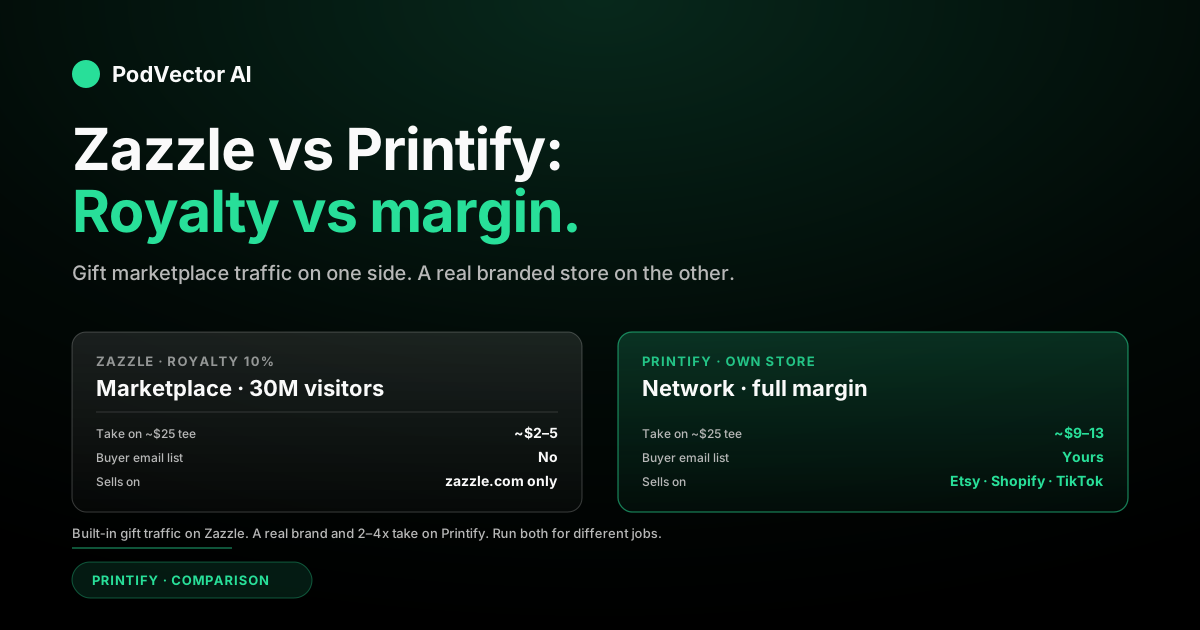
Quick Answer: Zazzle and Printify look like rivals but solve different problems. Zazzle is a marketplace plus a personalization engine — you upload designs, buyers find them through zazzle.com search, and the platform handles the storefront, the printing, and the customer. You take a royalty (10% default, your choice up to higher tiers) on every sale.
Printify is a fulfillment network behind your own store on Shopify, Etsy, TikTok Shop, WooCommerce, or any site you control. You bring the traffic. You set retail. You keep what's left after base cost and shipping — usually 2–4x the per-unit take versus a Zazzle royalty.
Pick Zazzle if you want zero operational lift and your designs map to gifts, weddings, party supplies, or invitations. Pick Printify if you're building a branded business with real margin and want to sell across multiple channels. Most sellers who scale eventually run both.
Zazzle vs Printify at a glance
Most comparison guides bury the structural difference and lead with feature checklists. We're inverting that. Read the snapshot, then we unpack every row.
| Axis | Zazzle | Printify |
|---|---|---|
| Category | POD marketplace + personalization platform | POD fulfillment network |
| You bring | Designs only | Designs + a store + traffic |
| Where buyers find you | zazzle.com search and gift category pages | Wherever you sell — Etsy, Shopify, TikTok Shop, your site |
| Founded | 1999 (Redwood City, CA) | 2015 (San Francisco / Riga) |
| Monthly active visitors | ~30M+ (gift- and event-skewed) | N/A — you drive the traffic |
| Who owns the customer | Zazzle | You |
| Monthly fees | None | Free tier; Premium $24.99/mo unlocks up to 20% off base |
| Catalog size | ~1,300+ products (wide gift surface) | ~1,300 products (apparel-heavy) |
| Print network | Centralized Zazzle production | 90+ providers, 140+ global locations |
| Pricing model | Set royalty 5–99%; Zazzle sets retail (base + royalty) | You set retail; pay base + shipping; keep the difference |
| Default royalty | 10% (most sellers run 10–20%) | N/A — you keep retail minus cost |
| Volume bonus | Yes — tiered up to ~17.5% extra at top tier | No — pricing is flat per plan |
| Bella+Canvas tee, US | Base around $20+ (Zazzle's own catalog) | $8.95 (Premium) / $10.95 (Free) |
| Typical $24.95 tee take | ~$2–5 royalty | ~$9–13 (plan and provider-dependent) |
| Strongest niches | Weddings, invitations, baby showers, gifts, monogrammed | Streetwear, branded apparel, niche stores, multi-product brands |
| In-app buyer customization | Deep — buyers edit text, color, layout themselves | Limited — you ship the final design |
| Customer support | Zazzle handles it | You handle it; Printify replaces production defects |
| Brand control | Zazzle's brand fronts the buyer | Your brand fronts the buyer; Printify is invisible |
| Best for | Designers and stationers with gift-shaped designs | Sellers building a branded POD business |
The category split: marketplace vs network
Searching "Zazzle vs Printify" frames the two as alternatives. Structurally, they aren't. They sit in different rows of the print-on-demand stack.
Zazzle is a marketplace plus a personalization engine. A shopper visits zazzle.com, searches "personalized wedding invitations" or "custom dog mom mug," and sees designs from thousands of independent designers. The buyer can then edit your design in-browser — change names, colors, dates, layout — before checking out.
You don't operate a store. You upload designs into Zazzle's store.
Printify is a fulfillment network. You already sell somewhere — Shopify, Etsy, TikTok Shop, WooCommerce, your own domain. Printify is the production layer that prints and ships when an order comes in. The customer experience is yours end-to-end. Printify is invisible to the buyer.
This split is the single most load-bearing fact in the comparison. Royalty vs margin, traffic vs no traffic, gift discovery vs branded store — every downstream answer follows from which model you picked.
Zazzle: the marketplace-plus-personalization model
Zazzle launched in 1999 out of Redwood City. It's one of the oldest print-on-demand businesses on the internet and the platform has been refining the same model for two and a half decades.
The pitch to designers is simple: upload artwork, apply it to Zazzle's catalog of products, and earn a royalty when a buyer purchases. Zazzle handles storefront, payments, printing, shipping, customer service, and returns.
The buyer experience is what makes Zazzle distinct from other marketplaces. Most products support in-app personalization — the customer can edit names, dates, colors, fonts, and layouts on top of your design before they buy. This makes Zazzle the default search result for "custom wedding invitations," "personalized baby shower decor," and a thousand other variants. You design the template. The buyer fills in their details.
Catalog runs roughly 1,300+ products. The shape of demand skews heavily toward gifts, events, and stationery — invitations, save-the-dates, business cards, monogrammed mugs, custom party supplies, baby gifts, wedding favors. Apparel and home decor exist, but they're not where Zazzle's traffic concentrates.
Two operational facts shape selling on Zazzle. First, you don't set retail directly — you set a royalty percentage (default 10%, range 5%–99%) and Zazzle calculates retail as base cost plus your royalty plus their margin. Second, you don't see who bought your work. No email, no list, no retargeting, no customer relationship.
Zazzle does run a Volume Bonus program that adds up to roughly 17.5% on top of your base royalty once you cross sales thresholds. For high-volume sellers in stationery and gift niches, that bonus can become a meaningful chunk of monthly earnings.
Printify: the fulfillment-network model
Printify launched in 2015 with a different shape. It's not a storefront. It's a network of 90+ independent print providers across 140+ global locations, tied together by software that routes your orders to the right factory.
You sell wherever you already sell. When an order lands, Printify forwards it to whichever provider you've assigned to that SKU. The provider prints the item, packs it under your brand, ships to the customer, and Printify charges you the base cost plus shipping.
The Free plan has no monthly fee. Premium at $24.99/month unlocks up to 20% off base costs across the entire catalog and pays for itself above roughly 30–40 monthly orders for most stores. For the full Premium breakdown, see our Printify Premium plan price breakdown.
Catalog runs roughly 1,300 products. Strong categories include apparel (Bella+Canvas, Gildan, Champion blanks), drinkware, accessories, home goods, wall art, and embroidery. If you want a single supplier for a multi-product brand without managing 5 different vendors, Printify has the catalog breadth to support it.
You own the customer relationship and the support inbox. Printify replaces production defects free of charge, but you triage every buyer message yourself. The trade is full ownership: brand, email list, retargeting pixels, repeat-purchase data, all yours.
Pricing and profit margins
This is the headline difference for most operators. We'll work through it with real numbers.
Zazzle's pricing
Zazzle's economic model is a royalty on top of base. You set a royalty percentage (default 10%) and Zazzle constructs the retail price.
The mechanics: Zazzle has a base price for each product. Your royalty is added on top. Zazzle's margin is added on top of that. The retail price the buyer sees is the sum.
A typical Zazzle apparel base sits in the $20+ range — meaningfully higher than a Printify or Printful base because Zazzle is also covering storefront, traffic, and customer service out of that number. A 10% royalty on a $25 retail tee nets you roughly $2.50. Push your royalty to 20% and you earn ~$5, but the retail price climbs and you compete against thousands of other designs at lower price points.
The Volume Bonus tier system adds a kicker once you cross specific monthly sales thresholds (Zazzle uses a points-based system tied to sales velocity). Top-tier sellers earn an extra ~17.5% on top of their royalty rate. That bonus is real money for the top decile of stationery and gift designers — it's also unreachable for casual uploaders.
Zazzle also runs near-constant site-wide promotions. 30% off this week, 40% off next week, free shipping for orders over $X. Designers don't opt out and the discount comes out of margin on both sides. Earnings during sale weeks dip.
Printify's pricing
Printify is free to start. The Free plan gives full catalog access at standard base costs. Premium at $24.99/month drops base costs by up to 20% — a Bella+Canvas tee goes from $10.95 to $8.95 in the US catalog.
There's no transaction fee, no royalty split, no Zazzle-style margin tax on top of base. Retail minus base minus shipping equals your margin. You set retail wherever you want, on whatever sales channel you've picked.
Premium math is straightforward. An extra $2 of margin on 30 shirts a month covers the subscription. Most sellers crossing 50 monthly orders should be on Premium. For deeper detail, see the complete guide to Printify Premium.
The honest margin comparison
On the same generic tee retailing around $24.95, here's the rough math:
| Platform | Base / cost in | Your take | Notes |
|---|---|---|---|
| Zazzle, 10% royalty (default) | ~$20+ Zazzle base | ~$2.50 | Royalty + retail set inside Zazzle's model |
| Zazzle, 20% royalty | ~$20+ Zazzle base | ~$5.00 | Retail climbs, conversion drops in marketplace search |
| Zazzle, top-tier seller | ~$20+ Zazzle base | ~$2.50 + Volume Bonus (~17.5% kicker) | Requires sustained sales volume |
| Printify Free | $10.95 + ~$4.95 ship | ~$9.05 | Customer pays shipping separately |
| Printify Premium | $8.95 + ~$4.95 ship | ~$11.05 | After $24.99/mo subscription |
The 2–4x take-per-shirt advantage on Printify is structural, not a quirk. Zazzle pays for the marketplace traffic out of base cost. Printify doesn't, because Printify isn't sending you traffic.
Put another way: Zazzle is charging you for traffic via lower margin. Printify charges you for traffic via your own marketing budget. Which one is cheaper depends entirely on how well you can drive your own demand.
Product catalog and customization depth
Both catalogs list around 1,300 products. The shapes of those catalogs differ.
Zazzle's catalog skews toward gifts and events. Invitations, save-the-dates, thank-you cards, business cards, monogrammed mugs, custom napkins, party banners, baby announcement cards, wedding favors. Apparel exists but isn't the gravity center of the platform.
Printify's catalog skews toward apparel and branded merchandise. Bella+Canvas, Gildan, Champion, Independent Trading Co. blanks. Hoodies, joggers, sweatshirts. Drinkware, hats, bags, embroidery, all-over-print, wall art, footwear. If your brand sells what a streetwear or lifestyle store sells, Printify has the SKUs.
The customization story is where Zazzle's model becomes distinctive. Most Zazzle products support real-time in-browser personalization — the buyer changes names, dates, layouts, colors, fonts, even adds photos, all before checkout. This is why Zazzle dominates "personalized [gift]" search on Google. The platform was purpose-built for it.
Printify doesn't have buyer-side personalization. You upload the finished design. If a buyer wants their name on a shirt, you have to either (a) sell pre-made variants or (b) integrate a third-party personalization app on your Shopify or Etsy store. The work falls on you.
For non-personalized merchandise — branded streetwear, niche apparel, lifestyle goods — Printify's lack of buyer-side customization is a feature, not a bug. You ship the design you designed. For gift markets, Zazzle's customization is doing the selling.
Fulfillment, shipping, and timelines
Zazzle handles fulfillment centrally from a small set of production facilities. Shipping times in the US typically run 3–5 business days production plus 3–7 business days shipping. International varies widely.
Printify's distributed network is its biggest fulfillment edge. Providers in the US, EU, UK, Australia, and Canada mean local production for local buyers. A US buyer ordering an SKU pinned to a US provider sees production in 2–5 business days and shipping in 3–5 business days — often faster than Zazzle for the same order, and almost always cheaper.
Quality is centralized on Zazzle, distributed on Printify. Zazzle's output is consistent because production is centralized. Printify quality depends on which provider you pin a SKU to — top-tier providers like Monster Digital, SwiftPOD, and District Photo are excellent; cheaper providers vary. Pin SKUs deliberately on Printify and quality is comparable; default to "lowest cost" and it isn't.
For more on Printify's product range and provider quality, see the complete guide to Printify's most profitable products.
Sales channels and integrations
This is one of the cleanest differences between the two.
Zazzle is a closed marketplace. You can't sell Zazzle products on Etsy, Shopify, TikTok Shop, or your own site. The product page lives at zazzle.com/yourdesign, and that's the only place it lives. Buyers find you through Zazzle search, gift category browsing, Google search results for personalized gifts that happen to surface Zazzle pages, or by following a Zazzle store link you've shared yourself.
Printify integrates with everywhere you'd actually run a POD business. First-party integrations include Shopify, Etsy, eBay, Wix, Squarespace, WooCommerce, BigCommerce, PrestaShop, and TikTok Shop. API access lets developers connect any platform Printify doesn't natively support. You publish a product to your Shopify store, the SKU is mirrored in Printify, and orders flow automatically when a customer buys.
This is the core philosophical split. Zazzle wants you inside Zazzle. Printify wants to be invisible behind whatever storefront you've already chosen.
Discovery, traffic, and marketing
Zazzle's biggest advantage and Printify's biggest demand on you.
Zazzle gets roughly 30M+ monthly visitors, heavily concentrated around gift and event buying intent. A new designer who uploads a strong invitation set or a clever monogrammed mug can start earning royalties within days, sometimes hours, with zero marketing spend. The platform's SEO carries gift-related searches into Zazzle product pages, and the marketplace's recommendation engine surfaces relevant designs in front of warm buyers.
You don't run ads. You don't run an email list. You don't have to know SEO. Designs and patience are the only inputs.
Printify gets you nothing on this dimension. Printify is the factory; you're the store. Traffic is your job — paid social, paid search, organic content, email, SEO, influencers, TikTok organic, whatever channel you can run profitably for your niche.
This is why the margin comparison from earlier doesn't tell the whole story. A Zazzle royalty is small but free of traffic cost. A Printify margin is large but only after you've paid to acquire the buyer. If your customer acquisition cost is $15 on Meta ads, your Printify margin on a $25 tee just dropped from $11 to negative. If you're an artist with no marketing skills and no audience, Zazzle's small royalty is real money and your Printify margin is theoretical.
Customer support, returns, and quality
Zazzle handles every customer-facing interaction. Buyer emails you with a complaint, refund request, or shipping question — Zazzle's CS team handles it. You see almost nothing.
Printify routes the inverse. You're the brand the buyer paid; you handle every email yourself. Printify's CS supports you, not the end customer. If a print is defective or a package is lost, Printify replaces or refunds at their cost — but the buyer-facing communication is yours to run.
For a side-hustle artist with a day job, Zazzle's hands-off CS is a huge feature. For a brand operator, owning the support inbox is part of owning the customer.
When you outgrow Zazzle
Most sellers don't quit Zazzle — they add Printify alongside it. The signal that it's time:
- You have a repeat-buyer pattern. Same customers keep coming back for new designs and you can't email them because they're Zazzle's, not yours.
- You're consistently top of marketplace search in your niche and the royalty math is leaving real money on the table.
- You've built an audience off-platform (Instagram, TikTok, an email list, a Substack) and you want to convert them to direct buyers without sending them through Zazzle's checkout.
- You need product types Zazzle doesn't carry well — branded streetwear, premium hoodies, embroidered hats, all-over-print.
- You want to sell on Etsy or TikTok Shop for buyer-discovery reasons Zazzle can't replicate.
The typical migration shape: keep Zazzle live for evergreen invitations, gifts, and templates that benefit from Zazzle's buyer-side customization. Spin up a Shopify or Etsy store on Printify for the apparel and branded merchandise where margins matter and the audience is already yours. Two stores. Two jobs. No conflict.
For broader context on what's available beyond these two platforms, see our roundup of alternatives to Printify for print-on-demand sellers and the apps like Printify comparison. The full list of best Printify alternatives for POD sellers covers the broader market beyond the marketplace-vs-network split this article focuses on.
The per-SKU profitability question nobody answers
Every comparison guide ends in "depends on your goals" and walks away. Useful as a frame; useless when you're staring at a hundred SKUs across two platforms wondering which one to push.
The real operating question once you're running both is per-SKU, not platform-level. For my Bella+Canvas tee with this specific design, which channel makes more money — Zazzle's marketplace traffic at 10% royalty, or my Shopify store on Printify Premium with my current acquisition cost?
That answer changes by design, by season, by acquisition channel, and by Zazzle promotional activity. A wedding-invitation template earns more on Zazzle in March than on Shopify because that's when buyers search. A streetwear hoodie earns more on Shopify because Zazzle's audience isn't shopping for streetwear.
This is the question Victor, PodVector AI's operator, was built to answer. Connect your store, and Victor reads your live sales data, base costs, and supplier mix from your unified data warehouse — then tells you which channel and which supplier would be most profitable per SKU, per region, per season, with the real numbers from your account.
Victor answers. Victor acts with your approval — automatically routing your top SKUs to the most profitable channel as cost, conversion, and ad spend move.
For the full Printify comparison universe, see the Printify comparison cluster hub and our broader Printify topic page. For the foundational deep dive, start with the complete guide to Printify for POD sellers.
Bottom line: which to pick
Pick Zazzle if:
- You design invitations, stationery, monogrammed gifts, wedding or event materials
- You want zero operational lift — no store, no ads, no inbox
- You have no audience and no plan to build one
- You'd rather earn a small royalty than run a brand
- Your designs benefit from buyer-side personalization (names, dates, colors)
- You're treating POD as passive income on top of a day job
Pick Printify if:
- You already sell on Etsy, Shopify, TikTok Shop, or your own site (or are willing to set one up)
- You want 2–4x the margin per unit and you're willing to drive your own traffic
- Your products are apparel-heavy, streetwear, branded merch, or anything Zazzle's gift-shopper isn't searching for
- You want to own the customer, brand, email list, and data
- You want local fulfillment in the US, EU, UK, AU, or Canada to cut shipping time
Or pick both. Run a passive Zazzle profile for evergreen gift and stationery designs that benefit from marketplace discovery. Run a Shopify or Etsy store on Printify for the apparel and branded products where margins and ownership matter. They target different buyer behaviors and rarely cannibalize each other.
For Zazzle's own framing, the Ecommerce-Platforms comparison gives a useful third-party read with vendor-feature side-by-sides.
FAQs
Which platform is easier for beginners?
Zazzle. You upload designs, pick products, set a royalty, and you're live. No store to build, no ads to run, no support inbox. Printify is structurally more work because you also have to operate the storefront and the marketing that brings traffic to it.
Which has better profit margins, Zazzle or Printify?
Printify, by 2–4x on a typical $25 tee. Zazzle's 10% royalty default nets you roughly $2.50; Printify Premium with your own pricing nets ~$11 after shipping. The catch is Printify's margin only matters if you can drive traffic — Zazzle bundles the traffic into the lower royalty.
Can I use Zazzle and Printify at the same time?
Yes, and most sellers who scale do. Keep Zazzle live for personalized gifts and stationery where buyer-side customization sells. Run a separate Shopify, Etsy, or TikTok Shop on Printify for apparel and branded merchandise. The two platforms target different buyer intents and don't conflict.
Does Zazzle integrate with Etsy or Shopify?
No. Zazzle is a closed marketplace. You can't sell Zazzle-fulfilled products on Etsy, TikTok Shop, Shopify, WooCommerce, or your own domain. If you need multi-channel selling, Printify is the fit. The Printify-to-Etsy and Printify-to-Shopify integrations are first-party and automated.
What is Zazzle's Volume Bonus and is it worth chasing?
Zazzle adds up to roughly 17.5% on top of your base royalty rate when you hit sales-velocity tiers. For a top-decile stationery designer or wedding-invitation seller, the bonus is meaningful — sometimes a third of total monthly earnings. For a casual uploader, it's effectively unreachable; you'd need to be hitting Zazzle's top thresholds month after month.
Which has better print quality, Zazzle or Printify?
Zazzle is more consistent out of the box because production is centralized. Printify's quality varies by provider — top-tier providers like Monster Digital, SwiftPOD, and District Photo often match or beat Zazzle's output. The fix on Printify is to pin SKUs deliberately to providers you've sample-ordered from.
Can I customize buyer-facing personalization on Printify?
Not natively. Printify ships the finished design you uploaded. If you want buyer-side personalization (names, dates, color swaps), you'd integrate a third-party personalization app on Shopify or Etsy. Zazzle's in-app personalization is built into the platform out of the box and is its biggest moat for the gift category.
Is Zazzle cheaper to start than Printify?
Both have no upfront or monthly fee on their entry tier. Zazzle is free forever. Printify's Free plan is free; Premium at $24.99/month pays for itself above ~30–40 orders/month. The real ongoing difference is margin per unit, which Printify wins decisively once you're driving any meaningful sales volume.
Does Zazzle own my customer the way Printify doesn't?
Yes. On Zazzle, the buyer is Zazzle's customer — you don't see their email, can't retarget them, and can't market new designs to them directly. On Printify, the buyer is your customer end-to-end; Printify is invisible. If long-term customer lifetime value matters to you, Printify's model is the only one that builds it.
Can I migrate my Zazzle designs to Printify?
Yes — the designs are your IP. Download source files, upload to Printify, pick products and providers, connect to your sales channel (Shopify, Etsy, TikTok Shop). The work is mostly in standing up the storefront; the design transfer takes minutes per SKU.
How much do Zazzle designers typically earn?
The distribution is heavily long-tail. Most uploaded designs sell zero copies a month. Successful designers in stationery, weddings, and gift niches earn anywhere from $100 to $10,000+ monthly with a deep back catalog and a tight niche. It's rarely a primary income for a solo designer working alone.
Which platform is better for selling t-shirts specifically?
Printify, by a wide margin. Zazzle's audience isn't searching for tees the way it's searching for invitations and gifts. Printify's apparel catalog (Bella+Canvas, Gildan, Champion, Independent Trading Co.) is built for the streetwear and lifestyle apparel market, with margins that work at typical Etsy/Shopify retail prices.
Stop guessing which channel makes you more money
Zazzle vs Printify. Printify Free vs Premium. Provider A vs Provider B. Every comparison hides the same operating question — on the SKUs I actually sell, which choice makes me more money this month?
Victor, PodVector AI's operator, connects to your store and answers that question with your real data. Per-SKU margin. Per-channel breakeven. Per-supplier routing. No spreadsheets, no guesswork. And ask "which channel would be most profitable for my top 10 products?" — get the answer in seconds.
Try Victor free