
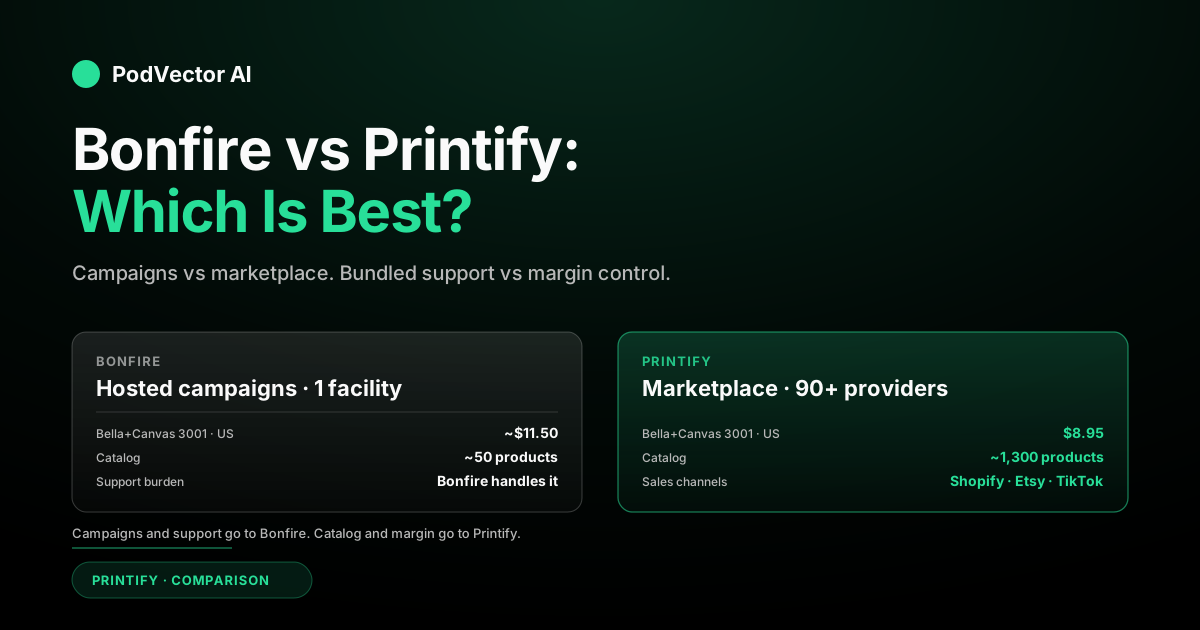
Quick Answer: Bonfire and Printify solve different problems. Bonfire is a hosted campaign platform — you launch a tee, Bonfire prints it, ships it, and handles support. It's built for fundraisers, creators, and one-off drops where you don't want to run a store.
Printify is a fulfillment network for your own store — you sell on Shopify, Etsy, TikTok Shop, or your own site, and Printify routes orders to one of 90+ print providers. It's built for sellers who want catalog depth, lower base costs, and full control of branding.
If you're building a recurring POD business with margin discipline, Printify wins on cost and scale. If you're running a one-time campaign or a nonprofit fundraiser and want zero operational lift, Bonfire wins. The two rarely compete head-to-head for the same seller.
Bonfire vs Printify at a glance
The two platforms aren't really competing for the same dollar. This table makes the split obvious — every row gets unpacked below.
| Axis | Bonfire | Printify |
|---|---|---|
| Model | Hosted campaign platform — Bonfire prints, ships, supports | Print-on-demand network — you sell, Printify fulfills |
| Where you sell | Bonfire-hosted campaign page | Your Shopify, Etsy, TikTok Shop, WooCommerce, Wix, etc. |
| Monthly fees | Free for standard campaigns; Bonfire Pro Essentials at a paid monthly rate for a permanent store | Free tier available; Premium plan unlocks discounted base costs |
| Catalog size | ~50 products (apparel-heavy) | ~1,300 products across apparel, home, accessories, drinkware |
| Print methods | DTG, DTF, screen printing | DTG, DTF, embroidery, all-over print, sublimation |
| Print network | Centralized — Bonfire's own production | 90+ providers, 140+ global locations |
| Customer support burden | Bonfire handles it | You handle it (Printify backs you up on print defects) |
| Profit model | You set a retail price, Bonfire takes the base cost, you keep the margin | You set retail, pay Printify the base + shipping, keep the difference |
| Sample base cost — Next Level Soft Tee, Pro plan | ~$18.61 (Essentials) / ~$11.89 (Super), per Bonfire Pro pricing page | Standard base cost varies by provider; Premium plan reduces it further |
| Best for | Fundraisers, nonprofits, one-off campaigns, creators new to merch | Recurring POD stores scaling beyond hobby revenue |
What is Bonfire?
Bonfire is a hosted print-on-demand platform built around campaigns, not stores. You upload a design, pick a product, set a retail price, and Bonfire generates a campaign page you can share.
When supporters buy, Bonfire prints the order in their facility, ships it, and handles any customer questions or replacements. You don't manage inventory, run a store, or deal with disputes.
The model started with fundraisers — nonprofits selling shirts to support a cause — and expanded to creators, churches, schools, and small communities. The pitch is operational simplicity: launch a merch drop without becoming a logistics operator.
According to Bonfire's own site, the platform is 100% free to use with no setup costs or upfront fees to launch a campaign. The only fee is an 8% processing fee on optional donations or tips added to orders, reduced to 3.5% for verified nonprofits. Standard campaign selling carries no platform fee — your profit is the difference between your retail price and the base cost.
Bonfire also offers Bonfire Pro — a paid tier for sellers who want a permanent storefront rather than a campaign-based model. According to the Bonfire Pro pricing page, the Essentials plan runs at a monthly or annual rate, while the Super plan (billed annually) unlocks lower base costs and removes fees on donations and self-fulfilled products.
You can also turn on a "permanent storefront" mode if you want campaigns to stay live indefinitely, but the underlying model is still campaign-first.
What is Printify?
Printify is a print-on-demand fulfillment network, not a storefront. You sell wherever you already sell — Shopify, Etsy, TikTok Shop, eBay, your own site — and Printify sits in the background as the production layer.
When an order comes in, Printify routes it to one of 90+ independent print providers across 140+ global locations. The provider prints the item, ships it under your brand, and Printify charges you the base cost plus shipping.
The Free plan is genuinely free — no monthly fee — and most sellers eventually upgrade to the Premium plan to unlock discounted base costs. That discount can be meaningful on high-volume catalogs, and the breakeven depends on your order mix and which SKUs you sell most. Printify is the operator's tool. You own the customer relationship, the brand, the data, and the margin discipline. You also own the customer support inbox.
Who Bonfire is best for
Bonfire fits a specific operator profile. If the following sounds like you, it's the right pick:
- Nonprofits and fundraisers. You're raising money for a cause, not building a store. Bonfire's donation tools, fundraising goal tracking, and supporter-friendly campaign pages were designed for exactly this.
- One-off drops. A creator launching a limited shirt for a podcast season, a school selling shirts for a graduating class, a band selling tour merch — Bonfire makes the launch take an afternoon.
- Operators who genuinely don't want to run support. Print-on-demand customer service is real work. Bonfire absorbing it has cash value, and that value scales with order volume.
- First-time merch sellers. If you've never sold a physical product, Bonfire removes the storefront, fulfillment, and support learning curves at once. You can grow into Printify later.
Where Bonfire stops fitting: the moment you want catalog depth, full brand control over the storefront, or the option to sell on Etsy and TikTok Shop where your audience already is.
Who Printify is best for
Printify fits the seller who wants a real business, not a campaign. The right-fit profile:
- Existing Etsy, Shopify, or TikTok Shop sellers. You already have a store and traffic. Printify plugs into the fulfillment seam without forcing you to migrate your customers anywhere.
- Margin-focused operators. Lower base costs and the ability to route the same SKU to different providers to hit price points matter — Bonfire's pricing model doesn't give you those levers.
- Catalog explorers. If you want to test all-over-print hoodies, ceramic mugs, embroidered hats, and posters in the same store, Printify's ~1,300-product catalog has the surface area.
- Sellers building a brand. Custom packaging, branded neck labels, your own returns address — Printify lets you make the experience feel like yours, not theirs.
Where Printify stops fitting: you actively don't want to handle support, you have no audience and no plan to build one, or you need a single campaign-style landing page and nothing else.
Pricing and profit margins
This is where the two platforms diverge most.
Bonfire's pricing
According to Bonfire's pricing and fees help article, selling through Bonfire campaigns is 100% free — all profits go directly to you. The base cost covers manufacturing, sourcing, and printing. Bonfire explains that the base cost decreases as you sell more products, and varies by number of ink colors, single vs. double-sided printing, and product type.
For sellers who want a permanent storefront rather than a campaign, Bonfire Pro adds a paid layer. The Bonfire Pro product pricing page lists two tiers: Essentials and Super. On Essentials, a Next Level Soft Ringspun Tee costs $18.61; on the Super plan (billed annually) it drops to $11.89. A Gildan Heavy Blend Hoodie is $28.95 on Essentials and $21.50 on Super. A 15 oz coffee mug runs $13.03 on Essentials and $7.77 on Super.
Your retail price minus the base cost is your profit. The high base on standard campaigns is the catch most first-timers miss — especially compared to Printify.
Printify's pricing
Printify is free to start. The Free plan gives you the full catalog at standard base costs. The Premium plan unlocks discounted base costs — a meaningful reduction on high-volume SKUs. Beyond that, there's no transaction fee. Your retail minus base minus shipping is your margin.
The math on upgrading to Premium depends entirely on your order volume and catalog mix. Once the per-unit savings across your real order volume exceed the plan's monthly cost, it pays for itself and compounds from there. Most active sellers find the crossover point comes sooner than expected.
The honest margin comparison
The gap between Bonfire's base costs and Printify's is substantial. At the same retail price, a Printify seller — even on the free plan — typically retains a much larger margin per unit than a Bonfire campaign seller, because Bonfire's base cost bundles in logistics and support that Printify leaves to the seller.
Bonfire earns its higher base by absorbing shipping logistics and support, which has real value on a one-off fundraiser. But for a recurring store, that bundled convenience is the most expensive line item you'll never see itemized.
For a deeper teardown of the subscription math, see our full breakdown of Printify Premium benefits and breakeven and the monthly cost analysis. For broader margin benchmarks, see our net profit margin benchmark for POD sellers.
Product catalog and quality
Printify wins catalog by a wide margin. Bonfire's catalog is apparel-heavy — according to Bonfire's site, it includes premium unisex tees, long sleeve shirts, hoodies and sweatshirts, Comfort Colors styles, eco-friendly options, printed hats, drinkware, kids styles, and bags. Printify's ~1,300 products span apparel, home goods, drinkware, accessories, wall art, and embroidery.
Print methods follow the same pattern. Bonfire sticks to DTG (direct-to-garment), DTF (direct-to-film transfer), and screen printing — great for tees and hoodies. Printify adds embroidery, all-over print, and sublimation, so you can run mugs, leggings, and stitched hats from one catalog.
Quality is where the comparison flips. Bonfire's centralized production means every order goes through the same quality control loop — variance is low and the team behind support actually sees the items leave the facility.
Printify's marketplace model means quality depends on which provider routes your order. Top providers like Monster Digital and SwiftPOD print at premium quality. Lower-rated providers can be hit-or-miss. The seller's job is to pin SKUs to specific providers rather than letting Printify auto-route.
If you want predictable quality without picking providers, Bonfire is more forgiving. If you're willing to learn the provider landscape, Printify can match or beat Bonfire on print quality at lower cost.
Fulfillment and shipping
According to Bonfire's FAQ, typical delivery for US orders is within 7–14 days depending on the product and shipping method. The trade-off for their batched production model is steadier output — but the buyer waits, and there's no faster tier.
Printify orders typically print in 2–5 business days, then ship from the nearest provider — most US orders land within a few days total. The fastest providers turn around in 24–48 hours; the slowest can take 5–7 days to print.
The gap widens overseas. Printify's 140+ global locations can print a UK order locally in 2–3 days, while a Bonfire order shipped from the US can take significantly longer to reach the same buyer. Bonfire's shipping rates page notes that shipping is priced on a tiered system based on package size and weight, with Tier 1 covering most non-fleece apparel and smaller accessories, Tier 2 covering fleece-based apparel and larger goods, and Tier 3 covering lightweight or small products (which ship without tracking).
If you sell into Europe or Australia, Printify can fulfill locally and avoid international shipping cost and time — Bonfire generally cannot.
For a closer look at how Printify stacks up against other multi-provider networks, our guide to websites like Printify covers the broader landscape.
Sales channels and integrations
Bonfire is its own storefront. You can embed campaigns on an existing site, but the checkout, payment, and order management all live on Bonfire. There's no Etsy integration, no TikTok Shop integration, no Shopify app.
Printify integrates with the channels POD sellers actually use:
- Shopify
- Etsy
- TikTok Shop
- WooCommerce
- eBay
- Wix
- BigCommerce
- Squarespace
- Walmart Marketplace
- Direct API for custom storefronts
If you have an audience on a marketplace, Printify meets you there. Bonfire requires the audience to come to Bonfire.
This is the single biggest structural difference. Etsy alone sends most POD sellers more buyer traffic than any standalone storefront ever will.
Setup process
Bonfire's setup is faster for the first product. Pick a tee, upload a design, set price, hit launch. You can be live in 15 minutes.
Printify's setup requires connecting a sales channel first, then designing products, then publishing them to your store. The first product takes 30–60 minutes. Every subsequent product is faster because the channel connection is reusable.
At scale, Printify wins on setup efficiency — you can publish 50 products to Etsy in an afternoon. Bonfire's campaign model treats each launch as its own event.
Customer support
Bonfire owns customer support end-to-end. Buyer emails Bonfire about a sizing issue, Bonfire handles it. You see none of it. This is genuinely valuable when you're running a campaign and don't want operational distraction.
Printify backs you up on production defects — misprints, damaged items, missing orders all get replaced free — but the buyer is your customer and writes to you first. You triage, then loop in Printify if it's a production issue.
For a 5-order-per-month side project, this difference is invisible. For a high-volume store, it's a real workload — and one of the main reasons Printify operators eventually hire a virtual assistant or use a help-desk tool.
The per-SKU profitability question
Most vendor comparisons miss the most important question for a POD operator: which platform makes more money per unit on the SKUs I actually sell?
The answer is rarely "always Bonfire" or "always Printify." It's per-SKU.
A high-volume tee at a competitive retail price nets far more on Printify with a sharp provider than it does on Bonfire, where the bundled base cost is much higher. A one-off fundraiser crewneck might still pencil out on Bonfire once you price in the support and shipping it absorbs for you. A ceramic mug is available in Bonfire's catalog (the Bonfire Pro pricing page lists mugs under drinkware on Pro plans), but not on standard campaigns — and the base cost differential versus Printify remains stark.
The right answer is to model both — actual base cost, actual shipping, actual support time — against your real sales mix. That's the work most sellers skip because the spreadsheet is painful.
This is the exact question Victor, PodVector's AI employee, was built to act on. Connect your Shopify store and Victor works from your real sales, costs, and supplier mix in a live data warehouse — then, when a different supplier would net more on a live SKU, he proposes the reprice with the old and new margin values shown side by side, and executes it with your approval before anything ships. No spreadsheet, no manual modeling. See how PodVector's approach to POD labor automation fits into a margin-focused store.
For a broader look at how comparison-shopping across suppliers can change your margin, see our Tapstitch vs Printify breakdown and the Teespring vs Printify comparison. The cross-supplier picture is also covered in our broader Printify comparison hub and the full Printify topic page. For checkout-side margin leakage, see our average checkout completion rate benchmarks.
Bottom line: which to pick
Pick Bonfire if:
- You're running a fundraiser, nonprofit campaign, or one-off drop
- You don't have a store and don't want to build one
- You actively don't want to handle customer support
- Your catalog ambition is a tee, a hoodie, and maybe a hat — not a 1,300-product catalog
Pick Printify if:
- You already sell on Etsy, Shopify, TikTok Shop, or your own site
- You want catalog depth beyond apparel basics
- You're chasing margin and willing to do provider-level tuning
- You want to build a brand the customer associates with you, not with the print platform
The real answer for many sellers is "both, for different products" — Bonfire for a one-time fundraiser, Printify for the recurring store. The platforms are friends more often than they're enemies.
For context on the alternatives landscape, see the original Bonfire comparison from Bonfire's own team — useful for the vendor side of the story, naturally biased toward their own product.
FAQs
Is Bonfire cheaper than Printify?
No — for the seller, Printify is typically much cheaper on base cost. Bonfire's bundled model folds in logistics and support, which drives the per-unit base higher than Printify's standard rates. Per-unit margins on Printify are generally much higher at the same retail price. Bonfire's value is in bundled logistics and support, not in cost.
Does Bonfire have any fees?
Standard campaign selling on Bonfire is free — no platform fee, no monthly subscription. According to Bonfire's site, the only fee is an 8% processing fee on optional donations or tips, reduced to 3.5% for verified nonprofits. Bonfire Pro plans add a paid monthly or annual subscription for a permanent storefront with lower base costs.
Can I use Bonfire and Printify together?
Yes. Many sellers run Bonfire for campaign launches and fundraisers while running Printify in their main Shopify or Etsy store. The platforms don't conflict — they serve different jobs.
Does Bonfire integrate with Etsy or Shopify?
No. Bonfire is a self-contained platform. If you need to sell on Etsy, TikTok Shop, or your own Shopify store, Printify is the fit.
Which has better print quality?
Bonfire is more consistent because production is centralized. Printify's quality varies by provider — top-tier providers (Monster Digital, SwiftPOD, District Photo) often match or beat Bonfire, but auto-routed orders can land at lower-rated providers. Pin your SKUs to specific providers to control quality.
Does Bonfire have a monthly fee?
Standard campaigns have no monthly fee. Bonfire Pro — the permanent storefront product — does carry a subscription, with the Essentials and Super tiers priced differently, as detailed on the Bonfire Pro pricing page.
Is Printify Premium worth it?
For sellers with consistent order volume, yes. The discounted base costs reduce your per-unit cost on every order, so the plan tends to pay for itself relatively quickly and then compounds. The exact breakeven depends on your catalog mix and volume — model it against your own order history.
Which is better for nonprofits?
Bonfire, clearly. The platform was designed around fundraising campaigns, includes donation tracking, and removes the operational burden volunteers can't easily absorb. According to Bonfire's site, verified nonprofits also get a reduced processing fee on donations.
Can I use my own brand with Printify?
Yes. Printify supports custom packing slips, branded neck labels (provider-dependent), and your own returns address. The customer experience can look entirely yours.
Let Victor move your SKUs to the cheaper supplier
Bonfire vs Printify. Printify Premium vs Free. Provider A vs Provider B. Every comparison hides the same question — on the SKUs I actually sell, which choice makes me more money?
Victor, PodVector's AI employee, connects to your Shopify store, finds the more profitable supplier for each live SKU, then proposes the reprice — showing you the old and new margin values — and executes it with your approval before anything ships. Per-SKU margin. Per-provider routing. No spreadsheets. And hand off the supplier math.
Try Victor free