
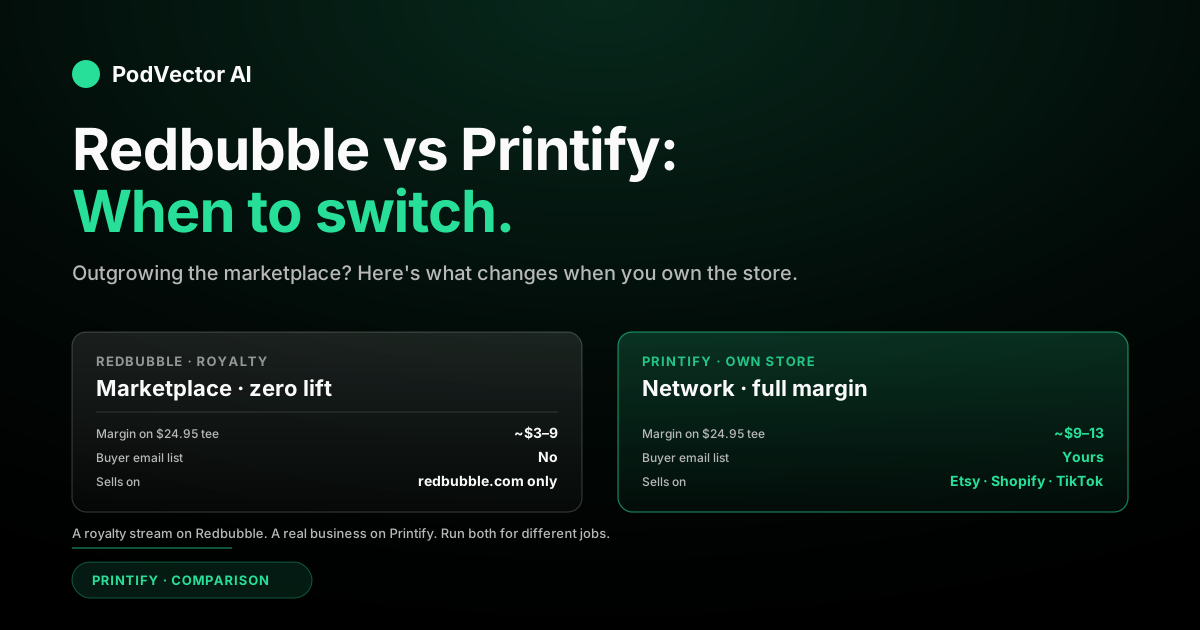
Quick Answer: Redbubble and Printify solve different problems. Redbubble is a closed marketplace — you upload art, they own the storefront, the buyer, and most of the margin. You earn a royalty. Printify is a fulfillment network behind your own store on Shopify, Etsy, TikTok Shop, or your own site. You bring the traffic, you keep the customer, and you keep far more margin per unit.
Redbubble wins on zero-effort setup and built-in discovery. Printify wins on margin, brand control, catalog depth, and channel flexibility. Most sellers who outgrow Redbubble add Printify alongside it rather than switching cold — keeping the passive Redbubble traffic while scaling real income through their own store.
Redbubble vs Printify at a glance
Most comparison guides bury the structural difference and lead with feature checklists. We're flipping that. Here's the snapshot first — every row gets unpacked below.
| Axis | Redbubble | Printify |
|---|---|---|
| Category | Print-on-demand marketplace | Print-on-demand fulfillment network |
| You bring | Designs only | Designs + a store + traffic |
| Where buyers find you | redbubble.com search and category pages | Wherever you sell — Etsy, Shopify, TikTok Shop, your site |
| Who owns the customer | Redbubble | You |
| Monthly fees | None (platform service fee taken per sale) | Free tier; Premium $24.99/mo unlocks up to 20% off base costs |
| Catalog size | ~60 products | Over 1,300 products (per Printify) |
| Print network | Redbubble's contracted production partners | 90+ independent providers, 140+ global locations |
| Pricing model | You set a markup % above Redbubble's base; they handle retail | You set retail; pay base + shipping; keep the difference |
| Customer support | Redbubble handles it | You handle it; Printify backs production defects within 30 days |
| Brand control | Redbubble's brand fronts the buyer | Your brand fronts the buyer; Printify is invisible |
| Sales channels | Redbubble.com only | Shopify, Etsy, TikTok Shop, WooCommerce, eBay, Wix, BigCommerce, Squarespace, Walmart, API |
| Best for | Artists with designs but no store or audience | Sellers building a branded POD business |
Why the comparison is awkward: marketplace vs network
Searching "Redbubble vs Printify" implies the two are alternatives. They're not really — they sit in different categories of the print-on-demand stack, and most sellers who use one eventually use both for different jobs.
Redbubble is a marketplace. A shopper visits redbubble.com, searches "vintage cat sticker," and sees designs from thousands of artists. The marketplace handles discovery, the storefront, checkout, printing, shipping, and returns. The artist's only job is uploading art. You don't have a store — you have an artist profile inside Redbubble's store.
Printify is a fulfillment network. You already have a store somewhere — Shopify, Etsy, TikTok Shop, WooCommerce, your own site. Printify is the production layer that prints and ships when you make a sale. The customer experience is yours; Printify never appears in front of your buyer.
This category split is the single most important fact in the comparison. Every other answer — margin, catalog, support, marketing — flows from it.
Redbubble: the marketplace model in detail
Redbubble was founded in Australia in 2006. It sells art-printed products — shirts, stickers, posters, phone cases, mugs, throw pillows — from independent artists to consumers worldwide.
The artist's job is to upload designs and choose which products to apply them to. Redbubble's job is everything else: storefront, search SEO, payments, printing, shipping, returns, customer service.
The catalog runs roughly 60 product types. Strong categories are stickers, posters, t-shirts, mugs, and phone cases — anything where the design carries most of the buying decision and the product itself is a commodity.
Two facts shape what it's like to operate on Redbubble. First, you don't set the retail price directly — you set a markup percentage on top of Redbubble's base, and they calculate retail. Second, you don't see who bought your work. No email, no retargeting, no list, no customer relationship.
For an artist who wants to draw and have something for sale, Redbubble is the lowest-effort path to first dollar in print-on-demand. For an operator who wants to build a brand, it's a dead end by design.
Printify: the fulfillment-network model in detail
Printify launched in 2015 as a different shape of business — not a storefront, but a network of 90+ independent print providers across 140+ global locations, glued together by software that routes your orders.
You sell wherever you already sell. When an order lands, Printify forwards it to the provider you've chosen for that SKU. The provider prints the item, ships it under your brand, and Printify charges you the base cost plus shipping.
The Free plan has no monthly fee. Premium at $24.99/month unlocks up to 20% off base costs across the catalog and pays for itself for most stores doing consistent monthly order volume. The catalog spans over 1,300 products — apparel, drinkware, accessories, home goods, wall art, footwear, embroidery, all-over-print, and niche items like Adidas and Champion branded blanks.
You own the customer relationship and the customer support inbox. Printify replaces production defects free within 30 days, but you triage every buyer message yourself.
Pricing, fees, and profit margins
This is the headline difference for most operators, so we'll spend time here.
Redbubble's pricing model
Redbubble starts from a base price per product. You add a markup percentage on top — most artists run somewhere in the range of 10–25%. The higher your markup, the more you earn per sale, but the more expensive your listing looks compared to competitors on the same marketplace search page.
Redbubble also runs frequent site-wide promotions — seasonal sales where a portion of the discount can come out of artist margins. You don't opt in or out. Earnings during heavy sale weeks can take a meaningful hit.
Redbubble's platform fees
Beyond the markup model, Redbubble charges a service fee on every sale that scales with your account tier. According to EcommerceCEO's 2026 analysis, Redbubble's tier-based platform fees can reach up to 50% for Standard accounts — a cost that quietly erodes per-unit returns even when your markup looks reasonable on paper.
Printify's pricing model
Printify is free to start. The Free plan gives you the full catalog at standard base costs. Premium at $24.99/month drops base costs by up to 20% across the catalog. There's no transaction fee — retail minus base minus shipping equals your margin. You set retail wherever you want, on whatever platform you sell.
The honest margin comparison
When you account for Redbubble's base costs and platform service fee, a Printify seller typically keeps significantly more per unit at the same retail price point. The Printify operator's structural advantage is that they set the retail price on their own store, control shipping presentation, and don't share margin with a marketplace fee layer. The trade-off is real: Printify operators run a store — marketing, listings, support, taxes, returns — while Redbubble absorbs all that operational work in exchange for controlling the margin.
For full operator-side cost modeling on Printify, see our Printify Premium plan price breakdown.
Product catalog and print quality
Printify wins catalog by an order of magnitude. According to Printify's own comparison page, Printify offers over 1,300 items — far more than Redbubble's selection of roughly 60 product types. Redbubble's catalog covers the marketplace classics — tees, stickers, posters, phone cases, mugs, throw pillows, tote bags — curated for design-driven buying. Printify's catalog spans apparel, home, drinkware, accessories, wall art, embroidery, footwear, and niche branded blanks like Adidas and Champion.
Quality is where the comparison flips slightly. Redbubble's centralized production keeps variance low — every order goes through the same quality control loop. Printify's network model means quality depends on which provider you select. According to Printify, sellers can select a provider with a 9.8/10 quality score, and manufacturing errors are covered by Printify's Merchant Protection for a free reprint or refund within 30 days.
The seller's job on Printify is to pin SKUs to specific providers rather than letting the system auto-route. If you're willing to learn the provider landscape, Printify can match or beat Redbubble on quality at a lower base cost. If you want consistent quality with zero configuration, Redbubble is more forgiving out of the box.
Fulfillment, shipping, and timelines
Both platforms ship globally, but the production speed and geographic reach differ significantly.
Redbubble typically prints in 3–5 business days, then ships via standard mail. International orders can take 2–3 weeks depending on the destination. The buyer experience is consistent because production is centralized.
Printify's 140+ global provider locations let you fulfill locally in the US, UK, EU, Australia, and Canada — reducing both shipping time and cross-border shipping cost. The fastest providers turn around in 24–48 hours; standard production runs 2–5 business days.
For an EU or Australian seller, Printify's local fulfillment is a structural advantage Redbubble can't match. Your customer gets the product faster and you don't pay international shipping on every order.
Sales channels and integrations
This is the second-biggest structural difference after the marketplace-vs-network split.
Redbubble is a self-contained channel. You cannot sell Redbubble-fulfilled products on Etsy, Shopify, TikTok Shop, or your own site. The marketplace is the channel — full stop.
As noted by Printify, you can sell almost anywhere online with Printify — your own website or top sales channels. Integrations include:
- Shopify
- Etsy
- TikTok Shop
- WooCommerce
- eBay
- Wix
- BigCommerce
- Squarespace
- Walmart Marketplace
- Direct API for custom storefronts
According to EcommerceCEO's 2026 analysis, because Printify is a fulfillment layer behind a real ecommerce store, sellers inherit the full sales toolkit of whichever platform they connect — abandoned cart recovery, discount codes, upsells, email flows, analytics, and multichannel inventory sync. None of that is available inside Redbubble's closed marketplace.
If you already have an audience on Etsy or Shopify, Printify meets you there. Redbubble requires the audience to come to redbubble.com. That's a real trade: Redbubble's built-in marketplace traffic is genuinely valuable for artists with no audience. Printify gives you nothing until you bring traffic, but everything you bring stays yours.
Discovery and marketing
Redbubble has discovery built in. People search for a niche term on the marketplace and might find your design. The platform's SEO can pull steady passive sales for designs that nail a search term.
The catch is distribution. You're competing with millions of artists on the same platform. Most uploaded designs sell very few copies per month. A small percentage of artists captures most sales — classic long-tail.
Printify gives you zero discovery. You bring the traffic — Etsy SEO, TikTok content, paid ads, your own audience, email. The upside is that every buyer you earn is yours: you can email them, retarget them, send them new launches. None of that is possible on Redbubble.
For sellers who already have an audience or know how to build one, Printify's "you bring the traffic" model is a feature, not a bug. For artists with no audience and no plan to build one, Redbubble's built-in discovery is the right starting point.
When you do run paid traffic to a Printify-powered Shopify store, the full advertising toolkit opens up. See our guides on Google Ads vs Facebook Ads for POD sellers and Shopify Google Ads strategy for print-on-demand to see how operators scale once they own the customer.
Customer support and returns
Redbubble owns customer support end-to-end. A buyer contacts Redbubble about a sizing issue and Redbubble handles it. You never see the message.
Printify backs sellers on production defects. According to Printify, their Merchant Protection covers a free reprint or refund within 30 days for manufacturing errors — but the buyer is your customer and writes to you first. You triage every message, then loop in Printify if it's a production issue.
For a 5-order-per-month side project, this difference is invisible. For a high-volume store, it's a real operational workload — one of the main reasons Printify operators eventually bring in a virtual assistant or a help-desk tool as they scale.
Redbubble's platform fee structure
This section is worth its own heading because it's frequently underestimated by new sellers. Redbubble doesn't just take a base cost — the platform charges a service fee on every transaction that scales with your account standing. According to EcommerceCEO's 2026 platform analysis, these tier-based fees can reach up to 50% for Standard accounts, which means a markup that looks profitable at signup can produce very thin real returns once all fees are accounted for.
On top of that, Redbubble's periodic site-wide sales may fund a portion of the discount from artist earnings rather than purely from platform margin. The combination of markup-model pricing, service fees, and promotional discounts makes Redbubble's true per-unit economics harder to model than Printify's straightforward retail-minus-base-minus-shipping structure.
If you're evaluating Redbubble for serious income, model the full fee stack — not just the headline markup — before committing a large design portfolio.
Signs you've outgrown Redbubble
Most Redbubble artists who eventually move to Printify hit the same signals. If you recognize any of these, the platform isn't going to grow with you.
Your monthly earnings are stalled despite a growing portfolio. Redbubble's long-tail distribution rewards a few hit designs and quietly buries the rest. If you've uploaded hundreds of designs and earnings are flat, the marketplace's algorithm has already placed you.
You want to set retail prices and run real promotions. Redbubble's markup-percentage model decouples you from retail strategy. If you've ever wished you could run a timed sale, a bundle discount, or a free-shipping threshold, you're describing what your own store gives you and Redbubble doesn't.
You want to email your customers. The single most valuable asset a small POD brand can own is a buyer email list. Redbubble structurally prevents it. The moment "I wish I could tell my repeat buyers about a new collection" enters your head, you're done with the marketplace model.
You're hitting a margin ceiling on your best sellers. If you have a design selling consistently each month at a small royalty, the same design on Printify behind your own store would clear materially more per unit — often several dollars more after Redbubble's service fee. Over a full year of orders, the gap compounds into a fundamentally different size of business.
You want to run ads. Running paid Meta or Google traffic to a Redbubble listing makes no sense — you don't own the customer, can't retarget, and give up the margin that paid ads require. Running ads to your own Printify-powered Shopify store opens the full performance marketing toolkit. See our Shopify Audiences Google Ads integration guide for how operators set that up.
Migrating from Redbubble to Printify (or running both)
The cleanest path for most Redbubble sellers isn't a full migration — it's running both for different jobs.
Keep your Redbubble profile alive for passive sticker and poster traffic. It costs nothing and long-tail searches keep paying out. Spin up an Etsy or Shopify store for your best-selling designs on Printify, where the margin math works in your favor.
The basic playbook:
- Audit your Redbubble bestsellers. Identify your top designs by unit volume over the last 12 months.
- Pick your channel. Etsy if you have no audience and want built-in buyer traffic. Shopify if you have an email list, social audience, or plan to run ads. TikTok Shop if your designs ride a trend.
- Set up Printify and connect the channel. The integrations for both Etsy and Shopify take under 30 minutes.
- Re-list your top designs. Same art, same product types, but now with full retail control and Printify-level base costs.
- Pin SKUs to good providers. Don't trust auto-route. Pick providers based on quality reviews, base cost, and location proximity to your buyers.
- Leave Redbubble running. Long-tail income stays passive. You haven't lost anything.
Once you're on Shopify with Printify, the full growth toolkit opens: post-purchase upsells, email flows, paid ads. See our guide on Shopify post-purchase upsell apps for a quick win most new Printify/Shopify operators miss. And for understanding how to use AI to track performance across your new store, see the complete guide to AI analytics for print-on-demand.
The per-SKU profitability question nobody answers
The Redbubble-vs-Printify comparison is the easy version. Most operators win structurally on Printify simply because the margin math is structural — Redbubble's royalty-plus-fee model can't beat owning the customer and setting your own retail.
The harder question hides inside Printify itself. With 90+ providers each pricing the same product differently and routing each region differently, a single product can have many valid supplier-and-shipping combinations with margins that differ by several dollars per unit. Multiply that across your top SKUs and you're looking at real money that depends on routing decisions most sellers never tune.
This is the exact problem Victor, PodVector's AI employee, was built to address. Connect your Shopify store and Victor reads your real sales data, base costs, and supplier mix from the live data warehouse, then identifies which supplier would be most profitable on each of your live SKUs — with the numbers, per region, per channel — and proposes the repricing or routing move as a structured action you approve or reject.
Victor is not an autonomous agent — every proposed move comes to you for approval before anything changes. For more on how the platform works and who it's for, see the full PodVector strategy overview.
For the full Printify comparison universe, see our Printify vs Redbubble breakdown (the inverse framing of this article), the Printify comparison cluster hub, and the broader Printify topic page.
Bottom line: which to pick
Pick Redbubble if:
- You're an artist who wants zero operational lift
- You have no audience and no plan to build one
- Your strongest products are stickers, posters, or fandom apparel that fit Redbubble's search behavior
- You're treating POD as a side hobby, not a real income line
- You'd rather earn a small royalty than run a store
Pick Printify if:
- You already sell on Etsy, Shopify, TikTok Shop, or your own site — or are willing to set one up
- You want meaningfully more margin per unit and are willing to run a store
- You want catalog depth well beyond apparel basics
- You want to own the customer, the brand, the email list, and the data
- You want local fulfillment in the US, EU, UK, AU, or Canada to cut shipping time and cost
- You want to run paid ads where you actually capture the buyer relationship
Or pick both. Plenty of artists keep a passive Redbubble profile for sticker and poster long-tail income while running a real Etsy or Shopify store on Printify for the products that actually scale. The two platforms target different buyer behaviors — they don't conflict.
For Printify's own framing of the same comparison, see Printify's official breakdown — useful for the vendor's side of the story, naturally biased toward their own product.
FAQs
Is Redbubble or Printify better for making money?
For sellers building a real business, Printify wins structurally — you keep more margin per unit, own the customer, and can run ads profitably. The trade is that you run a store yourself. Redbubble absorbs that operational work but takes a significant share of per-unit returns through its base cost, service fees, and promotional discount structure.
Can I use both Redbubble and Printify at the same time?
Yes, and most sellers who scale beyond Redbubble end up running both. Keep Redbubble live for passive sticker and poster traffic. Run a separate Etsy or Shopify store on Printify for the designs you want to scale. The platforms don't conflict.
Does Redbubble integrate with Etsy or Shopify?
No. Redbubble is a closed marketplace — you sell on redbubble.com or not at all. If you need to sell on Etsy, TikTok Shop, Shopify, WooCommerce, or your own site, Printify is the fit.
Which has better print quality, Redbubble or Printify?
Redbubble is more consistent out of the box because production is centralized. Printify's quality varies by provider — but according to Printify, sellers can select providers with very high quality scores, and manufacturing errors are covered by Merchant Protection within 30 days. Pin SKUs to specific vetted providers on Printify to control quality; don't rely on auto-routing.
Does Redbubble own my customer the way Printify doesn't?
Yes. On Redbubble, the buyer is Redbubble's customer — you don't see their email, can't retarget them, and can't market new designs to them. On Printify, the buyer is your customer end-to-end; Printify is invisible to them.
Is Redbubble cheaper than Printify to start?
Both have no upfront subscription cost. Redbubble has no monthly fee but takes a service fee on every sale. Printify's Free plan also has no monthly fee. Premium at $24.99/month unlocks up to 20% off base costs. The bigger ongoing difference is per-unit margin and the platform service fee Redbubble charges, where Printify wins decisively once you have meaningful sales volume.
Can I migrate my Redbubble designs to Printify?
Yes — the designs are yours. Download your source files, upload to Printify, pick your products and providers, and connect to your sales channel. The main work is setting up the new store; the designs themselves transfer quickly.
How much do Redbubble artists typically earn?
The distribution is heavily long-tail. Most uploaded designs sell very few copies per month. Earnings depend on niche strength, catalog size, and marketplace search position — and can be further compressed by Redbubble's service fees and promotional discounts. It's rarely a primary income for a single artist working alone.
Can I use my own brand and packaging on Printify?
Yes. Printify supports custom packing slips, branded neck labels (provider-dependent), and your own returns address. The customer experience looks fully yours — Printify never appears to your buyer. Redbubble's branding is unavoidable on its own platform.
Does Printify work with AI tools for managing my store?
Printify itself doesn't include AI store management. But if you run your Printify catalog through a Shopify store, tools like Victor from PodVector can read your Printify supplier data alongside your Shopify sales, identify per-SKU margin opportunities, and propose repricing moves you approve — all without you building a spreadsheet. See how that works in our AI tools for print-on-demand overview.
Stop guessing which supplier is more profitable
Redbubble vs Printify. Printify Free vs Premium. Provider A vs Provider B. Every comparison hides the same question — on the SKUs I actually sell, which choice makes me more money?
Victor, PodVector's AI employee, connects to your Shopify store and answers that question with your real data. Per-SKU margin. Per-provider routing. Per-channel breakeven. No spreadsheets. Every move comes to you for approval — Victor proposes, you decide. And ask "which supplier would be most profitable for my top products?" — get the answer in seconds.
Try Victor free