
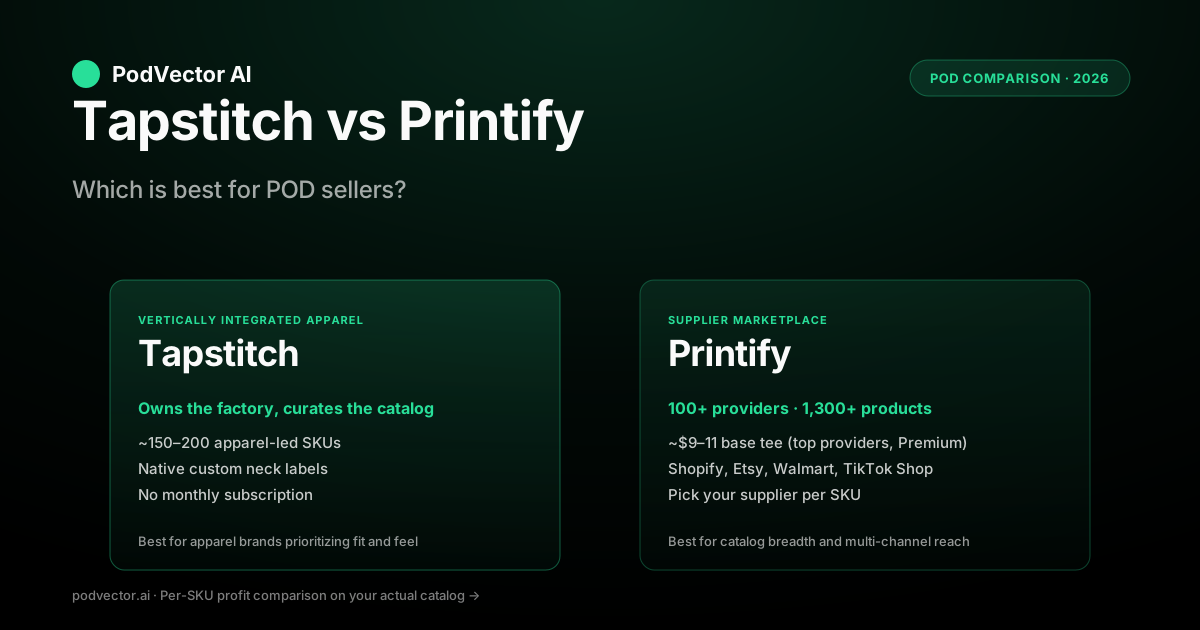
Quick Answer: Tapstitch is a vertically integrated, fashion-first POD platform that owns its production and blanks — every order runs through the same in-house facility (US and China), delivering consistent retail-grade quality on a deliberately narrow apparel catalog of 700+ fashion-forward blanks. Printify is a marketplace connecting you to around 90 print providers worldwide, with 1,300+ products across every POD category and integrations with every major selling channel.
Pick Tapstitch if you are building a clothing brand — heavyweight tees, oversized hoodies, fashion-forward fits — and quality consistency is your primary differentiator. Pick Printify if you want the widest catalog, the lowest base unit cost on standard apparel, and the ability to sell on Etsy, Walmart, TikTok Shop, and eBay from a single platform.
The honest answer for most sellers is not "which platform wins" — it is "which platform wins on which SKUs, in which countries, on which channels." That answer comes from your own order data, not from any review article including this one.
The Tapstitch-vs-Printify decision in 60 seconds
Both platforms turn a design into a fulfilled order. What sits behind that fulfillment is different in every meaningful way.
Tapstitch runs its own factory. According to Tapstitch's own comparison page, production runs through their facilities in the US and China, giving them direct quality control across a catalog of 700+ fashion-forward blanks spanning streetwear, vintage, athleisure, and more. The pitch, as ecommerce-platforms.com describes it, is "fashion-first blanks: better cuts, eco-conscious materials, multi-zone print capability, and a consistent production standard from a single in-house facility." The trade-off the company makes for you is tight quality control in exchange for a narrower selection.
Printify runs a marketplace. As eCommerceCEO notes, it "connects you to around 90 print providers worldwide, gives you 1,300+ products across every category imaginable, and lets you optimize for price, region, and turnaround on a per-product basis." The trade-off is huge selection with quality variance as your responsibility.
One is a curated apparel brand pretending to be POD. The other is a true POD network with curation as your job.
Side-by-side snapshot table
Use this for orientation. The sections below unpack the nuance behind each row.
| Dimension | Tapstitch | Printify |
|---|---|---|
| Business model | Vertically integrated apparel POD | Marketplace of ~90 print providers |
| Monthly subscription | None | Free plan; Premium ~$29/mo (discount on most SKUs) |
| Catalog size | 700+ fashion-forward blanks (apparel-led) | 1,300+ products across categories |
| Print methods (apparel) | DTG + DTF, multi-zone capable | DTG, DTF, screen print, embroidery (varies by provider) |
| Custom neck labels | Yes, native | Yes, on select providers only |
| Branded packaging | Hang tags, inserts; fully branded packaging supported | Varies by provider |
| Sales channel integrations | Shopify, Etsy, Wix | Shopify, Etsy, WooCommerce, Wix, eBay, Walmart, TikTok Shop, Squarespace, BigCommerce, PrestaShop + public API |
| Production locations | US (Los Angeles) and China (Guangzhou) | US, UK, EU, AU, China — chosen per SKU |
| No MOQ | Yes — single-unit production from day one | Yes |
| Best for | Apparel-first brands prioritizing fit, feel, and branding consistency | Sellers prioritizing catalog breadth, multi-channel reach, and base cost |
The architectural difference: vertically integrated vs supplier network
Most comparison articles frame this as "Tapstitch is newer, Printify is bigger." That misses the structural axis. The real difference is who controls the supply chain — and that choice cascades through pricing, consistency, catalog breadth, and the kind of brand you can build.
Tapstitch: vertically integrated
As Bootstrapping Ecommerce describes it, Tapstitch is "a fashion-focused, premium apparel print-on-demand solution built for clothing brands that care about garment quality, multi-zone prints, and cohesive branding." According to Tapstitch's own platform, production runs through their own facilities in the US (Los Angeles) and China (Guangzhou), with no third-party print provider in the middle.
The win is consistency. Every Tapstitch tee printed today should feel the same as one printed last month, because the blank, the ink, the printer, and the QA team are all the same. Fashion-forward fits — heavyweight tees, oversized hoodies, drop-shoulder cuts — are standard rather than catalog outliers. Custom neck labels and hang tags are natively supported. Tapstitch also supports no-MOQ production from a single unit, making it accessible at any stage of growth.
The trade-off is catalog. You cannot order a pet bandana, a specialty mug, or an embroidered cap from Tapstitch because Tapstitch does not produce those. The catalog is what the factory can make well, not what every POD seller might want to sell.
Printify: supplier network
Printify is the production layer for around 90 independent print providers. Each provider runs its own equipment, sources its own blanks, and sets its own pricing. Printify is the routing layer that lets you sync any of them to a storefront.
The win is range. According to Printify's own comparison page, the platform offers "the largest Catalog in Print on Demand and a global network of Print Providers." Sellers can pick a different provider per SKU based on quality, price, or location.
The trade-off is variance. The same blank tee printed by a top US provider will not feel identical to one printed by a budget provider abroad. Quality is a function of which provider you pick, and that picking is on you.
Pricing, subscription fees, and total cost
Headline prices on either home page do not tell the full story. The right comparison is total cost to land an order in a buyer's hands.
Subscription tiers
As ecommerce-platforms.com confirms, "Tapstitch keeps things simple on the subscription side: there are no monthly fees at all." You pay per order — base unit cost plus shipping — and that is the full platform cost.
Printify has a free plan and a Premium tier. The Premium plan costs approximately $29 per month and offers a discount on most products (per Printify's published pricing). For most sellers past 20–30 orders per month, Premium pays for itself quickly.
Base unit cost
On base unit cost, ecommerce-platforms.com concludes that "once you're doing meaningful monthly volume, the Premium discount more than offsets the subscription cost, and Printify's lower base prices across its supplier network generally produce better margins than Tapstitch's per-item costs, particularly on shipping."
Tapstitch's premium blanks — heavyweight GSM tees, oversized streetwear silhouettes — are not directly comparable to most Printify providers' standard offerings. The gap narrows on premium equivalents, where Tapstitch wins on consistency and Printify wins on flexibility.
The total-cost math
Printify's own comparison page (data collected January 2026) claims their platform delivers "over 60% higher monthly profits" at both low and higher sales volumes, based on Printify's chosen scenario with top providers and Premium pricing. Real-world results on a given seller's catalog will vary — the honest answer is to compute the comparison against your own SKUs rather than trust either company's headline claim.
Catalog size and product range
According to Bootstrapping Ecommerce, Printify has "1,300+ products, 90+ print providers, and integrations across every major ecommerce platform and marketplace." A large portion of that breadth is duplicate SKUs across providers — the same tee listed by multiple providers — but the long tail still includes specialty items Tapstitch does not carry at all.
Tapstitch's catalog is deliberately narrow. As ecommerce-platforms.com describes it, "its catalog is deliberately narrow — tees, hoodies, sweatshirts, joggers, and similar apparel — but the garments are curated for quality." According to Tapstitch's own platform, the catalog spans 700+ blanks across streetwear, vintage, athleisure, elegant, and other fashion categories, with eco-conscious materials and multi-zone print capability throughout.
Tapstitch also offers a custom production line where their team can source or produce SKUs outside the standard catalog. The lead time and minimum order quantity look more like traditional manufacturing than POD, but it is a real differentiator for established apparel brands with a specific physical product in mind.
The SKU question
If your top sellers are crewneck tees, hoodies, and the occasional cap, both platforms can fulfill your whole catalog. Tapstitch will likely feel and fit better; Printify will likely cost less per unit. If your top sellers include mugs, tote bags, posters, blankets, pet bandanas, or anything outside apparel, Tapstitch cannot fulfill that part of your store. You either run Printify alongside it or you pick Printify outright.
Print quality and consistency
Quality consistency is the dimension Tapstitch wins on most clearly — the variance question is the entire story.
Tapstitch quality
As Bootstrapping Ecommerce confirms, "Tapstitch uses in-house production, which means quality is standardized and consistent across its product range." The blanks come from the same supplier, the inks come from the same brand, and the QA team flags the same defects. The standard apparel feels retail-grade — heavyweight tees have the weight buyers expect from a boutique purchase, hoodies have lined hoods and reinforced seams, and prints sit flush against the fabric. According to sourcelow.com, independent reviewers call Tapstitch's garment quality "miles ahead" of Printful on streetwear specifically, and Tapstitch blanks include 6.5oz+ tees and 400 GSM hoodies with fashion-forward oversized cuts.
Tapstitch's centralized production also means that products delivered to customers should be consistent across repeat orders — a meaningful promise for brands whose reputation depends on consistency.
Printify quality
Printify's quality is a function of which provider you pick. According to Printify's own platform, it offers "more control over product quality through transparent Print Provider rankings and supplier choice" — the ranking system is a meaningful feature that helps sellers avoid lower-tier providers. Top-tier providers — Monster Digital, SwiftPOD, Print Geek, Awkward Styles — approach Tapstitch on print sharpness and apparel feel.
Lower-tier providers do not. Cheaper sticker prices come with thinner blanks, less precise ink coverage, and more shipping-related issues. Most experienced Printify sellers anchor on two or three top providers and route their best SKUs through them, leaving cheaper providers for low-stakes long-tail items. That curation is your responsibility, not Printify's.
Branding, packaging, and neck labels
Apparel POD lives and dies on whether the unboxing feels like a real brand. The two platforms approach this differently.
Tapstitch branding
According to Tapstitch's own platform, custom neck labels, hang tags, and fully branded packaging are all natively supported. You upload a logo or text, the factory prints it directly into the neckline, and the original blank's tag is removed. The result looks indistinguishable from a brand that ordered blanks and printed in-house. Because production is centralized, branding is consistent across every order — no provider-level feature variance.
Printify branding
Custom neck labels on Printify depend on which provider you pick. Monster Digital, Print Geek, and a handful of others offer the feature. Most providers do not. Branded packing slips and inserts are similarly provider-specific. Switching providers — for cost, speed, or location reasons — can mean losing branding features on the affected SKU, which is operational overhead Tapstitch does not have.
The takeaway: if branded apparel is core to your business, Tapstitch's consistency is a real win. If branding is nice-to-have, Printify's top providers cover most of the same features at lower cost.
Shipping, fulfillment, and delivery times
Production speed is roughly comparable on US apparel orders — both platforms produce most orders in a few business days. Where they diverge is on geographic footprint and delivery speed.
Tapstitch ships from Los Angeles and Guangzhou, according to sourcelow.com. Per Printify's comparison page (data collected January 2026), Tapstitch's US Special Line delivers in 5–7 business days, with international Special Line Pro running 7–9 business days and Standard Special Line running 9–14 business days. EU coverage exists but is thinner than Printify's network.
Printify's geographic spread is wider. According to Printify's own comparison page, the platform's "vast network of 90 Print Providers" spans the US, UK, EU, Australia, and China, with providers chosen per SKU. Top US providers ship within a few business days domestically. EU buyers shipped from EU providers see comparable timelines. International routing through Asia adds days but at materially lower base cost.
For a detailed walk-through of how platform fees and shipping compound on top of fulfillment costs, the same layering logic applies whether you are running Tapstitch, Printify, or a combination of both.
Integrations: where each plugs in
Both platforms integrate with the channels their target seller actually uses. The lists overlap on the core three and diverge sharply past that.
Tapstitch integrations
Tapstitch integrates natively with Shopify, Etsy, and Wix — those three cover the majority of small-to-mid POD sellers, so for most apparel brands the integration list is sufficient. What it does not cover is the broader marketplace surface — no native Walmart, no native eBay, no native TikTok Shop, no native BigCommerce. If your traffic comes from those channels, Tapstitch is structurally the wrong tool.
Printify integrations
Printify integrates with Shopify, Etsy, WooCommerce, Wix, eBay, Squarespace, BigCommerce, PrestaShop, Walmart, and TikTok Shop. There is also a public API for custom builds. As Bootstrapping Ecommerce notes, Printify is "purpose-built for sellers who want to test lots of niches, scale volume, and keep base costs as low as possible" — and that integration breadth is a core part of that design.
The Walmart and TikTok question
This is where many growing POD brands hit Tapstitch's ceiling. Walmart Marketplace and TikTok Shop are two of the fastest-growing US POD channels in 2026. Printify integrates with both natively. Tapstitch does not. If your roadmap includes either channel, Printify is the structurally correct pick — or you run both, with Tapstitch covering Shopify and Etsy and Printify covering Walmart and TikTok Shop.
Support, returns, and reputation
Printify is the older platform and has a deeper public review base. Trustpilot, Reddit, and POD community forums have more discussion threads on Printify than on Tapstitch. Tapstitch's review base is smaller but trends positive on apparel quality and consistency. Operational complaints tend to cluster around shipping speed for non-US destinations and the narrower catalog forcing sellers to run a second supplier alongside.
For returns and reprints, Tapstitch handles everything in-house since the production is in-house — tickets go to one team, decisions are quick, and outcomes are consistent. Printify routes order-specific tickets to the producing provider; Printify's own team handles platform-side issues. Resolution quality varies by provider, with top providers comparable to Tapstitch and lower-tier providers materially slower.
Profit margins: what actually hits your bottom line
Margin per order is a function of selling price, base unit cost, shipping, platform fees, and refund rate. Both platforms can produce healthy margins; the structure is different.
Tapstitch margin structure
Tapstitch charges no platform fee. Your cost is base unit plus shipping. On Shopify, the monthly subscription amortized across orders plus payment processing is minimal at any reasonable volume. On Etsy, the transaction fee plus listing fees plus offsite ad fees can take a significant slice off each order.
Printify margin structure
Printify's Premium tier delivers a discount on most SKUs. For sellers running meaningful volume, ecommerce-platforms.com confirms that "once you're doing meaningful monthly volume, the Premium discount more than offsets the subscription cost." The overall margin picture on standard apparel favors Printify's top providers over Tapstitch, particularly at scale. Printify's own comparison page (data collected January 2026) claims "over 60% higher monthly profits" in their chosen scenario — but the real-world gap depends entirely on which providers you use and which SKUs you sell.
The refund variable
Refund rate is the line item most operators ignore. Lower-quality suppliers produce more "where is my order" tickets, lost packages, and quality-related refunds — all of which eat the base-cost advantage. Tapstitch's centralized production typically runs a lower refund rate than Printify's lower-tier providers, and a roughly comparable rate to Printify's top providers. The right Printify provider beats Tapstitch on base cost without losing the refund-rate advantage; the wrong one loses on both.
Margin and AOV
Regardless of which platform you use, margin gains compound fastest when average order value rises. For tactics on A/B price testing that work on both Tapstitch- and Printify-fulfilled stores, running structured price experiments is one of the fastest paths to margin expansion without touching your supplier at all.
Multi-zone printing: an underrated differentiator
One feature that top-ranking comparison articles now cover — and that sellers increasingly ask about — is multi-zone printing capability.
Tapstitch supports multi-zone prints natively: front, back, sleeve, and collar prints can be combined in a single order without routing to multiple providers or managing separate SKUs. As ecommerce-platforms.com notes, "multi-zone print capability" is part of Tapstitch's core pitch for fashion-brand sellers. This matters for streetwear brands whose designs wrap around the garment, or for brands adding sleeve graphics to a full-front-back design.
On Printify, multi-zone printing depends entirely on which provider you select. Some top providers support it; many do not. Switching providers to access a multi-zone option may mean losing other features (custom neck labels, branded packaging) that you were getting elsewhere. The operational overhead of managing that complexity is real.
If multi-zone prints are part of your design language, Tapstitch is the structurally cleaner choice.
Pick X if Y
The shorthand most operators end up using.
Pick Tapstitch if
Your brand is apparel-first and quality consistency is core to your positioning. As eCommerceCEO puts it, "if you're launching a streetwear label or curated apparel line and your customers pay $35–50 per tee, this is your platform." Heavyweight tees, premium hoodies, fashion-forward fits, and multi-zone prints are your top sellers, and the margin difference is worth the buyer experience you get back.
You also pick Tapstitch if branded packaging, hang tags, and custom neck labels are non-negotiable, and you would rather not deal with the provider-by-provider feature variance on Printify's network. The "one team, one factory, one QA process" framing is the operational win. Tapstitch is also the right pick if your store sells exclusively on Shopify, Etsy, or Wix and your roadmap does not include Walmart, TikTok Shop, or eBay.
Pick Printify if
You want the widest catalog in POD, the lowest base unit cost on standard apparel, and integrations with every major marketplace. If your store sells beyond apparel — mugs, posters, totes, drinkware, home goods, pet items — Printify is the only option of the two. As Bootstrapping Ecommerce concludes, "Printify wins on catalog breadth, pricing flexibility, and multi-channel reach."
You also pick Printify if your traffic comes from marketplace channels (Etsy, Walmart, TikTok Shop, eBay) rather than from direct brand discovery. The integration list and the base unit cost advantage matter more the bigger your store gets. For the most-cited external head-to-head, see eCommerceCEO's 2026 Tapstitch vs Printify breakdown.
Running Tapstitch alongside Printify
It is possible to run both. Many apparel-first sellers do exactly this once their catalog crosses a certain size. The common split: Tapstitch covers the premium-tier apparel (heavyweight tees, oversized hoodies, fashion-forward silhouettes, multi-zone designs) where quality is the differentiator and the margin difference is worth it. Printify covers value-tier apparel (standard tees, Gildan basics) and everything outside apparel (mugs, totes, posters, home goods).
The cost is double the operational work — two product catalogs, two order systems, two reporting surfaces. Most sellers make this move only past a revenue threshold where the per-segment margin gains justify the overhead. Running two fulfillment partners also means your profit reporting has to reconcile two cost structures — a problem worth solving before it scales.
If you are advertising on Meta or Google across both suppliers, ad fatigue in Meta Ads is an additional variable to track: when creative runs long against a split-supplier catalog, you cannot always tell whether flagging ROAS is a supplier margin issue or a creative wear-out issue. Separating those signals early pays off.
The comparison most sellers actually need
Feature tables answer the wrong question. The right question is: on the products my store actually sells, in the countries my buyers actually live in, on the channels my traffic actually comes from, which option produces the highest profit per order?
As eCommerceCEO frames it: "the real question isn't which platform is 'better' — it's which one fits the kind of store you're actually building." A streetwear brand selling primarily heavyweight tees to US buyers through Shopify lands on Tapstitch. An Etsy seller running thousands of monthly orders across mugs, tees, and posters lands on Printify. A creator brand splitting between premium apparel and everyday accessories often runs both.
The right pick is downstream of your data, not downstream of which review article ranks highest on Google. The comparison you actually want is computed against your own orders, your own channels, and your own ad spend.
That is the gap PodVector sits in. Victor — PodVector's AI employee — connects to your Shopify store, your Printify and Printful supplier accounts, and your Meta and Google ad platforms. He reads your live order history, your supplier cost data, and your channel performance, then proposes the next profit move as a structured action — old value, new value, rationale, projected effect — and executes it in Shopify only after you approve. For the ad-attribution picture that feeds into per-channel profitability, understanding ad fatigue detection and solutions is a critical input: a platform switch looks far more or less profitable depending on whether your ad performance is already deteriorating. And if you are scaling Meta spend across a split-supplier catalog, Advantage+ Shopping Campaign catalogue setup is worth understanding before your next scaling push.
To understand how PodVector connects supplier data to store-level profit analysis, see the PodVector strategy guide.
FAQs
Is Tapstitch better than Printify for streetwear?
On apparel quality, usually yes. Tapstitch's heavyweight blanks, oversized fits, multi-zone print capability, and consistent QA process produce a more retail-feeling streetwear product than most Printify providers can match. According to sourcelow.com, independent reviewers call Tapstitch's garment quality "miles ahead" for streetwear specifically, citing heavyweight blanks and fashion-forward oversized cuts. The exception is Printify's top-tier providers (Monster Digital, SwiftPOD), which approach Tapstitch on print quality at lower base cost — but you have to find and anchor on them yourself.
Is Printify cheaper than Tapstitch?
On base unit cost for standard apparel at scale, generally yes. Ecommerce-platforms.com confirms that "Printify's lower base prices across its supplier network generally produce better margins than Tapstitch's per-item costs, particularly on shipping." On premium and heavyweight apparel, the gap narrows because Tapstitch's blanks are not directly comparable to most Printify providers' standard offerings.
Does Tapstitch have a monthly fee?
No. As ecommerce-platforms.com confirms, Tapstitch has no monthly fees — you pay only for the apparel you produce. Printify has a free plan and a Premium tier (approximately $29/month per Printify's published pricing) that delivers a discount on most SKUs.
Can I use Tapstitch and Printify together?
Yes — they do not conflict, and many apparel-first sellers run both. The common split is Tapstitch for premium tees and hoodies (including multi-zone designs), Printify for everything else (value-tier apparel, mugs, totes, posters, home goods). The cost is reconciling two reporting systems for one business.
Which platform has more integrations?
Printify, by a wide margin. Printify integrates with Shopify, Etsy, WooCommerce, Wix, eBay, Squarespace, BigCommerce, PrestaShop, Walmart, and TikTok Shop, plus a public API. Tapstitch covers Shopify, Etsy, and Wix.
Does Tapstitch ship faster than Printify?
Generally no. According to Printify's comparison page (data collected January 2026), Tapstitch's US Special Line runs 5–7 business days. Printify's top US providers can deliver faster domestically. Tapstitch ships from Los Angeles and Guangzhou (per sourcelow.com); Printify's broader network of US, UK, EU, and AU providers gives it a geographic advantage for non-US buyers.
Can I get custom neck labels on both?
Tapstitch supports custom neck labels and hang tags natively across its catalog, per Tapstitch's own platform. Printify supports neck labels only on select providers (Monster Digital and a handful of others). If branded labels are non-negotiable, Tapstitch is the cleaner pick.
Which has better print quality?
Tapstitch's quality is more consistent because the production network is centralized and the equipment is the same on every order. As Bootstrapping Ecommerce notes, "Tapstitch uses in-house production, which means quality is standardized and consistent across its product range." Top Printify providers match Tapstitch; lower-tier providers do not. The variance is the cost of Printify's cheaper sticker price.
Which has a bigger catalog?
Printify, by a wide margin. According to Bootstrapping Ecommerce, Printify lists 1,300+ products with 90+ print providers. Tapstitch's catalog spans 700+ fashion-forward blanks (per Tapstitch's own platform) — deliberately apparel-led, curated for quality rather than breadth.
Does Tapstitch support multi-zone printing?
Yes — multi-zone printing (front, back, sleeve, collar) is a native Tapstitch feature, part of its fashion-brand pitch. On Printify, multi-zone support varies by provider and often requires routing to a specific supplier that may lack other branding features you rely on.
Is Printify really more profitable than Tapstitch?
Printify's own comparison page (data collected January 2026) claims "over 60% higher monthly profits" based on their chosen scenario with top providers and Premium pricing. On a real seller's actual catalog, the gap depends heavily on which SKUs you sell, which Printify providers you use, and your volume. The honest answer is to compute it against your own orders rather than trust either company's headline.
How does ad performance interact with supplier choice?
More than most sellers realize. If your Meta or Google creative is fatiguing at the same time you switch suppliers, declining ROAS looks like a supplier problem when it is actually a creative problem — or vice versa. Understanding ad creative fatigue and separating it from fulfillment-side issues is essential before drawing conclusions from a supplier comparison. For a broader view of how fatigue statistics affect POD ad performance, see the ad fatigue statistics guide.
Can I see this comparison applied to my own store?
Yes — this is what PodVector is built for. Connect your Shopify store and your Printify or Printful account, and Victor reads your live SKUs and order history, proposes the supplier-related moves that win you margin, and executes approved changes directly in Shopify. Get started free.
Stop guessing which supplier is more profitable.
Victor — PodVector's AI employee — connects to your Shopify store and your Printify and Printful accounts, reads your live order history and supplier cost data, and proposes the switches that win you margin. You ask in plain English. He proposes the action with a rationale and projected effect. You approve. He executes it in Shopify with a full audit trail.
Try Victor free