
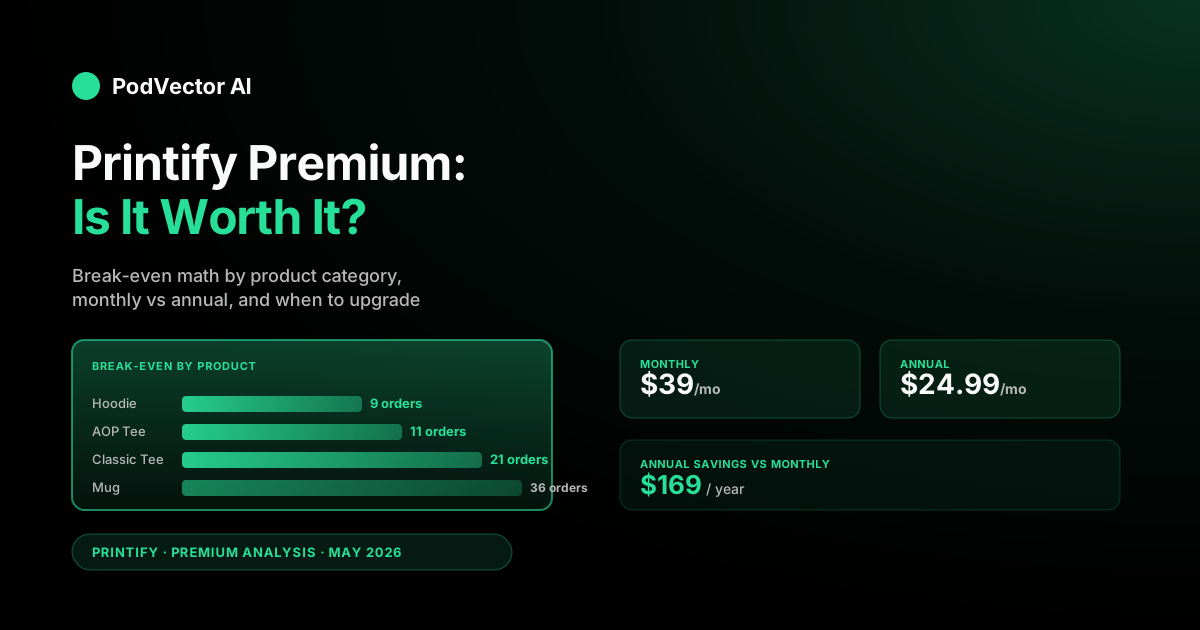
Quick Answer: Printify Premium costs $39/month (or $24.99/month billed annually at $299/year) and gives you up to 20% off product base costs. If you sell roughly 17 or more orders per month on the monthly plan — or 11+ on annual — the discount pays for itself.
But the real answer depends on what you sell. A store doing 20 hoodies a month saves more than one doing 20 mugs, because the dollar discount scales with base cost. Below, we break the math down by actual product category so you can see exactly where your store lands.
What Printify Premium actually includes
Premium unlocks three things on top of the free plan. The headline feature is a discount of up to 20% on most product base costs across Printify's catalog. That discount is applied automatically at checkout — you don't need to activate it per product.
You also get up to 10 store connections instead of 5 on the free plan. If you run separate Etsy, Shopify, and TikTok Shop storefronts, that ceiling matters. Five feels generous until you expand to a second niche or test a new marketplace.
The third feature is Printify Connect, which lets Printify's support team handle order-related issues (reprints, refunds, lost-in-transit claims) on your behalf. On the free plan, you handle those conversations yourself. For a full breakdown of what the plan includes and how the discount applies, see our guide on what Printify Premium is.
Printify Premium pricing in 2026
Printify raised the monthly price from $29 to $39/month on February 17, 2026. The annual plan stayed the same at $299/year ($24.99/month). That means annual billing now saves you $169/year compared to paying monthly — a 36% gap that didn't exist when monthly was $29.
The price hike changed the math for low-volume sellers. At $29/month, you needed about 13 orders to break even. At $39/month, that number jumps to 17. Annual billing still breaks even around 11 orders.
There is no free trial. You can downgrade back to the free plan at any time, but you won't get a prorated refund for partial months. If you want to explore Printify alternatives before committing, test on the free tier first.
The break-even math: monthly vs annual
The break-even calculation is simple. Divide your monthly subscription cost by the average dollar savings per order. The average product base cost across Printify's catalog runs around $12, and 20% off that saves you roughly $2.40 per order.
Monthly billing ($39/month): $39 ÷ $2.40 = ~17 orders/month to break even.
Annual billing ($24.99/month): $24.99 ÷ $2.40 = ~11 orders/month to break even.
At 30 orders/month, you save $72 in product costs. On the monthly plan, that's $33 net. On annual, that's $47 net. At 50 orders, the monthly plan nets you $81 and annual nets $95. The savings scale linearly — every additional order past break-even puts another $2.40 in your margin.
These numbers assume a $12 average base cost. Your actual savings depend heavily on what you sell, which is why a per-category breakdown matters more than the average. For context on how these product costs fit into your total cost picture, the Printify topic hub covers pricing, fulfillment, and provider comparisons across the platform.
Real savings by product category
The "20% discount" sounds uniform, but the dollar amount varies dramatically by product. A 20% discount on a $7 mug saves you $1.40. The same 20% on a $22 hoodie saves $4.40. That three-to-one difference changes the break-even entirely.
Here's what the math looks like across Printify's most popular product categories:
| Product | Approx. base cost | 20% savings/unit | Break-even (monthly @ $39) | Break-even (annual @ $25) |
|---|---|---|---|---|
| Bella+Canvas 3001 tee | $9.50 | $1.90 | 21 orders | 14 orders |
| Gildan 18500 hoodie | $22.00 | $4.40 | 9 orders | 6 orders |
| All-over print tee | $18.00 | $3.60 | 11 orders | 7 orders |
| 11 oz ceramic mug | $5.50 | $1.10 | 36 orders | 23 orders |
| Canvas poster (18×24) | $12.00 | $2.40 | 17 orders | 11 orders |
| Phone case | $7.50 | $1.50 | 26 orders | 17 orders |
| Tote bag | $13.00 | $2.60 | 15 orders | 10 orders |
The takeaway: apparel sellers break even fastest. If your store is mostly hoodies and all-over prints, Premium pays for itself at under 10 orders. If you primarily sell mugs and phone cases, you need much higher volume — 25+ orders — before the savings cover the fee.
Most stores sell a mix. Weight your product catalog by actual sales volume, not listing count, to get your real break-even. Ten hoodie orders and five mug orders saves $49.50 — that pays the $39 monthly fee with room to spare.
When Premium is worth it
You consistently sell 17+ orders per month. That's the monthly-plan break-even on average base costs. If you're already there, you're leaving money on the table every month you stay on the free tier.
Your catalog leans toward higher-cost products. Hoodies, sweatshirts, all-over prints, and premium tees all have base costs above $15. The 20% discount on those items puts more absolute dollars back in your margin than the same discount on a $5 sticker.
You run multiple storefronts. The jump from 5 to 10 store connections matters if you sell on Etsy, Shopify, and TikTok Shop simultaneously — or run separate stores for different niches. On the free plan, you'd have to consolidate or pick favorites.
You want Printify Connect handling customer issues. If you spend an hour per week dealing with reprints, refunds, and tracking inquiries, that's time you could reinvest in design or marketing. Printify Connect shifts that labor to Printify's team. For sellers connecting Printify with platforms like Shopify, WooCommerce, or Etsy, our Printify integrations guide covers the setup.
When Premium is NOT worth it
You sell fewer than 10 orders per month. Even on annual billing, you need about 11 orders to break even. If you're in the single digits, Premium is a fixed cost eating into already thin margins. Stay on the free plan until volume picks up.
You're just starting and testing products. Your first few months are about validating designs, finding a niche, and learning what sells. Adding a $39/month fixed cost to a store that's still in discovery mode is premature. The free plan gives you 5 store connections and full catalog access — that's enough to validate.
Your catalog is mostly low-cost accessories. If 80% of your sales are stickers, keychains, and phone cases with base costs under $8, the per-unit savings from Premium are small. You'd need 30+ monthly orders just to break even. At that volume, the savings are real but modest — roughly $6–10/month net.
Your sales are seasonal and unpredictable. If you do 40 orders in November and December but 5 orders in February through April, the annual plan averages out — but the monthly plan is a money pit in slow months. More on the seasonal math below.
Annual vs monthly: the seasonal seller question
The annual plan locks you in at $299/year ($24.99/month). The monthly plan costs $39/month ($468/year). That $169 annual gap is real — but the right choice depends on your sales pattern, not just the math.
Steady sellers (consistent 15+ orders/month year-round): Annual billing is the obvious choice. You save $169 and never think about it.
Seasonal sellers (big Q4, quiet Q1–Q2): This is where the math gets interesting. Say you sell 50 orders/month for four months (holiday season) and 8 orders/month for eight months. On the annual plan, you pay $299 and save roughly $2.40 × (200 + 64) = $634 — net positive by $335. On the monthly plan at $39 × 12 = $468, you save the same $634 — net positive by $166.
Even for seasonal sellers, annual usually wins. The only scenario where monthly makes more sense is if you plan to drop Premium entirely during the slow season. But toggling on and off is a hassle — and if you forget to cancel, you're paying $39 for months you could have paid $24.99.
The practical advice: if you've hit break-even for three consecutive months, switch to annual. If you haven't been selling long enough to know your pattern, start monthly and reassess after 90 days. If you ever decide the plan isn't working, our step-by-step cancellation guide walks through the process.
Premium vs Enterprise: when to level up
Printify's Enterprise plan is a custom-pricing tier aimed at high-volume sellers. There's no public price — you contact sales and negotiate based on your volume.
Enterprise typically makes sense at 100+ consistent orders per month. At that volume, even small per-unit discount improvements add up. If you're doing 200 orders/month and Enterprise saves an additional 5% per unit beyond Premium, that's an extra $240/month on a $12 average base cost.
Enterprise also offers dedicated account management, custom product sourcing, and priority production. If you're at the point where a single delayed shipment costs you a marketplace ranking penalty, that operational support has value beyond the discount math.
Most POD sellers will never need Enterprise. If you're reading this article to decide whether $39/month is worth it, Enterprise isn't your next step. Focus on getting to consistent 20+ orders first. The scale question comes later.
How to know when it's time to upgrade
The biggest problem with the "is Premium worth it" question is that it's not a one-time decision. Your order volume changes month to month. Your product mix shifts. What wasn't worth it in March might be leaving money on the table by June.
The sellers who get this right track two numbers: monthly order count and average base cost per order. Multiply them, take 20%, and compare to $39 (or $24.99). If the savings exceed the fee for three months running, upgrade.
This is exactly the kind of operational math an AI agent can handle for you. Victor, PodVector's AI employee, monitors your Printify order volume and product costs continuously. When your trailing 30-day order volume crosses the break-even threshold, Victor flags it — and if you're already on Premium, he tracks whether your actual per-unit savings match the expected 20% so you can catch provider-level pricing anomalies.
The point isn't that you need a tool to divide two numbers. It's that this decision should be reactive to your data, not a guess you make once and forget. Most sellers either upgrade too early (wasting money in slow months) or too late (leaving savings on the table for months before they notice). For sellers already tracking margins, our breakdown of whether Printify Premium is worth it covers the margin-tracking angle in depth.
FAQs
Does the 20% discount apply to shipping costs?
No. The Premium discount applies only to product base costs — the price Printify's print providers charge for producing the item. Shipping costs are set by the print provider and carrier, not by your Printify subscription tier.
Can I switch between monthly and annual billing?
Yes. You can switch to annual billing at any time from your Printify account settings. If you're currently on monthly, the switch takes effect at your next billing cycle. You can also switch from annual back to monthly, though you won't get a prorated refund for the remaining annual period.
Is there a free trial for Printify Premium?
No. Printify doesn't offer a free trial for Premium. However, you can use the free plan with full catalog access to estimate your order volume before committing. Once you know you're consistently above the break-even threshold, the upgrade is a straightforward math decision.
What happens to my Premium discount if I downgrade?
Your product prices revert to the standard (non-discounted) rates immediately. Any orders already placed at the discounted rate are fulfilled at the discounted price — Printify doesn't retroactively adjust orders.
Does Premium give me access to more products or print providers?
No. The full product catalog and all print providers are available on the free plan. Premium doesn't unlock exclusive products. The value is purely the discount on base costs, the additional store connections, and Printify Connect support. As noted in Chayaani's break-even analysis, the discount is the only feature most sellers should evaluate the plan on.
Let Victor track your Printify break-even automatically
Victor monitors your order volume, flags when Premium pays for itself, and catches margin leaks across your Printify providers — so you upgrade at the right time, not too early or too late.
Try Victor free