
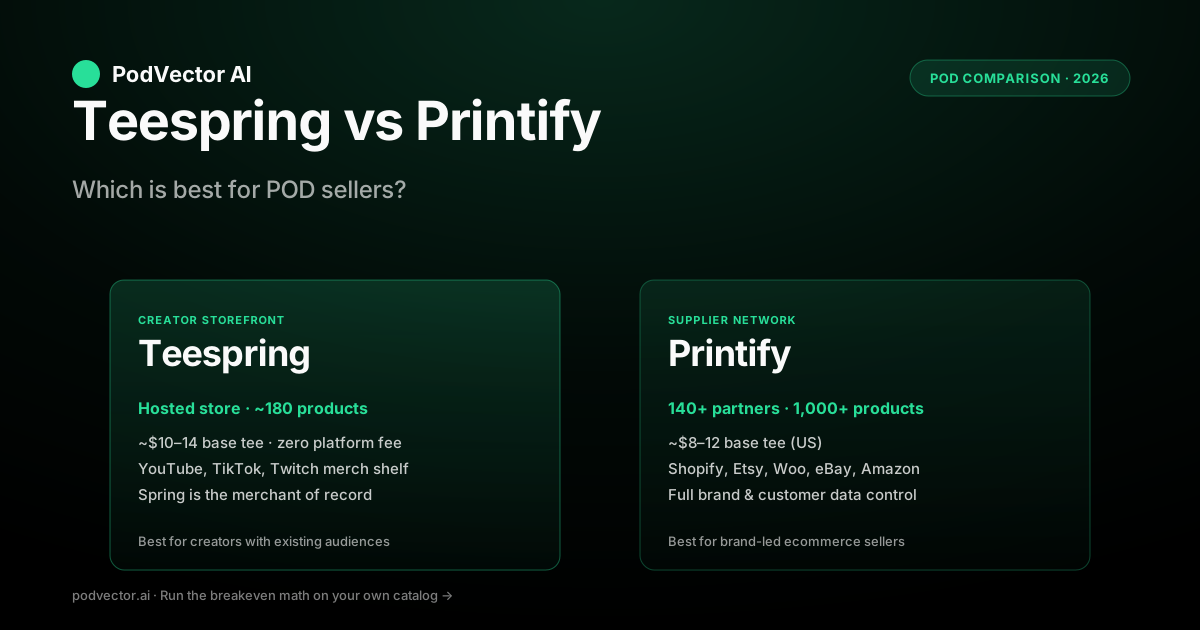
Quick Answer: Teespring (now branded as Spring) is a hosted creator platform. Printify is a supplier network behind your own store. They show up in the same SERP because both produce on demand — but you pick between them on whether you want a storefront handed to you or one you build yourself.
Spring wins on speed-to-launch, native YouTube and TikTok merch shelves, and zero fixed costs. Printify wins on base costs, product breadth, integrations with Shopify and Etsy, and full ownership of customer data.
For the rest of the supplier landscape, see the Printify topic hub and the comparison cluster. The breakeven math below is what most "which is best" guides skip.
TL;DR — quick verdict
Teespring (Spring) is built for creators with audiences. YouTube channel, TikTok following, Twitch streamer — Spring drops a working merch shelf onto your existing platforms in under an hour. No store to build, no taxes to register, no customer service to staff.
Printify is built for sellers who run a store. Shopify, Etsy, WooCommerce, Wix — Printify is the production layer behind it. Lower base costs, deeper catalog, full white-label, and you own every customer email.
If you're already monetizing an audience on a video platform, start with Spring. If you're building an ecommerce brand from scratch — or already have one — start with Printify. The breakeven sits around 17 shirts per month, with Spring cheaper below and Printify cheaper above.
Side-by-side snapshot
Quick view before the section-by-section breakdown. Dollar figures vary by SKU and print provider — verify on the products you actually sell.
| Factor | Teespring (Spring) | Printify |
|---|---|---|
| Business model | Hosted storefront + production | Supplier network behind your store |
| Who owns the customer | Spring (merchant of record) | You (full customer data) |
| Monthly fee | Free — no platform fee | Free; Premium $39/mo ($24.99/mo annual) |
| Base cost on a unisex tee | ~$10–$14 (fixed network) | ~$8–$12 (varies by provider) |
| Product catalog | ~180 products, creator-focused | 1,000+ products, 500+ apparel SKUs |
| Storefront required | No — hosted at spri.ng | Yes — Shopify, Etsy, Woo, Wix |
| Native creator integrations | YouTube merch shelf, TikTok Shop, Twitch | None |
| Print providers | Owned production facilities | 140+ aggregated partners |
| Branding control | Spring-branded checkout | Full white-label |
| Best for | Creators with existing audiences | Brand-led ecommerce sellers |
Two business models, not two products
Most comparison guides treat Teespring and Printify as competing POD apps. They aren't. They're different layers of the stack, and that's the first thing to internalize.
Teespring (Spring): the platform handles the business
Teespring rebranded to Spring in 2021. Same company, same fulfillment network, broader product range than just tees. Sellers and search results still use both names interchangeably.
Spring is the merchant of record. You upload a design, Spring spins up a hosted storefront at spri.ng/@yourname, and Spring handles checkout, payment processing, sales tax, fulfillment, shipping, returns, and customer service.
You set a markup above the base cost. Spring keeps the base cost, you keep the markup. There is no monthly fee, no platform commission beyond the base, and no upfront inventory cost.
The native integrations are the real product. A YouTube channel with monetization enabled can show a merch shelf directly under videos. TikTok creators link products to TikTok Shop. Twitch streamers get a dedicated panel on their channel page. None of those slots are available to non-partner POD platforms.
Printify: the platform handles production, you handle the business
Printify never sells to your customer. You build a store on Shopify, Etsy, WooCommerce, or anywhere else. Printify sits behind that store as the fulfillment layer.
When a buyer checks out, your platform sends the order to Printify, Printify routes it to one of 140+ print partners, and the partner produces and ships. The customer sees your brand throughout — your domain, your packaging, your email receipts.
That means you handle the things a real ecommerce operator handles: marketing, tax registration, customer service, refunds, abandoned-cart recovery. Printify just produces and ships. It is wholesale-style infrastructure, not a hosted storefront.
Where you can actually sell on each
Distribution decides the floor on what either platform can do. Spring and Printify wire into completely different stacks.
Spring: creator platforms first, ecommerce a distant second
Spring's integration list is platform-native. YouTube merch shelf, TikTok Shop, Twitch panel, Instagram product tags, Linktree, and Discord product drops. For a creator audience, those are the integrations that move money.
The traditional ecommerce side is thin. Spring no longer offers a direct Shopify or WooCommerce app the way Teespring did in the early days. You can link to a Spring product from any external site, but the listing lives at spri.ng — not on your own store.
Etsy is a hard no. Spring is not on Etsy's approved-fulfillment list, so Etsy sellers can't run Spring as their POD backend. The same is true for most B2B and wholesale flows.
Printify: the ecommerce stack, missing the creator slots
Printify connects to Shopify, Etsy, WooCommerce, Wix, Squarespace, BigCommerce, eBay, Amazon (with seller approval), TikTok Shop, and Walmart. The Shopify and Etsy apps are the most actively maintained — and both are first-class POD integrations on those platforms.
The API is well-documented and used by enterprise sellers, custom checkout flows, and ERP integrations. Manual order entry and CSV uploads are supported for one-offs.
What Printify cannot do is the YouTube merch shelf, the Twitch panel, or any native creator-platform slot. Those are reserved for approved partners — Spring being one of them. You can link from a YouTube description to a Shopify store powered by Printify, but the in-platform merch shelf below your videos requires a partner integration Printify doesn't have.
Pricing, base costs, and the crossover point
Most "Spring vs Printify" comparisons quote list prices and skip the volume math. The math is what determines which one is actually cheaper for your business.
Spring's zero-fixed-cost model
Spring charges no platform fee. No subscription, no per-order commission beyond the base cost, no hosting, no theme cost, no app stack. You pay only the base cost on each unit sold and keep the markup.
Base cost on a comparable unisex tee runs $10–$14 depending on which provider Spring's network routes to. Hoodies sit around $25–$32. Mugs around $7–$9.
For a creator selling 5–15 shirts a month, the all-in cost is meaningfully lower than running a Shopify store with Printify behind it. The Shopify base subscription alone would eat the whole month's profit at that volume.
Printify's three-tier model
Printify has three plans. Free covers unlimited products across 5 stores at standard base costs. Premium runs $39 a month (or about $24.99 a month if you pay annually) and discounts base costs by up to 20% on most products. Enterprise is custom, for sellers above roughly 10,000 orders a month.
On a Bella+Canvas 3001 unisex tee, the typical Printify base cost runs $8.50–$12.50 depending on which print provider you route to. Premium knocks that down by roughly $1.50–$2.50 per shirt.
The breakeven on Premium is around 17–20 shirts per month — past that, the discount pays for the subscription. For the full breakdown, see our Printify Premium price breakdown and the Premium pricing analysis.
The crossover math
Say you're selling a $25 unisex tee. On Spring, your base cost is roughly $11 and your fixed monthly cost is $0. Variable margin per shirt: $14.
On Printify Premium, your base cost is roughly $7. Add Shopify's $29 a month and the Printify Premium $39 a month and your fixed monthly cost is $68. Variable margin per shirt: $18.
Breakeven: $68 ÷ ($18 − $14) = 17 shirts a month. Below 17, Spring wins on absolute profit. Above 17, Printify wins, and the gap widens linearly with volume.
The structure holds even when you change garments, providers, or geography. Spring is cheaper at low volume because there is no overhead. Printify is cheaper at scale because the base costs are lower. A second perspective on the same crossover is in this Bootstrapping Ecommerce comparison.
Catalog depth and customization
What you can put on a shelf changes everything downstream — pricing strategy, audience targeting, repeat purchase rate.
Spring's creator-focused catalog
Spring's catalog is narrow and built around what creator audiences buy. Roughly 180 SKUs covering tees, hoodies, joggers, mugs, water bottles, hats, tote bags, posters, phone cases, stickers, and a few accessories.
The depth per category is shallower than Printify's. Fewer color options, fewer garment fits, fewer fabric weights. For creators selling to a fan base that wants the design, not the garment specs, that ceiling rarely matters.
Spring's "Boosted Network" feature pushes your products into third-party marketplaces like Amazon and eBay without separate setup. That's a unique distribution lever — but most sales still come from a creator's own channels, not the Boosted Network.
Printify's wide-catalog strategy
Printify's catalog crossed 1,000 products in 2024 and keeps expanding. Apparel runs deep — 500+ SKUs across tees, hoodies, sweatshirts, polos, joggers, and performance wear from Bella+Canvas, Gildan, Champion, Next Level, and the major mills.
Beyond apparel, Printify carries mugs, water bottles, hats, bags, blankets, pillows, posters, canvas prints, framed prints, stickers, phone cases, jewelry, pet products, drinkware, and a growing home-goods section. For the weirder SKUs, see our roundup of alternatives to Printify.
Customization runs deeper too. All-over-print, embroidery on select garments, and direct-to-garment printing are available — though specific options vary by which print provider you route to.
Fulfillment, shipping, and print quality
Production quality and shipping speed drive return rates more than design choices do.
Spring: owned production, predictable output
Spring runs production through a smaller, tightly controlled facility network it owns. The benefit is predictability — quality varies less between two orders of the same SKU. The cost is higher base prices and a narrower catalog ceiling.
Shipping times: 3–7 business days for US domestic, 7–14 days international. Spring's shipping costs are bundled into the retail price the customer sees, which is simpler for buyers but harder for sellers to optimize.
Returns and customer service are Spring's responsibility, not yours. That's an operational win for creators who don't want complaint queues, and a data loss for sellers who want to learn from return reasons.
Printify: a network of partners, picked by you
Printify aggregates 140+ independent print partners worldwide. You pick which partner produces each product — Monster Digital and Drive Fulfillment in the US, Print Logistic in Latvia, Stallion in the UK, plus dozens of others.
That choice is power and risk. The right partner produces consistent, well-priced units. The wrong one ships a 30% return rate. Order samples from any partner before listing their products is the advice every experienced Printify seller gives.
Shipping in 2026: 2–5 business days for US domestic, 5–10 days for international from a US partner, 2–4 days for EU domestic if you route through an EU partner. The full picture across the supplier landscape is in our complete Printify alternatives comparison.
Customer data, branding, and the long-term asset
This is where Spring and Printify split the most — and where the wrong choice costs you the most a year in.
Spring: the platform owns the audience layer
Spring-branded throughout. Checkout happens on spri.ng. Receipts come from Spring. Customer service emails come from Spring. If a buyer wants to "buy more stuff from that creator," they search on Spring, not on your domain.
You get aggregated sales data on your Spring dashboard. You don't get individual customer email addresses, demographic data, or purchase-history detail. That's a hard ceiling on email marketing, retargeting, and audience-building outside the original platform.
For creators whose business is the audience itself — YouTube subscribers, TikTok followers, Twitch viewers — this is a non-issue. The audience lives on the platform, not in a CRM. For ecommerce-first sellers it is a dealbreaker.
Printify: full white-label, you own everything
Your domain on the store, your packaging (custom packing slips on Premium), your brand on shipping notifications, your customer database in your CRM. The buyer never sees the word "Printify" anywhere.
For sellers building a long-term brand asset — an email list, a retargeting audience, a list of past customers to remarket to — Printify keeps you in control of all of it. Customer email goes into your platform. Buying behavior shows up in your analytics. You can run abandoned-cart recovery, post-purchase upsells, and lifetime-value campaigns.
The asset compounds. A Shopify store with 5,000 past customers and a 25% repeat purchase rate is worth more than a Spring storefront with the same gross sales, because you can market to those customers again on your own terms.
Which seller fits which platform
Pick by the operator you actually are, not the operator the SERP wants you to be.
Pick Teespring (Spring) if…
You're a YouTuber, TikToker, Twitch streamer, podcaster, or other creator with an existing audience on a native-merch platform. You want to launch this week with zero infrastructure. You don't care about owning the customer data because the platform already owns your audience.
You expect your catalog to stay small — 5–20 SKUs, mostly apparel. You're selling to fans of you, not shoppers of a category. Marketing happens through your own content, not paid ads.
Pick Printify if…
You already have or are building a Shopify, Etsy, WooCommerce, or independent store. You want the customer email, the retargeting pixel, and the long-term brand asset. You sell a catalog that benefits from breadth — apparel plus home goods plus accessories.
You expect to scale past 20 orders a month within a year. You're running paid traffic, email lists, or category SEO — channels where owning the customer relationship matters more than platform-native distribution.
Pick both if…
You're a creator who also wants a longer-term ecommerce business. The common pattern: Spring for the YouTube and TikTok merch shelf (zero-effort sales from the existing audience), Printify behind a Shopify store for paid-traffic campaigns and expanded catalog. The two don't conflict — see the next section.
Running both at the same time
Treating Spring and Printify as either/or leaves money on the table for any creator who also wants real ecommerce. The dual-platform setup is straightforward.
Spring lives where the audience is. Enable the YouTube merch shelf, the TikTok Shop, and the Twitch panel. Upload your 8–12 most fan-driven SKUs — tees, hoodies, mugs, stickers. The point is zero-friction monetization for viewers who are already on the platform and one click from buying.
Printify lives where the ad spend goes. Build a Shopify or Etsy store, set up the Printify integration, build out the broader catalog (apparel + accessories + home goods), and run paid traffic, SEO content, and email flows. The point is to build an ecommerce asset that doesn't depend on platform algorithms.
The mistake to avoid: duplicating SKUs at different prices on both platforms. Pick one as the "creator price" (Spring) and one as the "brand price" (Printify-behind-Shopify), and keep them visually distinct so the audience doesn't notice the gap.
Running the numbers on your own catalog
The breakeven math at the top of this guide uses one shirt SKU and average base costs. Your real catalog has dozens of SKUs, each routed to a different provider with different base costs, ad spend, and return rates. The "which is cheaper" question gets messier the more SKUs you have.
This is the gap most POD operators run into. Sample-based comparisons stop being useful once you're past the first few products. You need to model your real catalog against real margin and ad-spend data — which is a spreadsheet job most sellers either skip or get wrong.
Victor is an AI employee built for POD sellers. It connects to your store, your supplier costs (Printify, Printful, supplier alternatives), your shipping, and your ad spend, then maintains a live data warehouse that ties them all to a single source of truth. You ask "which supplier would be more profitable on my top 10 SKUs" and Victor answers using your actual orders — not a generic average.
For the broader Printify-vs-alternatives picture beyond Teespring, see our Zazzle vs Printify comparison.
FAQs
Is Teespring better than Printify for beginners?
Teespring (Spring) is faster to launch — you can have a working merch storefront in under an hour with no other tools. Printify requires a separate store on Shopify, Etsy, or similar, which takes longer to set up but pays back with better margins and customer data once you're past the learning phase.
Is Teespring still called Teespring?
Officially it's called Spring (rebranded in 2021), though most sellers and search results still use Teespring. The product, fulfillment network, and creator features are the same — only the name and domain changed.
Which has lower base costs, Teespring or Printify?
Printify, by about 15–25% on most apparel SKUs. Printify Premium widens the gap further. Spring's higher base costs reflect bundled platform services — hosted storefront, payment processing, customer service — that you don't have to staff separately.
Can I use Printify on YouTube the way I use Teespring?
No, not natively. YouTube's merch shelf only supports approved partners, and Spring is one of them. Printify isn't. You can link from YouTube to a Shopify store powered by Printify, but the in-platform merch shelf below your videos requires a partner integration Printify doesn't have.
Does Teespring work with Etsy?
No. Etsy's POD policy requires sellers to handle production themselves or use an approved fulfillment integration. Printify is one of the supported integrations. Spring is not, so Etsy sellers should pick Printify or another Etsy-integrated supplier.
Is Printify Premium worth it vs Teespring's free model?
If you sell more than ~17 shirts a month, yes — the Premium discount on base costs exceeds the $39 monthly fee, and your absolute profit per shirt is higher than Spring's. Below that volume, Spring's zero-fixed-cost model usually wins on total profit despite the higher base costs.
Can I sell on Teespring and Printify at the same time?
Yes, and many creators do. Run Spring for native YouTube and TikTok merch traffic where the platform integration matters. Run Printify behind a separate Shopify store for paid-traffic campaigns and broader catalog. They serve different distribution channels and don't conflict.
Which has better print quality?
Spring's quality is more consistent because they run owned production. Printify's quality varies by which print partner you choose — the best Printify partners exceed Spring on print fidelity and garment fit, but the worst Printify partners fall well below it. Sampling the specific Printify partner before scaling is non-optional.
What's the cheapest way to start in print on demand?
Teespring/Spring, by total upfront cost. No store fees, no app fees, no subscription. The trade-off is the higher base cost per unit that catches up at volume.
Can I move my Teespring designs to Printify?
Yes, but you have to recreate listings manually. There's no direct migration tool. Plan 3–4 weeks for the move: build the new store, upload designs, pick Printify providers, order samples, then redirect existing traffic. Run both in parallel for 60 days so legacy audience traffic doesn't drop off while the new store ramps.
Stop running supplier-vs-supplier math in a spreadsheet
Teespring vs Printify is the easy version of the question. The hard version: which combination of suppliers, products, and channels would make your store more profitable on the SKUs you already sell?
Victor is an AI employee for POD sellers that ties your Shopify, Printify or Printful supplier costs, and Meta and Google ad spend into a single source of truth. Ask "which supplier would be more profitable for my top 10 products?" and Victor answers with real numbers from your own orders — not vendor marketing copy.
Victor proposes orders and supplier switches; you approve, he executes. Today it tells you what to switch and why.
Try Victor free