
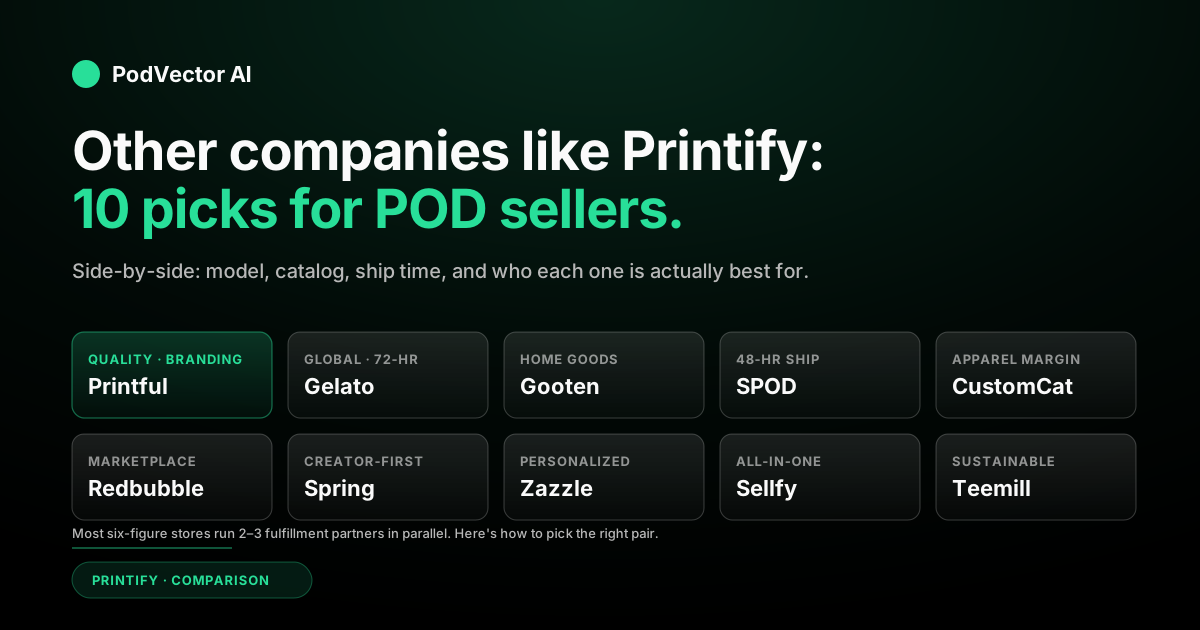
Quick Answer: The strongest companies like Printify are Printful, Gelato, Gooten, SPOD, CustomCat, Redbubble, Spring, Zazzle, Sellfy, and Teemill.
Printful wins on quality control and branding because it owns most of its factories. Gelato wins on global delivery speed. Gooten and CustomCat win on margin for apparel-heavy stores. Redbubble, Spring, and Zazzle are marketplaces, not fulfillment partners — different business model entirely.
Pick by where your buyers live, what you sell, and whether you need a storefront or just a fulfillment back end.
Why look past Printify?
Printify runs a marketplace model. You don't print with Printify — Printify routes your order to one of ~90 print providers in its network. That keeps catalog huge and pricing competitive, but it also means inconsistent quality, variable shipping speed, and limited branding control.
Most sellers eventually hit one of three walls. Quality variance on a hero SKU. A region where shipping is too slow to compete. Or a product category Printify doesn't price well in.
At that point you need a second supplier — or a replacement. Both are normal. Most six-figure POD stores run 2–3 fulfillment partners in parallel.
If you're early in the research phase, our shops like Printify breakdown covers the marketplace side of the comparison too.
10 best companies like Printify
1. Printful
Printful is the obvious first alternative. It owns most of its print facilities (vs. Printify's network model), so quality and branding control are tighter.
Best for: Stores selling branded apparel where consistency matters more than rock-bottom unit cost.
Strengths: Owned facilities, branded inserts, packing slips, embroidery on most apparel, strong Shopify/Etsy integrations, embroidery digitizing included on Pro plans.
Watch out for: Per-unit pricing runs 15–30% above Printify on equivalent products. Margins are tighter — you'll feel it on competitive SKUs.
Pricing: Free to use, no monthly fee. Optional Printful Growth subscription unlocks discounts at $24.99/month (worth it past ~$1k/month in fulfillment).
2. Gelato
Gelato runs a global production network across 130+ print partners in 32 countries. Its algorithm routes each order to the print partner closest to the customer.
Best for: Stores shipping internationally, especially Europe and Asia-Pacific. If half your buyers are outside the US, Gelato cuts shipping times dramatically.
Strengths: Local production means 72-hour delivery in major markets, lower per-order CO₂, and no cross-border duty headaches.
Watch out for: Catalog is smaller than Printify's. Pricing is competitive but not the cheapest.
Pricing: Free Forever tier with no monthly cost. Paid plans (Gelato+, Gold, Platinum) add product discounts and design tools at $14.99–$119/month.
3. Gooten
Gooten focuses on home goods, drinkware, and lifestyle products alongside apparel. Its catalog leans toward higher-margin product categories.
Best for: Stores moving away from t-shirts into home décor, mugs, blankets, and accessories.
Strengths: 280+ products with strong home goods coverage, flat-rate shipping, automated fulfillment routing across 50+ manufacturers.
Watch out for: The dashboard is dated compared to Printify. Customer support reviews are mixed during peak seasons (Q4 especially).
Pricing: Free to use. No subscription tier. You pay per order only.
4. SPOD (Spreadshirt Print On Demand)
SPOD is Spreadshirt's fulfillment-only product. It's built for speed: 48-hour ship-out on 95% of orders is the published commitment.
Best for: Stores where speed beats catalog depth. Time-sensitive promos, event merch, last-minute Christmas pushes.
Strengths: Industry-leading turnaround, simple pricing, strong US and EU print facilities.
Watch out for: Smaller catalog (~200 products vs Printify's 1,000+). Branding options are limited.
Pricing: Free. Per-product pricing only, no subscription.
5. CustomCat
CustomCat is a US-based fulfillment partner with one of the lowest base prices in the industry on standard apparel.
Best for: High-volume apparel stores chasing margin. If your average order is a $24 t-shirt, every dollar of unit cost matters.
Strengths: Aggressive base pricing (often $2–4 cheaper per shirt than Printify), DTG and embroidery in-house, fast US production.
Watch out for: Smaller international footprint — shipping outside North America gets expensive. Catalog skews apparel-heavy.
Pricing: Free tier available. CustomCat Premium subscription at $30/month unlocks deeper discounts (typically pays back at ~$500/month in fulfillment).
6. Redbubble
Redbubble is a marketplace, not a fulfillment-only platform. You upload designs; Redbubble handles the storefront, traffic, payments, and fulfillment.
Best for: Artists who want to test designs without running a store. Passive income on long-tail design portfolios.
Strengths: Built-in audience (millions of monthly visitors), zero storefront work, broad product catalog.
Watch out for: Low margins (often 10–20% per sale), no customer relationship (the buyer is Redbubble's, not yours), no email list, no retargeting. You don't own the business.
Pricing: Free to list. Redbubble takes the majority of each sale and pays you a designer royalty.
7. Spring (formerly Teespring)
Spring is similar to Redbubble in model — a marketplace with creator tools layered on top. It's heavily integrated with YouTube via the YouTube Merch Shelf.
Best for: Creators with existing audience (YouTube, Twitch, TikTok). The Merch Shelf integration is the real value here.
Strengths: Audience-first design (creator profile pages, follower mechanics), strong analytics dashboard, embeddable storefronts.
Watch out for: Same caveat as Redbubble — you don't own the customer. Margin is tight unless you're driving your own traffic.
Pricing: Free. Spring takes a base cost per item; you set the markup.
8. Zazzle
Zazzle is the marketplace veteran (founded 2005). It specializes in personalized, customizable products — weddings, business cards, custom invitations.
Best for: Niches where buyers personalize products (names, dates, photos) before checkout. Stationery, gifts, events.
Strengths: Sophisticated customization tools, strong SEO presence, established trust signals.
Watch out for: The interface feels dated. Designer royalties are typically 5–15% — even lower than Redbubble.
Pricing: Free to list. Royalty-based payouts.
9. Sellfy
Sellfy is an all-in-one platform — built-in storefront, payments, and print-on-demand fulfillment in one tool. Closer to Shopify + Printful in a single account.
Best for: Sellers who don't want to run a Shopify store separately. Beginners who want the simplest path to a live store.
Strengths: Fastest setup of any platform on this list, integrated email marketing, supports digital products and POD side by side.
Watch out for: Less flexible than Shopify if you grow past a few products. Subscription required from day one.
Pricing: Starter at $29/month (or $19 annual). Business and Premium tiers add features at $79–$159/month.
10. Teemill
Teemill is UK-based and sustainability-focused. All products are organic cotton, printed in a UK facility powered by renewables, and designed to be returned and recycled.
Best for: UK and EU sellers with sustainability-first brand positioning. Ethical fashion niches.
Strengths: Genuine eco-credentials (closed-loop recycling, organic cotton, renewable power), free storefront, clean integrations.
Watch out for: UK-only printing means slower/expensive shipping to North America. Apparel-only catalog.
Pricing: Free. Teemill takes a base cost per item; you set the price.
Side-by-side comparison
| Platform | Model | Best for | Catalog size | Avg ship time | Subscription? |
|---|---|---|---|---|---|
| Printify | Fulfillment network | Catalog breadth, low price | ~1,000 | 5–10 days | Optional ($29/mo) |
| Printful | Owned facilities | Quality + branding | ~340 | 4–8 days | Optional ($24.99/mo) |
| Gelato | Global network | International stores | ~150 | 3–6 days | Optional ($14.99+/mo) |
| Gooten | Fulfillment network | Home goods, accessories | ~280 | 4–7 days | None |
| SPOD | Owned facilities | Speed | ~200 | 2–4 days | None |
| CustomCat | Owned facilities | Apparel margin | ~550 | 3–6 days | Optional ($30/mo) |
| Redbubble | Marketplace | Passive design royalties | ~70 | 5–10 days | None |
| Spring | Marketplace | Creators with audience | ~180 | 5–10 days | None |
| Zazzle | Marketplace | Personalized products | ~1,300 | 4–8 days | None |
| Sellfy | All-in-one | Beginners, single tool | ~80 | 5–10 days | Required ($29+/mo) |
| Teemill | Owned facility (UK) | Sustainable fashion | ~50 | 3–7 days UK / 7–14 US | None |
How to pick the right one
Skip the feature checklists. Three questions get you to the answer faster.
1. Where do your buyers live? If 60%+ are US: CustomCat, Printful, or SPOD. If you're shipping globally: Gelato. If you're UK/EU-focused: Teemill or Gelato.
2. What do you sell? Apparel-heavy: CustomCat or Printful. Home goods and accessories: Gooten. Personalized/gift items: Zazzle. Sustainable fashion: Teemill.
3. Do you have a storefront? If yes: any fulfillment-only partner (Printful, Gelato, Gooten, SPOD, CustomCat). If no and you want one fast: Sellfy. If no and you just want royalties: Redbubble, Spring, or Zazzle.
Most stores end up with 2–3 partners running in parallel. The default pairing we see most often: Printify for catalog breadth, Printful for branded hero SKUs, plus one regional partner (Gelato or Teemill) for international orders.
For a deeper integrations angle on running these alongside Shopify, see Shopify vs Printify and the Shopify-Printify setup guide. For Etsy sellers, the Etsy-Printify setup guide walks through the parallel flow.
The hidden problem: tracking margin across suppliers
Here's the part nobody warns you about. Running 2–3 fulfillment partners is the right answer for most stores. But it breaks your margin reporting.
Printify's dashboard shows your Printify costs. Printful's dashboard shows your Printful costs. Your Shopify dashboard doesn't know either — it just shows the revenue side.
To answer "which supplier is more profitable for this specific product?" you'd need to pull fulfillment cost reports from each supplier, match them to your Shopify orders by SKU, layer in ad spend per product, then subtract platform fees. Most sellers don't do that. They guess.
That guessing is what kills POD margins at scale. You scale ads on a t-shirt that "feels" profitable but is actually losing $1.40 per sale once you include Printify's shipping markup and your Meta ads true cost.
This is exactly what we built Victor to solve. Victor connects to Printify, Printful, Shopify, Meta Ads, and Google Ads, pulls everything into a unified data store, and lets you ask in plain English: "Which supplier would be more profitable for my mug SKUs this month?" or "What's my true margin on each variant after ad spend?"
You get a real answer with real numbers, not a hunch. That's the gap none of the Printify alternative roundups talk about — because most of them are written by the platforms themselves.
For a head-to-head on specific Printify competitors, see our Redbubble vs Printify comparison. For the broader Printify landscape, the Printify topic hub indexes all of our coverage, and the Printify comparisons cluster groups every side-by-side analysis in one place.
FAQs
Is there a free alternative to Printify?
Most Printify alternatives are free to use with no monthly fee — including Printful, Gelato, Gooten, SPOD, CustomCat (free tier), Redbubble, Spring, Zazzle, and Teemill. You pay per order. Sellfy is the main exception; it requires a paid plan from day one.
Which Printify alternative is best for Etsy?
Printful, Gelato, and Gooten all have strong Etsy integrations. Printful is the most common pick for Etsy because of branding consistency. If you're shipping internationally from an Etsy store, Gelato's local production usually wins on customer satisfaction.
Is Printful better than Printify?
For branded apparel where quality consistency matters, yes. For maximum catalog and lowest per-unit pricing, Printify usually wins. Most established stores run both — Printify for breadth, Printful for hero SKUs.
For the full breakdown, see the Printify comparisons hub or our deep dive on Printful's own alternatives list (note: written by Printful).
Can I use multiple POD suppliers at once?
Yes, and most successful stores do. The catch is margin tracking gets harder with each supplier you add. You'll want a unified reporting layer (or a tool like Victor) once you're past 2 suppliers.
What's the cheapest Printify alternative?
For apparel, CustomCat is usually the cheapest per unit. For home goods and accessories, Gooten and SPOD are competitive. For international orders, Gelato wins on landed cost (price + shipping + duties combined) even when the per-unit price is higher than Printify.
Are marketplace platforms (Redbubble, Spring, Zazzle) actually alternatives to Printify?
Not really. They're a different business model. With Printify, you own the store, the customer, and the brand. With marketplaces, you upload designs and collect royalties — the marketplace owns everything else. Compare them only if you don't plan to run your own store.
Stop guessing which supplier wins on margin
Running Printify and Printful side by side? Victor pulls live data from your Shopify store, Printify and Printful accounts, and Meta and Google ad accounts, then answers margin questions in plain English.
Try Victor free