
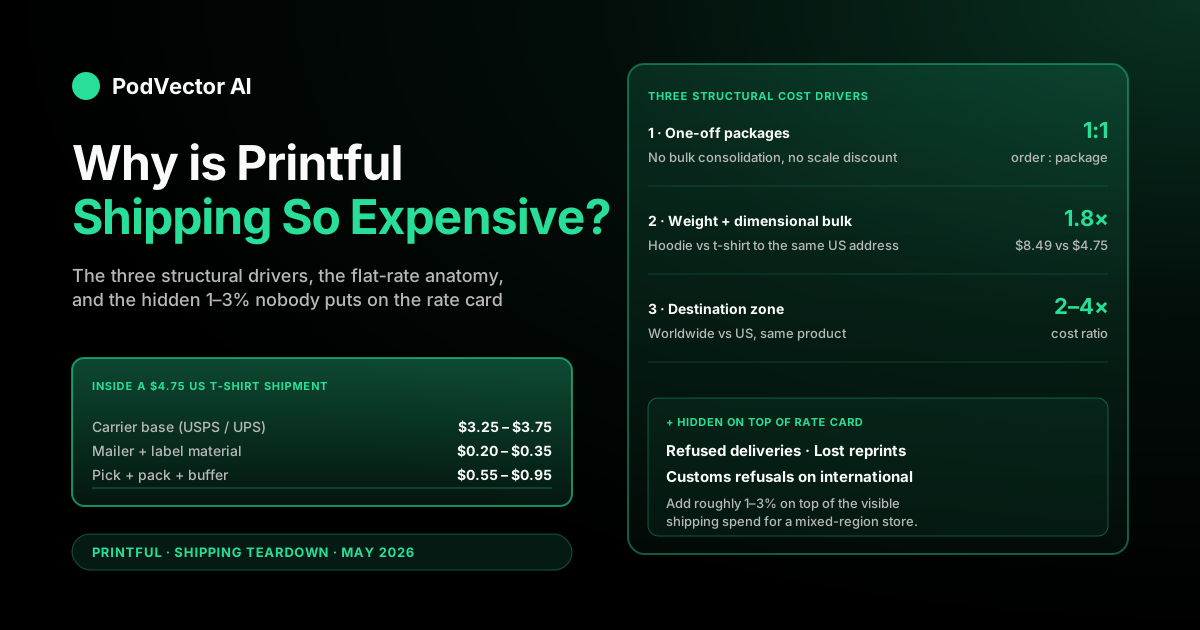
Quick Answer: Printful shipping looks expensive because every order is produced and shipped individually — there is no bulk consolidation, no warehouse pre-pick, and no carrier discount the way Amazon gets one. Each package pays full carrier rate plus Printful's pick-pack handling baked into the flat fee.
The biggest cost drivers are item weight and bulk (a hoodie is roughly 2× the dimensional weight of a t-shirt), destination zone (worldwide rates run 2–4× US rates), and the unavoidable per-package handling on a make-one-ship-one model. Customs, refused deliveries, and lost-order reprints quietly add another 1–3% on top.
For POD sellers the real question is not whether the rate is "expensive" in the abstract — it's what shipping is doing to your blended margin per order this month. The rate card is the input. The margin number is the work.
The short version: three structural reasons
Printful shipping is not arbitrarily expensive. It's expensive because of the production model.
Printful prints every order on demand, one unit at a time, then hands it to a carrier as a single small package. That model has three cost properties that traditional ecommerce dropshipping does not have.
No bulk consolidation. Amazon ships 10 orders in one box from a warehouse. Printful ships 10 orders in 10 boxes from a print facility. Every package pays the carrier's per-package minimum.
No buyer-side leverage on rates. Printful buys carrier capacity at scale, but each individual package still gets billed at small-parcel rates. There is no full-truckload discount when each item is its own shipment.
Handling has to be inside the rate. Pick, pack, label, hand-off — these cost real money per package on a one-off model. On a 10,000-unit Shopify Plus fulfillment run, those costs amortize. On a one-shirt Printful order, they don't.
This is the same reason any print-on-demand or "ship-one-at-a-time" service feels expensive — Printify, Gelato, Teelaunch, Apliiq all sit in the same structural box. It's a category property, not a Printful pricing decision.
For everything in Printful's shipping setup — rate cards, regions, the API, free shipping mechanics, drop shipping flows — see the Printful shipping hub. For the full Printful library (pricing, products, integrations, costs), the Printful topic hub indexes it.
Driver #1: Every order is a one-off package
The single biggest reason POD shipping feels expensive is that there is no economy of scale at the package level. Each order is its own carrier shipment with its own base fee.
Compare two scenarios for shipping 100 t-shirts to 100 different US addresses.
Traditional ecommerce. A 3PL pulls 100 shirts from existing inventory, picks them into 100 padded mailers in an hour, hands them to USPS, and pays roughly $4.50 per package — about $450 total. The mailer cost, the labor cost, and the carrier discount are all amortized across the volume.
Print on demand. Printful prints 100 shirts on demand (this is what you're really paying for vs. a 3PL), packs each into its own mailer, and ships each as its own package. Each package still pays roughly $4.75 to USPS plus an embedded handling slice — and the printing labor sits on top of the product cost, not the shipping cost.
The shipping line on your invoice looks similar between the two models. The difference is that the POD model can't combine 10 orders going to one ZIP into one box. Every order is a separate package, every package pays the full carrier minimum.
This is structural. It does not get fixed by Printful changing pricing. It gets fixed by the economics of small-parcel shipping changing — or by you bundling more items per order so the additional-item rate kicks in.
Driver #2: Item weight and dimensional bulk
Carriers price small parcels on the greater of actual weight and dimensional weight. Dimensional weight is volume divided by a constant — a bulky-but-light package gets billed as if it were heavier.
This is why a hoodie ships for almost 2× a t-shirt to the same address. The hoodie weighs maybe 1.5× the shirt, but it takes up roughly 2.5× the box volume. The carrier bills the higher of the two.
Some quick reference points on what each category actually weighs and how it ships:
- T-shirt: ~150g actual, fits a flat mailer — cheapest to ship by a wide margin
- Hoodie / sweatshirt: ~600g actual, but bulky — bills closer to 800g dimensional
- Mug (11 oz): ~500g, fragile, requires padded box — extra material adds to the rate
- Canvas print (16x20): bulky and rigid — bills on dimension, not weight
- Backpack: heavy and large — pays both ways, hence the $10.49 US base
- Pillow: light but voluminous — almost always bills on dimensional weight
If your store sells "everything," your blended shipping cost per order is dragged up by the bulky low-volume items in the catalog. Knowing which SKUs are dimensional-weight items vs. flat-mailer items is the first step in pricing them correctly.
A practical implication: pillows, blankets, all-over-print apparel, and ceramic items are systemically expensive to ship. If those are your bestsellers, you need a higher retail price than a t-shirt store to land the same margin.
Driver #3: Destination zones and routing
Printful groups the world into nine shipping regions and charges a different rate card for each. The spread between cheapest and most expensive zones for the same product is 3–5×.
The nine zones in rough order of cost-per-product:
- USA — lowest rates, highest volume, mostly USPS Ground Advantage and UPS Ground
- Europe (EU) — intra-EU rates from Latvian and Spanish facilities, comparable to US rates for shorter routes
- UK — similar to EU but with post-Brexit customs handling
- Canada — slightly above US rates, slower transit due to cross-border processing
- EFTA (Switzerland, Norway, Iceland, Liechtenstein) — non-EU customs add cost
- Australia / New Zealand — long-haul air freight, 7–14 day standard transit
- Japan — long-haul plus local last-mile premium
- Brazil — customs friction and unreliable transit add cost and risk
- Worldwide — anything not above, prices run 2–4× the US rate for the same product
The pricing is not linear with distance. A shirt printed in Riga and shipped to Paris is cheaper than the same shirt shipped from Charlotte to Seattle, because Printful routes orders to the nearest production facility when one exists.
The Worldwide bucket is where margin disappears quietly. A US-priced $25 t-shirt with $4.75 shipping is comfortable. The same shirt to a Worldwide destination at $12–$18 shipping is at-or-below cost. If your store ships everywhere by default, the Worldwide segment may already be losing money for you.
For the destination-by-destination breakdown of who you ship to and at what cost, see our Printful Europe shipping times and costs guide and the US/EU shipping comparison.
What's actually inside Printful's flat rate
The flat rate you see on the rate card is not what the carrier charges. It's the carrier rate plus Printful's per-package handling, plus a small operational buffer. Worth knowing the rough split.
For a typical $4.75 single-shirt US shipment, the rough breakdown:
- Carrier cost (USPS Ground Advantage or UPS Ground): ~$3.25–$3.75
- Mailer and label material: ~$0.20–$0.35
- Pick, pack, and hand-off labor allocation: ~$0.40–$0.65
- Operational buffer (returns, mis-prints, address corrections): ~$0.15–$0.30
None of those line items are negotiable for Printful — they're either fixed costs of running a print facility or carrier-set rates. The flat-rate model just packages them into one number you can plan against.
This is also why "live rates" returned by the Printful API match the flat rate card so closely. The API is not pulling a real-time carrier quote — it's returning the same flat fee schedule, computed for your specific cart and destination.
The benefit of the flat model: you can plan your retail pricing against a stable number without re-quoting every cart. The cost: you can't shave shipping by switching carriers or service levels at the order level.
How much you're actually paying right now
Current 2026 US rates by category, first item / additional item:
- T-shirts: $4.75 / $2.20
- Hoodies and sweatshirts: $8.49 / $2.50
- All-over print clothing: $6.49 / $2.50
- Hats and beanies: $3.99 / $1.60
- Mugs (11 oz): $4.95 / $2.55
- Posters (small): $4.99 / $1.50
- Canvas prints: $9.99–$24.99 depending on size
- Backpacks: $10.49 / $4.50
- Tote bags: $4.49 / $2.00
- Phone cases: $3.99 / $1.60
- Pillows (18x18): $7.99 / $3.50
Two patterns to call out. The first-item fee is what hurts on single-unit orders — and single-unit orders are the most common cart size in POD. Second, the spread between cheap (hats, phone cases) and expensive (backpacks, canvas) is more than 2×, so your category mix has more impact on blended shipping than your destination mix does for most US-focused stores.
For the full per-region breakdown across every category — including the regions where these rates climb fastest — see our complete Printful shipping times and costs guide.
The hidden costs nobody puts on the rate card
The rate card is the visible cost. There are three categories of shipping-adjacent cost that don't show up there.
Refused or undeliverable packages. Wrong address, customer refused at delivery, package returned to facility — you pay the original shipping with no refund. Printful's policy is the original shipping is non-refundable on return-to-sender events. Industry data suggests 0.5–2% of POD orders run into address or delivery issues.
Lost-in-transit reprints. Printful covers the reprint and reshipping for confirmed lost packages, but only after a waiting window (4 weeks domestic, 6 weeks international). During that window you're holding the customer complaint. If the package later arrives, you've paid for two shipments and the customer has one in the closet and one in the mailbox.
Customs and duty refusals on international orders. Printful does not pre-pay customs. The buyer is hit at delivery, sometimes for 10–25% of order value. Refusal rates spike in Canada, Brazil, and parts of EFTA. Each refused order is the original shipping plus the production cost — gone.
Aggregate impact: for a typical mixed-region POD store, hidden shipping costs add 1–3% on top of the visible rate card. If your visible shipping spend is 12% of revenue, your true shipping cost is closer to 13–15%.
The margin math: shipping as a percent of revenue
The useful framing is not "are Printful's rates expensive?" It's "what percentage of my revenue is going to shipping, and is it moving?"
Quick math for a $25 t-shirt store, US-focused, single-item orders:
- Revenue per order: $25 + $4.75 shipping pass-through = $29.75
- Product cost (Printful): $9.50
- Shipping (Printful): $4.75
- Payment processing (2.9% + 30¢): $1.16
- Gross profit: $14.34, or 48% gross margin
Shipping here is 16% of revenue. Not painful by itself. But three things move it.
Now run the same math for a hoodie store, US-focused:
- Revenue per order: $45 + $8.49 shipping = $53.49
- Product cost: $24.50
- Shipping: $8.49
- Payment processing: $1.85
- Gross profit: $18.65, or 35% gross margin
Shipping is now 16% of revenue too, but the gross margin is 13 points lower because hoodies are higher-cost products with the same shipping-to-revenue ratio. A 10% shipping increase here drops gross margin by 1.7 points — which is the difference between "profitable" and "marginal" for a lot of stores.
The takeaway: shipping cost as a flat dollar is one number. Shipping cost as a percent of revenue is what you should be tracking, and you should be tracking it weekly, not quarterly. Region mix drift, product mix drift, and quiet carrier-price changes move it without anyone noticing.
For the deeper margin teardown including the per-region cost variance, see our Printful pricing and fees full breakdown.
Six tactics that actually reduce shipping pain
You cannot make Printful shipping cheap. You can make it less painful by changing your store's shape around it.
1. Drive multi-item carts. The additional-item rate is roughly half the base rate. A 3-shirt cart pays $4.75 + $2.20 + $2.20 = $9.15 in shipping, or $3.05 per shirt — that's the cheapest possible Printful t-shirt shipping. Quantity discounts, bundle pricing, and "buy 2 get 1" promos shift you toward this.
2. Cut the worldwide tail. Restrict shipping to USA, EU, UK, Canada, and AU/NZ. Skip Worldwide, EFTA, and Brazil unless you've priced specifically for them. The 5–10% of orders going to those regions often have negative margin.
3. Raise prices on bulky-item SKUs. If a SKU is shipping-heavy (hoodies, canvas, pillows, backpacks), it needs a higher markup than your t-shirts to land the same margin. Stop using the same markup multiplier across your whole catalog.
4. Use live rates for international. Flat rates undercharge international orders. Live rates pass the true cost to the customer and protect your margin. Domestic can stay flat — international should not.
5. Set the right delivery expectation. Most "expensive shipping" complaints are actually "slow shipping" complaints in disguise. Customers who expected 3-day delivery for $4.75 are angry the package took 10 days. Show "fulfillment 2–5 days + transit 3–8 days" on the product page. Reframe the price as the price of two-week delivery, not the price of fast delivery.
6. Track shipping cost weekly, not quarterly. The drift catches you when you're not looking. Pull shipping cost per order, blended shipping as % of revenue, and per-region shipping cost into the same place as your revenue numbers. Watch them with the same frequency you watch CAC.
For the integration patterns POD stores use to keep shipping cost visible without manual spreadsheets, our shipping times and costs guide covers the API endpoints and warehouse loading patterns.
How Printful compares to Printify on shipping
Same structural model, slightly different implementation.
Printify is a network of print providers — the same product can be fulfilled by 5–15 different providers, each with their own shipping rates. This means Printify's shipping cost per SKU varies by provider, sometimes meaningfully. The same shirt can be $4.45 from one provider and $5.95 from another.
Printful runs its own facilities, so the rate per category per region is uniform. Predictable for planning, but you don't get to shop providers for cheaper shipping the way you can on Printify.
In practice, US apparel shipping is roughly comparable between the two. Printify edges cheaper when you pick the lowest-rate provider for a SKU; Printful edges more predictable and faster on the fulfillment leg. International is where Printful's network of EU printing facilities pays off — Printify's international depends on which provider you're routed through.
If you're switching between them on shipping cost alone, the difference is usually under 5%. If you're switching on reliability, fulfillment time, or international coverage, that's a bigger conversation.
FAQs
Why is Printful shipping more expensive than Amazon?
Amazon ships from warehouses with pre-built inventory, consolidates orders, and has negotiated carrier rates at multi-billion-package scale. Printful prints and ships every order individually as it's ordered, with no consolidation. The per-package economics are fundamentally different — Amazon is amortizing fixed costs across enormous volume, Printful is paying full per-package cost on every order.
Does Printful mark up shipping above what the carrier charges?
Yes, but only by the per-package handling and operational cost — typically $0.75–$1.30 per package above raw carrier cost. The flat rate is carrier cost plus material plus pick-pack labor plus a small buffer for refused-delivery and address-correction losses.
Can I get cheaper shipping by negotiating with Printful?
No, the rate card is standard for all merchants. Printful's enterprise plans add discounts on product cost, not shipping. The only way to lower per-order shipping cost is to drive larger carts (multi-item orders hit the additional-item rate) or restrict to lower-cost regions.
Why is Printful international shipping so expensive?
Long-haul air freight is several times more expensive than domestic ground. Worldwide-bucket destinations also incur customs processing, slower transit (so more risk of loss reimbursement), and last-mile delivery in markets where Printful has no local partner. The 2–4× cost ratio vs. US is structural.
Is it cheaper to print elsewhere and ship myself?
Only at meaningful volume. The break-even is typically around 1,500–2,000 units per month per SKU, where wholesale blank cost plus your own print setup plus your own pack-and-ship labor undercuts Printful's bundled cost. Below that volume, you're paying more in time, capital, and quality variance than Printful's markup costs you.
Why does my Printful shipping invoice differ from the rate card?
Three common reasons. First, multi-product carts split into shipping "buckets" by fulfillment facility, so a 3-item cart can have more than one "first item" charge. Second, address corrections and re-routing add small fees that aren't on the rate card. Third, the rate card is rounded; invoices show fractional cents.
Will Printful shipping get cheaper over time?
Probably not meaningfully. Carrier rates trend up 4–8% per year, and Printful's flat rates have to keep pace. The lever for sellers is not waiting for cheaper shipping — it's structuring your store around the rate card (multi-item carts, restricted regions, correctly-priced SKUs) so the cost stops being painful.
How do I reduce shipping costs on Printful right now?
Three highest-leverage moves: restrict shipping regions to your profitable zones, raise prices on bulky-item SKUs to absorb the higher shipping, and incentivize multi-item carts so the additional-item rate kicks in. Together these usually drop blended shipping-as-% of revenue by 2–4 points without touching Printful's pricing.
What's the difference between Printful's flat rate and live rate?
Functionally not much. Both pull from the same flat-rate schedule. "Live rate" means the rate is computed at checkout against the specific cart and destination and passed through to the customer with no markup; "flat rate" means you pre-set a fixed shipping price in your store and absorb the variance. Live is more accurate for mixed carts and international; flat is simpler and predictable for single-product stores.
Knowing why it's expensive isn't the same as knowing what it's doing to your margin.
The rate card explains the cost structure. It doesn't tell you that your blended shipping moved from 14% of revenue to 17% last month because Europe orders quietly spiked, or that your hoodie line dropped below 30% gross margin after the last carrier price update.
Victor connects to your Printful account, pulls every itemized shipping line into your data warehouse, and answers questions like "how is shipping eating my margin this week vs. last quarter?" in plain English. AI employee, live data, no spreadsheet.
Try Victor free