
Quick Answer: Printful orders inside the EU typically arrive in 7–14 business days end-to-end. According to Printful's Help Center, standard fulfillment takes 2–5 business days, then international shipping runs 1–20 business days depending on destination — with Western and Central Europe sitting at the faster end of that range. According to a cross-provider shipping comparison by Fuel POD, Printful handles the vast majority of orders within five business days at the fulfillment stage, with most completed in 2–3 business days.
Express compresses the total to roughly 3–8 business days. Printful's shipping page confirms that rates are set per product category and region — always verify current EU rates there before publishing them to customers, as two rate batches already moved in 2026.
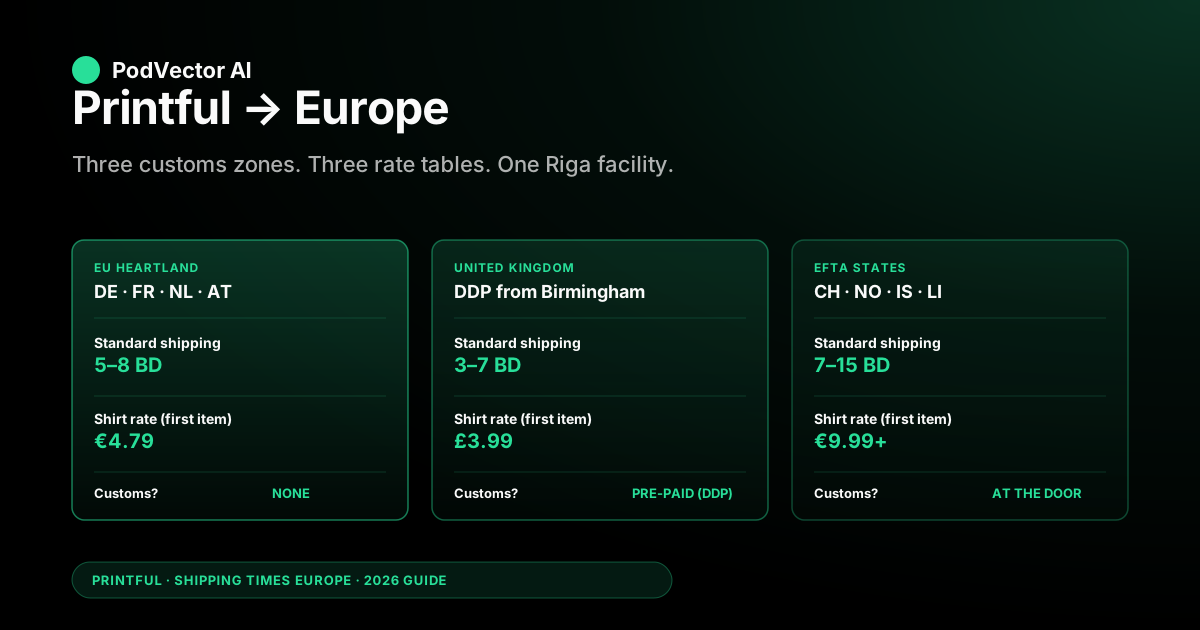
The UK and the EFTA states (Switzerland, Norway, Iceland, Liechtenstein) sit outside the EU customs union — separate rate tables, separate transit windows, and real customs risk for cross-border orders.
Total delivery time across Europe
Printful's delivery time is two numbers added together: fulfillment time (printing your product) plus shipping time (getting it to the buyer's door). According to Printful's shipping page, the estimated delivery time (EDT) is the sum of estimated fulfillment and shipping time.
For most of mainland Europe, the realistic end-to-end window looks like this:
- Fulfillment: 2–5 business days, per Printful's Help Center
- Standard shipping from EU facility: 5–8 business days for Western and Central Europe
- Standard shipping from EU facility: 8–12 business days for Northern, Southern, and Eastern Europe
- Express shipping from EU facility: 1–3 business days continent-wide (carrier leg only — fulfillment still takes 2–5 days)
- Total standard: 7–14 business days for the EU heartland
- Total express: 3–8 business days continent-wide
According to Printful's Help Center, international shipping runs 1–20 business days post-fulfillment. That range is wide because it covers everywhere from Portugal to Finland and treats outlying islands the same as Berlin or Paris.
The honest read: 5–10 business days post-fulfillment is the median experience for buyers in Germany, France, the Netherlands, Belgium, Austria, and the Czech Republic. Beyond 14 days starts to look like a customs hold or a missed handoff between Printful's facility and the local carrier. Note that express speeds up the carrier leg only — it does not skip fulfillment, per PodVector's Printful shipping rates guide.
Country-by-country breakdown
Printful publishes one EU-wide standard window, but the lived delivery time varies a lot by country. Below is the realistic median (post-fulfillment, standard shipping) based on Printful's facility locations and typical carrier networks.
| Country | Standard shipping (post-fulfillment) | Customs? |
|---|---|---|
| Germany | 4–7 business days | No (intra-EU) |
| Netherlands, Belgium, Luxembourg | 4–7 business days | No (intra-EU) |
| France | 5–8 business days | No (intra-EU) |
| Austria, Czech Republic, Poland | 5–8 business days | No (intra-EU) |
| Italy, Spain, Portugal | 6–10 business days | No (intra-EU) |
| Sweden, Denmark, Finland | 6–10 business days | No (intra-EU) |
| Ireland | 6–10 business days | No (intra-EU) |
| Greece, Bulgaria, Romania | 8–14 business days | No (intra-EU) |
| UK | 3–7 business days (DDP) | Pre-paid via DDP |
| Switzerland, Norway, Iceland (EFTA) | 7–15 business days | Yes — at the door |
Two patterns matter for your unit economics. First, the further the destination from Riga or Madrid, the longer the tail — Greece and Bulgaria run noticeably slower than Germany. Second, the EFTA states are a different beast entirely: longer transit, customs declarations, and door-fee surprises.
Outlying islands (Madeira, the Canary Islands, the Greek islands, Sardinia, Sicily) add 2–5 business days on top of the country baseline. Buyers there expect it; sellers often don't budget for it in their delivery promise.
According to PodVector's Printful dropshipping review, EU orders generally run 7–14 business days end-to-end, and Q4 production windows are longer than the rest of the year — plan your holiday shipping cutoffs accordingly.
Which Printful facility ships your EU order?
Printful uses an automatic routing system that picks the closest facility with the product in stock. According to Printful's Europe page, they print and ship from in-house European facilities in Spain, the UK, and Latvia. For European orders, the priority order is typically:
- Riga, Latvia (EU) — the default for most apparel orders going to EU destinations. Intra-EU shipping, no customs.
- Madrid, Spain (EU) — handles overflow and some specialty categories. As noted in PodVector's global shipping guide, a German customer ordering a tee triggers fulfillment in Riga or Madrid — not a transatlantic haul from Charlotte.
- Birmingham, UK — the default for UK-bound orders, and a fallback for EU orders when EU facilities are out of stock.
- USA facilities (Charlotte, Los Angeles, Dallas) — used when the product is not stocked anywhere in Europe. Long transit and almost guaranteed customs fees.
You don't get to pick the facility. Printful does it based on real-time stock and product type, which means the same store can route order #1 through Riga and order #2 through Birmingham depending on what's available that day.
This routing variability is why the same Berlin buyer can see a 7-day delivery on one order and an 11-day delivery on another — depending on whether the product they bought is stocked locally or has to ship from the US, per PodVector's global shipping guide.
The cleanest defense: check Printful's product catalog for each variant in your store and confirm it's stocked in Riga or Madrid. If a popular SKU is UK-only or US-only, swap it for an EU-stocked equivalent.
Shipping costs by product (EU, UK, EFTA)
Printful uses flat-rate shipping, with separate rate tables per region. According to Printful's shipping page, rates are set per product category and destination region, with a higher "first item" rate and a lower "each additional" rate. Always verify current EU rates against Printful's live shipping page before publishing them to customers — rates shifted twice in 2026, per PodVector's Printful shipping rates guide.
The structure is consistent across regions: a higher first-item rate plus a lower per-additional-item rate. Standard intra-EU rates for common product categories (always cross-check live before publishing):
- T-shirts and apparel (EU): check Printful's shipping page for the current first-item and additional-item rate — two rate updates in 2026 mean any figure printed here may already be stale
- Hoodies and sweatshirts (EU): separate rate, higher than apparel — verify live
- Backpacks (EU): separate, higher rate — verify live
- Mugs (EU): ship separately from apparel with a separate fee per mug
- Posters and wall art (EU): separate flat rate — verify live
UK rates run slightly cheaper for single items but lose the per-add-on advantage. EFTA rates are significantly higher — Printful publishes a separate EFTA States rate table that runs well above the intra-EU baseline. Express shipping carries a meaningful premium over standard rates; check Printful's shipping page for the current express surcharge by destination.
One detail sellers miss: the "EU rate" applies to all 27 member states uniformly, regardless of distance from Riga or Madrid. Shipping a shirt to Lisbon costs the same as shipping one to Vilnius, even though the transit time triples. That's good for cost predictability and bad if you're trying to model marginal logistics cost by destination.
2026 rate changes: what moved and when
Shipping rates are not static. According to PodVector's Printful shipping rates guide, rates shifted twice in 2026: a targeted accessories-only round in late February, and a broader batch of first-item and additional-item changes that went live on June 4, 2026 (published with a downloadable old-vs-new list). As PodVector's global shipping guide notes, carrier price changes do not stay flat — and two separate rate batches before mid-2026 is evidence of that cadence.
What this means in practice:
- Any shipping rate table you published before June 2026 is likely out of date for at least some categories
- Reconcile your Printful invoice export against your Shopify shipping revenue monthly — not quarterly
- A small per-item rate increase on a high-volume SKU compounds fast: a modest change on an apparel item can move quarterly profit by a meaningful amount if left undetected, per PodVector's shipping rates guide
- Subscribe to Printful's product update emails so you catch future rate batches before they hit your P&L
According to PodVector's complete Printful shipping zones guide, Printful uses nine shipping regions (USA, Canada, Europe, UK, EFTA, Australia/New Zealand, Japan, Brazil, Worldwide) with separate flat rates per region per product category. The Europe and EFTA regions are distinct — a common mistake is treating them as the same zone.
The UK and EFTA customs traps
Since January 2021, the UK is outside the EU customs union. Printful handles this in two opposite ways depending on direction:
- UK → UK orders: ship from Birmingham, no customs, fast (3–7 BD post-fulfillment)
- EU → UK orders: Printful's DDP (Delivered Duties Paid) option pre-collects UK VAT, so the buyer pays at checkout instead of at the door
- UK → EU orders: cross an external customs border — possible VAT, possible carrier handling fee, possible multi-day customs delay
The EFTA states (Switzerland, Norway, Iceland, Liechtenstein) are not in the EU and have their own customs rules. Any Printful shipment to an EFTA country crosses an external border, no matter where it ships from. Expected outcomes:
- Local VAT collected at the door
- Carrier handling fee on top of the stated shipping rate
- Customs declaration delays of 1–5 business days
- Possible refusal at the door if the buyer didn't expect the fees
According to PodVector's complete Printful shipping zones guide, EU and UK VAT and Australian/NZ GST must be collected at checkout at the buyer's local rate, via your storefront's tax settings or via Printful's IOSS integration. Printful uses IOSS (Import One-Stop Shop) for low-value EU orders under €150, which collects VAT at checkout and removes the door-fee surprise — but IOSS only covers the EU. EFTA buyers always face door fees, and that's a transparency issue you need to flag in your storefront copy.
The cleanest fix for EFTA: if you're selling meaningful volume into Switzerland or Norway, build the door-fee expectation into the product page. "Local taxes payable on delivery" in your checkout footer kills the majority of refund-request emails on EFTA orders.
The multi-parcel cost trap
According to Printful's shipping page, products fulfilled in different locations ship separately, and multiple-shipment orders have higher shipping costs than single-shipment orders. Multi-item orders that span product categories ship as separate parcels, with separate shipping fees each. A cart with a shirt + a mug + a poster ships as three parcels and bills three shipping line items.
The math gets ugly fast for EU orders. Each of those three product categories ships at its own first-item rate — consult Printful's live shipping page for current EU rates, since all three rate lines may have moved in the 2026 updates.
Your storefront shipping calculator in Shopify, WooCommerce, or wherever you sell needs to handle the multi-parcel logic correctly. If it sums to a single flat rate at checkout, you're quietly eating the difference on every multi-category order. According to Printful's shipping page, Printful notes that some products are calculated assuming they always ship separately — occasional co-shipment is possible but still billed at the single-item rate.
The single biggest lever here is to bundle within categories. Three shirts in one cart ship together with a lower total shipping cost than three different product types. The same revenue, meaningfully lower shipping cost, just from product mix.
Setting buyer expectations across Europe
European buyers expect precision. Vague estimates kill conversion and trigger pre-shipment refund requests, especially in DACH (Germany, Austria, Switzerland) where buyers are highly tracking-aware.
What works on the product page and checkout:
- Show country-specific estimates based on shipping address, not a generic range
- Add a one-line note: "Printed in Europe, shipped from Latvia or Spain" — this signals intra-EU and short transit
- For EFTA destinations, add: "Local taxes payable on delivery" — protects you from refund requests over door fees
- Offer express as a paid upgrade with a concrete date: "Arrives by [date]"
- Send a fulfillment-stage tracking email when the order moves from "Printing" to "Shipped"
- For Q4, publish a holiday cutoff date prominently — per PodVector's shipping rates guide, Q4 production windows run longer than the rest of the year, so your cutoff should be conservative
The single highest-leverage tweak: separate the fulfillment estimate from the shipping estimate in your buyer comms. "Your order is being printed (2–5 days), then shipped (5–8 days)" reads as professional. A single vague range reads as an excuse.
How European shipping eats your POD margin
The shipping line on Printful's invoice looks small in isolation. Aggregated across hundreds of European orders, it's often the single largest variable cost after the product itself.
The typical patterns POD sellers miss:
- Single-item EU orders are shipping-cost dominant: the flat first-item rate represents a meaningful slice of revenue before product cost on mid-priced apparel — check Printful's current rate table against your retail price to see the actual percentage
- Multi-item single-category carts dilute shipping significantly compared with multi-category carts
- EFTA orders carry substantially higher shipping costs than EU orders for the same product, which silently destroys your Switzerland and Norway unit economics if you priced them off your EU baseline
- Birmingham-routed orders that hit customs friction generate refunds, which destroy unit economics retroactively
- Rate drift is silent: as PodVector's global shipping guide notes, your store's region mix can shift — a viral post brings a wave of European orders, and worldwide shipping is substantially higher than domestic — your retail price didn't move, but your gross margin dropped
The way to actually see this is to track shipping cost per order against product price per order, broken down by destination country, on a weekly cadence. That's the kind of question Victor — PodVector's AI employee — can answer against your live Printful and Shopify order data: "What did shipping to Switzerland cost me last week as a percent of revenue, and how does that compare to Germany?" — without you building a spreadsheet. When the answer points to a pricing fix, Victor can propose and execute a Shopify-side reprice or free-shipping threshold adjustment with your approval.
For the broader cost picture, see our Printful monthly cost breakdown, which itemizes every fee line that compounds with shipping. If you're evaluating whether Printify's EU network might cut your shipping cost, our Printify pricing model breakdown gives you the same level of detail on the other side. And if you want to automate the Shopify-side response to margin pressure — repricing products, adjusting free-shipping thresholds — see how PodVector's POD automation approach fits into a Shopify workflow.
FAQs
How long does Printful take to ship to Europe?
According to Printful's Help Center, standard fulfillment takes 2–5 business days, then international shipping runs 1–20 business days depending on destination. Western and Central European buyers (Germany, France, Netherlands, Belgium, Austria) sit at the faster end of that range; peripheral markets (Greece, Bulgaria, Romania) sit closer to the longer end. Total end-to-end for most of the EU is 7–14 business days on standard shipping. Express compresses the carrier leg to 1–3 business days but does not skip fulfillment.
How much does Printful shipping to Europe cost?
Printful uses flat rates per product category and region, with a higher first-item rate and a lower additional-item rate. According to Printful's shipping page, rates are set per region and shift periodically — two EU rate updates already occurred in 2026. Always verify the current figures at Printful's official shipping page before publishing them to customers. UK and EFTA states have separate, distinct rate tables.
Does Printful ship to all EU countries?
Yes — Printful ships to all 27 EU member states at the same intra-EU flat rate. Delivery times vary by distance from the fulfillment facility, but the flat-rate cost structure is uniform across the union, per Printful's shipping page.
Will my European buyer pay customs fees?
Not for orders fulfilled in Riga or Madrid and shipped within the EU — those ship intra-EU with no customs. EFTA destinations (Switzerland, Norway, Iceland, Liechtenstein) always involve door customs and VAT collection. UK orders use DDP (Delivered Duties Paid) which pre-collects VAT at checkout, so no surprises at the door.
Which Printful facility ships to Europe?
According to Printful's Europe page, Printful operates in-house European print facilities in Latvia, Spain, and the UK. Riga (Latvia) is the primary EU facility; Madrid (Spain) handles overflow and some specialty categories; Birmingham (UK) handles UK-bound orders. US facilities are used only when no European facility stocks the product variant. You don't control which facility — Printful's routing system picks based on real-time stock.
What's the difference between EU and EFTA shipping?
EU orders ship intra-union with no customs and uniform flat rates. EFTA orders (Switzerland, Norway, Iceland, Liechtenstein) cross an external customs border, trigger door VAT collection plus a carrier handling fee, and pay a significantly higher shipping rate. Transit time is also longer for EFTA versus core EU destinations. According to PodVector's complete Printful shipping zones guide, Printful treats Europe and EFTA as two distinct shipping regions with separate rate tables.
Can I offer free shipping to European customers?
You can absorb the shipping cost into your retail price, but you cannot make Printful waive its fee. Most POD sellers add a margin buffer to the retail price on apparel and present it as "free shipping" — works if your price point is high enough to absorb it, fails if you're already competing on price. EFTA destinations are nearly impossible to absorb economically on single-item carts given the higher rate and door-fee exposure. See our A/B price testing guide for how to validate whether a free-shipping price point actually converts better before committing store-wide.
What's the fastest Printful shipping option to Europe?
Express shipping is 1–3 business days post-fulfillment continent-wide, so roughly 3–8 business days total including fulfillment. As noted in PodVector's shipping rates guide, express speeds up the carrier leg only — it does not skip fulfillment. For UK destinations, Standard DDP at 3–7 business days post-fulfillment is the best balance of speed and cost.
How do Printful's European shipping times compare to Printify or Gelato?
Printful's EU times are competitive thanks to the Riga and Madrid facilities. Printify routes through a network of EU-based print partners with similar transit windows but more variability per SKU — see our Printify and Shopify integration guide for how that setup affects routing. Gelato uses a distributed-fulfillment model that often beats both on transit time but at different per-unit cost. For your store, the right answer depends on which products you sell most and where your buyers cluster.
Does Printful's published delivery estimate include weekends?
No — all estimates are in business days, Monday–Friday, per Printful's Help Center. A 7-business-day total realistically lands 9–11 calendar days later once you factor in weekends. Public holidays (national holidays in Latvia, Spain, and the destination country) add further delays around Christmas, Easter, and August.
Did Printful raise European shipping rates in 2026?
Yes. According to PodVector's Printful shipping rates guide, rates shifted twice in 2026: a targeted accessories-only round in late February, and a broader batch affecting first-item and additional-item rates that went live in early June 2026. If your storefront shipping table hasn't been updated since before June 2026, it is likely showing stale figures for at least some product categories. Always verify current EU rates at Printful's live shipping page.
How does AI help manage Printful shipping costs across Europe?
Tools like generative AI for ecommerce can surface shipping cost patterns by destination country. Victor — PodVector's AI employee — reads your live Printful and Shopify order data and can answer questions like "which EU countries are costing me the most in shipping relative to revenue?" so you can adjust pricing or thresholds. Victor proposes Shopify-side changes (like repricing or adjusting your free-shipping threshold) with your approval; Printful itself remains a read-only surface. For a deeper look at how Victor fits into a POD workflow, see PodVector's strategy guide.
Related guides
- Printful Shipping Calculator (Step-by-Step) — how to model the cost before you commit
- Printful API Shipping Rates Endpoint — for custom storefront integrations
- Printful Bella Canvas 3001 Shipping Time — product-specific deep dive
- How Much Does Printful Cost Per Month? — the full fee stack shipping sits on top of
- Printify Pricing Model — compare the EU network economics
- Does Printify Work with Shopify? — platform setup that affects facility routing
- PodVector for POD Sellers — how Victor automates Shopify-side responses to margin pressure
- A/B Price Testing for POD — validate free-shipping price points before rolling them out
- Ad Fatigue in Ecommerce — the other margin leak that compounds with shipping pressure
- Generative AI for POD Ecommerce — how AI reads cost patterns across your store
- Printful Shipping cluster hub
- Printful topic hub
- External: Printful's official shipping page for live rate quotes
Stop guessing which European countries are eating your margin.
Printful's invoice tells you what you paid. It doesn't tell you that certain EFTA destinations are costing you a significantly higher share of revenue in shipping while core EU markets sit much lower — or that the June 2026 rate update quietly moved your unit economics on several product categories.
Victor — PodVector's AI employee — connects to your Shopify and Printful data and answers questions like "What did shipping to each EU country cost me last week, and which destinations are below break-even?" in plain English, against live numbers, no spreadsheets. When the answer points to a pricing fix, Victor can propose and execute the reprice or free-shipping threshold change on Shopify with your approval.
Try Victor free